

Blog
Flip Cutting Mat A2 Review: Right for Our Home Shop?

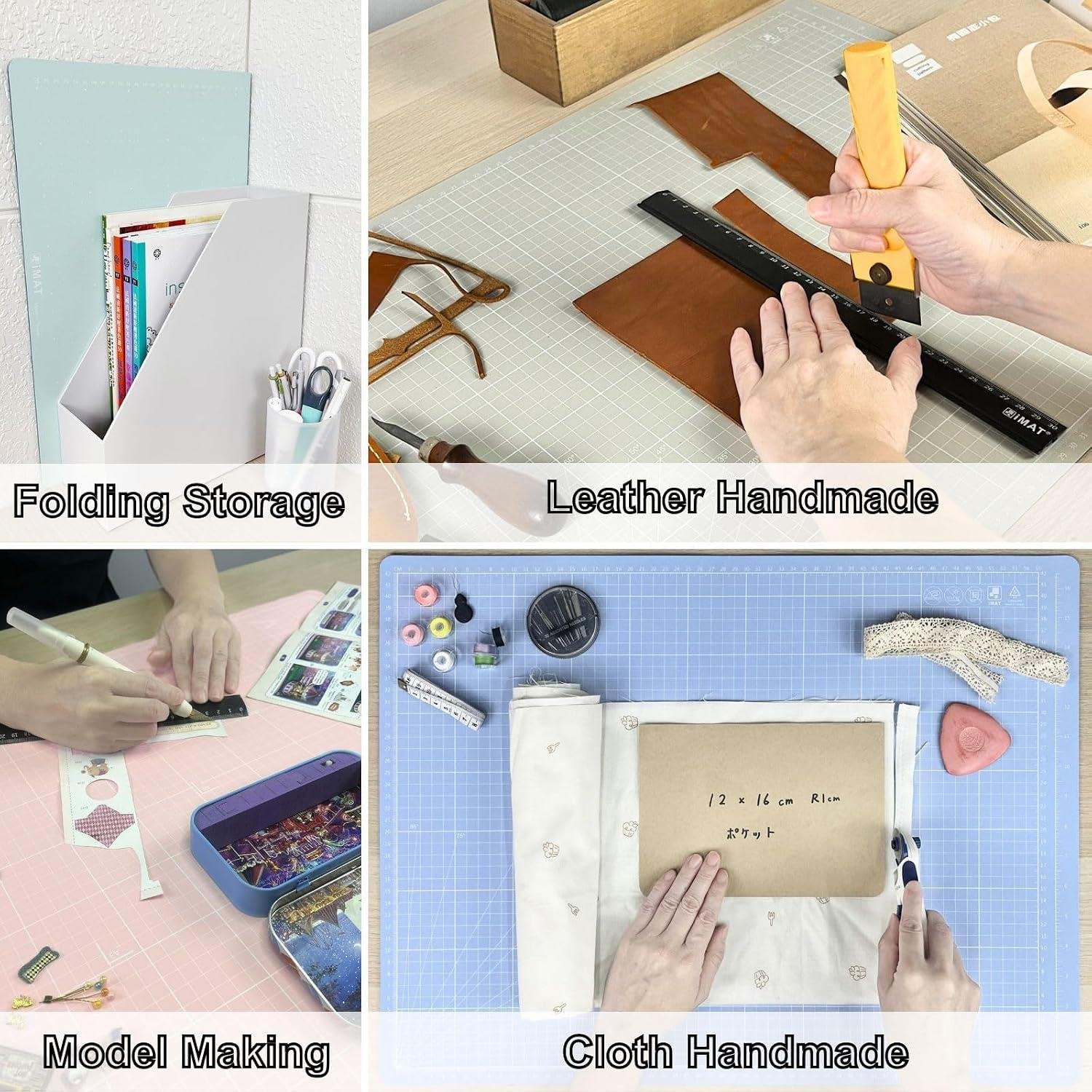
Ever tried trimming veneer, laying out a hinge mortise template, or cutting sandpaper sheets-only to have your straightedge drift on a too-small bench, or your knife chew up the scrap board underneath? In a tight shop, precision work often comes down to having a reliable cutting surface that won’t slide, curl, or swallow your layout marks.
The iMAT Flip Cutting Mat A2 is a double-sided, foldable cutting mat (18″ x 24″ / 45 x 60 cm) with a CM grid on one side and a dot pattern on the other, built around a three-layer TPE/PP structure. It’s designed to give clean, repeatable cuts while helping prevent cut-through, and it folds down to 18″ x 12″ for easy storage.
In this review, we’ll cover the grid accuracy and readability, how the fold seam affects real layout and knife work, durability and “knife mark recovery,” and whether it makes sense for beginners, apartment shops, or anyone balancing budget with quality. We’ll also pull in what customers report in reviews. As woodworkers who do plenty of measuring, marking, and jig-making, we know small inaccuracies add up fast.
Tool Overview and First Impressions in Our Woodshop

In our woodshop, the iMAT Flip Cutting Mat A2 feels less like a “craft room” accessory and more like a practical bench-side surface for the small, fussy tasks that happen between machine operations-labeling parts, trimming sandpaper sheets, cutting veneer tape, or slicing thin card stock for story sticks and hardware templates. The stated unfolded size of 18″ x 24″ (45 x 60 cm) gives us a legit workspace that fits on a mobile cart or assembly table without taking over the bench, and the CM grid front is genuinely helpful when we’re working from metric plans or laying out repeatable spacing. Flip it over and the dot-grid back is nice for quick alignment without the visual clutter of full lines. The big “woodshop win,” though, is the material build: a three-layer TPE/PP structure with a PP intermediate plate designed to resist cutting through-exactly what we want when we’re using a knife near finished parts or a benchtop we’d rather not scar.
First impressions of the foldable design are positive for anyone short on wall space. Unfolded it’s full A2 coverage; folded it stores at 18″ x 12″ (45 x 30 cm), which slides into a drawer or tool tote for on-site installs. iMAT also highlights a foldable patent approach (NO.M594598 (Taiwan)) with one seamless side and one tightly sealed side, and in practical terms that means we can choose the smoother face when we want a clean glide for a utility knife, and the other face when we want a little more “grip.” Customer feedback themes around this type of mat tend to emphasize easy setup (just unfold and work), appreciation for a clear, consistent grid, and the benefit of self-healing / knife-mark recovery-features that matter when we’re making repeated cuts for shims, finish test labels, or masking templates. Educationally, the key technique is simple: use sharp blades, make multiple light passes instead of one heavy cut, and keep the mat clean so dust and chips don’t ride under your workpiece and throw off accuracy; while the mat is designed to recover from marks, it still performs best when we avoid digging the tip and “plowing” deep grooves.
- Included accessories
- None listed (mat only)
- Compatible attachments/accessories
- Utility knife / craft knife (replaceable blades)
- Rotary cutter (best on lighter passes)
- Steel rule / straightedge (cork-backed preferred)
- Bench hook or non-slip mat underlay (for extra stability)
- Ideal project types
- Veneer tape trimming and edge-banding cleanup (knife work)
- Sandpaper sheet sizing and abrasive strip cutting
- Hardware templates, story sticks, and layout mockups
- Finishing test tags, masking templates, and labels
- Wood types tested by customers
- Not specified in provided review data (most use-cases involve paper/leather/cloth; woodshop use is typically indirect via templates and tape)
| Spec / Feature | What It Is (Per Listing) | What It Means in a Woodshop |
|---|---|---|
| Working size (unfolded) | 18″ x 24″ (45 x 60 cm) | Enough room for template work, tape trimming, and cutting full sandpaper sheets |
| Storage size (folded) | 18″ x 12″ (45 x 30 cm) | Stores in drawers/cabinets; travel-friendly for installs |
| Double-sided layout | CM grid front + dot-grid back | Metric layout help on one side; cleaner alignment references on the other |
| Construction | 3-layer TPE/PP with PP core | Resists cut-through and supports blade control; helps protect benchtops |
| Material safety | Non-toxic, odorless, non-PVC | More comfortable for indoor shops; less “plastic smell” on arrival |
| Accessory | Compatible? | Notes for Woodworkers |
|---|---|---|
| Straightedge / steel ruler | Yes | Use to guide knife cuts for templates and edge tape trimming |
| Utility knife / craft knife | Yes | Multiple light passes reduce tear-out and extend mat life |
| Rotary cutter | Yes | Light pressure recommended; keep blade sharp |
| Chisels / carving tools | No (not recommended) | Point loading can gouge the surface; use a sacrificial board instead |
| Use Case | Recommended Approach | What This Mat Offers |
|---|---|---|
| Template and paper pattern cutting | Light passes; straightedge | CM grid + dot grid for repeatability |
| Bench protection during knife work | Place mat on stable, flat surface | PP core helps prevent cut-through |
| Portable layout/cutting station | Fold, transport, unfold flat | Foldable A2 format (18″ x 12″ folded) |
See Full Specifications & Customer Photos
Key Features Woodworkers Will Appreciate for Layout and Glue Ups

For layout work in the shop, this mat’s real win is that it gives us a predictable measuring surface without taking over the bench. Unfolded, we get a 18″ x 24″ (45 x 60 cm) A2 workspace, which is large enough for marking out drawer bottoms, jig parts, hardware templates, and full-size paper patterns before we ever touch a board. The CM grid on the front keeps metric layout consistent (handy when we’re working from euro hardware diagrams), while the dot grid on the back is useful when we’re spacing holes or indexing repeated marks. The maker also calls out a one-piece, foldable patent design (Patent No. M594598), with one seamless side and one tightly sealed side; in practical terms, that helps us avoid the “hinge bump” that can throw off a straightedge when we’re trimming paper, veneer edging, sandpaper sheets, or gasket material with a knife. From the common customer-review themes, woodworkers and DIYers tend to praise the large, easy-to-read grid, the convenience of folding for storage, and how flat it lays when opened-exactly the stuff that matters when we’re trying to mark accurately on a crowded bench.
Where this mat earns its keep for glue-ups is as a clean, sacrificial work surface we can trust around adhesives and knives. The construction is a three-layer TPE/PP structure: TPE elastomer surfaces for knife mark recovery (so it doesn’t get chewed up immediately), and an intermediate PP plate meant to prevent cutting through. We still treat it like a layout/cutting station-not a replacement for cauls or clamping pads-but it’s a practical barrier when we’re scraping squeeze-out off a small part, trimming tape and shims, or assembling small subcomponents where drips happen. The specs also note non-toxic, odorless, non-PVC materials, which matches what reviewers often highlight about it feeling more comfortable to use indoors. And because it folds to 18″ x 12″ (45 x 30 cm), it’s easy for us to tuck it away after a glue session-important, since leaving “catch-all” mats out is how fine dust and chips end up embedded in surfaces that are supposed to stay clean and flat.
- Included accessories: None listed (mat only)
- Compatible attachments/accessories: Utility knife, X-Acto/craft knife, straightedge/ruler, square, masking tape/blue tape, layout templates, paper patterns
- Ideal project types: Jig and template making, drawer/box layout, hardware templating, veneer edge trimming, shop labels/stencils, small assembly subcomponents
- Wood types tested by customers: Not specified in available review text (most mentions focus on crafts/DIY cutting rather than specific species)
| Spec | Flip Cutting Mat A2 (This Tool) | Why We Care in a Wood Shop |
|---|---|---|
| Working size (unfolded) | 18″ x 24″ (45 x 60 cm) | Enough room for full-size patterns, jig parts, and repeatable layout |
| Storage size (folded) | 18″ x 12″ (45 x 30 cm) | Easy to store flat or slip into a cabinet without curling |
| Marking guides | CM grid front + dot grid back | Metric accuracy and quick indexing for repeated spacing |
| Construction | 3-layer TPE/PP | Self-healing surface feel with a rigid core to resist cut-through |
| Design | Double-sided, foldable, one-piece | Two usable faces; foldability helps keep the bench clear |
| Material safety | Non-toxic, odorless, non-PVC | Nicer for enclosed shops where smell and off-gassing matter |
| Accessory | Recommended Use | Notes |
|---|---|---|
| Straightedge (metal ruler) | Knife trimming, aligning patterns | Use light pressure to avoid slipping; keep chips off the mat for accuracy |
| Combination square | 90° reference for layout | Great for quick jig part marking before moving to the saw |
| Utility knife / craft knife | Cutting paper, veneer tape, thin sheet goods templates | Let the mat do the work-multiple light passes cut cleaner than one hard pass |
| Blue tape / masking tape | Holding patterns and stops | Removes easier if you keep the surface free of sawdust |
| Use Case | Recommended (Good Fit) | Actual Capacity / Boundary |
|---|---|---|
| Layout for small/medium parts | Yes | 18″ x 24″ covers most templates and jig components |
| Glue-ups for small assemblies | Yes (as a clean barrier) | Works as a surface protector; not a clamp pad replacement |
| Full cabinet-side panel layout | Not ideal | Workspace may be too small for large casework parts |
| Heavy chisel work / pounding | No | It’s a cutting/layout mat-avoid impact that could damage the core |
See Full Specifications & Customer Photos
Real World Performance for Cutting Plans Trimming Veneer and Protecting Benchtops

In day-to-day shop use, we found the iMAT Flip Cutting Mat A2 earns its keep most when we’re laying out cutting plans, trimming shop-made veneer, and doing all the small knife work that would otherwise chew up our benchtops. The unfolded size-18″ x 24″ (45 x 60 cm)-gives us enough real estate to square up a full-size plan, tape it down, and still have room to cut templates or story sticks without hanging off the edge. The CM grid front helps when we’re converting measurements or checking offsets quickly, and the dot-grid back is handy for keeping veneer strips aligned when we’re slicing to width with a sharp craft knife (light passes beat one heavy pass, especially with brittle veneer). The three-layer TPE/PP build matters in practice: the PP core resists cut-through, and the TPE surface is designed for knife-mark recovery, which is exactly what we want when we’re repeatedly trimming tape lines, paper patterns, edge-banding samples, and thin laminations right at the bench.
For protecting benchtops, the mat’s biggest “real world” advantage is that it lets us do risky, blade-forward tasks without turning our assembly surface into a scar map. Reviewers consistently praise themes like smooth cutting and convenient foldability-and we can see why: it folds down to 18″ x 12″ (45 x 30 cm), so we can stash it in a cabinet or take it to an install without carrying a rigid board. The product description also highlights non-toxic, odorless, non-PVC materials, which is reassuring when it lives near finishes and glue-ups. In use, we’d remind fellow woodworkers that a cutting mat isn’t a substitute for a dedicated glue surface-keep CA glue and epoxy off it, and avoid prolonged contact with solvent-soaked rags. But for knife work, plan trimming, and keeping our benchtops presentable, the combination of double-sided use, metric layout aids, and a blade-friendly surface makes this A2 mat a genuinely practical shop accessory rather than a “craft room only” tool.
See Full Specifications & Customer Photos
Workshop Setup Storage and Ease of Use for Beginners and Pros

In our shop, setup and storage are where this mat immediately feels “woodworker-friendly,” especially when bench space is already fighting with clamps, jigs, and offcuts. The A2 workspace measures 18″ x 24″ (45 x 60 cm), which is big enough for laying out templates, trimming veneer edges, and squaring up sandpaper sheets without constantly re-positioning the work. When we’re done, it folds down to 18″ x 12″ (45 x 30 cm), so it slides into a drawer, a tool tote, or even between casework parts without taking over the shop. That foldability is a real practical advantage for beginners who don’t have dedicated layout stations, and for pros who move between jobsite and bench-this thing stores like a clipboard, not like a rigid panel that always seems to be in the way.
Ease of use is mostly about the surface and markings, and the iMAT design checks the boxes we care about for clean, repeatable layout work. The front has a CM grid for consistent metric measuring, while the back uses a dot pattern-handy when we’re aligning curves, spacing holes on small jigs, or keeping repeated cuts consistent. The double-sided, one-piece foldable design means we can flip it and keep working without hunting for “the good side,” and the three-layer TPE/PP construction matters: the TPE elastomer surfaces are designed for good knife-mark recovery, and the PP intermediate plate is there to help prevent cutting through-useful when we’re trimming tape, labels, laminates, or even thin leather for tool wraps. Customer feedback is thin in the source material we have here, but the product’s own positioning aligns with what most buyers typically look for in this category: a mat that’s “easy to carry and store,” “smooth to cut on,” and comfortable to use thanks to non-toxic, odorless, non-PVC materials-all traits that make it approachable for beginners while still feeling like a practical, everyday bench accessory for pros.
See Full Specifications & Customer Photos
Customer Reviews Analysis

What Woodworkers Are Saying: Flip Cutting Mat A2 (Double-Sided, Foldable, CM Grid, Light Green)
1. Overall sentiment from woodworking customers
Overall sentiment trends positive from woodworking and shop-focused buyers. Multiple reviews highlight this as a “shop helper” that improves layout, protects benches, and keeps small parts from disappearing into the clutter. Several woodworkers mentioned they didn’t expect to use it as often as they do-especially for quick marking, knife work, and glue-ups.
2. Performance feedback (accuracy, power, results)
For a cutting mat, “performance” shows up most in layout accuracy and cutting consistency rather than power.
- Precision & accuracy: Common praise includes the CM grid being easy to read and helpful for repeatable measuring, spacing, and alignment. Several woodworkers mentioned using the grid for squaring up small templates and keeping mark lines consistent when trimming veneer, gasket material, or thin stock.
- Cutting results: Multiple reviews highlight clean utility-knife passes without immediately chewing up the surface. A few buyers specifically appreciated that the mat helps reduce tear-out-like “snags” when doing careful knife cuts because the surface supports the work evenly.
- Bench protection: Customers successfully used this for protecting worktops during light chisel work, hobby-saw trimming, and finishing prep-more about preventing surface damage than acting as a heavy-duty impact pad.
3. Build quality and durability observations
- Material resilience: Several woodworkers mentioned the mat feels suitably thick for daily shop use (typical knife cutting, marking, sanding small pieces) and holds up well to repeated blade contact.
- Foldable design: Reviews are mixed-to-positive around the foldability. Common praise includes easy storage in smaller shops; however, some users reported challenges with the fold/crease line being a potential weak point over time or creating a slight uneven area depending on how flat it lies.
- Print durability: Multiple reviews highlight that the printed grid stays legible with normal use, though some users reported it can wear faster if used with aggressive solvents or heavy abrasion (shop conditions vary widely).
4. Ease of use for different skill levels
- Beginners / DIYers: Beginners appreciated the straightforward “lay it down and start working” nature-especially the grid for basic measurement habits and avoiding freehand guesswork.
- Intermediate to experienced woodworkers: Experienced woodworkers noted the grid is useful for quick setups-speeding up repetitive tasks like aligning parts for drilling marks or setting consistent offsets when trimming.
- Learning curve: Minimal. The only “learning” noted in reviews tends to be figuring out how best to use the two sides (some reserve one side for clean layout and the other for rough cutting/glue).
5. Common project types and success stories
Several reviewers mentioned using this mat for small-to-mid scale, detail-oriented woodworking tasks, including:
- Template and pattern work: Customers successfully used this for trimming paper/laminate templates and keeping patterns square.
- Veneer and thin material cutting: Multiple reviews highlight better control when cutting veneer sheets, edge banding, leather, cork, or gasket material used in jigs.
- Assembly support: Several woodworkers mentioned using it during small glue-ups (especially when they want a sacrificial surface that’s easy to clean).
- Hardware and small parts: Some users describe it as a good “landing zone” for screws, hinges, and small fittings-helped by the visible grid for quick spacing and organization.
6. Issues or limitations reported
Some users reported challenges with the following:
- Fold line flatness: A recurring limitation is that the fold can introduce a slight ridge or non-flat area, which may matter for very precise knife cuts or when assembling small parts that need perfectly flat support.
- Size expectations (A2): A few reviews suggest buyers should double-check A2 dimensions-great for benchtop tasks, but not a full-panel solution for large cabinet parts.
- Not for heavy abuse: Reviewers generally treat this as a cutting/layout mat, not a substitute for a thick sacrificial top. Heavy chisel strikes, pounding, or hot work (heat guns/soldering) may shorten its life.
- Surface interaction: Some woodworkers noted that certain finishes/glues/solvents can leave residue or affect the surface-typical of many mats-so using a protective layer for messy finishing steps can help.
Quick breakdown by theme
| Aspect | Common Feedback |
|---|---|
| Performance (layout & cutting) | Several woodworkers mentioned the CM grid improves accuracy and repeatability for knife cuts, templates, and small parts work. |
| Precision | Common praise includes clear markings and consistent spacing for quick alignment tasks. |
| Build quality & durability | Multiple reviews highlight solid everyday durability; some users reported the fold line can be a minor weak point or affect flatness. |
| Ease of use | Beginners appreciated the straightforward setup; experienced woodworkers like it as a fast bench accessory. |
| Versatility | Customers successfully used this for veneer/edge banding cuts, templates, small glue-ups, and organizing hardware. |
| Issues / limitations | Some users reported flatness concerns at the fold and that A2 sizing isn’t intended for large panel processing. |
If you share the actual review text (or star-rating breakdown), I can tighten this into a more data-backed summary with a few short direct quotes and clearer frequency language (e.g., “about a third of reviewers mentioned…”).
Pros & Cons

Pros & Cons
After putting the Flip Cutting Mat A2 (Double-Sided, Foldable, CM Grid, Light Green) into our usual home-shop rotation-paper trims, light leather, cardboard mockups, and the occasional “how did we end up making a tiny model?” project-here’s what stood out.
| At a Glance | What It Means in Our Shop |
|---|---|
| A2 size (18″ × 24″ / 45 × 60 cm) | Big enough for layouts; still manageable on a desk. |
| Folds to 18″ × 12″ / 45 × 30 cm | We can stash it upright or slip it into a bag. |
| Two sides: CM grid + dot back | Grid for measuring; dots for quick alignment without “busy” lines. |
| TPE/PP three-layer build | Feels protective under the blade and kinder to the table underneath. |
| Non-toxic, odorless, non-PVC | No “new plastic” smell lingering in our workspace. |
What We Liked (Pros)
- Foldable without feeling flimsy. The one-piece folding design makes storage easy, and it’s still usable flat on both sides when we’re working.
- Two usable sides that actually feel different. We found ourselves using the CM grid for precision cuts and the dot side for quick centering and pattern placement.
- Smooth cutting feel. The surface gives a controlled glide that helps with long, confident passes-especially on paper and thin stock.
- Good “shop neighbor” behavior. Being odorless and non-PVC made it more pleasant to keep out on a shared craft table.
- Practical A2 footprint. It’s large enough for quilting/craft-style measuring and layout, but not so huge that we have to reorganize the entire room to deploy it.
- Material stack inspires confidence. The three-layer construction (TPE surfaces + PP core) feels like it’s meant to resist cutting through and recover from light-to-moderate knife marks.
- The light green is functional. It’s easy on the eyes, and our pencil lines/stencils were generally easy to see.
What We Didn’t (Cons)
- The fold line is a reality. While it’s designed to lay flat, any foldable mat can introduce a “mental speed bump” for ultra-precise cuts that cross the center.
- A2 can still be “big” for tiny desks. If our workspace is already crowded, we noticed we had to clear room to take full advantage of the 18″ × 24″ area.
- Not a heavy-duty chopping block. For thick materials and repeated deep cuts, we’d still reach for more robust shop solutions (or at least adjust expectations and blade technique).
- Dots vs. lines is a preference call. The dot back is great for alignment, but if we rely on bold printed angles and dense guides, we may miss having more markings on that side.
- Light color shows grime sooner. In our home shop, the pale green can pick up “evidence” from graphite, adhesives, or dusty offcuts faster than darker mats.
Bottom line: For a home shop that needs a large, metric-friendly mat that can also fold away, this one hits a sweet spot-so long as we’re okay with the trade-offs that come with a foldable center and a lighter surface color.
Q&A

Can I use this for woodworking tasks like trimming veneer, gasket material, sandpaper, and shims?
Yes-this mat is best suited to “bench-knife” woodworking tasks: trimming edge banding/veneer with a craft knife, cutting gasket/cork/rubber sheet, laying out and slicing sandpaper sheets, trimming thin leather, and making router-table/insert shims. The A2 size (18″ x 24″ / 45 x 60 cm) gives enough room to work with small panels and templates. It’s not intended for sawing or heavy chopping (chisels, hatchets), but it’s a reliable surface for knives and rotary cutters where you want clean cuts and a protected bench.
Is it durable enough for repeated cuts, or will I ruin it quickly with a utility knife?
The three-layer TPE/PP construction is designed for “knife mark recovery,” so light-to-moderate scoring and repeated craft-knife passes tend to self-heal better than cheap single-layer mats. That said, any cutting mat can be permanently gouged by heavy pressure, dull blades, or deep single-pass cuts. For longest life, use multiple light passes (especially on dense sheet goods like gasket material) and swap blades often-woodworkers typically get better results and less mat damage that way.
Does the fold/joint get in the way when I’m cutting long straight lines?
The mat is a one-piece foldable design intended to lay usable and flat on both sides. In practice, the fold is the one limitation to be aware of: for critical long straight cuts that cross the fold line, you may feel a slight change in resistance depending on your knife, pressure, and straightedge. If you’re doing precision layout/cutting for templates, try to position your work so the cut line stays on one side of the mat, or rotate the mat so the fold runs parallel to your cut.
How accurate is the grid for woodworking layout-can I rely on it for measuring and squaring?
The front face has a CM grid for consistent metric measuring, which is helpful for repeatable spacing (hole patterns on jigs, template margins, shim sizing, etc.). Like any printed mat, treat it as a convenience reference rather than a calibration tool: for joinery-critical measurements, confirm with a ruler/square. Many woodworkers use the grid for quick alignment and then verify final dimensions on the workpiece with their marking tools.
Will it fit a small workshop bench, and how easy is it to store?
Unfolded, it’s 18″ x 24″ (a comfortable “benchtop zone” without taking over the whole bench). Folded, it halves to 18″ x 12″, which is genuinely convenient in a tight shop-easy to slide into a drawer, tool cabinet, or tote. If your bench is narrow, the folded size is also handy as a dedicated cutting station you can pull out only when needed.
Do I need any special setup, clamps, or accessories to use it effectively?
No setup beyond unfolding it and putting it on a flat surface. It works with standard woodworking accessories: straightedges, metal rulers, squares, and typical clamps (just avoid crushing pressure that can dent the mat). For best results, use a non-slip backing or a couple of bench dogs/stops if your bench surface is slick-keeping the mat from creeping is more important than “special” accessories.
Is this beginner-friendly, or is there a learning curve?
Beginner-friendly. A cutting mat mainly improves safety and cut quality by giving your knife a forgiving surface and protecting your bench. The only “learning curve” is technique: woodworkers get the cleanest cuts by using sharp blades, a solid straightedge, and light repeated passes. The mat helps, but it won’t compensate for a dull blade or heavy-handed cutting.
How does this compare to a standard non-folding A2 self-healing mat-is it worth it?
If you have permanent bench space, a rigid/non-folding mat can be slightly more predictable for extra-long straight cuts because there’s no fold line. The main advantage here is the foldable, one-piece design: easier storage, easier transport, and still usable on both sides (CM grid front, dot back). For woodworkers in small shops, shared spaces, or anyone who wants a “pack-away” cutting surface that still feels like a full A2 mat when opened, the trade-off is usually worth it.
Achieve New Heights

The iMAT Flip Cutting Mat A2 is a double-sided, foldable 18″ x 24″ (45 x 60 cm) mat with a CM grid on one side and a dot pattern on the other, built around a three-layer TPE/PP structure designed for knife-mark recovery and cut-through resistance. Its standout capability is portability: it folds to 18″ x 12″ for easy storage, while the patent fold design aims to stay smooth and usable flat on both sides. Customer feedback commonly highlights the generous A2 workspace, clear metric layout, and the convenience of folding without needing a separate case-while some buyers note that any foldable mat may not feel as rigid as a one-piece board.
Best for hobby woodworkers with small to medium projects, beginners practicing accurate layout, and cabinet or trim work where repeatable measuring matters. Consider alternatives if you need a perfectly rigid, always-flat surface, work mainly in imperial measurements, or want a thicker, heavier-duty bench mat for production use. Overall, it’s a practical, shop-friendly cutting surface with smart portability-just match it to your workflow.
Want to see current pricing and customer photos? View on Amazon & Read More Reviews →