

Blog
Acacia Knife Drawer Organizer Review: Right for Us?

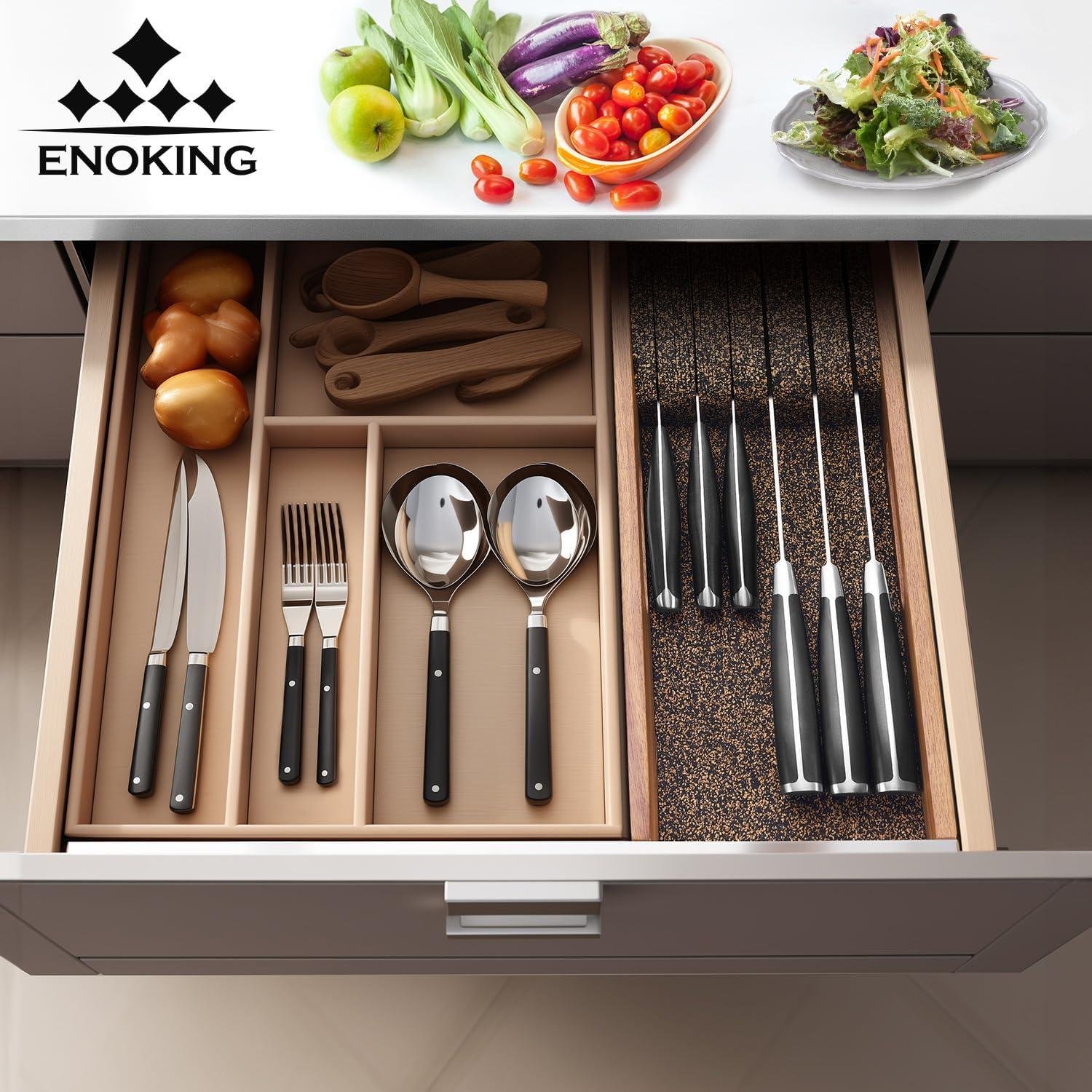
Ever spent an hour tuning a plane iron to razor sharp, only to toss it in a drawer where edges clack together, nick, and turn your “precision” back into guesswork? In small shops and crowded kitchens alike, space constraints force us to store our sharpest tools wherever they’ll fit-and accuracy always suffers when blades get knocked out of true.
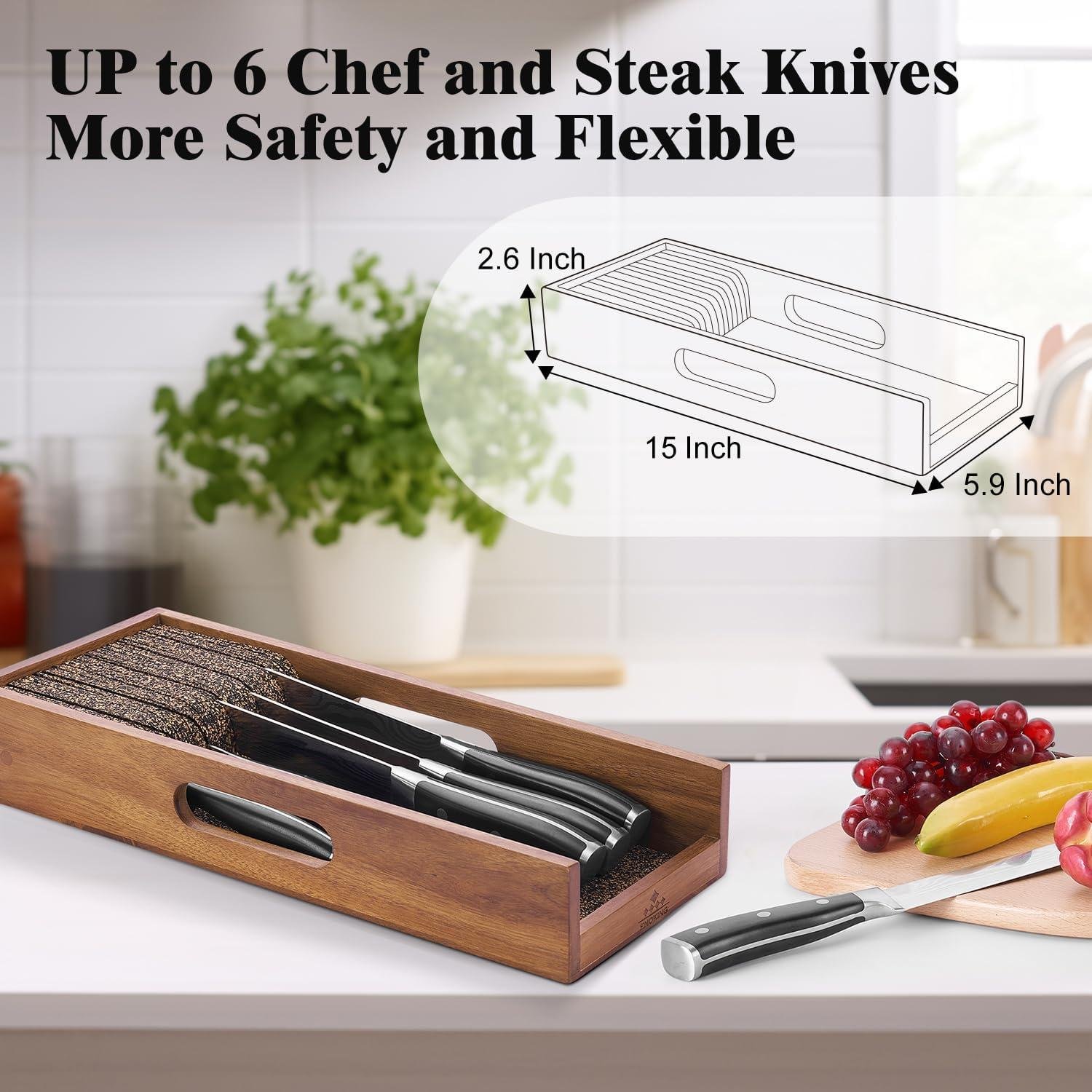
That’s where the ENOKING Knife Drawer Organizer Insert comes in: an in-drawer knife block made from natural acacia wood (listed at 15 x 5.9 x 2.6 in) with cork-and-rubber composite dividers designed to cradle blades, plus a non-slip base with silicone pads and no installation required.
In this review, we’ll look closely at its build quality, divider design, drawer fit, and day-to-day usability-especially for mixed knife sets and different skill levels, from first-time organizers to detail-obsessed makers. We’ll also weigh budget vs. materials, referencing what customers report: solid quality, a clean fit in many drawers, and practical storage for steak and chef knives-along with a few notes about divider spacing and handle clearance.
As woodworkers, we care about grain, joinery, and whether “durable” is marketing or reality-so we’ll approach this like any shop fixture we’d trust near sharp edges.
First Impressions and Build Quality in Acacia and Cork
When we first pulled this in-drawer block out of the packaging, the acacia body read like a properly chosen shop hardwood-tight grain, warm color, and that “finished but not plastic” feel we look for in jigs and bench fixtures that live close to blades. At 15 x 5.9 x 2.6 inches, it’s sized more like a compact bench appliance than a bulky countertop block, which matters to us because drawer storage keeps edges away from airborne grit and accidental shop bumps. Several review themes line up with what we saw in hand: customers repeatedly call the build “great quality” and say it “looks great and keeps your knives stable and sharp,” and the fit is a common win-“fits nicely in a drawer” and even “perfectly next to a utensil tray in our wide drawer.” From a woodworker’s perspective, that footprint is worth measuring against your drawer’s inside height: a few reviewers note knife handles can protrude and make it harder to close, which is the same clearance math we do when we build custom inserts or router-bit trays.
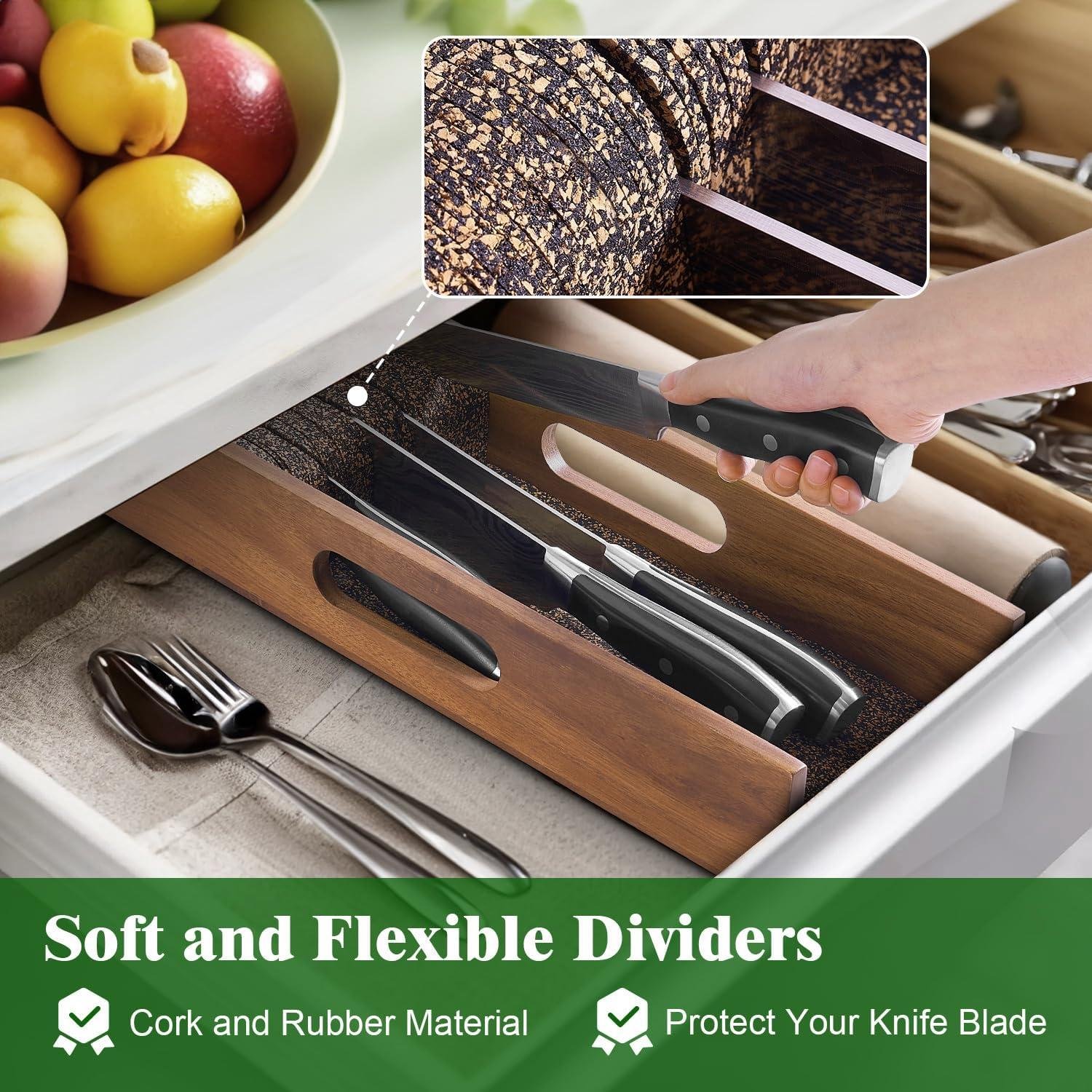
The more interesting material choice is the divider system: ENOKING uses cork-and-rubber composite dividers intended to flex around different blade shapes instead of forcing every knife into a fixed slot. In workshop terms, that’s a “universal cradle” concept-useful when your lineup includes a mix of chef knives, steak knives, or odd profiles (one reviewer mentioned extra Cutco knives that didn’t fit their main block). Most feedback supports the idea as functional-customers say it “works as advertised” and is “great for storing steak knives”-but we also saw a cautionary theme worth taking seriously: one reviewer reported the cork can cross-cut/tear during insertion and become ineffective. Our takeaway is educational and practical: insert blades spine-first when possible, keep the edge centered, and don’t force a wide bolster through a tight gap-treat the cork like a sacrificial liner, not a structural part. The base also earns points for shop-like stability: four non-slip silicone sheets underneath help it stay put in a drawer the way rubber feet stabilize a bench hook, and the fact that there’s no installation means it’s a quick “drop-in fixture” rather than another assembly task at the end of a long day in the shop.
See Full Specifications & Customer Photos
Real World Performance Keeping Edges Protected and Drawers Quiet

In day-to-day shop life, we care less about marketing terms and more about whether an organizer actually prevents edge damage and drawer chaos when our hands are busy. This insert’s footprint-15 x 5.9 x 2.6 in (listed as 15*2.5*6 in in the description)-is a practical “bench accessory” size that slides into most kitchen or break-room drawers without stealing the whole bay. The big performance feature is the cork + rubber composite dividers: instead of forcing every knife into a fixed slot, the material is meant to flex around blades so edges aren’t clinking against neighboring steel. That matters in a woodworking mindset because a knife edge is no different than a freshly honed chisel-impacts and lateral rubbing dull it fast. Review themes back that up: customers repeatedly call the unit “great quality”, note it “keeps your knives stable and sharp”, and appreciate that it “fits nicely in a drawer”-including next to a utensil tray in a wide drawer.
Drawers getting noisy is usually a “movement” problem, not a storage problem, and ENOKING addresses that with four non-slip silicone sheets on the base. In use, that design should reduce skating when the drawer shuts, which helps keep handles from shifting and blades from bumping. The reviews are mostly aligned with that “works as advertised” expectation, especially for steak knife storage, but it’s also where the real-world nuance shows up: one buyer mentions having to pull out a few dividers to fit their knife set, another notes handles may protrude and interfere with closing, and one negative experience reports the cork cross-cut/tearing during insertion. From a woodworker’s angle, that reads like standard fit-up: measure drawer depth, check handle height clearance, and don’t jab the edge downward-insert blades with a slight angle and guided pressure, the same way we’d protect a plane iron on a tool rack. Used with that kind of care, this insert is a tidy, low-effort way to keep edges protected and the drawer quieter without needing any installation.
- No installation required (drop-in insert)
- Four non-slip silicone base sheets
- Cork/rubber composite dividers
- Compatible with chef knives
- Compatible with steak knives
- Works well as an add-on for overflow knives (e.g., “extra knives that don’t fit in the main block” per reviews)
- Drawer organization for kitchen/break-room in a woodworking shop
- Edge-safe storage when you want counter space clear for prep/finishing tasks
- Secondary knife storage for overflow sets
- Acacia wood (body material, per specs)
- Cork/rubber composite (dividers, per specs)
| Spec / Feature | What It Is | Why We Care in Real Use |
|---|---|---|
| Overall size | 15 x 5.9 x 2.6 in (also shown as 15*2.5*6 in) | Determines whether it fits beside utensil trays and whether handles clear the drawer. |
| Divider material | Cork + rubber composite | Flexible contact points can reduce edge-to-edge impacts versus hard slots. |
| Base grip | 4 non-slip silicone sheets | Helps prevent sliding, which reduces drawer noise and blade shifting. |
| Body wood | Acacia | Dense hardwood feel; reviewers frequently describe it as “good/great quality.” |
| Capacity / Fit Check | Recommended (What to Measure First) | What Reviews Suggest Happens in Practice |
|---|---|---|
| Drawer width & footprint | Confirm at least 15 in length and about 6 in width available | Many report it “fits nicely”, including next to a utensil tray in a wide drawer. |
| Knife handle clearance | Measure drawer depth; leave headroom above 2.6 in organizer height plus handle rise | One reviewer notes handles can protrude and make closing harder. |
| Knife thickness/shape variability | Plan for thicker bolsters or wide blades; don’t force the dividers | Some remove dividers for fit; one negative report mentions cork tearing/cross-cutting when forcing knives in. |
| Accessory / Add-On | Compatible? | Notes |
|---|---|---|
| Utensil tray (side-by-side) | Yes (drawer space permitting) | A reviewer mentions it works perfectly next to a utensil tray in a wide drawer. |
| Additional non-slip pads | Potentially | If your drawer liner is slick, extra pads can further reduce movement (not included beyond the base sheets). |
| Drawer liner mat | Yes | Can reduce vibration/noise and help keep the organizer from drifting over time. |
See Full Specifications & Customer Photos
Key Features Woodworkers Will Appreciate for Shop and Kitchen Organization
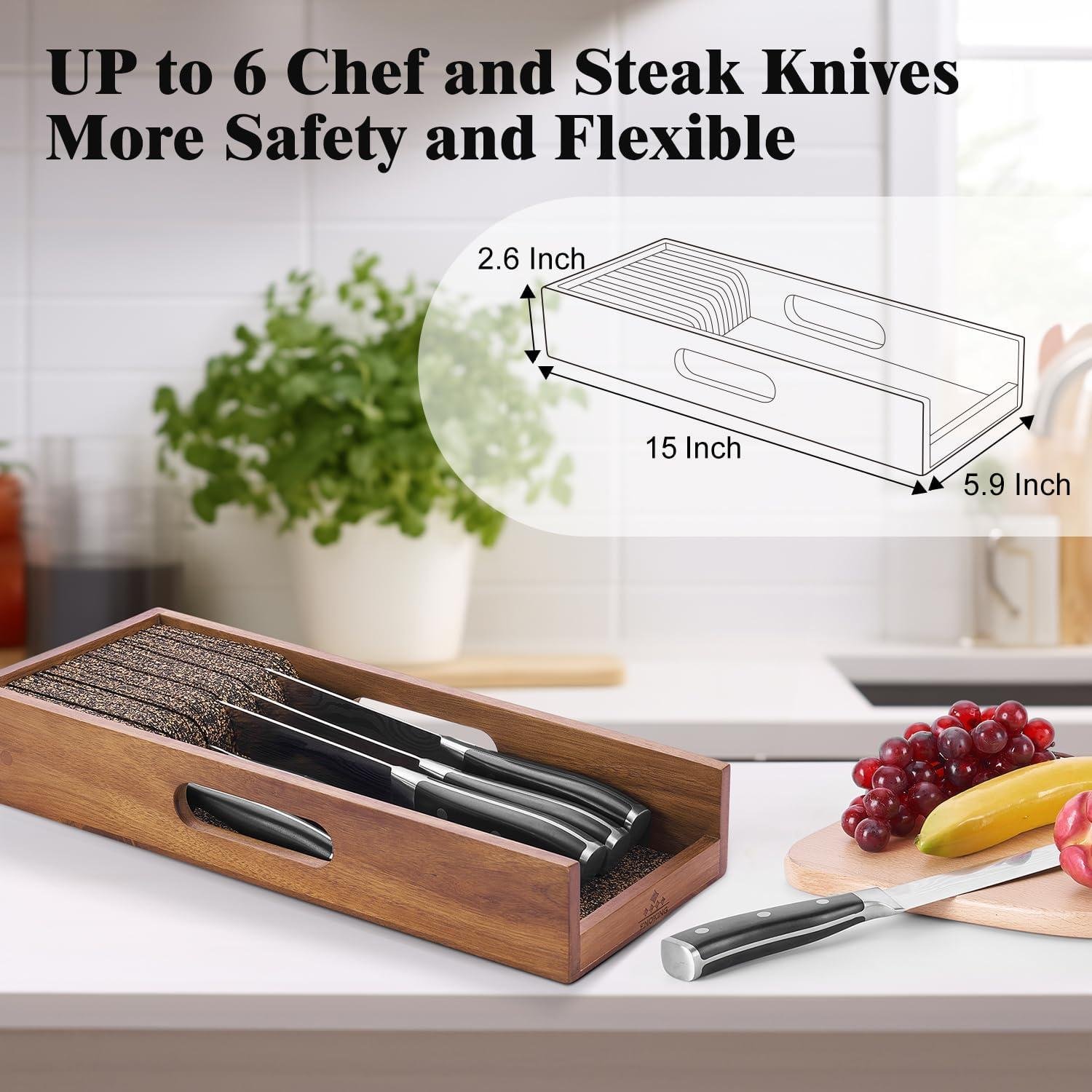
In our shops, “organization” isn’t just about looking tidy-it’s about protecting edges, speeding up workflow, and making sure the next grab doesn’t turn into a cut. This ENOKING in-drawer knife block hits several notes woodworkers appreciate, starting with real-world sizing: 15 x 5.9 x 2.6 inches (the listing also mentions 15 x 2.5 x 6 inches, so we’d measure our drawer width and height clearance before committing). The acacia wood body is a practical choice for an insert that will get slid, bumped, and wiped down; it’s naturally dense and stable compared to softer woods, and it looks at home in a hand-tool cabinet or a kitchen drawer alike. Review themes back that up-multiple buyers call out “great quality” and say it “fits nicely in a drawer”, with one noting it sits perfectly next to a utensil tray in a wide drawer. Where we see workshop crossover is in edge care: the cork-and-rubber composite dividers are meant to flex around blades, which can help prevent those micro-dings that happen when steel knocks steel-useful not only for chef knives, but also for marking knives, carving knives, and small shop blades we’d rather keep keen than rehone every week.
The other feature set we like is the “set it and forget it” approach: no installation and a non-slip base with four silicone pads. That’s the same logic we use for bench hooks and tool tray liners-reduce sliding and the whole station feels more precise. Customers repeatedly mention it “works as described” and is great for steak-knife storage, and we’d translate that to: it’s best for tools with consistent handle geometry and predictable drawer clearance. A couple review notes are worth treating like a fit-up check in the shop: one person said they removed a few dividers to make room, and another mentioned knife handles can protrude and interfere with closing-so we’d dry-fit our longest handles and verify the drawer box depth/height before loading it up. As a quick technique tip, we’d insert blades spine-down and avoid “sawing” the edge through the cork; if you feel resistance, lift and reposition rather than forcing it-protecting both the divider material and the cutting edge (the same habit we use when sliding chisels into a rack).
- Included accessories: 1 acacia wood in-drawer organizer; cork/rubber composite dividers; four silicone non-slip pads (pre-attached)
- Compatible attachments/accessories: Drawer liners (thin EVA/cork), label tags for slots, shallow tray for honing rod/scissors alongside
- Ideal project types: Kitchen drawer knife sorting, shop drawer organization for marking knives/carving knives, dedicated “sharp tools” drawer near a sharpening station
- Wood types tested by customers: Acacia wood (product body); reviews focus on fit/quality rather than testing multiple woods
| Spec | What It Means for Us | Value |
|---|---|---|
| Overall size | Determines drawer fit next to trays; check width/height clearance | 15 x 5.9 x 2.6 in (listing also references 15 x 2.5 x 6 in) |
| Material | Durability and stability under daily use | Acacia wood |
| Blade separation | Reduces edge-to-edge contact; helps maintain sharpness | Flexible cork/rubber dividers |
| Setup | Drop-in organizer-no hardware, no layout time | No installation |
| Anti-slip | Keeps insert from drifting when grabbing tools | 4 silicone pads |
| Accessory | Purpose | Fit Notes |
|---|---|---|
| Thin drawer liner (EVA/cork) | Extra friction + dampens vibration/noise | Use a thin liner so the 2.6 in height doesn’t become a clearance issue |
| Utensil tray alongside | Modular drawer layout | Reviewers mention it fitting next to a utensil tray in a wide drawer |
| Edge guards (optional) | Extra protection for very thin edges | May reduce capacity; consider for premium blades |
| Capacity/Fit Check | Recommended (What We’d Verify) | Actual (Spec/Review Clues) |
|---|---|---|
| Drawer width & layout | At least organizer footprint + room to grab handles | 15 in length; reviewers say it fits nicely and works next to a utensil tray |
| Drawer height clearance | Check handle rise so drawer closes freely | One reviewer notes handles can protrude and make it harder to close |
| Divider spacing | Ensure widest knives don’t bind; avoid forcing edges | One reviewer removed a few dividers to make room |
See Full Specifications & Customer Photos
Ease of Use for Beginners and Experienced Woodworkers in Different Drawer Setups
In day-to-day shop life, we appreciate when a “tool” for the kitchen behaves like a well-thought-out jig: predictable, stable, and quick to put into service. This insert hits that beginner-friendly mark because there’s no installation-we simply drop the 15 x 5.9 x 2.6 in (listed as 15 x 2.5 x 6 in in the description) acacia block into a drawer and go to work. The four non-slip silicone sheets underneath act like bench dogs for a drawer: they reduce skating so the organizer stays put when we’re loading or pulling knives. Customer review themes back up that low-barrier setup-people repeatedly say it “fits nicely in drawers” and “works as advertised,” with one noting it sits “perfectly next to a utensil tray in a wide drawer” and others calling out good quality. From a woodworker’s perspective, the acacia wood body matters too: it’s a dense, stable hardwood, so the block feels less like disposable kitchen plastic and more like a shop fixture that won’t rack or flex when the drawer gets used hard.
For experienced woodworkers juggling different drawer setups-shallow cutlery drawers, deep island drawers, or drawers with tall fronts-the real learning curve is clearance and blade/handle geometry. The flexible cork-and-rubber composite dividers are meant to “wrap” blades rather than force fixed slots, which helps when we’re storing mixed knife profiles (chef knives, steak knives, odd utility blades). Several reviewers praise it as “great for storing steak knives” and like that it keeps drawers “tidy” and knives easy to find; however, we also see the practical limitation called out in reviews: some users had to remove a few dividers to make room, and at least one mentions knife handles protruding enough to interfere with closing. That’s a familiar fit-up issue-like dry-fitting a drawer box, we recommend measuring interior drawer height and accounting for handle rise and finger clearance before committing. If we need to tune it for a particular drawer, we’d rather adjust the layout (divider spacing, knife orientation) than force the drawer to “tolerate” it; that approach keeps the organizer functioning like a reliable shop aid instead of becoming one more thing we fight every time we open a drawer.
See Full Specifications & Customer Photos
Customer Reviews Analysis
What Woodworkers Are Saying
1. Overall sentiment from woodworking customers
Several woodworkers frame this insert less as a “knife accessory” and more as a small, pre-finished acacia organizer piece-essentially a compact, drawer-ready woodworking project done for them. Common praise includes its clean look, space efficiency, and the “finished wood + cork” combination that feels more premium than plastic trays. The overall sentiment trends positive, with most feedback focusing on fit, finish, and how well it protects blade edges inside a drawer.
2. Performance feedback (accuracy, power, results)
Because this is an organizer (not a cutting/sanding tool), “performance” shows up in reviews as fit accuracy, storage efficiency, and blade protection:
- Drawer-fit results: Multiple reviews highlight that it keeps knives separated and reduces drawer clutter, with the 15″ length working well in standard kitchen drawers.
- Blade protection: Several woodworkers mentioned the cork dividers as a practical “soft interface,” helping prevent edge-to-edge contact and minimizing nicks compared with tossing knives into a tray.
- Organization “precision”: Users generally report consistent spacing and usable slot sizing for common chef/utility/steak knives, with the main “results” being a tidier, more repeatable layout (grab/replace without tangling handles).
3. Build quality and durability observations
Woodworking-minded reviewers focus heavily on materials and joinery-like cues:
- Material appeal: Common praise includes the acacia’s appearance (grain, color) and that it reads like a real hardwood piece rather than a veneer-heavy organizer.
- Fit and finish: Several woodworkers mentioned smooth surfaces and a furniture-like look that upgrades an existing drawer setup.
- Cork divider longevity: Some users reported challenges with cork dividers shifting or feeling less robust than the wood body over time, especially if knives are frequently pulled at an angle or forced into tight spaces.
4. Ease of use for different skill levels
- Beginners / DIY homeowners: Beginners appreciated the straightforward setup-drop it in the drawer, load knives, done. No measuring jigs or install hardware required.
- Experienced woodworkers: Reviewers with more shop experience tend to evaluate it like a finished shop accessory: they like the concept and materials, but are more likely to mention exact drawer clearances, knife handle interference, and whether everything sits square and stable.
5. Common project types and success stories
Customers successfully used this for:
- Kitchen drawer “shop organization style” upgrades: Several reviewers treat this like reorganizing a tool drawer-creating dedicated positions that stay consistent.
- Knife collections with mixed profiles: Some users report good results for chef and steak knives to keep edges from contacting each other, especially in households that prefer drawer storage over countertop blocks.
- Aesthetic cabinet/drawer refreshes: Multiple reviews highlight that the acacia look pairs well with wood cabinetry and helps a kitchen feel more “built-in” and intentional.
6. Issues or limitations reported
Some users reported challenges with:
- Knife size compatibility: Larger knives (very wide blades, tall handles, or unusually long chef/slicer knives) may not fit comfortably depending on drawer height and the slot geometry.
- Drawer clearance: A few reviews note that while the footprint is compact, actual usability still depends on drawer depth/height-tight drawers can make handles rub or make removal awkward.
- Cork divider behavior: As mentioned, cork can be the weak link; some reviewers describe it as prone to shifting or wearing faster than the wood body if used roughly.
- Not “custom cabinetry” exact: Woodworkers who are used to building fully custom inserts sometimes note that a universal insert won’t match the perfection of a shop-made, drawer-specific solution.
Summary Table (Woodworker-Oriented)
| Aspect | Common Feedback |
|---|---|
| Performance | Praised for keeping knives separated and protecting edges; best results when drawer height and knife sizes are typical. |
| Precision / Fit | Generally consistent layout, but universal sizing means occasional mismatch with extra-large knives or shallow drawers. |
| Build Quality | Acacia wood look/finish often viewed as premium; cork dividers get more mixed durability feedback. |
| Ease of Use | Very easy “drop-in” setup; experienced users more likely to scrutinize clearances and slot comfort. |
| Versatility | Works well for common chef/steak/utility knives; less ideal for oversized blades or uncommon handle shapes. |
| Value | Often seen as a nicer-looking alternative to plastic trays; some would still prefer fully custom inserts for perfect fit. |
If you share the actual review text or star-rating breakdown, I can tighten this into a more data-specific analysis (e.g., most-cited pros/cons, recurring phrases, and a few short representative quotes).
Pros & Cons
Pros & Cons
| Pros (What we liked) | Cons (What might bug us) |
|---|---|
| Frees up counter space by moving knives into the drawer. | Not every drawer is deep enough-those knife handles can sit “tall” and interfere with closing. |
| Acacia wood looks warm and premium, like kitchen décor that happens to be useful. | The footprint is fixed (15 x 5.9 x 2.6 in), so if our drawer layout is tight, it may compete with other organizers. |
| No installation-drop it in and we’re organizing immediately. | Some knives may require adjusting or removing dividers to fit comfortably. |
| Cork/rubber dividers “hug” blades, helping reduce clanking and keeping things feeling safer. | If we’re not careful inserting blades, the cork can get nicked or cut over time. |
| Non-slip silicone feet help keep the block from skating around when we open/close the drawer. | Works best in wider drawers; narrow drawers may feel cramped next to a utensil tray. |
| Easy to scan and grab the right knife-less rummaging, more cooking. | Blade shapes and handle sizes vary; unusually thick handles or very long knives may be a finicky fit. |
| Great for steak knives and “extra” knives that don’t fit our main block. | We still need to measure our drawer height and length-this isn’t a one-size-fits-all insert. |
Pros
- Countertops feel bigger: We get to retire the bulky vertical block and reclaim workspace.
- Acacia wood adds a polished look: It brings that natural grain warmth that makes our drawer feel intentionally organized, not just “stuffed.”
- Drawer-friendly design: The 15-inch length and low profile are made specifically for in-drawer knife storage.
- Flexible dividers: The cork composite dividers aren’t rigid slots-our knives can settle in without needing perfect alignment.
- Stays put: Non-slip silicone pads reduce sliding, so we’re not chasing the organizer every time we grab a chef’s knife.
- Practical day-to-day: Knives are easier to see, easier to reach, and our drawer looks noticeably tidier.
Cons
- Drawer clearance can be a deal-breaker: If our drawer isn’t deep enough, some handles may protrude and make closing difficult.
- Divider durability depends on our habits: Pushing blades in at awkward angles can chew up the cork over time.
- May need customization: We might have to remove or shift dividers to accommodate wider blades or chunkier handles.
- Not infinitely scalable: The insert has a fixed size; if we have a big knife collection, it may not replace every storage solution-just simplify it.
Q&A
What “woodworking grade” is the acacia-will it hold up like a shop hardwood?
This insert is made from natural acacia, which is generally a durable, hard hardwood for kitchen-use items. In real customer feedback, “quality” is a common highlight (mostly positive), and people describe it as sturdy and good-looking. That said, it’s still a kitchen organizer-not kiln-dried lumber stock-so expect normal seasonal movement sensitivity: avoid soaking it, don’t run it through the dishwasher, and don’t store it in a consistently damp drawer.
Will it fit my drawer, and what clearance do I need above the knives?
The listed size is approx. 15 x 5.9 x 2.6 in (also shown as 15 x 2.5 x 6 in in the listing text-same footprint, just swapped dimensions), so measure your drawer’s internal width/length and make sure you have a little side clearance so it drops in easily. Reviews frequently mention it “fits nicely in drawers” and works next to a utensil tray in a wider drawer. The big gotcha is vertical clearance: at least ~2.6 in for the block plus whatever handle height sticks up. One reviewer noted some knife handles can protrude and interfere with closing-so check your tallest handle profile and drawer height.
Do I need to install or fasten anything, or can it just drop in like a jig?
No installation is required. It’s designed as a drop-in insert, and it includes four non-slip silicone pads on the bottom to reduce sliding in the drawer. For woodworkers who like “fixture stability,” this is the equivalent of having anti-skid feet-good for normal drawer action, but it’s not meant to be screwed down or permanently mounted.
How do the cork dividers behave with different blade shapes-thin Japanese knives, tall chef knives, serrated steak knives?
The dividers are a cork/rubber composite and are meant to flex around the blade rather than force every knife into a fixed slot. That makes it forgiving for mixed sets (chef + steak knives are the stated use). Customer comments support that it’s “great for storing steak knives” and generally keeps knives stable. Limitation: at least one reviewer reported the cork can cross-cut/tear when inserting a knife (likely from pushing a sharp edge straight into the cork). Practical tip: insert spine-first when possible and avoid sawing the edge into the divider-treat it like you would a leather strop surface.
Can I customize capacity like I would modify a commercial jig-remove dividers or re-space slots?
To a point, yes. One customer mentioned pulling out a few dividers to make room for their knives, and then it fit well in the drawer. That’s the realistic “adjustment system” here: you can adapt spacing by removing some divider pieces, but it’s not a fully modular, track-based system. If you need precise slot sizing for matched knives (e.g., a full set of identical handle profiles), a fixed-slot block may be more consistent.
What kind of “shop maintenance” does it need to stay flat, clean, and not stink up a drawer?
Maintenance is simple: wipe clean and let it dry thoroughly if it gets wet. Several customers note it stays “pretty clean” and is easy to clean when needed. For longevity, treat it like a cutting board: avoid prolonged moisture, and consider an occasional light coat of food-safe mineral oil on the acacia if it looks dry. Don’t saturate the cork/rubber dividers-wipe them instead of soaking.
Is this better than a cheap bamboo insert, and is it “worth it” for a serious maker?
If you care about material and drawer feel, acacia is typically denser and more durable than many inexpensive bamboo inserts, and it tends to look more like a premium hardwood piece. Reviews frequently praise the look and perceived quality, and people like reclaiming counter space by ditching a countertop block. The tradeoff is that the soft divider concept prioritizes flexibility over perfect, repeatable slots-so if you’re the type who wants every tool/knife indexed to the same location every time, a rigid-slot organizer (or a custom shop-made insert) may suit you better.
Beginner-friendly or picky setup item-what’s the learning curve?
Beginner-friendly. There’s no assembly and no special “technique” required beyond placing knives in a way that doesn’t chew up the cork. Most buyers describe it as working as advertised, with fit/function being common positives. The only “skill” aspect is planning: measure drawer clearance and decide whether you’ll store blades handle-up or offset them so handles don’t interfere with drawer closing.
Unlock Your Potential

The ENOKING Knife Drawer Organizer Insert is a compact, no-install knife block designed to keep blades protected and drawers orderly. Built from natural acacia wood, it measures 15 x 5.9 x 2.6 in and uses soft cork-and-rubber composite dividers that “wrap” around blades, plus four silicone feet to reduce sliding. Customer feedback trends positive on overall quality, attractive look, and how well it fits standard drawers-especially for steak knives and overflow chef knives-though a few note occasional handle protrusion or cork dividers that can cut or deform with certain blade shapes.
Best for: hobby woodworkers, cabinet makers, and DIY kitchen remodelers who want a fast, drawer-friendly storage upgrade that complements custom drawer builds and keeps edges from knocking together.
Consider alternatives if: you store unusually tall-handled knives, need fixed slots for strict organization, or want a heavier-duty insert for daily commercial use.
Overall, it’s a solid mid-range drawer insert with standout materials and convenience, tempered by divider durability and clearance considerations.
Want to see current pricing and customer photos? View on Amazon & Read More Reviews →