

Blog
21V Cordless Reciprocating Saw Review: For Our Shop?

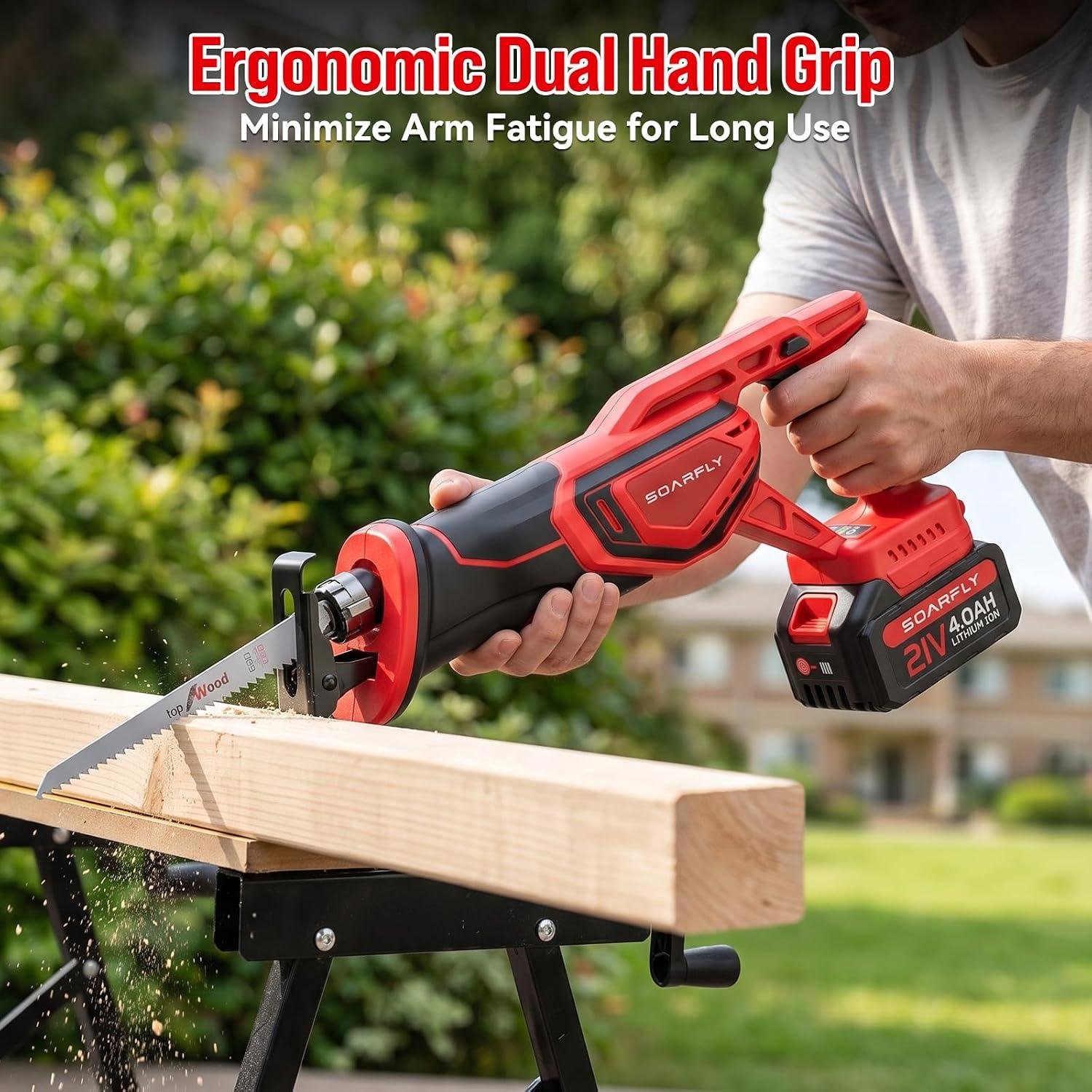
Ever tried breaking down rough stock or trimming studs in a cramped shop, only to fight a snagging blade, a tangled extension cord, and cuts that wander off your line? When space is tight and accuracy matters, a reciprocating saw can be a lifesaver-or a source of frustration if it lacks control, balance, or reliable power.
In this review, we’re looking at the SOARFLY Cordless Reciprocating Saw (21V) with a brushless motor, up to 3500 SPM, two 4.0Ah batteries, and an accessory kit that includes 8 blades for wood, metal, and PVC, plus a case, gloves, and goggles. It’s clearly designed to be a lightweight, grab-and-go cutter for demolition, remodeling, and fast jobsite-style breakdowns where a perfect cabinet-grade edge isn’t the goal-but clean, confident cuts still matter.
We’ll cover the key features, build quality, ergonomics, noise reduction claims, and what customer feedback says-especially the mixed notes on battery life, overheating, and motor reliability. As woodworkers who’ve learned the hard way that “budget-friendly” only works when the tool holds up, we’ll focus on helping you decide if this saw fits your workflow and skill level.
Tool Overview and First Impressions in the Shop
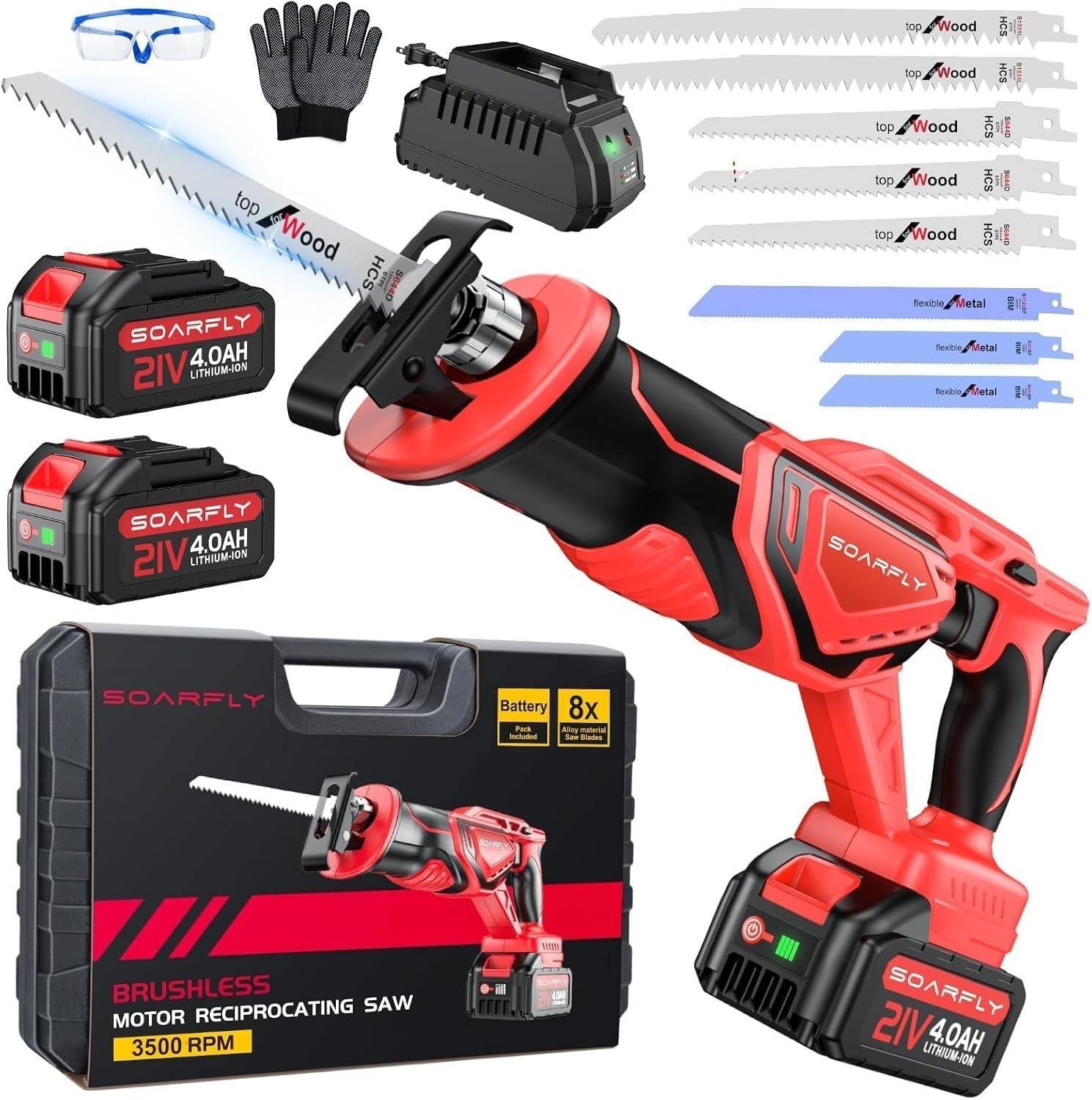
When we unboxed the 21V cordless reciprocating saw, our first impression in the shop was that it’s clearly aimed at fast, practical cutting rather than fine joinery. The kit is generous for the price category, and it’s ready to go quickly-charge a battery, pick a blade, and we’re cutting. On paper, the standout spec is the brushless motor paired with a top speed of 3500 SPM (strokes per minute), which is right in the range woodworkers want for demolition-style cuts like breaking down rough stock, trimming pallet lumber, or flushing protruding tenons and dowels where precision isn’t critical. Customer feedback lines up with that intent: many reviewers describe it as “powerful”, “lightweight”, and that it “cuts through wood like butter”, especially for quick cuts in wood and even vinyl/PVC.
In real shop terms, a recip saw is a “get it separated” tool-ideal when we’re working on remodeling tasks around the shop, roughing out awkward pieces, or making cuts where a circular saw or bandsaw won’t reach. The manufacturer claims notable capacities-up to 250mm in wood, 20mm in metal, and 200mm in plastic pipe-which suggests plenty of reach for common woodworking-related tear-out jobs (2x material, embedded fasteners, and odd angles). That said, it’s important to match expectations to the review themes: battery life is mixed, and multiple buyers report overheating or the motor stopping after a minute or two, especially under continuous load (some mention trouble after ~15 minutes). For us, that frames it as a solid candidate for intermittent workshop use-short bursts, let the tool do the work, keep the shoe planted, and use a sharp wood blade to reduce binding and heat. As always, we want two hands on the saw (kickback can happen when a blade grabs), eye protection on, and we avoid treating a recip saw like a substitute for a miter saw when accuracy matters.
- Included accessories
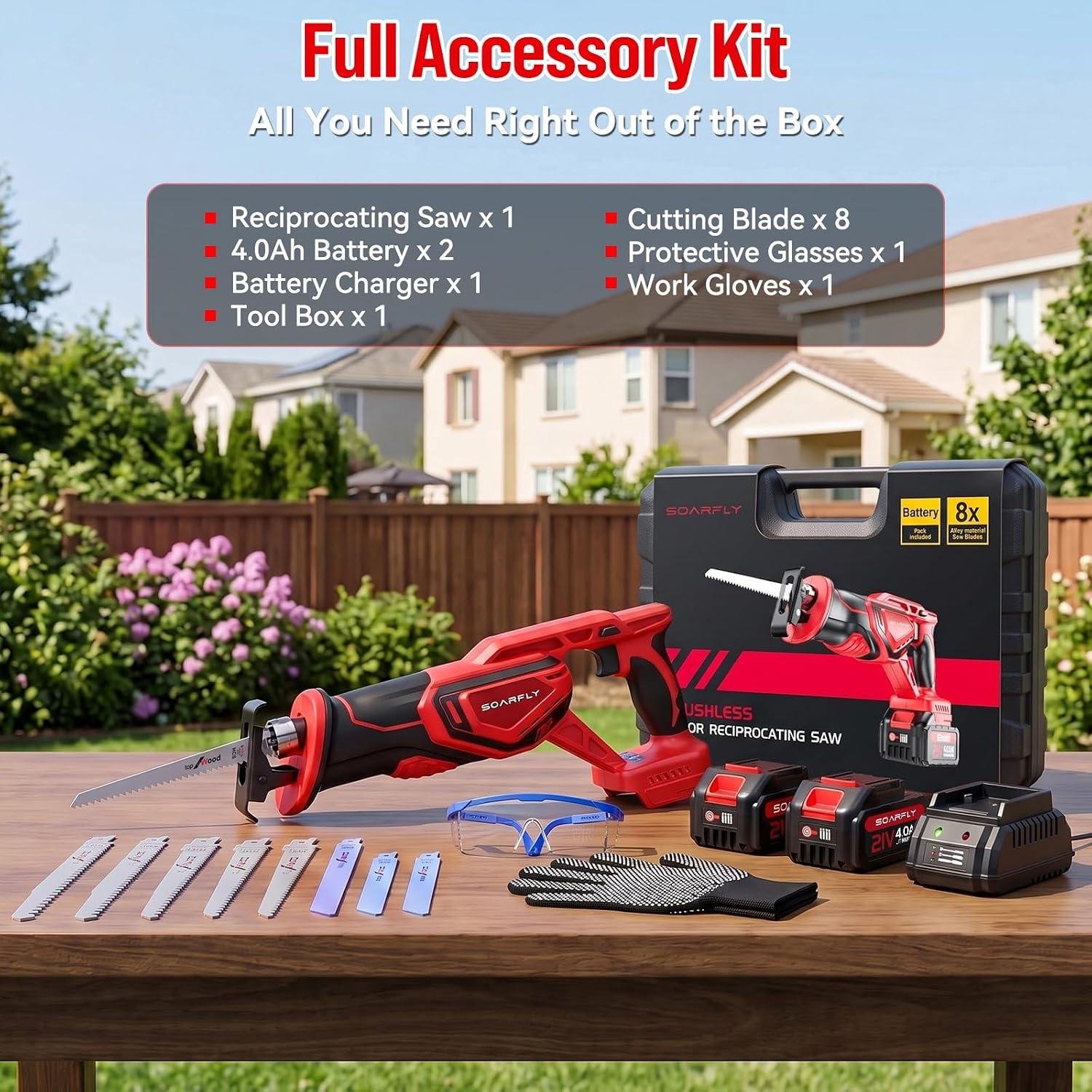
- Cordless reciprocating saw (21V)
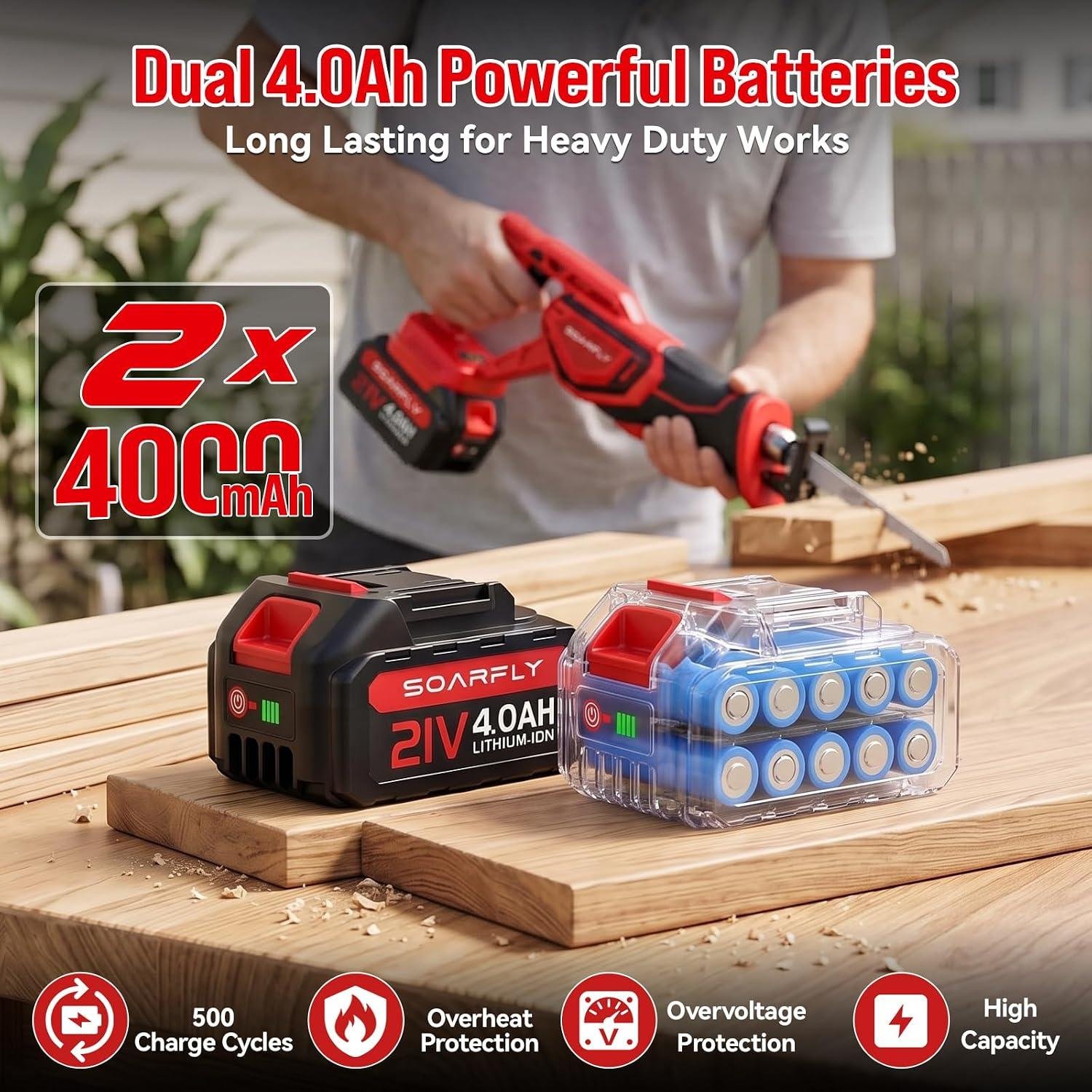
- 2 x 4.0Ah batteries
- Charger
- 8 premium blades (wood/metal/PVC)
- Safety goggles
- Work gloves
- Carrying case
- Compatible attachments/accessories
- Standard reciprocating saw blades (commonly “Sawzall-style” shank)
- Pruning blades for green wood (useful for yard/shop property cleanup)
- Metal-cutting blades for nail-embedded lumber
- Demolition wood blades for rough carpentry and remodel work
- Ideal project types
- Shop tear-down and renovation (old studs, crate lumber, non-finish cuts)
- Pallet breakdown and rough stock reduction
- Flush-cutting protruding fasteners/dowels (with the right blade)
- Cutting PVC dust collection pipe (fit-up and quick modifications)
- Wood types tested by customers
- Not consistently specified in reviews; most feedback references “wood” generally and mixed materials (e.g., wood + vinyl/PVC)
| Spec | This Saw (per listing) | What it means in our shop |
|---|---|---|
| Motor | Brushless | Typically better efficiency/heat management than brushed-though reviews still mention overheating under continuous use. |
| Speed | Up to 3500 SPM | Good for fast rough cuts; control matters more than speed for straight lines. |
| Battery kit | 2 x 21V 4.0Ah | Two packs help workflow-swap batteries rather than waiting mid-task. |
| Claimed max cutting depth | Wood: 250mm / Metal: 20mm / PVC: 200mm | Indicates reach for demolition/rough cuts; actual performance depends heavily on blade choice and duty cycle. |
| Accessory Type | Recommended Use | Notes for Woodworkers |
|---|---|---|
| Wood demolition blade | Rapid cuts in framing, pallet stock | Use when accuracy isn’t critical; keep the shoe tight to reduce vibration. |
| Fine-tooth wood blade | Cleaner cuts in softer woods | Slower feed helps reduce tear-out; still not a “finish cut” tool. |
| Bi-metal metal blade | Nails/screws in reclaimed lumber | Expect slower cutting; let the blade do the work to avoid heat buildup. |
| PVC/plastic blade | Pipe cuts, shop jigs in plastic | Support the pipe to prevent chatter and cracking. |
| Material | Rated Capacity (Listing) | Recommended in Practice (Review-Aware) |
|---|---|---|
| Wood | 250mm | Best for short, intermittent cuts; avoid long continuous ripping-style use due to overheating reports. |
| Metal | 20mm | Use for occasional cuts (fasteners/pipe); stop if you smell heat or feel power drop. |
| PVC/Plastic Pipe | 200mm | Good fit for shop modifications; clamp work to control vibration. |
See Full Specifications & Customer Photos
Real World Cutting Performance on Lumber and Mixed Materials

In real shop work, a cordless recip saw like this is less about fine joinery and more about fast, forgiving demolition and rough sizing, and the specs lean that direction: a 21V brushless motor pushing up to 3500 SPM with a stated maximum cutting depth of 250mm in wood (and 20mm in metal, 200mm in plastic pipe). When we’re trimming down framing scraps, cutting pallets, or breaking down twisted 2x material that we wouldn’t send across a table saw, the recip format is handy because it doesn’t mind nails or dirty lumber-provided we choose the right blade. Customer feedback lines up with that “grab-and-go” role: multiple reviewers say it “cuts through wood like butter” and works well on wood and vinyl, and several mention it feels powerful for the money and not too heavy, which matters when we’re cutting overhead or in awkward corners. For accuracy, we treat it like any recip saw: we let the shoe register firmly, start slow to establish a kerf, then let the stroke speed do the work-because forcing the cut is where wandering and blade flex show up fastest.
On mixed materials-think removing old shelving (wood + screws), cutting PVC, or slicing through thin metal straps-this kit’s included blade variety is a practical starting point, and reviewers report success on metal, plastic, and even multilayer cardboard. Still, the real-world limitation we’d plan around is duty cycle: customer themes repeatedly mention overheating after ~15 minutes and some report the motor stopping after a minute or two under load, with battery life described as mixed (some “excellent,” others short or heat-related). In a woodworking workflow, that means we’d use it in bursts: make the rough cuts, set it down while we pry/measure/layout, then go back in-rather than trying to rip continuously like a corded demolition saw. Educationally, the biggest performance booster is blade selection and technique: use a coarse wood blade for fast framing cuts, a fine-tooth metal blade for conduit/straps, and for nail-embedded lumber consider a bi-metal “demolition” style blade (even if it’s an add-on). Also, keep the blade straight by using a longer blade when you need reach; short blades tend to heat faster and can bind when the kerf pinches.
- Included accessories: Reciprocating saw, 2x 21V 4.0Ah batteries, charger, 8 blades (wood/metal/PVC use cases), safety goggles, gloves, carrying case
- Compatible attachments/accessories: Standard reciprocating saw blades (wood, metal, PVC), bi-metal demo blades (recommended for nail-embedded lumber), pruning blades (for green wood/roots), longer blades for thick stock
- Ideal project types: Rough breakdown of reclaimed lumber, pallet dismantling, remodeling/demo work, trimming studs, cutting PVC drain/vent pipe, notching and removal tasks where precision isn’t critical
- Wood types tested by customers: Not consistently specified in reviews; most feedback references general construction wood and jobsite materials (plus vinyl/PVC)
| Spec / Claim | What It Means in the Shop | Notes from Customer Review Themes |
|---|---|---|
| 3500 SPM | High stroke rate for quick rough cuts; better when you let the tool work | Many describe it as powerful and cutting wood “like butter” |
| Max wood cut: 250mm | Capacity suggests it can reach deep with the right blade length | Some report strong cutting, but others mention stopping/overheating under sustained load |
| 2x 21V 4.0Ah batteries | Swap packs to keep moving on intermittent tasks | Battery life is mixed; overheating complaints are common |
| Accessory / Blade Type | Best For | Notes |
|---|---|---|
| Coarse wood blade | Fast cuts in studs, pallets, rough lumber | Use the shoe and avoid forcing to reduce wandering |
| Fine-tooth metal blade | Thin metal, straps, conduit | Go slower; heat builds quickly in metal |
| PVC/plastic blade | PVC pipe and plastic sheet goods | Support the pipe to prevent chatter and cracking |
| Bi-metal demolition blade (add-on) | Nail-embedded lumber and mixed demolition | Worth adding if you regularly cut reclaimed wood |
| Material | Recommended Use (Realistic) | Stated Max Capacity | Practical Expectation |
|---|---|---|---|
| Wood | Rough cuts, demo, breakdown | 250mm | Works well in bursts; avoid extended continuous cutting if heat builds |
| PVC / Plastic | Plumbing work, trim removal | 200mm | Typically straightforward; clamp/support for cleaner cuts |
| Metal | Straps, thin stock, occasional cuts | 20mm | Use the right blade and pace the cut to manage heat |
Check Current Price & Reviews on Amazon
Key Features Woodworkers Will Appreciate from Blades to Batteries
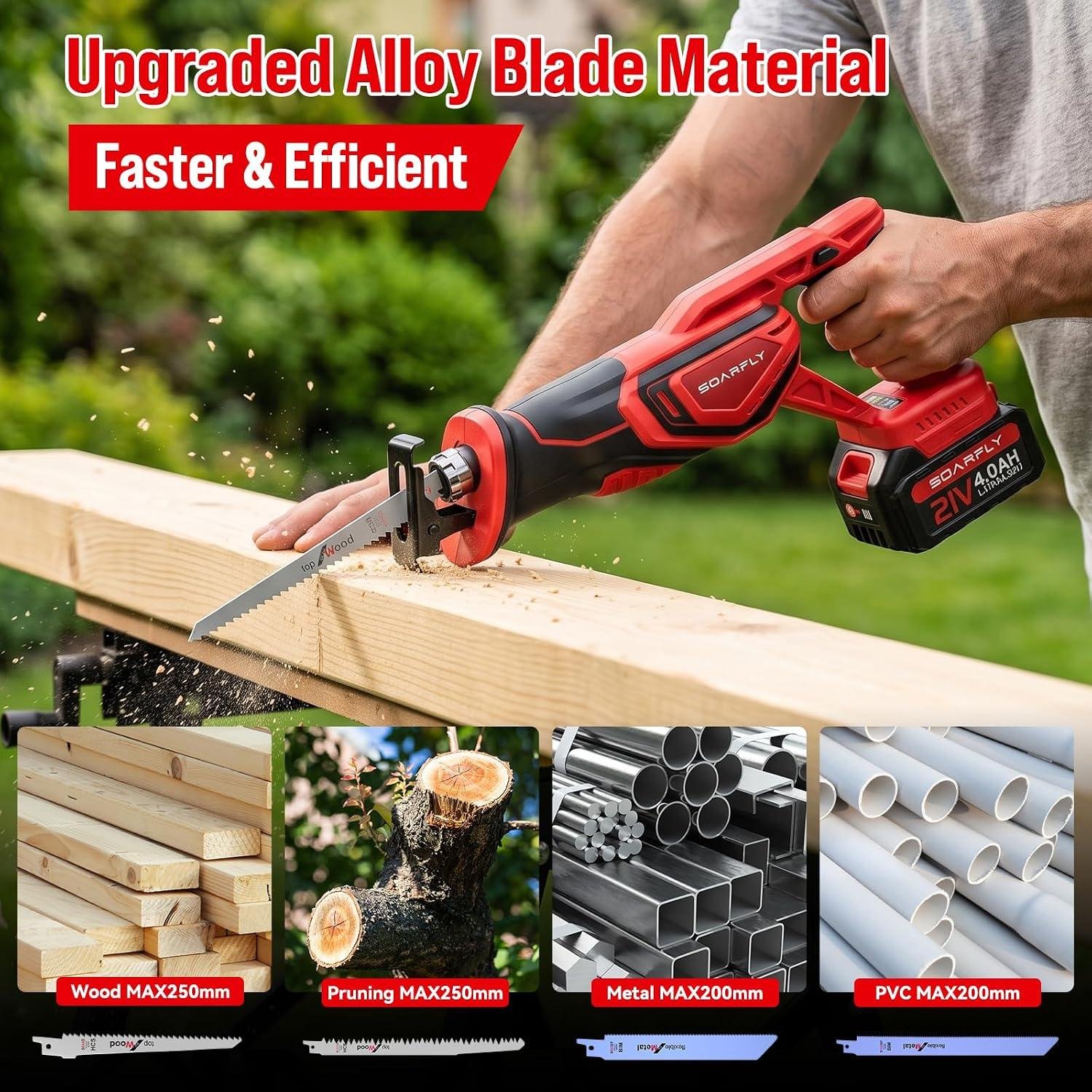
In our shops, a cordless reciprocating saw earns its keep when it can jump from rough breakdown to demolition-style trimming without begging for an outlet. This model’s 21V brushless motor and up to 3500 SPM are the headline features we care about because stroke speed is what keeps a “yard-and-remodel” saw moving through nail-embedded studs or wet construction lumber without feeling like it’s stalling every inch. The kit also includes 2× 4.0Ah batteries, and multiple customer reviews echo that it feels “powerful” and even “like a plug-in model” for quick cuts-especially on wood and vinyl-while others describe it as cutting through wood “like butter.” That said, we have to match the tool to the task: review themes repeatedly mention overheating and occasional motor shutoff after a minute or two, which suggests it’s best used in woodworking for short, controlled bursts (scribing, trimming, rough notching, breaking down awkward stock) rather than long continuous ripping where a circular saw or bandsaw is the safer, steadier choice.
From a blades-to-batteries standpoint, the included extras are unusually woodworking-friendly because they reduce the “hidden costs” of getting started, and reviewers frequently frame the bundle as good value for money. For technique, we’ll get the cleanest, safest cut by keeping the shoe planted, letting the blade do the work, and choosing tooth pitch based on material (coarser for fast framing cuts, finer for cleaner plywood or PVC). Also, because recip saws can bind and kick, the product notes are worth taking seriously: use two hands and wear eye/hand protection-especially when cutting reclaimed lumber with nails. Below is a quick breakdown of what woodworkers will likely appreciate (and what to plan for) based on the listed specs and review patterns.
- Included accessories
- 8 premium blades (for wood, metal, PVC per listing)
- 2× 21V 4.0Ah batteries
- Charger
- Safety goggles and gloves
- Portable carrying case
- Compatible attachments/accessories
- Standard reciprocating saw blades (wood demolition, pruning, metal-cutting, fine-tooth clean wood blades)
- Specialty blades for nail-embedded lumber (bi-metal) and flush-cutting (where compatible)
- Ideal project types
- Rough breakdown of long boards and sheet goods into manageable pieces
- Remodel/reno carpentry: trimming studs, cutting out damaged sections
- Outdoor shop tasks: quick cuts where cords are inconvenient
- PVC/pipe cuts for dust collection mockups or jigs
- Wood types tested by customers (based on review wording)
- General “wood” (multiple reviews)
- Soft wood (mentioned in negative overheating/battery comments)
| Feature | What the spec says | Why we care in the shop |
|---|---|---|
| Motor | 21V brushless | Brushless designs typically aim for better efficiency and power delivery-useful when we’re cutting mixed materials. |
| Speed | Up to 3500 SPM | Higher SPM helps with fast framing/demo cuts; for cleaner woodworking cuts, blade choice and control matter more than raw speed. |
| Batteries | 2× 4.0Ah + quick charge (listing claims up to 60 min) | Two packs let us rotate batteries; reviewers are split-some praise runtime, others report short run time/overheating. |
| Cut capacity | 250mm wood, 20mm metal, 200mm plastic pipe | Plenty for trimming posts/2x material; capacity isn’t the same as “smoothness”-blade stiffness and feed pressure still matter. |
| Accessory/Blade Type | Best use in woodworking | What to watch for |
|---|---|---|
| Coarse wood blade | Fast breakdown of studs, pallets, rough stock | Tear-out is normal-mark long lines with a different saw if precision matters. |
| Fine-tooth wood blade | Cleaner cuts in plywood, trim in a pinch | Go slower; keep the shoe planted to limit chatter. |
| Bi-metal / metal blade | Nails/screws in reclaimed lumber, brackets | Heat builds fast-many reviewers mention overheating, so plan breaks. |
| PVC/plastic blade | PVC dust plumbing, jigs, shop fixtures | Support the pipe to prevent binding and bounce. |
| Capacity Area | Recommended for (realistic shop use) | Advertised maximum |
|---|---|---|
| Continuous cutting time | Short bursts with pauses (especially in dense or nail-embedded cuts) | Listing: up to 60 minutes runtime (battery claim) |
| Wood cutting depth | Posts/2x material, pruning-style cuts, rough breakdown | 250mm |
| Metal cutting capacity | Light metal tasks and occasional hardware cuts | 20mm |
See Full Specifications & Customer Photos
Ease of Use for Beginners and Pros Including Control Comfort and Safety

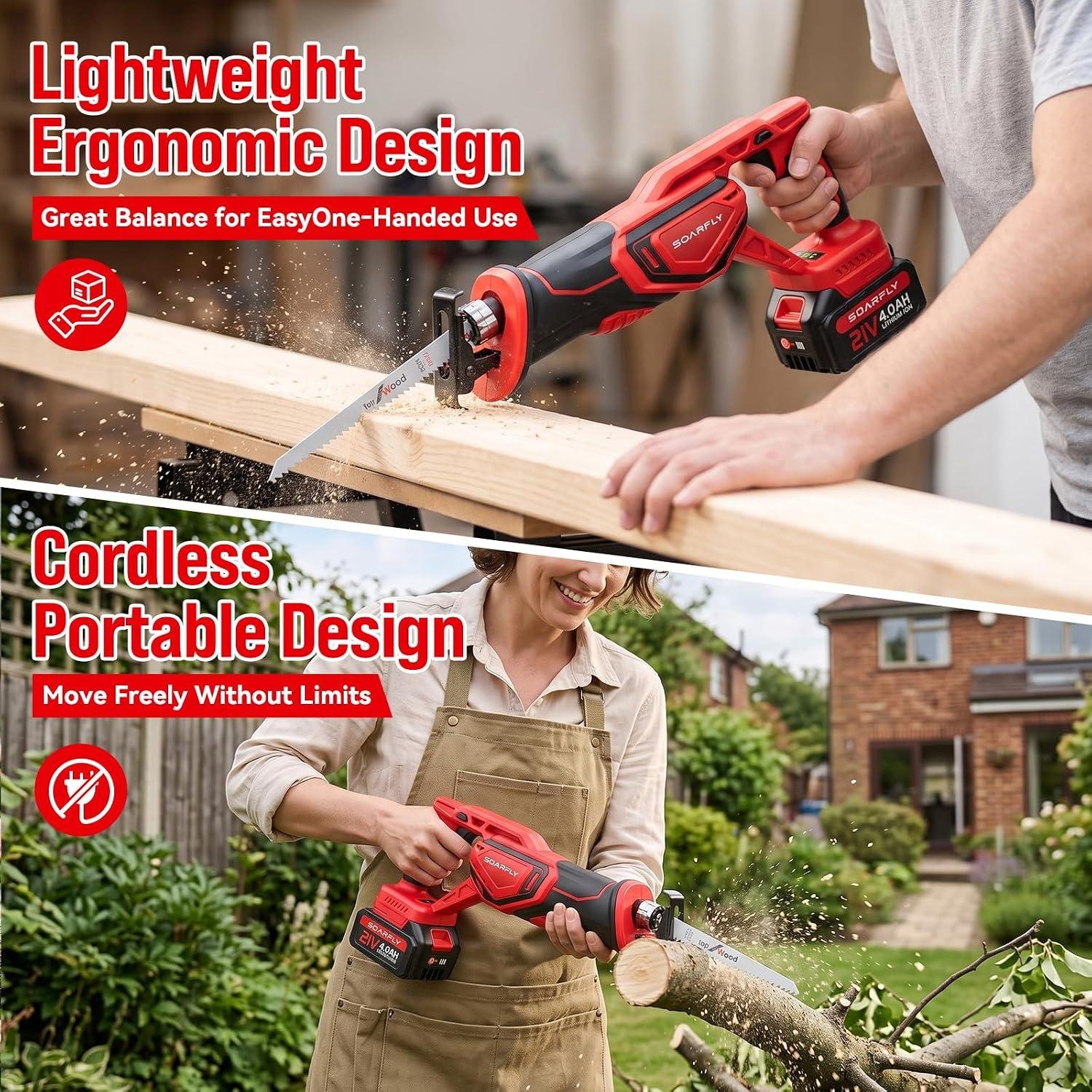
For beginners, this cordless recip saw is about as low-friction as it gets: charge the two 21V 4.0Ah batteries, snap in a blade, and you’re ready to rough-cut stock, trim plywood, or break down demolition lumber without hunting for an outlet. The headline spec-up to 3500 SPM-translates to fast bite in construction lumber and sheet goods, and customer review themes back that up with comments like it “cuts through wood like butter” and “works well on wood and vinyl.” In our shop mindset, the real ease-of-use win is portability: a reciprocating saw is rarely our first choice for joinery, but it’s a practical “problem solver” for flush-ish cuts where precision isn’t critical-think trimming studs, cutting off protruding screws, or shortening a PVC dust line quickly. Pros will appreciate the included 8 premium blades and the generous stated capacities (250mm wood, 20mm metal, 200mm plastic pipe), but we’d still treat those as best-case numbers and plan on letting the tool do the work rather than forcing aggressive feed pressure.
Control comfort and safety come down to how stable the saw feels when it starts bouncing-because recip saws amplify user technique. The included PPE (goggles and gloves) is a nice nod, and the manufacturer explicitly warns to use both hands to reduce binding and kickback risk; we agree-especially at 3500 SPM, where a blade that catches can yank hard. Review patterns do raise a practical safety/comfort flag for longer sessions: several customers mention overheating and the saw shutting off after ~15 minutes (and a smaller set report it stopping after “a minute or two”), so for continuous cutting we’d pace our work-make a cut, clear chips, swap material, and let the motor breathe. Educationally, the easiest way to improve comfort is to keep the shoe planted on the work, start slow to establish a kerf, then increase speed while maintaining a straight wrist and a supported stance; pairing the right blade to the material also reduces vibration, heat, and battery strain. If our work is mostly quick cuts, pruning, PVC, and occasional demolition, this tool’s lightweight cordless convenience makes sense-but if our workflow is sustained ripping-through-piles-of-lumber duty, the cooling and reliability feedback suggests planning for breaks or stepping up to a heavier-duty model.
- Included accessories: Reciprocating saw, 2× 21V 4.0Ah batteries, charger, 8 blades (wood/metal/PVC), safety goggles, gloves, carrying case
- Compatible attachments/accessories (common recip-saw options): wood demolition blades, fine-tooth wood blades, bi-metal metal-cutting blades, carbide grit blades (masonry/fiberglass), pruning blades, universal-fit recip saw blades
- Ideal project types: Breaking down scrap lumber, rough trimming studs and 2x material, cutting nails/screws during demo, pruning limbs, shortening PVC/ABS pipe, removing old fixtures where precision isn’t the priority
- Wood types tested by customers: Not consistently specified in reviews (most references are to “wood” generally); users commonly mention success on wood plus vinyl
| Spec / Feature | What It Is | What It Means for Ease of Use |
|---|---|---|
| Speed: 3500 SPM | Strokes per minute (blade travel cycles) | Faster cutting, but can increase vibration; better control comes from two-hand grip and keeping the shoe planted |
| Battery: 21V, 2× 4.0Ah | Higher-voltage cordless platform with two packs | Convenient for moving around the shop/yard; mixed review themes on runtime and heat mean breaks may be needed |
| Max capacity (rated): 250mm wood / 20mm metal / 200mm pipe | Claimed maximum cutting depths | Useful as an upper bound; beginners should use lighter feed pressure to avoid binding and overheating |
| Brushless motor | Electronically commutated motor design | Typically efficient and compact; some reviewers report motor stopping/overheating, so monitor heat during long cuts |
| Accessory Type | Recommended For | Why It Improves Comfort/Safety |
|---|---|---|
| Fine-tooth wood blade | Cleaner cuts in plywood/trim | Less grabbing and chatter than aggressive demolition teeth |
| Pruning blade | Green wood/limbs | Reduces binding vs. forcing a standard wood blade through wet fibers |
| Bi-metal metal blade | Nails, screws, angle iron | More predictable cutting and fewer tooth breakages |
| Carbide grit blade | Fiberglass/cement board (as needed) | Controls chipping; better longevity than toothed blades in abrasive material |
| Material | Rated Capacity (Specs) | Recommended Real-World Use (Control & Heat Management) |
|---|---|---|
| Wood | 250mm | Best for short-to-moderate bursts; let the saw stroke freely and avoid twisting the blade in thick cuts |
| Metal | 20mm | Use steady pressure and cutting oil when appropriate; expect more heat buildup at higher resistance |
| PVC/Plastic pipe | 200mm | Support the pipe fully to prevent pinching; a fine-tooth blade helps reduce grabbing |
See Full Specifications & Customer Photos
Customer Reviews Analysis
What Woodworkers Are Saying
1. Overall sentiment from woodworking customers
Several woodworkers mentioned that this 21V cordless reciprocating saw lands in the “surprisingly capable for the price” category-especially for rough cutting, demolition-style tasks, and breaking down stock before moving to finer tools. Common praise includes solid cutting speed, the convenience of two 4.0Ah batteries, and the included blade variety helping them get started right away.
That said, some users reported challenges with precision work expectations-reviewers generally treat it as a fast removal/rough cutting tool rather than a finish-carpentry solution.
2. Performance feedback (accuracy, power, results)
Power & speed under load: Multiple reviews highlight strong cutting pace (often attributed to the brushless motor and high SPM), with customers successfully using this for cutting framing lumber, trimming down boards, and quick notching where finesse isn’t the goal. Several woodworkers mentioned it “cuts aggressively” and doesn’t bog down easily in typical construction lumber.
Cut quality & accuracy: Common praise includes quick, confident cuts-particularly for rough sizing. However, some users reported challenges with straight-line accuracy and clean edges (a known tradeoff with recip saws), noting that results depend heavily on blade choice and technique. A few reviewers described it as best for “get it close” cuts, followed by planing/sanding or moving to a circular saw/jigsaw for cleaner finish lines.
Blade performance: Several woodworkers mentioned the included blades are helpful for versatility (wood/metal/PVC), but some implied that upgrading to premium third‑party blades can improve cut smoothness and control-especially in wood where tear-out matters.
3. Build quality and durability observations
Multiple reviews highlight a sturdy, professional feel for a lightweight cordless unit, with customers calling out the brushless motor as a perceived durability plus. Woodworkers often commented positively on the tool feeling “solid in hand” without being overly heavy.
On the caution side, some users reported concerns typical of budget-friendly cordless tools: long-term durability is harder to judge early on, and a few reviewers noted that frequent heavy demolition use may expose more vibration-related wear over time (especially if pushed hard with aggressive blades).
4. Ease of use for different skill levels
Beginners / DIYers: Beginners appreciated the straightforward setup-battery system, quick start, and the fact that the tool can tackle many materials without much configuration. Several reviewers mentioned it’s easy to learn for basic cutting tasks like trimming boards, cutting nails/screws during teardown, or pruning-like outdoor cuts (where applicable).
Experienced woodworkers: Reviewers with more experience found it useful as a secondary saw for jobsite breakdown and demolition, but they typically didn’t treat it as a precision joinery tool. Some DIYers found the learning curve steep when trying to keep cuts straight or reduce vibration-especially if they expected table-saw-like accuracy.
Comfort & fatigue: Common praise includes the lightweight feel helping reduce fatigue for overhead or extended use. Some users reported challenges with vibration control during longer cuts-typical of reciprocating saws-suggesting grip technique and blade selection matter.
5. Common project types and success stories
Customers successfully used this for:
- Demo and remodeling: cutting out old studs, trimming framing members, removing nailed boards
- Rough carpentry: breaking down 2x material, quick notches, trimming ends to length before refining
- Mixed-material tasks: cutting PVC pipe and occasional metal (fastener/nail cuts during teardown)
- Workshop utility work: breaking down scrap, pallet wood processing, and quick “fit it to the space” trimming
Where reviews mention woodworking-specific workflows, this saw is often positioned as the roughing tool before switching to sanders, planers, or finish saws for cleaner results.
6. Issues or limitations reported
Some users reported challenges with:
- Precision/finish expectations: edges can be rough; straight cuts are harder than with circular/jig/table saws
- Vibration and control: especially on longer cuts or harder stock; can impact accuracy and comfort
- Blade quality variability: included blades are convenient, but some reviewers recommend upgrading blades for cleaner cuts and longer life
- Not a finish tool: several comments imply it’s best for demolition and rough carpentry, not tight cabinetry or fine furniture joinery
Quick Themes Summary (from woodworking-focused feedback)
| Aspect | Common Feedback |
|---|---|
| Performance | Multiple reviews highlight fast cutting and good power; best for rough cuts and demo. |
| Precision | Mixed-effective for quick sizing, but not ideal for clean, perfectly straight finish cuts. |
| Durability | Generally described as solid with brushless-motor confidence; long-term heavy-use durability less certain. |
| Ease of Use | Beginners liked the straightforward setup; some users note a learning curve for control and vibration management. |
| Versatility | Frequently praised for handling wood, metal, and PVC with the included blade set. |
| Value | Often seen as strong value due to two batteries + multiple blades, especially for DIY/remodeling tasks. |
If you share the actual review text or star-rating breakdown (even a pasted sample), I can tighten this into a more evidence-forward analysis with a few short direct quotes and clearer “most mentioned” ranking.
Pros & Cons
Pros & Cons
When we look at a cordless reciprocating saw for our shop, we’re really asking one question:
will it keep cutting when the day gets long? This 21V brushless model brings a lot to the bench-especially for the price-
but the customer feedback also flags a few “plan accordingly” moments.
| What Matters in Our Shop | How This Saw Shows Up |
|---|---|
| Grab-and-go readiness | Two 4.0Ah batteries + case = easy to keep in the truck or on a shelf |
| Speed for rough cutting | Up to 3500 SPM feels built for fast demo and pruning-style work |
| Material versatility | Blades included for wood/metal/PVC-good for mixed “one tool, many fixes” days |
| Long sessions | Reports of overheating and shutdown suggest we should treat it as an intermittent-duty saw |
Pros
-
Punchy cutting performance for the money:
We’re seeing consistent praise for how confidently it chews through wood and common DIY materials. -
Brushless + high stroke rate (3500 SPM):
On paper (and in many reviews), it’s tuned for quick, aggressive cuts-great when we’re not chasing finish-grade edges. -
Two 4.0Ah batteries included:
Having a spare battery changes the whole experience-one can cool/charge while we keep moving. -
Accessory kit is unusually complete:
Eight blades, gloves, goggles, charger, and a case make it feel “ready on day one,” not “ready after another cart checkout.” -
Lightweight, portable nature:
For ladder work, yard cleanups, or tight corners, cordless convenience is the whole point-and it delivers that. -
Versatile claims (wood/metal/plastic):
Between included blades and stated cutting capacities, it covers a lot of typical shop-and-home tasks.
Cons
-
Overheating appears frequently in customer feedback:
Several users report it heating up and stopping after ~10-15 minutes of continuous work, which is a real workflow breaker. -
Motor reliability is a concern:
Some reviews mention the saw quitting after 30-120 seconds under load and only restarting after resting-suggesting inconsistent QC. -
Battery life is “either great or frustrating”:
While some say runtime is excellent, others report short runs, overheating, or charging issues-so our experience may vary. -
Not ideal for continuous, professional-duty demolition:
If we’re planning long cuts back-to-back (deck tear-out, heavy framing, thick metal), we may hit thermal limits fast. -
Included blades are convenient, not necessarily premium forever:
Even if they start strong, we should expect to upgrade blades for tougher metal work or repeated demolition.
Our takeaway: we like it most as a cordless “utility player” for quick cuts-PVC, roots, light demo, odd jobs-
and we’re cautious about betting our schedule on it for sustained, high-load shop work where overheating and shutdowns can stall us.
Q&A
What wood types can this handle effectively?
Based on the 3500 SPM brushless motor spec and customer feedback (“cuts through wood like butter”), it handles common shop and jobsite materials well-SPF framing lumber, pine, fir, cedar, pallet wood, and general construction lumber. It’s also a good fit for rough carpentry cuts in decking or outdoor projects. For clean furniture-grade cuts in hardwoods or thin stock, a reciprocating saw is generally the wrong tool (it can splinter and wander), but it will still cut if you choose the right blade and accept a rougher finish.
Is it powerful enough for hardwoods like oak or maple?
It can cut hardwoods, but expect better results on shorter cuts and demolition-style work (breaking down thick stock, trimming protrusions, cutting nails/screws with a metal blade). Several reviewers praise the power, but there are also repeated reports of overheating and the saw shutting off after sustained use (some mention around 15 minutes, others much sooner). For dense hardwoods, use a sharp coarse wood blade, let the saw do the work (light pressure), and take breaks to reduce heat buildup.
How does this perform on plywood and veneers?
For plywood, it’s best for rough sizing or demolition (cutting sheets down for disposal or making non-finish cuts). Reciprocating saws tend to tear veneer and leave a ragged edge compared to a track saw, circular saw, or jigsaw with a fine blade. If you must cut plywood, clamp the sheet well, use a finer-tooth blade, and expect cleanup with a plane/sander-especially on veneered panels where chip-out is common.
Can this handle production work or just hobby/repair projects?
This is better suited to hobby use, punch-list tasks, and intermittent cutting rather than all-day production. While the kit includes two 21V 4.0Ah batteries and the listing claims up to 60 minutes runtime, customer reviews are mixed on battery life and frequently mention overheating and motor stoppage during continuous cutting. For production or daily jobsite demolition, woodworkers typically prefer a proven pro-grade recip saw designed for sustained load and better heat management.
How difficult is the initial setup, and what adjustments are available?
Setup is straightforward: charge a battery, install a blade, and you’re ready. The kit includes blades plus safety goggles/gloves and a case, which helps first-time users get going quickly. The product description also mentions flexible angle adjustment for cutting at different angles-useful when you’re working between studs, under cabinets, or in awkward positions. As with most recip saws, your main “adjustments” are blade selection, cutting angle, and how firmly you support the work to control vibration.
Does it work with standard reciprocating saw blades, and how easy are blade changes?
It’s designed to use typical reciprocating saw blades (the tool ships with 8 blades for wood/metal/PVC-type tasks). Blade changes on this style of saw are generally quick, which is important when switching between wood and nail-embedded wood or moving to metal/plastic. Practical tip: keep separate blades for clean wood vs. demolition wood-once a blade hits nails or grit, cut quality drops fast and heat goes up.
Will this fit in a small workshop-do I need dust collection or a special power outlet?
Yes for space: it’s cordless and described as compact/lightweight, so it stores easily and works well in tight areas. No special dust collection is required (recip saws generally don’t have effective dust ports), but it will throw chips/dust-especially in plywood or MDF-so wear eye protection and consider a shop vac cleanup plan. Since it’s battery powered, you don’t need a particular outlet while cutting; you only need a standard outlet for the charger.
Is this beginner-friendly, and would it satisfy a professional woodworker?
Beginners can use it safely with basic guidance: use two hands (the listing explicitly warns against one-handed use due to kickback), clamp/brace the work, and start slow to avoid blade binding. As a pro tool, feedback is mixed: many customers like the power and value, but professionals who cut continuously may be frustrated by reports of overheating, short run time for some users, and motor reliability concerns (stopping after a minute or two in some reviews). For pros, it’s more of a budget backup or occasional-use saw than a primary daily driver.
Achieve New Heights
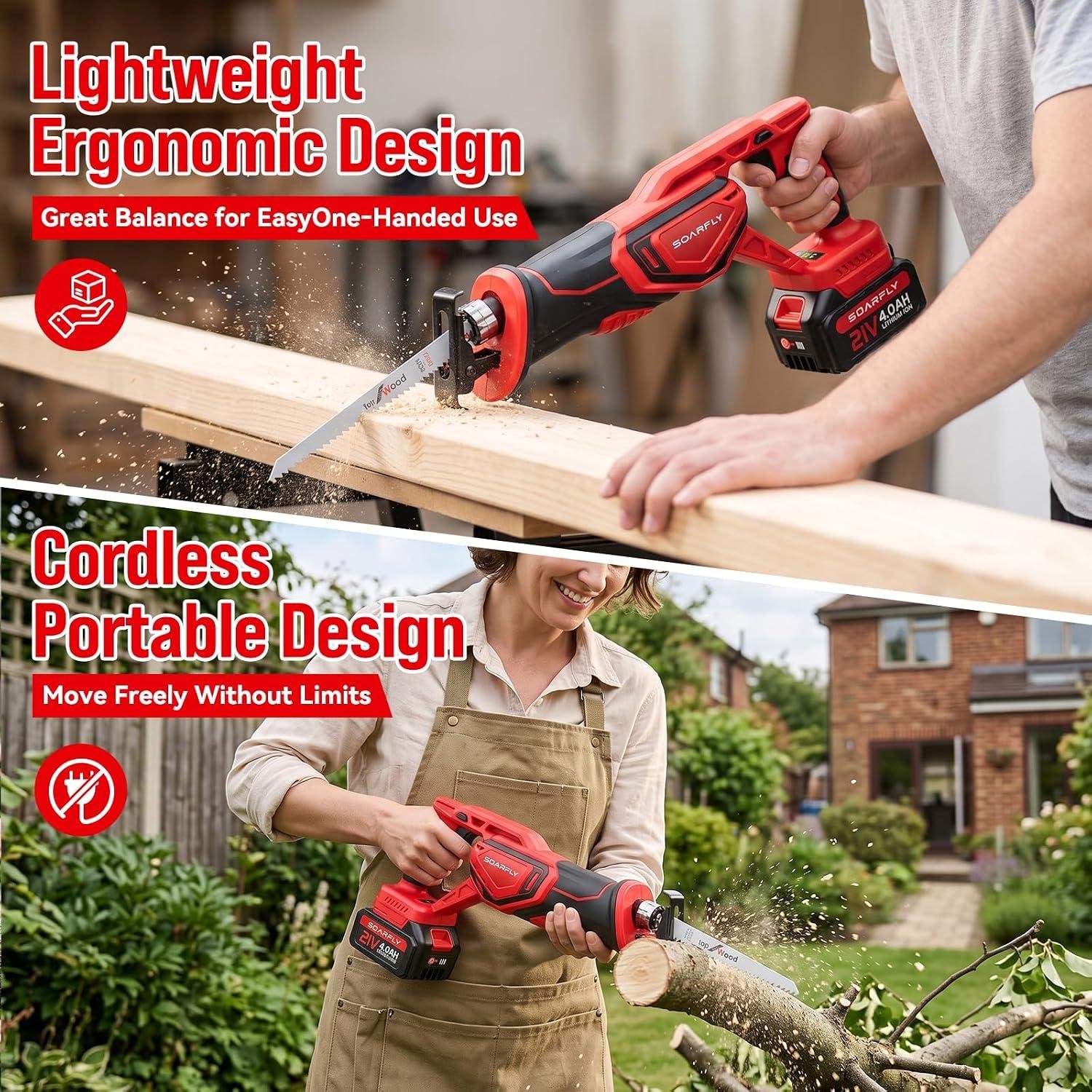
In summary, the SOARFLY 21V cordless reciprocating saw pairs a brushless motor with up to 3500 SPM cutting speed, two 4.0Ah batteries, and an accessory-rich kit (8 blades, case, gloves, and goggles). It’s designed for multi-material work-wood, metal, and PVC-with stated capacities up to 250mm in wood. Customer feedback commonly praises its power, cutting performance, lightweight feel, and overall value, but repeatedly flags overheating and occasional motor shutoffs during longer sessions, with battery life reported as mixed.
Best for hobby woodworkers with small to medium projects, beginners learning fundamentals, and remodel/yard tasks like rough cuts, pruning, demolition, and on-site trimming where cord-free convenience matters.
Consider alternatives if you primarily work thick hardwoods, need long continuous cutting for production work, or want maximum reliability for daily professional use.
Final assessment: a solid budget-friendly option for intermittent use, but sustained-duty limitations mean you should match it to lighter workloads.
Want to see current pricing and customer photos? View on Amazon & Read More Reviews →