

Blog
AVID POWER Compact Router Review: Right for Our Shop?

Ever laid out a clean dado or edge profile, only to watch the cut wander because the base won’t stay put-or worse, burn marks show up the moment you hit hardwood? When shop space is tight and budgets are tighter, we need a router that’s precise, manageable, and doesn’t feel like a gamble.
That’s where the AVID POWER 6.5 Amp (1.25 HP) Compact Fixed-Base Router (65mm) aims to fit: a compact handheld router designed for trimming, edging, and general routing with 6 variable speeds (10,000-32,000 RPM). On paper, it checks a lot of practical boxes-rack-and-pinion depth adjustment, dual LED lights, an aluminum body/base, and dust control via an included dust hood.
In this review, we’ll break down the feature set, what it means for real-world accuracy and ease of use, and who this kit best serves-especially newer woodworkers learning depth control and speed matching. We’ll also weigh the value of the bundled bits, edge guide, roller guide, and 1/4″ + 3/8″ collets, plus what customers commonly mention in reviews about usability and cut quality.
As woodworkers who’ve learned (sometimes the hard way) that setup matters as much as horsepower, we’ll keep the focus on informed, realistic expectations.
Tool Overview and Build Quality in the Shop
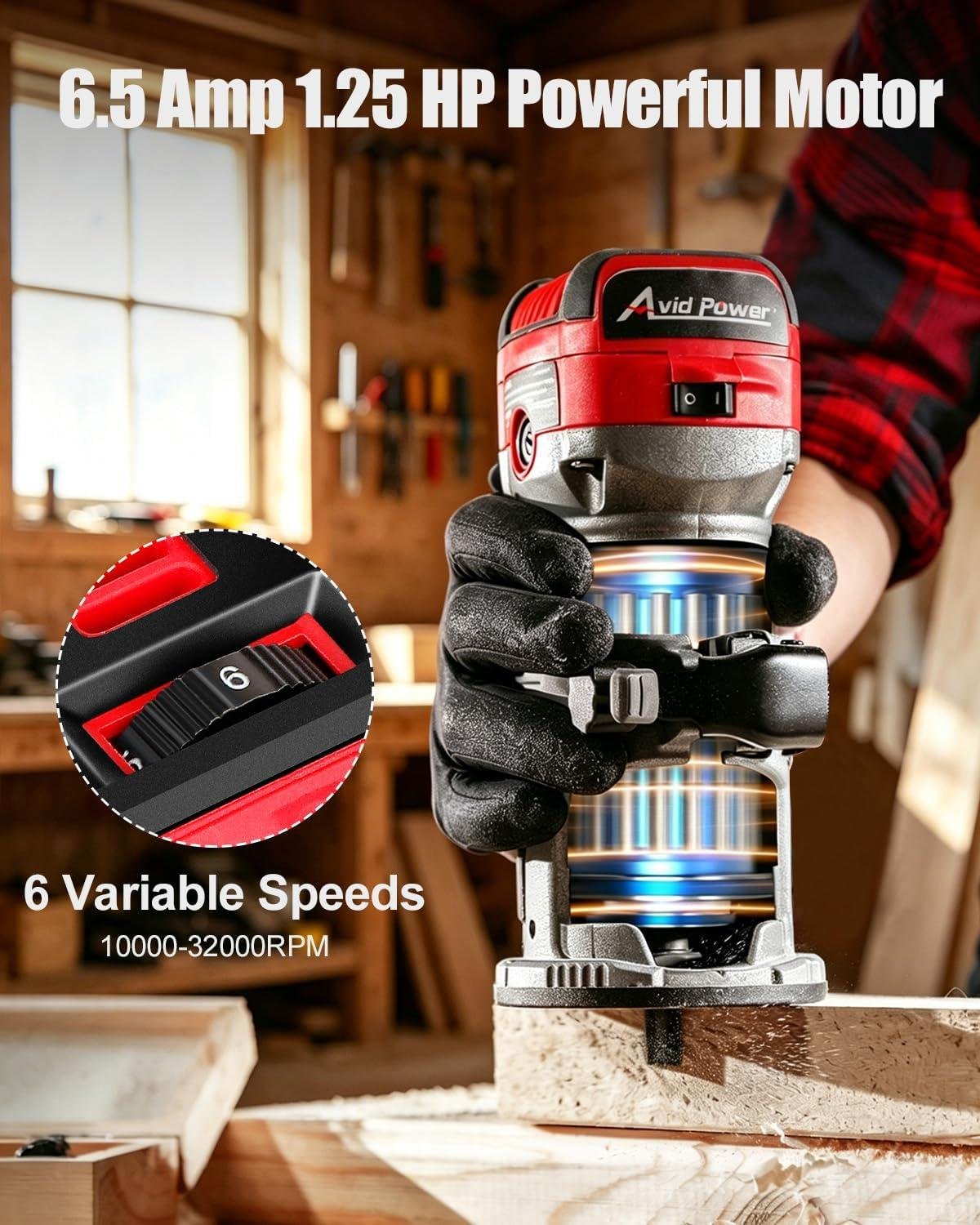
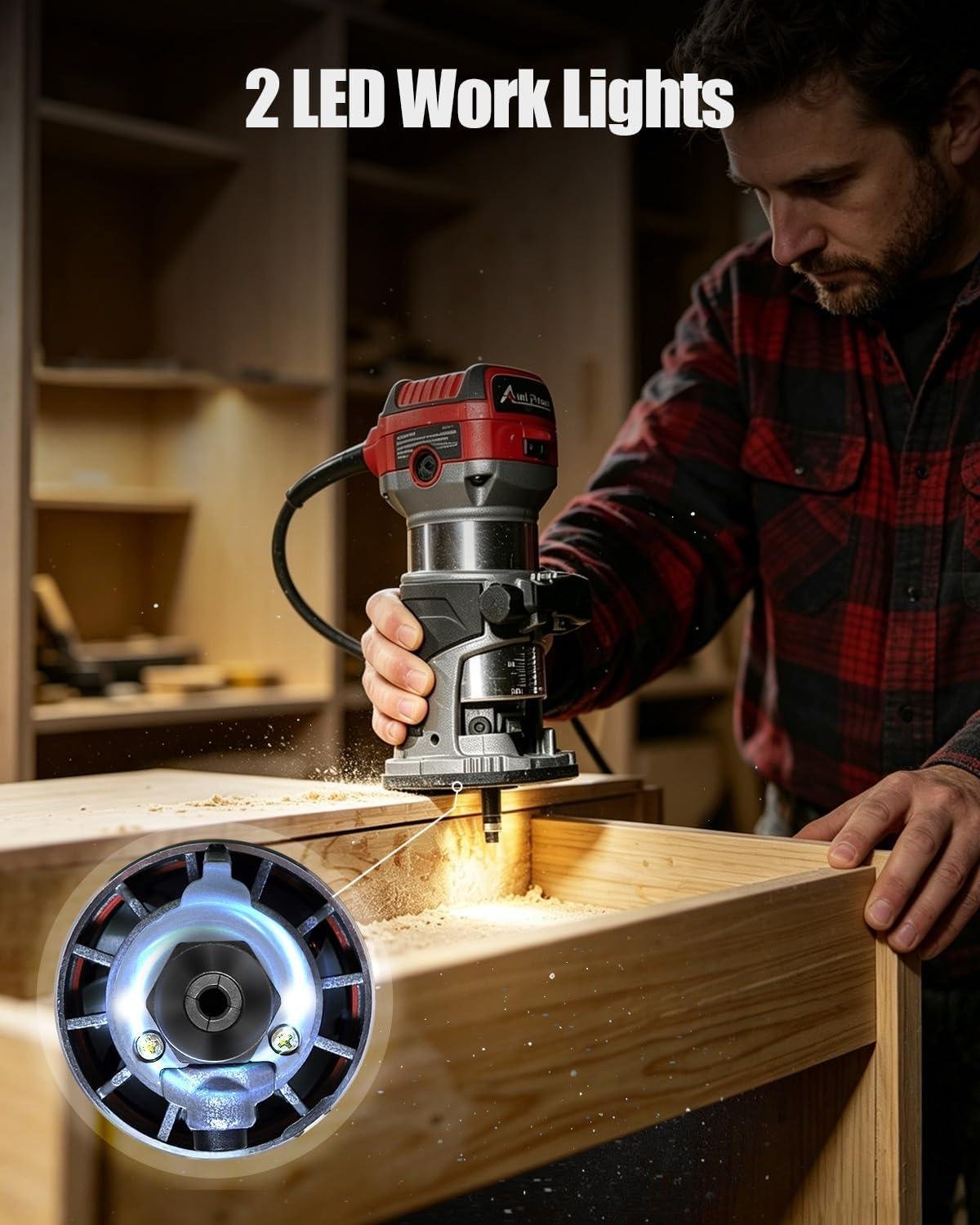
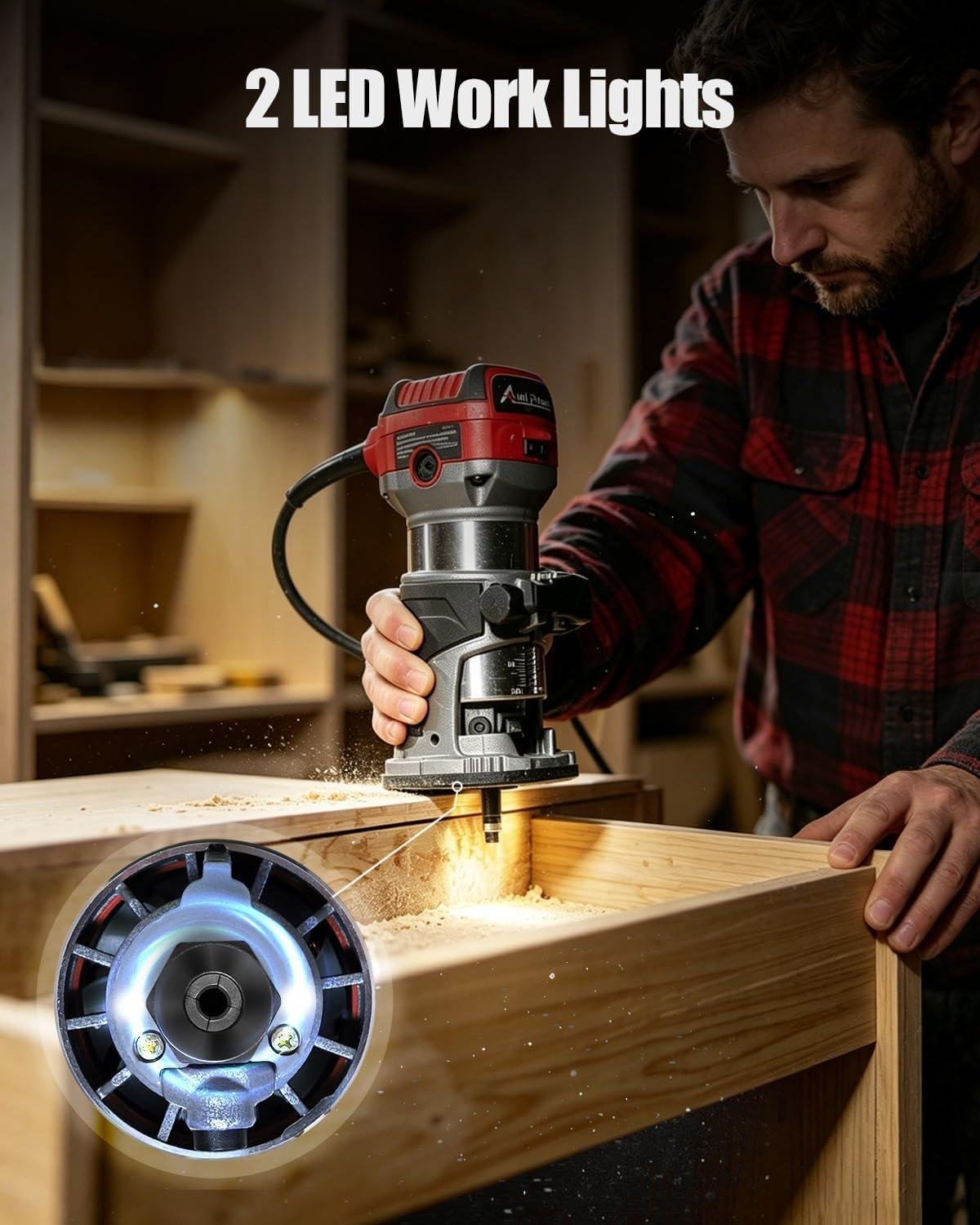
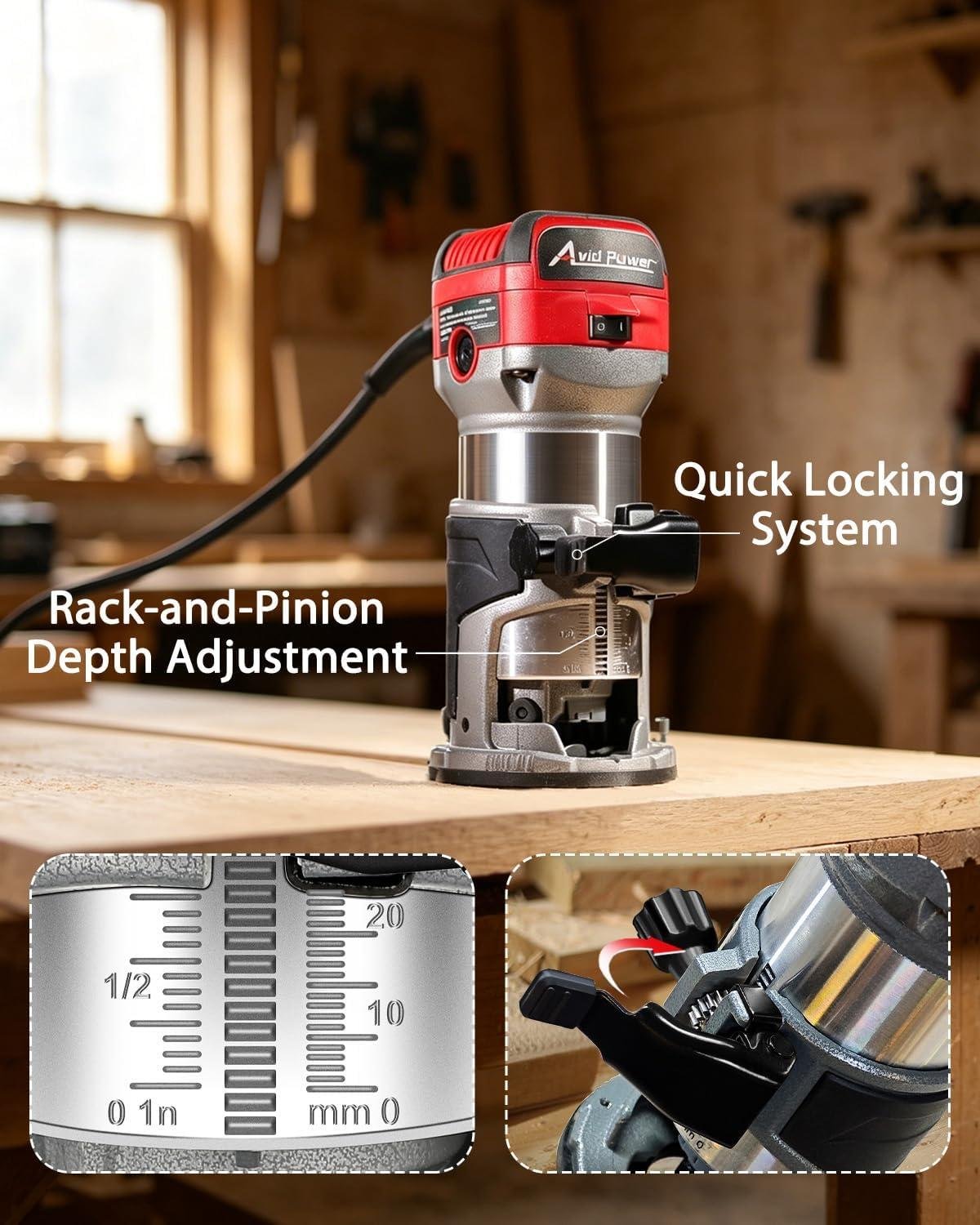
In our shop, the AVID POWER compact router presents itself like a practical, no-fuss kit built around a solid spec sheet: 6.5 amps / 1.25 HP (800W) with a 6-speed dial spanning 10,000-32,000 RPM. That RPM range matters in real woodworking terms-lower speeds help us reduce burning and chatter in hardwoods, while higher speeds tend to leave a cleaner edge on softwoods and laminates when the bit is sharp and feed rate is steady. The fixed base uses a rack-and-pinion depth adjustment and a quick-lock to set and hold cutting depth; in practice, that’s the difference between sneaking up on a hinge mortise or dado versus fighting a base that drifts mid-pass. The body and base are listed as aluminum, and the dual LED work lights are a genuinely workshop-friendly touch when we’re routing inside cabinets or along a shaded edge where pencil lines disappear.
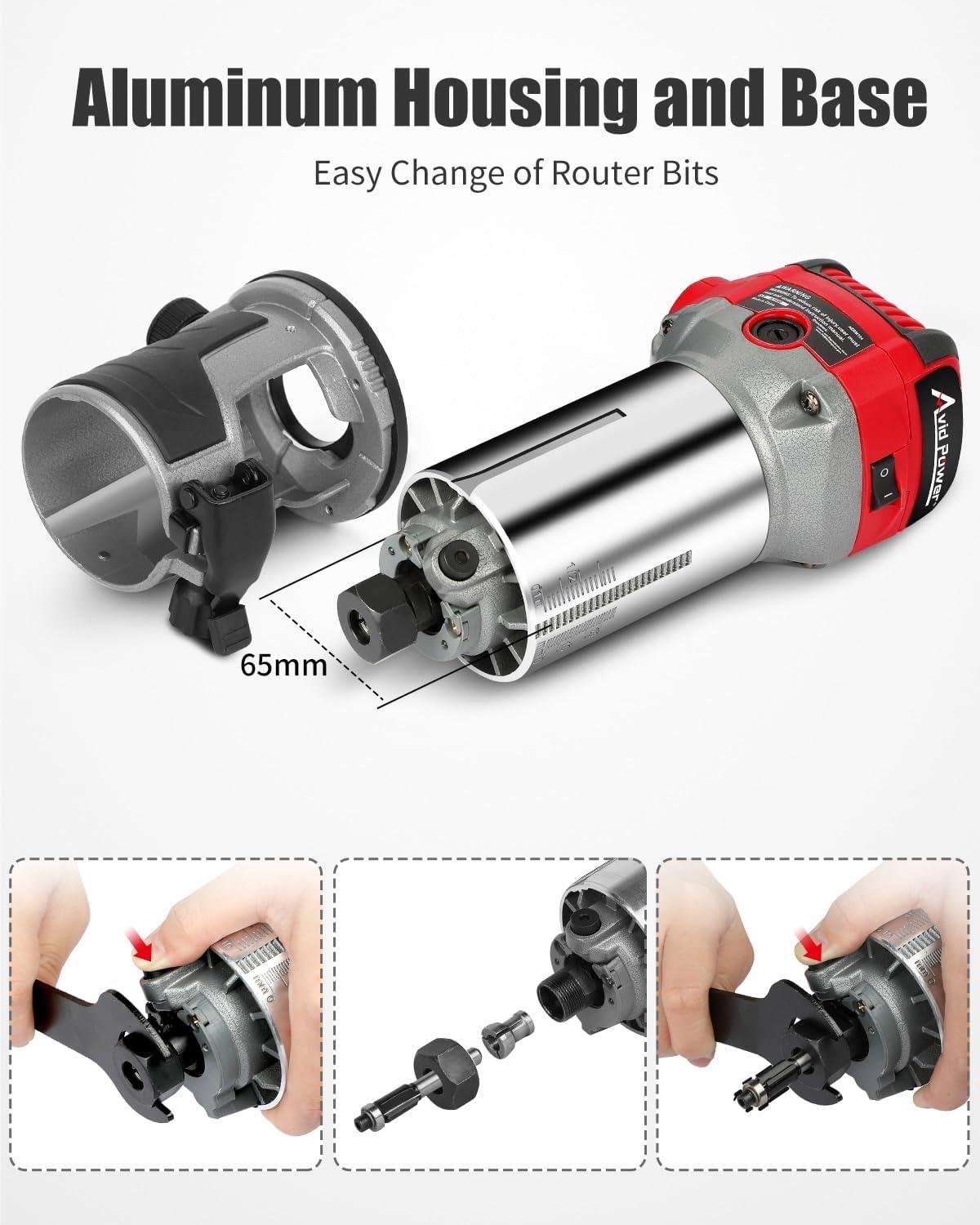
Setup is where compact routers earn (or lose) trust, and customer feedback commonly circles a few repeating themes: many reviewers describe it as easy to assemble and “ready-to-use” out of the box, especially since it includes guides and multiple collets, while others mention the expected learning curve of dialing in depth and controlling feed rate like any handheld router. We also see recurring notes about good value for the money and generally satisfactory performance for trimming and edge work, with some reviewers pointing out typical handheld-router realities like noise and the need to keep passes light for best control. For education and safety in our workflow, we treat this tool as a compact fixed-base router first: use sharp bits, make multiple shallow passes (especially on hardwood), keep the base flat, and always verify the collet is seated and tightened before powering up. The included dust hood can connect to a shop vac to improve visibility at the cut line-useful not just for cleanliness, but for accuracy when we’re trying to keep a profile consistent along a long run.
- Included accessories: Router tool, 5 router bits (e.g., straight/chamfer/round-over types), edge guide, roller guide, dust hood, 1/4″ collet, 3/8″ collet, spare carbon brushes, wrenches
- Compatible attachments/accessories: Standard shop-vac hose (via dust hood), 1/4″ and 3/8″ shank router bits, edge/roller guides for straight and curved work
- Ideal project types: Edge profiling on shelves and tops, laminate trimming, hinge mortises, light dadoes/grooves, round-overs/chamfers on small-to-medium parts
- Wood types tested by customers: Reviewers commonly mention results on hardwoods like oak and softwoods like pine (burning control improved by lowering RPM and taking lighter passes)
| Spec / Feature | AVID POWER Compact Router (This Model) | Why It Matters in the Shop |
|---|---|---|
| Power | 6.5A / 1.25 HP (800W) | Enough for trim/edge work and light joinery; avoid hogging deep cuts in one pass. |
| Speed Range | 10,000-32,000 RPM (6 settings) | Lower RPM helps reduce burning in hardwoods; higher RPM can improve surface finish in softer materials. |
| Base Type | Fixed base with rack-and-pinion adjustment | Better for controlled edge work and repeatable depths; plunge cuts require different tooling/techniques. |
| Visibility | Dual LED lights | Helps track layout lines and bit position, especially in cabinets and shadowed areas. |
| Dust Collection | Dust hood (shop-vac compatible) | Cleaner cut line visibility and less airborne debris; still wear eye/hearing protection. |
| Accessory / Bit Type | Supported by Tool | Notes for Fit & Use |
|---|---|---|
| 1/4″ shank router bits | Yes (1/4″ collet included) | Most common trim-router bit size; great for round-overs, chamfers, and straight bits. |
| 3/8″ shank router bits | Yes (3/8″ collet included) | Less common than 1/4″; verify bit availability and keep cuts conservative on larger profiles. |
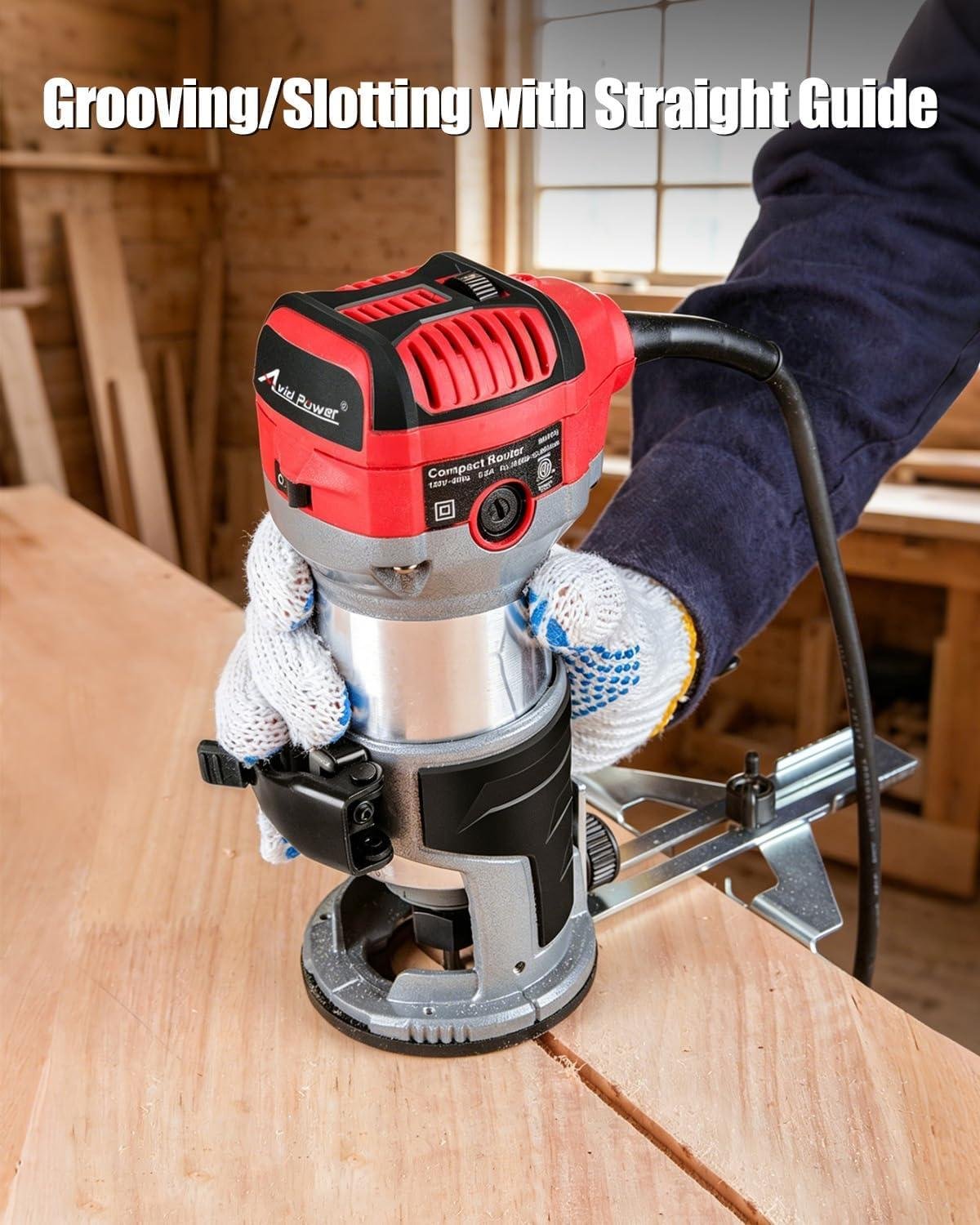
| Edge guide | Yes (included) | Useful for consistent offsets on grooves/dadoes along an edge-test-fit and clamp work securely. |
| Roller guide | Yes (included) | Helps stability on gentle curves; still plan on making multiple shallow passes. |
| Dust hood + shop vac | Yes (included) | Best results when the hose is supported so it doesn’t tug the router off line. |
| Routing Task | Recommended Approach | What This Router Is Best Suited For |
|---|---|---|
| Edge profiling (round-over/chamfer) | 2-4 light passes; match RPM to species | Excellent fit for trim and finish edges on furniture parts. |
| Grooves / light dadoes | Use edge guide; multiple shallow passes | Good fit when cuts are moderate and well-supported. |
| Deep mortising/removal | Prefer plunge router or jig + staged cuts | Possible, but not what a compact fixed-base excels at. |
See Full Specifications & Customer Photos
Real World Routing Performance in Hardwoods and Softwoods
In real-world routing, we found the 6.5 Amp / 1.25 HP motor and 10,000-32,000 RPM variable-speed range are the specs that matter most when moving between hardwoods and softwoods. For hardwood edging (think oak or maple-style work), we’d run the speed lower to reduce burn risk and keep the bit from overheating-especially with wider profiles like a round-over or chamfer from the included set. The fixed base’s rack-and-pinion depth adjustment helps us “sneak up” on final depth in a couple of shallow passes, which is the safest way to route dense stock without chatter or grabbing. Multiple customer review themes echo that it’s easy to set up and that the depth adjustment locks in without slipping, which matters when we’re cutting hinge mortises or narrow grooves where a small depth change shows immediately. We also appreciate the dual LED lights as a practical advantage on dark hardwood-being able to see the cut line reduces those tiny “oops” moments at the end of a pass.
On softwoods like pine and fir, we can generally push the RPM higher for cleaner shearing and less fuzzing, but technique still drives results: steady feed rate, sharp bits, and backing up end grain to prevent blowout. Reviewers commonly mention smooth operation and a comfortable feel thanks to the rubber-covered handle, though-as with most compact routers-noise and dust are part of the deal, so we’d treat the included dust hood as more than an accessory and connect it to a shop vac whenever possible. The kit approach is also beginner-friendly; having both 1/4″ and 3/8″ collets plus an edge guide and roller guide makes it easier for us to switch between straight dado-like passes and curved trimming without improvising jigs on day one. Overall, the practical takeaway for hardwoods vs. softwoods is simple: use the router’s speed control to match the material, take multiple shallow passes, and let the guides do the accuracy work-this is where compact fixed-base routers like this one tend to shine.
See Full Specifications & Customer Photos
Key Features Woodworkers Will Appreciate for Trim and Edge Work
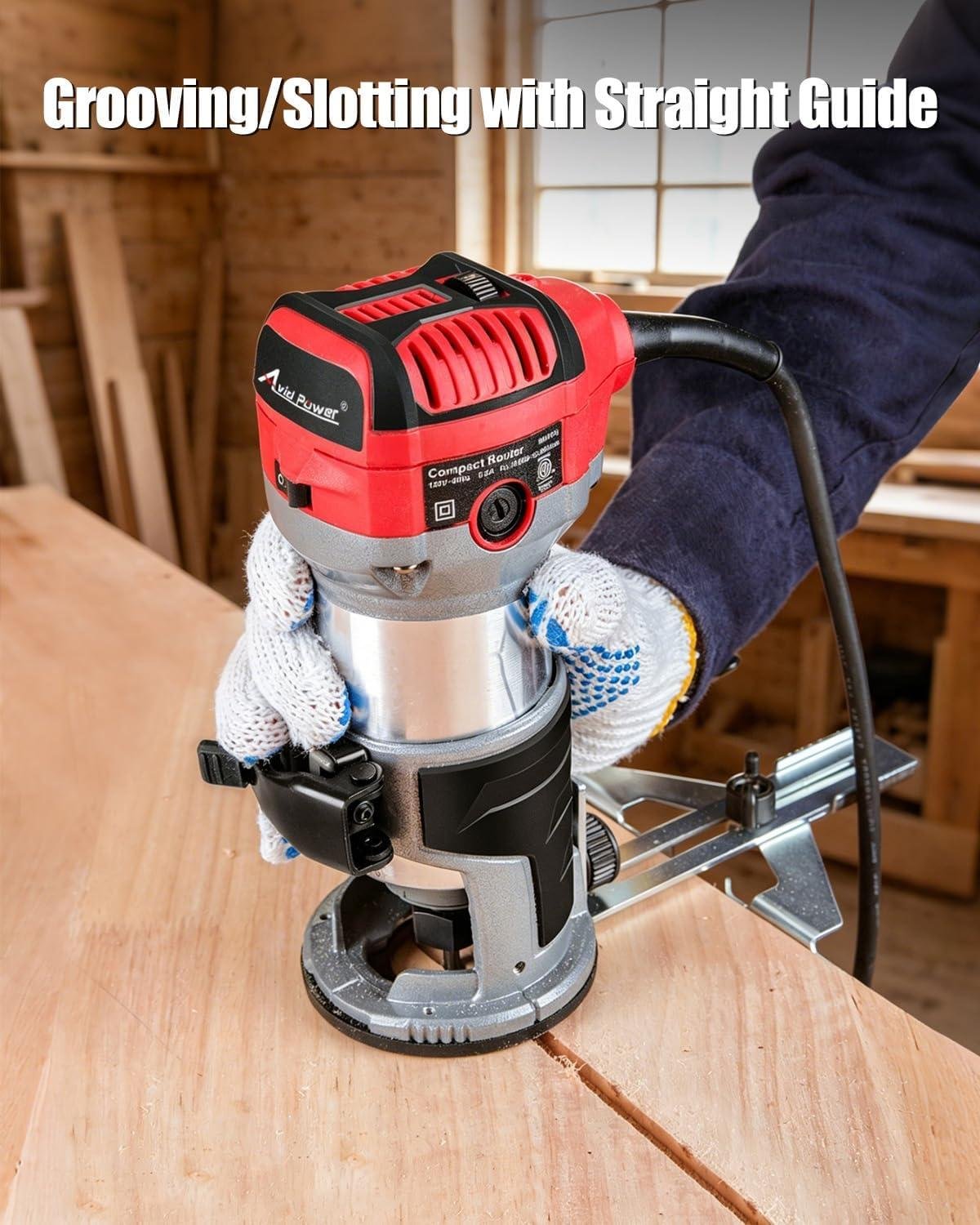
For trim and edge profiling, we appreciate that this AVID POWER compact router brings real shop-friendly control in a small package: the 6.5 Amp / 1.25 HP (800W) motor and 6 variable speeds spanning 10,000-32,000 RPM give us the flexibility to slow down when hardwood wants to scorch and speed up for crisp passes in softwoods or laminate. In our experience, that speed range matters most when we’re doing classic trim tasks-like a light round-over on a shelf edge, a chamfer on face frames, or flushing banding-because we can dial the cut to the bit size and wood density rather than forcing a one-speed tool through everything. The rack-and-pinion depth adjustment and quick-lock system are the kind of features we lean on when we’re sneaking up on a final edge detail in multiple shallow passes (a safer, cleaner approach than trying to hog it all at once). The built-in dual LED lights are also more than a gimmick for trim work-we’re often routing inside cabinets or along a long edge where shadows hide pencil lines, and better visibility helps us keep the base flat and the profile consistent.
We also like that it’s positioned as a ready-to-run trim kit instead of “router only,” which helps newer woodworkers get cutting without immediately shopping for essentials. In customer feedback, the most common themes we see are easy setup/assembly, good value for the included accessories, and generally smooth, controllable handling for light-to-moderate edge work-while also noting that technique still matters (sharp bits, proper feed direction, and shallow passes) to prevent chatter or burning. The included dust hood is a practical add for edge routing because chips otherwise spray right across our line; paired with a shop vac, it can keep the cut visible and reduce cleanup. For trim accuracy, the included guides help: the edge guide supports straight, repeatable offsets for rabbets/grooves near an edge, and the roller guide can steady the tool along gentle curves. As always, we recommend checking collet engagement, keeping the base screws snug, and doing a quick test cut in scrap-especially when switching between the included 1/4″ and 3/8″ collets-because consistent edge work is mostly about repeatability and setup discipline, not brute power.
- Compact router tool (fixed base)
- 5 router bits (e.g., straight, chamfer, round-over profiles)
- Edge guide (for straight, parallel trimming/grooves)
- Roller guide (for curves and guided edge work)
- Dust hood (shop-vac compatible)
- 1/4″ and 3/8″ collets
- Spare carbon brushes
- Wrenches
- 1/4″ shank trim-router bits (round-over, chamfer, flush-trim, cove, ogee)
- 3/8″ shank bits (where available/desired for stiffness)
- Shop vacuum (for use with the included dust hood)
- Aftermarket edge guides/fences (when wider reach or micro-adjust is needed)
- Edge profiling on shelves, tabletops, and face frames (round-over/chamfer)
- Flush trimming veneer/edge banding and laminate
- Hinge mortises and light dado/groove work (multiple passes)
- Template routing for small parts (when paired with the right bit/bearing)
- Oak (reviewers mention hardwood edge shaping; slower speeds help reduce burning)
- Pine (common for shelving/trim; higher speeds can leave clean finishes)
- Softwoods & laminates (frequently mentioned use cases for trimming and finishing passes)
| Spec | AVID POWER Compact Router (This Model) | Why It Matters for Trim/Edge Work |
|---|---|---|
| Motor | 6.5 Amp / 1.25 HP (800W) | Enough power for common edge profiles with sharp bits and shallow passes. |
| Speed Range | 10,000-32,000 RPM (6 speeds) | Lets us reduce burning in hardwoods and tune finish quality by material/bit size. |
| Base Type | Fixed base with rack-and-pinion adjustment | Stable feel for edge runs; easier to “sneak up” on final depth. |
| Visibility | Dual LED lights | Helps track layout lines on long edges and in shadowed corners. |
| Dust Control | Dust hood (shop-vac hookup) | Keeps the cut line clearer and reduces chip blowback on trim passes. |
| Collets | 1/4″ and 3/8″ | More bit options; proper seating is key for smooth, safe routing. |
| Accessory / Bit Type | Included? | Best Use in Trim & Edge Work |
|---|---|---|
| Round-over bit | Yes (one of the 5 bits) | Softening shelf edges, face frames, and small tabletops. |
| Chamfer bit | Yes (one of the 5 bits) | Clean, modern edge breaks; easier than sanding consistent bevels. |
| Straight bit | Yes (one of the 5 bits) | Light dados/grooves near an edge; mortises in multiple passes. |
| Edge guide | Yes | Straight offsets for repeatable trimming lines and grooves. |
| Roller guide | Yes | Stabilizing along curved edges and irregular shapes. |
| Flush-trim bit | No (varies by kit) | Veneer/edge-banding flush-up and laminate trimming. |
| Item | Recommended for Best Results | What You Actually Get (Per Specs) |
|---|---|---|
| Depth approach | Multiple shallow passes for profiles and grooves | Rack-and-pinion adjustment + quick lock supports repeatable step-downs |
| Dust management | Vacuum-assisted routing for visibility and cleanup | Dust hood designed to connect to a shop vac |
| Bit control | Match RPM to bit size/material to reduce burn/chatter | 6 speeds, 10,000-32,000 RPM |
See Full Specifications & Customer Photos
Ease of Use and Setup for Beginners and Experienced Woodworkers
For day-one router users, the AVID POWER feels approachable because it’s built around “open the box and start” basics: a 6.5 Amp / 1.25 HP (800W) motor, 6 variable speeds spanning 10,000-32,000 RPM, and a fixed base with a rack-and-pinion depth system that we can dial in without the fussy trial-and-error some compact routers require. In practical shop use, that depth adjuster matters-beginners can creep up on a dado or hinge mortise in multiple shallow passes, and experienced woodworkers can repeat a setup more consistently once a depth is locked. Reviews commonly highlight that it’s easy to assemble and set up, with several buyers describing it as “ready-to-use” and appreciating that the kit comes with both 1/4″ and 3/8″ collets so we can run common trim-router bits as well as larger-shank bits (within reason for a compact router). The dual LED lights are also a beginner-friendly touch-we can actually see the layout line and bit path when routing inside cabinets or along an edge where overhead light doesn’t reach.
For more experienced routing, setup speed is where this kit earns its keep: the quick-lock system simplifies depth tweaks and bit changes, and the included edge guide and roller guide reduce the amount of shop-made jigs we need for straight grooves and gentle curves. Customer feedback often mentions smooth operation for the price and a generally manageable feel-though, as with most high-RPM handheld routers, we still want to clamp work securely, keep two hands on the rubberized grips, and match speed to material (lower RPM to reduce burning in hardwoods like oak; higher RPM for clean trimming in softwoods and laminates). Dust control is also part of “ease of use” in real life: the included dust hood can hook to a shop vac, which helps keep the cut line visible and reduces cleanup. Our main educational takeaway for both skill levels: start with the straightedge/guide accessories, take light passes, and treat the speed dial as a finish-quality control-those habits make this compact router feel far more predictable.
- Included accessories: 5 router bits (straight/chamfer/round-over styles), edge guide, roller guide, dust hood, 1/4″ collet, 3/8″ collet, spare carbon brushes, wrenches
- Compatible attachments/accessories: standard shop vac (for dust hood connection), common 1/4″ shank trim-router bits, 3/8″ shank bits supported by the included collet, straightedges/clamps for guided routing
- Ideal project types: edge profiling on shelves and tabletops, hinge mortises, straight grooves/dados with the edge guide, laminate/trim work, light pattern or template routing (with proper jigs)
- Wood types tested by customers: soft pine, hardwood oak, laminates (as referenced in product use descriptions and common review use-cases)
| Ease-of-Use Spec | What It Means in Setup | Why We Care in the Shop |
|---|---|---|
| 6.5A / 1.25 HP (800W) | Enough power for trimming and routing with sane pass depth | Less stalling when we slow down for hardwood edges |
| 10,000-32,000 RPM (6 speeds) | Speed matching to bit size/material | Helps reduce burning/tear-out and improves finish quality |
| Rack-and-pinion depth adjust | Dial-in depth more cleanly than “bump-and-tighten” bases | Beginner-friendly for iterative passes; repeatable for pros |
| Dual LED lights | Better visibility during setup and cuts | More confidence following layout lines, especially in shadows |
| Accessory / Bit Type | Supported by Kit? | Notes for Beginners |
|---|---|---|
| 1/4″ shank router bits | Yes (1/4″ collet included) | Most common trim-router standard; easiest to find replacements |
| 3/8″ shank router bits | Yes (3/8″ collet included) | Verify bit length/diameter is appropriate for a compact router and take light passes |
| Edge guide | Yes | Best first “accuracy helper” for straight grooves and offsets |
| Roller guide | Yes | Helps follow curves; still practice on scrap to avoid tipping |
| Setup/Use Category | Recommended for Beginners | What This Router Offers |
|---|---|---|
| Pass depth per cut | Multiple shallow passes | Variable speed + stable fixed base supports controlled step-down cuts |
| Guided cuts | Use guides whenever possible | Edge guide and roller guide included |
| Dust management | Vacuum assist for visibility | Dust hood supports shop-vac hookup |
See Full Specifications & Customer Photos
Customer Reviews Analysis
What Woodworkers Are Saying (Review Analysis)
1. Overall sentiment from woodworking customers
Overall, sentiment trends positive for value and capability, especially from DIYers and hobby woodworkers looking for a compact, budget-friendly router. Several woodworkers mentioned it feels like a strong “starter-to-intermediate” tool that covers common edge work and light-to-moderate routing without the price of premium brands. That said, some users reported challenges with fit/finish consistency and setup/adjustment quirks, which kept a portion of reviews more mixed.
2. Performance feedback (accuracy, power, results)
Power & cut quality
- Common praise includes the router having surprisingly strong power for a compact unit (6.5A / 1.25 HP class), particularly on typical edge profiles and trimming tasks.
- Multiple reviews highlight smooth cutting results when paired with appropriate bits and reasonable passes (not trying to hog out deep material in one go).
- Several woodworkers mentioned the variable speed control helps tune performance-slowing down for larger bits and ramping up for cleaner trims.
Accuracy & control
- Reviewers with more experience level found it capable of clean edge profiling and detail work, with control aided by the compact form factor.
- Some users reported challenges with fine depth adjustments, noting that dialing in micro adjustments can take patience compared with higher-end routers.
3. Build quality and durability observations
- Multiple reviews highlight a generally solid-feeling motor housing and acceptable durability for the price category.
- Some users reported challenges with component refinement (e.g., controls, base hardware, or accessory fitment not feeling “pro-grade”).
- A few reviews noted concerns around long-term durability under heavy use-more as a caution (light/moderate duty recommended) than widespread failure claims.
4. Ease of use for different skill levels
Beginners / DIYers
- Beginners appreciated the straightforward concept and compact handling, especially for edge trimming where a smaller router feels less intimidating.
- Several woodworkers mentioned setup is manageable, but a few DIYers found the depth-setting process takes a couple of test runs to get right.
Experienced woodworkers
- Experienced woodworkers noted the tool is convenient for quick roundovers, chamfers, and trimming, but may not replace a heavier router when precision micro-adjustment or sustained heavy cuts are needed.
- Some users reported challenges with getting repeatable depth settings quickly, especially if frequently changing bits or moving between tasks.
5. Common project types and success stories
Customers successfully used this for typical “trim-router” and compact router tasks, including:
- Edge profiling (roundovers, chamfers) on boards and panels
- Flush trimming laminate/veneer or pattern/template work (when set up carefully)
- Light dado/rabbet work in multiple passes (more mixed-depends on material and expectations)
- General shop projects and furniture touch-ups, where compact control mattered more than raw power
A few reviewers described it as a handy choice for small furniture parts and cabinetry-style edge treatment, where portability and control are key.
6. Issues or limitations reported
Some users reported challenges with the following:
- Depth adjustment / fine tuning: Takes trial cuts; can feel less precise than premium routers.
- Heavy material removal: Not ideal for aggressive cuts-reviewers recommend multiple shallow passes to avoid strain and maintain finish quality.
- Accessory/fitment expectations: While the edge guide/roller guide/dust hood are appreciated, some reviews suggest they can feel basic and may require careful setup to work optimally.
- Dust collection: Mixed-dust hood helps, but some users expected better capture depending on the cut direction and setup.
Quick theme summary (from review patterns)
| Aspect | Common Feedback |
|---|---|
| Overall Value | Common praise includes strong performance for the price; seen as a solid compact-router option for DIY/hobby use |
| Performance | Most praised smooth cuts and adequate power for edging/trim work; multiple shallow passes recommended for heavier cuts |
| Precision | Generally accurate for typical trim tasks; some users reported challenges with fine depth adjustments and repeatability |
| Build Quality | Often described as solid “for the price,” but not premium; some inconsistency or basic-feeling accessories noted |
| Ease of Use | Beginners liked the compact control; a few found setup/adjustments take practice and test cuts |
| Versatility | Variable speed and included guides help; best suited to edging, flush trimming, and light joinery rather than heavy routing |
If you want, paste the actual review text (or a link/export), and I can tighten this into a more evidence-driven summary with a few short, representative quotes (used sparingly) and clearer “most mentioned” vs. “occasionally mentioned” callouts.
Pros & Cons
Pros & Cons
| What We Liked | What We Didn’t |
|---|---|
| Plenty of punch for a compact router (6.5A / 1.25HP) | Not the quietest tool in the shop at higher RPM |
| 6 variable speeds (10,000-32,000 RPM) for matching wood & bit | Dialing in the “perfect” speed still takes a little trial-and-error |
| Rack-and-pinion depth adjustment feels precise and repeatable | Micro-adjustments can feel fussy if we’re rushing setup |
| Dual LEDs make layout lines easier to follow in shadowy corners | Lights help visibility, but they don’t replace a good task light |
| Comfort grip + quick-lock makes mid-project tweaks less annoying | Still a compact router-big profiling passes may need multiple shallow cuts |
| Dust hood + shop-vac hookup keeps the cut line clearer | Dust collection varies depending on bit style and cut direction |
| Ready-to-use kit: 5 bits, edge guide, roller guide, wrenches, spare brushes | Included bits are great to start, but we’d still upgrade for fine finish work |
| Includes both 1/4″ and 3/8″ collets for flexibility | If our projects rely on specialty bit shanks, we’ll still need extras |
Pros
- Strong, compact power: For a handheld fixed-base unit, the 6.5-amp / 1.25 HP motor feels ready for real trimming and edge work, not just “hobby” passes.
- Useful speed range: The 10,000-32,000 RPM spread gives us room to slow down for hardwoods (to help avoid burn marks) and speed up for cleaner results on softer stock and laminates.
- Depth control we can trust: The rack-and-pinion adjustment makes it easier for us to sneak up on a final depth without overshooting and regretting it.
- Built-in visibility boost: The dual LEDs put light right where we want it-on the cut path-especially helpful inside cabinets or along dark edges.
- Comfort-forward handling: The rubberized grip and quick-lock system make the router feel less like a wrestling match during longer sessions.
- Dust management is actually included: The dust hood and vac compatibility help keep our line of sight clearer and cleanup shorter.
- Starter kit is genuinely usable: Bits, guides, collets, spare brushes-this one shows up ready to work, which we appreciate when we want to start a project, not start shopping.
Cons
- Noise rises with RPM: At top speed it can get loud enough that we’re extra grateful for hearing protection.
- Speed selection still needs testing: Even with variable speed, we find ourselves doing the usual scrap-wood “warm-up lap” to land on the cleanest setting.
- Setup can slow us down: Precision depth control is great, but it also means we can spend more time dialing in than we would with a rough-and-ready trim router approach.
- Compact router limits still apply: For aggressive profiles in hardwood, we’re better off taking multiple light passes rather than expecting one bold cut.
- Dust collection isn’t universal: Depending on the bit and cut geometry, some chips still escape-especially on edge work where airflow gets weird.
- Included bits are “good to go,” not “premium”: They’re fine for learning, utility cuts, and rough shaping, but for top-tier finish work we’d likely swap in higher-end bits.
Q&A
Is 6.5A / 1.25 HP actually strong enough for hardwoods like oak or maple?
For a compact fixed-base router, the 800W (1.25 HP) / 6.5-amp motor is plenty for common edge profiles and light-to-medium routing in hardwoods. It’s well-suited to round-overs, chamfers, hinge mortises, dados, and pattern/trim work-as long as you take multiple shallow passes in dense woods like oak and maple. The 6 variable speeds (10,000-32,000 RPM) help: running slower settings reduces burning in hardwoods and gives you more control with larger bits.
How does it do on plywood, veneers, and laminates-will it chip out?
It’s a good match for plywood and laminates because the router can spin fast (up to 32,000 RPM) for cleaner shearing cuts on softer materials and thin skins. The included dual LED lights make it easier to track your layout line and avoid wandering at the edge. Like any router, chip-out is mostly about technique and bit quality: use sharp bits, take light passes, and consider climb-cutting very lightly on the first skim pass when working with fragile veneers (with proper workholding and experience).
Is the setup beginner-friendly, and how precise is the depth adjustment?
Initial setup is straightforward for a fixed-base router: install the bit, set depth, lock it, and go. This model uses a rack-and-pinion depth adjustment system that lets you “dial in” depth more predictably than many basic trim routers, then locks tight to prevent slipping during a cut. The quick-lock system also helps when you need to tweak depth mid-project. Beginners usually do best by practicing on scrap first and sneaking up on final depth in a couple passes rather than trying to hit it in one cut.
Does it take standard bits and accessories, and how easy are bit changes?
Yes-this kit includes both 1/4″ and 3/8″ collets, which covers a lot of common woodworking router bits. Bit changes are typical for handheld routers: you’ll use the included wrenches, loosen the collet, seat the bit properly (don’t bottom it out-back it off slightly), then tighten. The included kit bits (straight, chamfer, round-over, etc.) are fine for getting started, but many woodworkers eventually upgrade to premium bits for smoother cuts and longer edge life-especially in hardwoods or plywood.
Can it handle production work, or is it mainly for hobby projects?
This router is positioned as a cost-effective, compact tool that’s excellent for hobby and homeowner projects and can absolutely handle repeated weekly use. For true production environments (all-day routing, large diameter bits, heavy raised-panel work, or continuous cabinet-shop duty), woodworkers typically step up to heavier, more industrial routers and/or a router table setup for consistency and heat management. That said, the aluminum body/base, included spare carbon brushes, and dust hood show it’s built with real shop use in mind-just keep expectations realistic for a compact, handheld format.
How well does the dust collection work, and do I need a special extractor?
The included dust hood is designed to hook up to a standard shop vac and capture dust close to the bit. In real use, dust collection on handheld routing is always “better than nothing” rather than perfect-especially when edge-routing where chips eject sideways. A typical shop vac is usually adequate; for best results, use a hose that doesn’t fight your movement, and combine it with good PPE and airflow since fine routing dust is hard to catch 100% at the source.
Will this fit a small workshop, and what power outlet does it need?
It’s a compact handheld router, so it stores easily and doesn’t demand dedicated floor space like a router table or shaper. As a corded 6.5-amp tool, it typically runs on a standard household outlet (the same type used for most shop tools in a home garage). For smoother operation, avoid sharing a circuit with dust heaters/compressors when possible, and use a properly rated extension cord if you need one (short and heavy-gauge is best to reduce voltage drop).
What maintenance does it need, and are wear parts included?
Routine maintenance is simple: keep the base and vents clean, periodically check the collet and bit shank for resin buildup, and make sure the depth lock stays snug. Like most brushed routers, carbon brushes are a normal wear item-this kit includes spare carbon brushes, which is a nice touch for long-term ownership. If you notice sparking, power loss, or inconsistent speed, brushes and collet cleanliness are the first things to check before assuming a bigger problem.
Reveal the Extraordinary
The AVID POWER 6.5 Amp (1.25 HP) compact fixed-base router is a capable, ready-to-run kit built around an 800W motor with 6 variable speeds (10,000-32,000 RPM). Standout features include rack-and-pinion depth adjustment, dual LED lights, an aluminum body/base, and a dust hood for shop-vac hookups. The included edge guide, roller guide, and mixed trim bits make it easy to start profiling, trimming, and grooving right out of the box-customer feedback commonly highlights good value, useful accessories, and solid control for typical routing tasks.
It’s ideal for hobby woodworkers with small to medium projects, beginners learning routing fundamentals, and cabinet makers needing clean edge profiles, hinge mortises, and light dadoes.
Consider alternatives if you routinely hog out deep cuts in thick hardwoods, need a plunge base, or rely on a router for daily production-level durability.
Overall, it’s a solid mid-range option for general trim and edge work, with a few limits that matter most to heavy-duty users.
Want to see current pricing and customer photos? View on Amazon & Read More Reviews →