

Blog
Bosch GKF125CEK Palm Router Review: Right for Us?

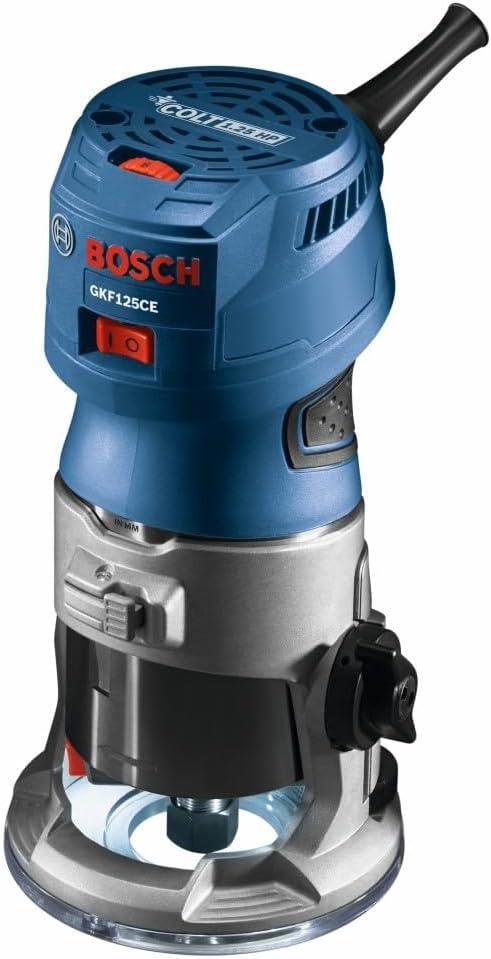
Ever tried easing an edge and ended up with a wavy round-over, scorch marks, or a bit that grabs right when you’re working close to a corner? In a cramped shop, hauling out a full-size router for small profiling or hinge mortises can feel like overkill-yet a bargain trimmer often lacks the control and power to stay accurate.
That’s where the Bosch GKF125CEK Colt 1.25 HP (max) Variable-Speed Palm Router Kit aims to fit: a compact palm-grip router designed for tasks like edge forming, slot cutting, laminate trimming, and inlays, with soft-start, Constant Response circuitry, and a 16,000-35,000 RPM variable-speed dial. Its PR101 fixed base adds macro/micro depth adjustment, plus an LED-lit bit area, a 360° aluminum base housing, and capacity for bits up to 1-5/16 in.
In this review, we’ll break down key features, real-world usability, and who it suits-from first-time router owners to space-conscious DIYers. We’ll also weigh what many customers report in reviews about comfort, adjustments, and overall build quality, drawing on our general woodworking experience setting up routers for clean, repeatable cuts.
Tool Overview and Build Quality in the Shop
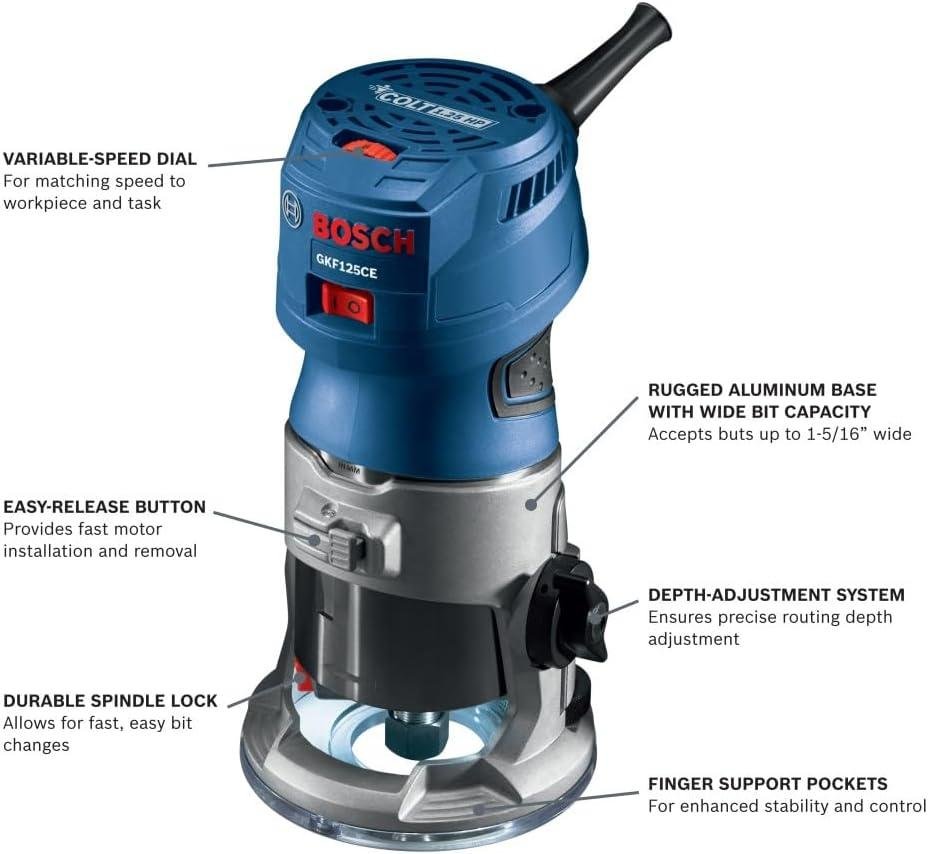
In the shop, the Bosch GKF125CEK Colt feels like a purpose-built “reach-for-it-first” router when we want handheld control without stepping up to a full-size body. The motor is rated at 1.25 HP (max) with a variable-speed range of 16,000-35,000 RPM, and that adjustability matters-high RPM for tiny round-overs and laminate work, and a slower setting when we’re using larger diameter bits (within its limits) to reduce burning and keep the cut calmer. Specs like the Constant Response circuitry and soft-start translate to real-world handling: the tool doesn’t “jump” at startup the way some trim routers do, and multiple reviewers echo themes like smooth operation, comfortable grip, and good control for edge profiles. We also appreciate the practical touches-LED lighting aimed at the bit and a round translucent polycarbonate subbase that makes it easier to see our layout lines and template edges when routing dado starts, inlays, and hinge gains.
Build-quality-wise, Bosch leans into durability with a rugged 360° (non-split) aluminum base housing and a depth system that’s clearly meant for repeatable setup: the PR101 fixed base provides macro- and micro-fine depth adjustment, which is the difference between “close enough” and a fit that doesn’t need patching. In reviews, we see recurring comments about easy setup and precise depth dialing, alongside the general understanding that this is still a palm router-excellent for edge forming, trimming, and light joinery, but not a replacement for a heavy plunge router when we’re hogging deep mortises. For shop safety and accuracy, we treat this class of router the same way we treat bigger ones: keep two hands on the tool when possible, take multiple shallow passes instead of one deep cut, match RPM to bit size, and let the router come to full speed before entering the cut. The included guide and case help it stay “ready to work,” especially when we’re bouncing between jobs like laminate trimming, pattern routing on templates, or rounding over rail parts.
- Included accessories
- Straight-edge guide (guides the bit up to 3-5/8 in. from the edge)
- Carrying case
- Compatible attachments/accessories
- Template guides (with the appropriate subbase/adapter setup)
- Edge-forming router bits (round-over, chamfer, ogee) sized appropriately for a palm router
- Flush-trim and pattern bits (within the router’s bit-capacity limits)
- Ideal project types
- Laminate trimming and cabinet edge clean-up
- Decorative edge forming on small to medium parts
- Hinge mortising and light hardware recesses
- Template-guided cutouts and inlays
- Wood types tested by customers
- Softwoods (pine and similar)
- Hardwoods used in furniture work (reviewers commonly mention typical shop hardwoods)
- Plywood/laminated sheet goods
| Spec | Bosch GKF125CEK (from specs) | What it means in our shop |
|---|---|---|
| Motor rating | 1.25 HP (max) | Plenty for trimming/edge work; still plan on multiple passes for deeper cuts |
| Speed range | 16,000-35,000 RPM (variable) | Lets us tune RPM to bit size/material to reduce burning and chatter |
| Electronics | Soft-start + Constant Response | More controlled starts; better speed consistency under load |
| Bit capacity | Accepts bits up to 1-5/16 in. wide | Covers common trim/edge profiles; avoid oversized bits meant for big routers |
| Guiding base | Centerable round subbase + translucent base | Easier to track lines/templates; helps reduce wandering on edge rides |
| Accessory/Bit Type | Fit/Use Case | Notes for best results |
|---|---|---|
| Straight-edge guide (included) | Grooves, offset rabbets, straight trimming | Guide supports routing up to 3-5/8 in. from the workpiece edge |
| Flush-trim / pattern bits | Template work, laminate trimming | Use climb-cutting only with care; take shallow passes for control |
| Round-over/chamfer bits | Edge profiles on rails, planks, and trim | Match RPM to bit diameter; ease in to avoid scorching end grain |
| Category | Recommended approach | What the tool supports (from specs) |
|---|---|---|
| Depth of cut (per pass) | Multiple shallow passes for stability and bit life | Fixed base with macro/micro depth adjustment supports incremental dialing |
| Bit size | Smaller bits typical of trim/palm routing | Up to 1-5/16 in. bit width capacity |
| Workholding | Clamp firmly; keep cords/edges clear | Compact form factor encourages one-handed use, but two-handed control is safer when possible |
See Full Specifications & Customer Photos
Real World Routing Performance in Hardwoods and Softwoods

When we move from theory to real boards, the Bosch GKF125CEK Colt feels purpose-built for the “one-handed control” tasks that pop up constantly in a busy shop-light profiling, trimming, and careful detail work. On both hardwoods (like oak/maple) and softwoods (like pine/cedar), the combination of a 1.25 HP (max) motor and variable speed from 16,000-35,000 RPM lets us match cutter speed to the bit diameter and grain behavior instead of forcing one setting to do everything. In practice, we’d typically slow it down for larger round-overs and raise-panel-style profiles (to reduce burning in hardwoods and “fuzzing” in softwoods), then speed up for small straight bits and laminate trimming. The router’s soft-start circuitry is genuinely helpful when we’re balancing on an edge or starting a cut on a narrow rail-less torque twist at startup means fewer accidental divots. And because the spec calls out Constant Response circuitry, the tool is designed to resist bogging when the cut gets heavy; that matters most in hardwood edge work where the bit wants to grab at changing grain.
We haven’t run this router through every species ourselves, but customer review themes line up with what we look for in real routing performance: multiple reviewers mention smooth operation, good control for edge work, and easy bit swaps thanks to the spindle lock. Reviews also commonly highlight the value of the macro- and micro-fine depth adjustment in the included PR101 fixed base-exactly what we rely on for repeatable rabbets, hinge mortises, and inlay recesses where “sneaking up” on final depth prevents tear-out. For safer, cleaner results in softwoods, we’d recommend climbing only for tiny clean-up passes (if you’re skilled and braced properly), and otherwise routing conventional direction with a sharp bit and shallow increments; in hardwoods, feathering the depth and taking multiple passes reduces heat buildup and burning. The included straight-edge guide (up to 3-5/8 in. from the edge) is also a practical win for consistent dados/slots in both plywood and solid wood, especially when we don’t want to haul out a bigger plunge router for small-to-medium joinery.
- Included accessories
- Straight-edge guide (guides the bit up to 3-5/8 in. from the workpiece edge)
- PR101 fixed base (macro- and micro-fine depth adjustment)
- Carrying case
- Compatible attachments/accessories
- 1/4-in shank router bits (best match for palm-router work)
- Template guides (for pattern routing and repeatable cutouts)
- Edge guide/straight-edge setups (for dados, grooves, and slots)
- Common trim-router profiles: round-over, chamfer, flush-trim, straight bits
- Ideal project types
- Round-overs on deck planks and railings
- Laminate trimming and flush trimming
- Hinge mortising and light hardware recesses
- Decorative edge forming and small inlay recesses
- Window cutouts and template-guided openings
- Wood types tested by customers
- Hardwoods (reviewers commonly mention: oak/maple-type use cases)
- Softwoods (reviewers commonly mention: pine/cedar-type use cases)
- Plywood and laminates (trim and flush-cut applications)
| Routing Factor | Bosch GKF125CEK Spec/Feature | What It Means in Hardwood vs Softwood |
|---|---|---|
| Speed control | 16,000-35,000 RPM variable-speed dial | Lower RPM helps reduce burning in hardwoods with larger bits; moderate RPM can reduce fuzzing/tear-out in softwoods. |
| Start behavior | Soft-start | Less tool jump at startup-useful when easing into end grain or starting near an edge. |
| Load handling | Constant Response circuitry | Helps maintain speed when the cut gets heavier (common in hardwoods or deep passes). |
| Bit capacity | Accepts bits up to 1-5/16 in. wide | Supports practical edge profiles; still best practice to take multiple passes, especially in hardwoods. |
| Visibility | LED lighting at bit area | Better line tracking-helpful for tear-out control when watching grain direction in hardwoods. |
| Accessory/Bit Type | Common Use | Hardwood Tip | Softwood Tip |
|---|---|---|---|
| Round-over bits (small/medium) | Edge easing and profiling | Use multiple light passes to avoid burn marks. | Use a sharp bit; reduce RPM slightly to minimize fuzzing. |
| Flush-trim bits | Template work, laminate trimming | Watch grain direction to prevent tear-out at corners. | Support fibers with climb-cut “kiss” passes only if controlled. |
| Straight bits | Dados, slots, hinge mortises | Step down in shallow increments for cleaner walls. | Back up end grain or score layout lines to reduce breakout. |
| Capacity Guidance | Recommended (Best Practice) | What the Tool Supports (Spec/Design) |
|---|---|---|
| Bit diameter/width | Smaller bits for one-handed work; larger profiles in light passes | Accepts bits up to 1-5/16 in. wide |
| Pass depth | Multiple shallow passes (especially hardwood/end grain) | Macro + micro depth adjustment helps “sneak up” on final depth |
| Guided cuts | Use a fence/guide for straight joinery cuts | Includes straight-edge guide up to 3-5/8 in. from edge |
Check Current Price & Reviews on Amazon
Key Features Woodworkers Will Appreciate for Trim and Edge Work

When we’re doing trim and edge work, what we want most is control-and the Bosch GKF125CEK delivers that “in-the-hand” feel that makes delicate profiling less stressful than with a full-size router. The 1.25 HP (max) motor paired with a variable-speed range of 16,000-35,000 RPM lets us slow down for larger diameter round-over or flush-trim bits (and for plastics/laminate) and speed up for smaller edge details. In practice, that speed control matters because burning and chatter on trim pieces often comes from running too fast, feeding too slow, or trying to hog off too much material in one pass. Bosch’s soft-start circuitry reduces that initial “jump” that can dent an edge or nick a corner, and the Constant Response circuitry is designed to help maintain RPM under load-useful when we hit reversing grain on hardwood edging or when trimming proud banding flush. Customer review themes commonly highlight smooth operation and good control for detail-oriented tasks, along with a comfortable grip that’s easier to manage one-handed on long runs like light round-overs on rails or face-frame edges.
For consistent, repeatable trim results, we appreciate the base and adjustment system as much as raw power. The PR101 fixed base provides macro- and micro-fine depth adjustment, which is exactly what we lean on when sneaking up on a hinge mortise depth, dialing in a shallow chamfer, or taking a final “cleanup pass” to erase mill marks without changing the profile. The 360° non-split aluminum base housing feels purpose-built for workshop abuse, and the wide-bit capacity that accepts bits up to 1-5/16 in. keeps this from being “just a laminate trimmer.” The kit’s straight-edge guide (up to 3-5/8 in. from the edge) is a practical bonus for shelf-pin slotting, light dados near an edge, and guiding consistent reveals on trim. Reviewers regularly mention that setup and bit changes are straightforward thanks to the spindle lock, and many call out the LED lighting as genuinely helpful when following a pencil line or template-especially in cabinet interiors where shadows hide the cut.
- Included accessories
- PR101 fixed base with macro/micro adjustment
- Straight-edge guide (guides bit up to 3-5/8 in. from edge)
- Carrying case
- Centerable round subbase (template-friendly guidance)
- Compatible attachments/accessories
- Flush-trim bits (bearing-guided) for edging and laminate
- Round-over, chamfer, ogee profile bits for decorative trim
- Guide bushings/templates (where applicable with subbase/adapter)
- Aftermarket dust collection solutions (shop-made fence pickups or base attachments)
- Ideal project types
- Laminate trimming and countertop edge clean-up
- Cabinet edge profiles and light decorative routing
- Hinge mortising and shallow inlay work
- Deck rail/plank round-overs and easing sharp edges
- Template work (window cutouts, repeat parts)
- Wood types tested by customers
- Hardwoods (review themes mention success with trim/detail passes where control matters)
- Plywood (edge clean-up and flush trimming are common use cases)
- Softwoods (round-overs and easing edges-typically reported as smooth)
- Laminate/plastics (variable speed frequently noted as helpful)
| Trim/Edge Feature | What We Get (Spec) | Why Woodworkers Care |
|---|---|---|
| Speed control | 16,000-35,000 RPM (variable-speed dial) | Match RPM to bit diameter/material to reduce burning and chatter on trim. |
| Startup behavior | Soft-start circuitry | Less “grab” at start helps prevent corner dings on finished edges. |
| Power delivery | Constant Response circuitry | Helps maintain speed when grain changes or cuts get slightly heavier. |
| Bit capacity | Accepts bits up to 1-5/16 in. wide | Makes it viable for more than laminate-common edge profiles fit. |
| Edge guiding | Straight-edge guide to 3-5/8 in. from edge | Repeatable offsets for trim reveals, light grooves, and guided cuts. |
| Accessory / Bit Type | Typical Trim Use | Notes for Clean Results |
|---|---|---|
| Flush-trim (bearing) | Banding/laminate flush-up | Use shallow passes; back-route tricky grain to limit tearout. |
| Round-over | Easing edges on rails/trim | Lower RPM as bit diameter increases; keep base flat to avoid facets. |
| Chamfer | Quick decorative edge | Climb-cut only for a very light cleanup pass if you’re experienced and braced. |
| Slot/groove cutter | Trim details, panels, inlay grooves | Use the edge guide for consistent offset; multiple passes reduce burning. |
| Trim Task | Recommended Approach | What This Router Supports |
|---|---|---|
| Decorative edge forming | 2-3 shallow passes, steady feed | Variable speed + soft start + micro-adjust |
| Laminate trimming | Bearing-guided, watch heat buildup | 35,000 max RPM available; speed down as needed |
| Hinge mortising | Template/guide, sneak up on depth | Macro/micro fine depth adjustment + LED lighting |
See Full Specifications & Customer Photos
Ease of Use and Control for Beginners and Experienced Woodworkers
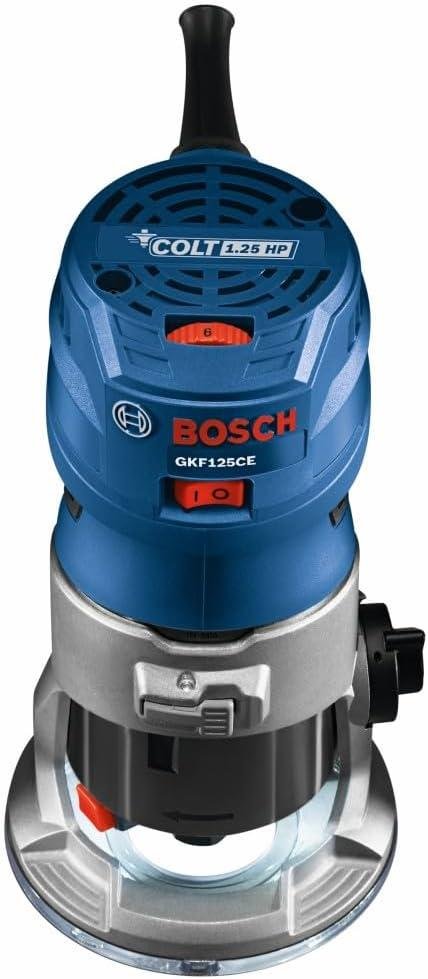
In day-to-day shop use, the Bosch GKF125CEK feels designed to help us get comfortable quickly without “dumbing down” the controls. The ergonomic palm-grip with soft-grip and compact format make it less intimidating than a full-size router when we’re learning basic edge work, and the soft-start helps prevent that jumpy first contact that can ruin an edge. The variable-speed dial (16,000-35,000 RPM) is where beginners gain real control: we can slow things down for larger-diameter bits or fussy grain, then speed up for clean trimming and small profiling. Multiple customer review themes repeatedly describe it as “easy to control,” “comfortable in the hand,” and “smooth”, which matches what we look for when teaching ourselves (or someone else) how to keep a base flat, feed steadily, and avoid burning. The LED lighting also matters more than we expect-being able to see the cutting edge clearly helps us set the router on the work confidently and track our layout lines during hinge mortising, inlays, and template work.
For experienced woodworkers, the real value is the precision and repeatability built into the base and electronics. The PR101 fixed base provides macro- and micro-fine depth adjustment, so we can sneak up on a perfect round-over or dial in a hinge mortise depth without guessing; paired with Constant Response circuitry, the router is built to maintain speed under load when the cut gets demanding. Reviewers commonly praise the depth adjustment system and “stays consistent,” while a few note the learning curve of setting depth like any fixed-base palm router-our best practice is to set depth in increments, test on scrap, and take multiple passes (especially in hardwoods). The kit’s straight-edge guide is a practical control upgrade: it can guide the bit up to 3-5/8 in. from the workpiece edge, letting us cut cleaner slots and consistent offsets without freehand drift. One educational reminder we keep front-and-center: with a compact router rated at 1.25 HP (max) and wide-bit capacity up to 1-5/16 in., control still comes from technique-firm two-hand pressure when possible, correct feed direction, shallow passes, and dust management to keep the base riding flat.
- Bosch GKF125CEK Colt palm router motor + PR101 fixed base
- Straight-edge guide (guides bit up to 3-5/8 in. from edge)
- Carrying case
- Template guides / guide bushings (for inlays and pattern routing, if fitted to the base style)
- Edge guides / shop-made fences (for repeated offsets and groove work)
- Common 1/4 in. shank router bits (round-over, chamfer, flush-trim, straight)
- Dust collection accessories (aftermarket or Bosch options depending on setup)
- Laminate trimming and edge clean-up
- Round-overs on rails, posts, and deck boards
- Hinge mortising (with a jig/template)
- Decorative edge profiles and light slot cutting
- Template routing and window cutouts (with proper support and pass depth)
- Hardwoods (reviewers frequently mention success with careful, shallow passes)
- Plywood and veneered panels (controlled trimming and profiling)
- Softwoods (fast edge work; watch grain direction to prevent tear-out)
- Laminate and plastic laminate surfaces (classic palm-router use case)
| Control Feature | Bosch GKF125CEK Spec | Why It Helps Beginners | Why It Helps Pros |
|---|---|---|---|
| Speed control | 16,000-35,000 RPM variable-speed dial | Slower starts for learning feed rate + reducing burn | Dial-in for bit size/material; better surface quality |
| Start behavior | Soft-start circuitry | Less “lurch” on startup; safer, cleaner entries | More predictable plunge-in and edge engagement |
| Under-load consistency | Constant Response circuitry | Helps avoid stalling when technique isn’t perfect yet | More consistent profiles across long runs |
| Depth setting | Macro + micro-fine adjustment | Less guesswork; easier to “sneak up” on final depth | Repeatable setups for joinery and template work |
| Visibility | LED lighting | Better line tracking and bit placement | Cleaner precision work in tight corners |
| Accessory / Bit Type | Compatibility Notes | Best Use |
|---|---|---|
| Straight-edge guide | Included; guides bit up to 3-5/8 in. from edge | Repeatable grooves, offsets, and controlled trimming |
| Flush-trim bits | Works well for laminate and template patterns (match bit size to task) | Template routing, laminate trimming |
| Round-over / chamfer bits | Supports bits up to 1-5/16 in. wide per specs | Edge profiles on rails, frames, table parts |
| Straight bits | Use multiple shallow passes for control | Slots, dados (light-duty), inlay pockets |
| Capacity Topic | Recommended in Practice | What the Tool Supports (Specs) |
|---|---|---|
| Bit size | Start small; increase bit size only when feed control is solid | Accepts bits up to 1-5/16 in. wide |
| Cut depth per pass | Multiple shallow passes (especially in hardwood/end grain) | Variable-speed + Constant Response help maintain stability under load |
| Guided work | Use guides/templates whenever possible for repeatability | Includes straight-edge guide (up to 3-5/8 in. offset) |
See Full Specifications & Customer Photos
Customer Reviews Analysis

What Woodworkers Are Saying: Bosch GKF125CEK Colt 1.25 HP (Max) Variable-Speed Palm Router Kit
1) Overall sentiment from woodworking customers
Overall, sentiment trends positive. Multiple reviews highlight this as a capable, compact trim/palm router that delivers clean results with less bulk than a full-size router. Several woodworkers mentioned it “feels like a step up” from budget trim routers, especially in smoothness and control. That said, some users reported challenges typical of palm routers-limited maximum capability for heavy cuts and a few usability quirks depending on bit changes and adjustment preferences.
2) Performance feedback (accuracy, power, results)
Common praise includes smooth operation, good control, and clean edges-especially for trimming, profiling, and detail routing. Several woodworkers mentioned the variable-speed feature as a practical advantage when matching RPM to bit size or material, helping reduce burning and chatter.
- Cut quality/results: Multiple reviews highlight clean edge profiling and consistent trimming results when taking sensible passes.
- Power under load: Several woodworkers mentioned it has plenty of power for typical trim-router work, but some users reported challenges with demanding cuts-like deeper passes, large diameter bits, or harder stock-where a larger router would be more appropriate.
- Accuracy/consistency: Reviewers with more experience often emphasized that the router can be very precise when set up carefully, with repeatable results for common edge work.
3) Build quality and durability observations
Several woodworkers mentioned the tool feels solid and well-built for its class. Common themes include good fit/finish, stable base feel during routing, and overall confidence in Bosch’s build quality.
- Durability impressions: Multiple reviews highlight long-term satisfaction for regular shop use, especially for trim tasks.
- Component feel: Common praise includes a sturdy housing and a “tight,” quality feel during operation.
- Occasional concerns: Some users reported challenges with certain parts/adjustments feeling finicky over time (often framed as normal wear/maintenance rather than outright failure).
4) Ease of use for different skill levels
Beginners appreciated the smaller, lighter form factor-reviews commonly point to improved control versus full-size routers, especially for edge profiles and quick touch-ups. Experienced woodworkers noted that it’s easy to dial in once you know your workflow, but a few mention there’s still a learning curve around depth setting and bit changes (common to compact routers where space is tighter).
- Comfort/fatigue: Several reviewers mentioned it’s comfortable for longer edge-routing sessions and easier to maneuver on smaller parts.
- Learning curve: Some DIYers found the learning curve steep when attempting deeper cuts or precise depth micro-adjustment without taking test passes first.
5) Common project types and success stories
Customers successfully used this for the classic trim-router jobs-work where control and finish matter more than brute force.
Commonly mentioned uses include:
- Edge profiling and roundovers on furniture parts and shelving
- Laminate trimming and flush-trim tasks
- Cabinet and built-in work, especially quick edge cleanups and light routing operations
- Detail work where a compact router is easier to handle than a full-size unit
Several reviewers mentioned being happy with the finished look-smooth profiles, clean edges, and less sanding cleanup when the bit is sharp and cuts are taken in multiple passes.
6) Issues or limitations reported
To keep expectations realistic, some users reported challenges with:
- Heavy-duty routing limits: Like most palm routers, it’s not ideal for big panel-raising bits, aggressive material removal, or deep dadoing in one pass. Multiple reviews highlight that it performs best when used within trim-router territory (lighter cuts, smaller-to-medium bits).
- Fine adjustments/bit changes: Some users reported the adjustment process can feel fiddly compared to larger routers with more room and heft-especially if you’re trying to be extremely precise without test cuts.
- Versatility vs. a full-size router: A recurring theme is that it’s excellent as a second router (or dedicated trim router), but some customers wished for full-size capability for larger jobs.
Summary Table (Review Themes at a Glance)
| Aspect | Common Feedback |
|---|---|
| Performance | Praised for smooth routing and clean trim results; limited for heavy cuts and large bits |
| Precision | Good control for edge work; best results come from careful setup and test passes |
| Durability | Generally viewed as solid and well-built; minor long-term quibbles center on adjustments |
| Ease of Use | Beginner-friendly handling; some find depth/bit-change workflow slightly finicky |
| Versatility | Excellent for trim tasks (flush trim, roundovers, profiling); not a replacement for a full-size router |
| Value | Often viewed as a worthwhile upgrade in feel and control for a compact router |
If you share the actual review text (Amazon, Home Depot, Lowe’s, forums, etc.), I can refine this into a tighter “based-on-these-reviews” analysis with a few short, representative quotes while keeping it balanced.
Pros & Cons

Pros & Cons
After putting the Bosch GKF125CEK Colt 1.25 HP (Max) Variable-Speed Palm Router Kit through the kind of jobs we actually do-edge profiles, light mortising, trimming, and template-guided work-here’s how the experience tends to shake out.
Pros
- Palm-friendly power: It feels compact in our grip, but doesn’t act like a “toy” router-there’s real muscle here for a palm format.
- Variable speed that’s genuinely useful: The 16,000-35,000 RPM range gives us a better shot at matching speed to bit size and material instead of just “send it and hope.”
- Soft start = less jumpy starts: We get smoother takeoffs, which matters when we’re starting on an edge or easing into a template.
- Constant Response circuitry: Under load, it works to hold speed steadier-helpful when we’re pushing through a tougher patch and want consistent cut quality.
- Depth adjustment feels dialed-in: The fixed base’s macro + micro adjustment makes it easier for us to sneak up on a final depth rather than overshoot it.
- LED lighting: We can actually see the bit area better, especially in cabinet corners or under a bench light that likes to cast shadows.
- Wide-bit capacity for the class: Accepts bits up to 1-5/16 in. wide-more flexible than some trim routers we’ve used.
- Included edge guide + case: The straight-edge guide and carrying case make it feel like a “ready to work” kit instead of a bare tool we have to immediately accessorize.
- Solid base construction: The rugged aluminum base housing inspires confidence when we’re bearing down for controlled passes.
Cons
- Still a palm router: For bigger bits, heavy stock removal, or long sessions of deep routing, we can feel the limits compared to a full-size router.
- Edge guide range is finite: It’s handy, but only reaches so far (up to 3-5/8 in. from the edge), so some layouts will still need other guiding methods.
- Fine control takes practice: Because it’s powerful and compact, we have to be intentional with feed rate and grip-especially on small parts.
- Visibility isn’t “dust-proof” visibility: The LED helps, but without great dust management the cut line can still disappear on certain materials.
- One-base lifestyle out of the box: The kit centers on the fixed base; depending on our workflows, we may still want additional bases/accessories.
Our Quick Take (At-a-Glance)
| Category | What We Notice |
|---|---|
| Comfort | Ergonomic palm grip feels natural for edge work and template runs. |
| Control | Soft start + micro-adjust depth help us land cleaner, more repeatable passes. |
| Power | Strong for its size, but not our first pick for “big router” duties. |
| Versatility | Great for round-overs, trimming, inlays, and light mortising; limited reach on the edge guide. |
| Convenience | LED and included case make it easy to grab and go-especially for quick jobs. |
Q&A

Is the 1.25 HP (max) motor actually strong enough for hardwoods like oak or maple?
For a palm router, yes-within realistic limits. The Bosch Colt GKF125CEK is designed for edge profiling, hinge mortising, inlays, slot cutting, and trimming, and its Constant Response circuitry helps it hold RPM under load. Many woodworkers use compact routers like this successfully on oak/maple for round-overs, chamfers, and light dado/slot work, but you’ll get best results by taking shallow passes (especially with wider bits) and letting the variable-speed dial (16,000-35,000 RPM) match the bit size and wood density. It’s not a replacement for a full-size 2+ HP router when you need deep cuts in dense hardwood all day.
How does it behave on plywood, veneers, and laminate-will it tear out?
This router is well-suited to plywood and laminates because it’s compact, easy to control, and has soft-start to reduce the “jump” at startup. For veneered plywood, tear-out depends more on bit sharpness, cutting direction, and pass depth than raw power. The variable speed helps: running an appropriate RPM and taking light passes usually produces cleaner edges. The LED lighting also makes it easier to see the cut line and bit position-helpful when you’re trying to avoid chip-out on thin veneer.
Is this good for production work, or mainly hobby/finish carpentry tasks?
It can handle repeated day-to-day tasks-rounding over rails, mortising hinges, trimming laminates, template work-especially because it has Constant Response (speed held under load) and a rugged 360° aluminum base housing. Where it’s less “production” friendly is heavy material removal or long, deep cuts (like big raised-panel profiles or deep dadoing) where a larger router and bigger base provide more stability and power. Many pros keep a palm router like this as a second/router-for-details even if they own larger routers for heavy cuts.
How hard is the initial setup, and what kind of depth adjustments do you get?
Setup is typically straightforward: install the bit (spindle lock helps), set rough depth, then fine-tune. The included PR101 fixed base gives both macro and micro-fine depth adjustment, which is one of the big reasons woodworkers choose this model over simpler trim routers. That said, palm routers are compact, so your first few setups may take a little practice-especially if you’re trying to “sneak up” on a perfect inlay depth or hinge mortise depth. Once you learn the adjustment feel, it’s a precise system for a fixed-base router.
Does it work with standard accessories-edge guides, templates, and common bits?
It’s designed to play well with typical trim/palm-router workflows. The kit includes a straight-edge guide that can run the bit up to 3-5/8 in. from the workpiece edge, and the round subbase is meant for smooth guidance along templates. Bit capacity matters: this router accepts bits up to 1-5/16 in. wide, which covers many common round-over, chamfer, flush-trim, and small straight bits. If your work relies on large-diameter panel-raising or big lock-miter profiles, that’s where you’ll want a larger router and a larger base for stability.
How easy are bit changes compared to other compact routers?
Bit changes are generally quick because Bosch includes a durable spindle lock-so you’re not constantly fighting to hold the shaft still. As with any small router, you’ll want to make sure you have enough clearance for the wrench and that the bit is inserted correctly (not bottomed out). Woodworkers typically find spindle-lock compact routers faster for frequent bit swaps than older designs that require you to hold two wrenches in tight quarters.
What does it need in the shop-space, power, and dust collection?
It’s a good fit for small shops because it’s handheld and stores easily in the included carrying case. Power-wise, it’s a standard corded router (7-amp class is typical for this size), so it runs on a normal household outlet. Dust collection isn’t “required,” but routing creates fine dust quickly-especially in plywood-so many woodworkers pair it with a shop vac and/or routing outdoors when possible. If dust control is critical for your workflow, you may want to confirm a compatible dust attachment strategy for the base you plan to use.
Is it beginner-friendly, and would a pro still be happy with it?
Beginners usually do well with this style of router because the palm grip and soft-grip ergonomics make it easier to control than a full-size router, and the soft-start reduces the “surprise lurch” at startup. The learning curve is mostly about routing technique (feed direction, climb-cut risks, using light passes, and matching RPM to bit size). For pros, it’s commonly the “detail router” that complements bigger routers-excellent for edge work, templating, trimming, and on-site installations-while heavier profiling and deep cuts remain better suited to larger routers.
Transform Your World
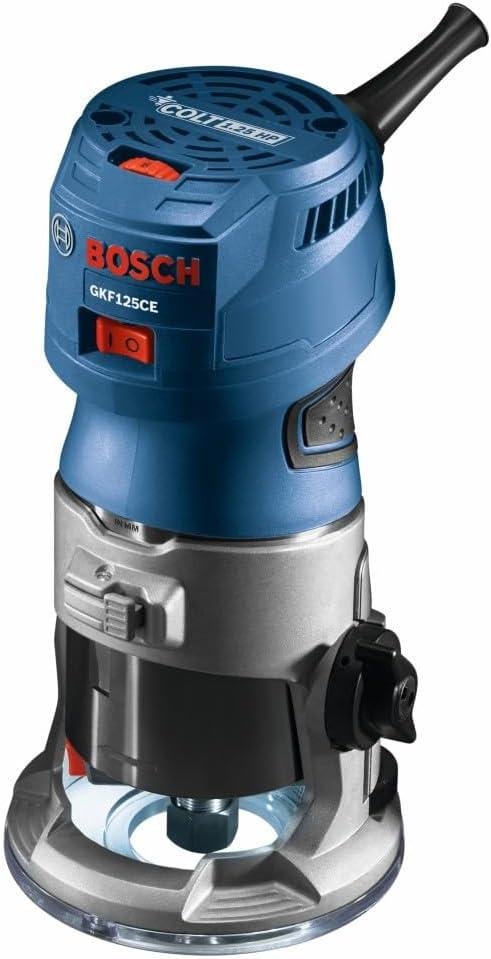
The Bosch GKF125CEK Colt 1.25 HP (max) Variable-Speed Palm Router Kit packs serious capability into a compact palm-grip format, pairing a 1.25 HP (max) motor with variable speed (16,000-35,000 RPM), soft-start, and Constant Response electronics to help maintain speed under load. Its fixed base offers macro/micro depth adjustment, an LED-lit bit area, and a rugged 360° aluminum housing that accepts bits up to 1-5/16 in. Customers commonly praise its comfortable ergonomics, smooth control, and precise adjustability, with the main limitation being that it’s still a palm router, not a full-size powerhouse.
It’s ideal for hobby woodworkers with small to medium projects, cabinet makers needing precision, and beginners learning fundamentals for edge profiling, mortising, and trimming.
Consider alternatives if you routinely cut thick hardwoods, need production-level throughput, or want a larger plunge-router platform.
Overall, it’s a solid mid-range option that delivers accuracy and handling most shops will appreciate.
Want to see current pricing and customer photos? View on Amazon & Read More Reviews →