

Blog
DEWALT DWE43116 Angle Grinder Review: Right for Us?


Ever tried flattening a glue line or cleaning up a stubborn knot only to watch your sander bog down, throw dust everywhere, and leave you chasing low spots across a big panel? In a tight shop, we often reach for one tool that can do fast shaping, speedy metal prep for hardware, or aggressive stock removal—without eating up bench space or our budget.
That’s where the DEWALT Angle Grinder Tool DWE43116 comes in.It’s a 4-1/2″ to 6″ high-performance hand grinder built around a 13-amp motor,rated at 9,000 RPM,and designed with DEWALT’s Dust Ejection System to help protect the internals from debris pulled through the vents. At 5.7 lbs,it aims to balance power with control,and it ships with multiple Type 27 guards (4.5″, 5″, and 6″) plus a side handle and flanges.
In this review, we’ll cover key features, real-world ergonomics, durability expectations, and who this grinder fits—especially for woodworkers learning the angle-grinder learning curve. We’ll also reference what customers consistently report in reviews. Our perspective comes from general shop experience choosing tools that prioritize accuracy, safety, and value.
Tool Overview and Build Quality for the Woodshop

In our woodshop, the DEWALT DWE43116 reads less like a “metal shop” grinder and more like a rough-shaping utility tool we can pull off the shelf when sanding drums, flap discs, or carving wheels make more sense than a hand plane.It’s driven by a 13-amp motor with a 9,000 RPM rating,which is a useful reminder for woodworkers: on an angle grinder,RPM is fixed and aggressive,so control comes from the accessory choice and a light touch—not from dialing speed down (there’s no variable-speed control here). The body feels stout without being brick-heavy at a listed 5.7 lbs, and the trigger switch grip style gives us “feathering” control in the first couple seconds of contact—important when we’re blending an edge or knocking down proud joinery without digging a trench. DEWALT’s Dust Ejection System is also a practical feature in a woodworking habitat, where fine sanding dust is everywhere; it’s designed to push debris out of the intake path to help protect the motor (still, we’d treat this as added insurance, not a replacement for good cleanup and smart positioning).
Build-quality wise, the kit is setup-friendly and workshop-minded: we get multiple guard sizes for different wheel diameters, and the included side handle is a must for two-handed control when shaping wood (customers frequently echo themes like “plenty of power,” “solid feel,” and “runs smooth”, with some also noting the typical tradeoffs—noise and vibration—that come with a high-RPM grinder). For woodworking use, we’d emphasize technique and safety: keep the guard installed, use wheels rated above tool RPM, and avoid forcing the cut—let the abrasive do the work to reduce burning and gouging, especially on softer species. This grinder doesn’t include dust collection, so we plan for dust at the source (shop vac nearby, downdraft table when possible, and a respirator), and we treat grinder accessories like “power carving tools” with real bite. If our work includes sculpted edges, live-edge flattening cleanup, or quick rust/paint removal on hardware for reclaimed furniture, the DWE43116’s power-to-weight balance makes it a capable shop companion.
- Included accessories
- (1) Side handle
- (1) Inner and outer flange
- (1) 4.5 in. Type 27 guard
- (1) 5 in. Type 27 guard
- (1) 6 in. Type 27 guard
- Compatible attachments/accessories (common woodshop use)
- Flap sanding discs (4-1/2″ to 5″)
- Fibre sanding discs with backing pad
- Non-woven surface conditioning discs
- Carving wheels (wood-rated, RPM-rated appropriately)
- Wire wheels/cups (for hardware, not wood shaping)
- Ideal project types
- Live-edge cleanup and blending (light shaping)
- Chair and stool sculpting (with carving/sanding accessories)
- reclaimed wood prep (removing embedded grime/finish carefully)
- Hardware restoration for furniture builds
- wood types tested by customers
- Not consistently specified in available review themes (most feedback focuses on power, smoothness, and durability rather than species)
| Spec | DEWALT DWE43116 (from specs) | why it matters in a woodshop |
|---|---|---|
| Motor | 13 amp | More torque helps sanding/carving accessories maintain speed under load (less stalling). |
| No-load speed | 9,000 RPM | Fast material removal; demands careful handling to avoid gouges and burning. |
| Wheel capacity | 4-1/2″ to 6″ (guards included) | Supports common sanding and surface-prep discs; larger wheels can cover area faster. |
| Weight | 5.7 lbs | Manageable for short shaping sessions; still heavy enough to feel planted. |
| Dust management | Dust Ejection System | Helps protect internals from fine dust (but not a substitute for dust collection). |
| Accessory Type | common size Range | Best Woodshop Use | Notes |
|---|---|---|---|
| Flap disc | 4-1/2″–5″ | Edge rounding, smoothing sculpted parts | Choose grit based on control; coarse grits remove wood very fast. |
| Fibre disc + backing pad | 4-1/2″–5″ | Flattening small high spots, surface blending | Keep moving to avoid heat marks. |
| Surface conditioning disc | 4-1/2″–5″ | Finish stripping, light blending without deep scratches | Frequently enough more forgiving than hard abrasives. |
| Carving wheel | 4″–5″ | Power carving and shaping | Use only wood-rated wheels with RPM rating ≥ 9,000. |
| capacity Consideration | Recommended (woodworking best practice) | Actual Tool Capability (from specs) |
|---|---|---|
| Material removal per pass | Light passes; avoid forcing | High power (13 amp) + 9,000 RPM can remove material quickly if pushed |
| Duty cycle for shaping | Short bursts; let tool cool; clean dust often | Dust Ejection System helps with debris, but heat/dust are still factors |
| dust strategy | Respirator + localized cleanup | No dust port; relies on Dust Ejection System for internal protection |
See Full Specifications & Customer Photos
Real World Performance for Shaping Edges and Removing Material

For shaping edges and honest, no-nonsense material removal in the shop, the DEWALT DWE43116 brings the kind of muscle we usually reserve for “this piece needs to change now” moments. with a 13-amp motor spinning up to 9,000 RPM, it’s well-suited for aggressive work like flattening proud epoxy fills, knocking down a stubborn proud knot stabilization patch, or dressing a welded shop jig before it gets anywhere near a board. In our woodworking workflow, an angle grinder isn’t a precision joinery tool—it’s a fast shaping tool—and the DWE43116’s power and 5.7 lb weight hit a practical balance: substantial enough to feel planted on a flap disc, but not so heavy that it becomes a chore for quick rounding and beveling jobs on non-furniture parts (think: shop fixtures, metal legs, or concrete/stone top accessories). Many customer review themes echo that feel—people frequently mention strong power and solid build,while a common reminder is that grinders are inherently loud and can feel intense if you’re new to two-handed control.
Where this model becomes more woodshop-friendly than some bargain grinders is in its durability-minded airflow: the Dust Ejection System is designed to push debris out of the intake area, and reviewers frequently enough describe it as “holding up well” in dusty environments—useful when we’re doing messy work like sanding cured finishes with abrasive wheels (done carefully), shaping resin/wood hybrids, or cleaning up reclaimed lumber hardware scars (after pulling nails). Setup is straightforward—DEWALT includes multiple guards so we can match the wheel size and style to the job, and customer feedback commonly praises the easy setup and agreeable grip once the side handle is positioned. Educationally, the big takeaway we’d stress is technique: let the RPM do the work, keep the disc moving to avoid heat checks or gouges, and treat this like a “remove quickly, refine later” tool—follow up with a sander, rasp, or plane if the surface will be seen. Because an angle grinder can remove stock alarmingly fast, especially at 9,000 RPM, we consider eye/ear protection and disciplined workholding non-negotiable.
- Included accessories
- (1) side handle
- (1) Inner and outer flange
- (1) 4.5 in. Type 27 guard
- (1) 5 in.type 27 guard
- (1) 6 in. Type 27 guard
- Compatible attachments/accessories
- Type 27 grinding wheels (4-1/2 in., 5 in., up to 6 in. with proper guard)
- Flap discs (for blending and controlled shaping)
- Fiber sanding discs with backing pad (for fast leveling)
- Wire wheels/cups (for hardware cleanup and rust/paint removal on jigs)
- Ideal project types
- Shop jigs and fixtures (metal brackets, angle iron, carts)
- Reclaimed lumber prep (removing embedded grime/finish remnants carefully)
- Epoxy/resin flattening and edge blending (with appropriate abrasives and dust control)
- Outdoor builds with metal components (benches, table bases, gate hardware)
- Wood types tested by customers
- Not consistently specified in reviews (most feedback is general-purpose use across materials)
| Spec | DEWALT DWE43116 (from listing) | What it means in our shop |
|---|---|---|
| Motor | 13 amps | Plenty of torque for aggressive abrasives (flap discs/fiber discs) |
| no-load speed | 9,000 RPM | Fast stock removal; demands disciplined control to avoid gouging |
| Weight | 5.7 lbs | Feels stable for grinding; can fatigue arms on long sessions |
| Wheel size range | 4-1/2 in. to 6 in. (guards included) | Flexibility for different grinding/sanding wheel diameters |
| Accessory Type | Typical use (Woodshop) | Notes |
|---|---|---|
| Flap disc (grit range) | Edge beveling, blending patches, shaping non-show surfaces | Start coarser, then step up grits; keep moving to prevent burn |
| Fiber disc + backing pad | Fast leveling of fills/epoxy and rough flattening | Very aggressive—practice on scrap first |
| Grinding wheel (Type 27) | Metal removal (jigs, bases, brackets) | use the correct guard size for the wheel diameter |
| Wire cup/wheel | cleaning hardware, removing rust/paint on shop components | Throws debris—eye/face protection is critical |
| Capacity Consideration | Recommended (Practical) | Actual (Tool/Spec) |
|---|---|---|
| Material removal per pass | Light passes, controlled pressure | High removal potential due to 13A + 9,000 RPM |
| Session length (comfort) | Short bursts with breaks | 5.7 lb body can fatigue users during extended grinding |
| Dust management | Use external dust control/respirator | Dust Ejection System helps tool durability,not jobsite dust capture |
See Full Specifications & Customer Photos
Key Features Woodworkers Will Appreciate for Control and Safety

For control, what stands out in our woodworking workflow is the combination of a trigger switch (easy to feather on and off when we’re easing into a cut) and a side handle for two-handed guidance—both big deals when we’re using flap discs to break edges on shop jigs or cleaning up welds on a workbench base. On paper, the tool is built for authoritative starts and steady pressure: a 13-amp motor spinning at a 9,000 RPM rating gives us enough headroom that we’re less tempted to “lean on it” (which is where grinders get grabby and unsafe around wood). The 5.7 lb weight also hits a practical middle ground—substantial enough to feel planted, but still manageable when we’re working at odd angles or doing short bursts during fitting and assembly. In customer review themes, we frequently see praise for power and solid feel, with users describing it as “strong” and “works great” for demanding grinding tasks, which translates well to woodshop scenarios like hardware modification, sharpening shop-made scrapers with abrasive accessories, or dressing a tool rest.
For safety, woodworkers should pay attention to guarding and dust management, and this model checks two important boxes. DEWALT includes multiple guards so we can match the guard to the wheel size rather than running “naked” (a common shortcut that isn’t worth the risk), and the Dust Ejection system is designed to help keep abrasive debris from building up inside the motor through the air intake vents—useful in a shop where sanding dust is unavoidable.That said, we still need to treat an angle grinder as a metalwork-first tool and be deliberate if we bring it near wood: use the correct accessory, keep the guard between us and the wheel, and avoid aggressive cutting that can scorch resinous species or catch end grain.Reviewers frequently enough mention straightforward setup/handling and dependable performance, but regardless of experience level, we recommend rehearsing the motion with the tool unplugged, then starting at a shallow angle and letting 9,000 RPM do the work—our control improves and kickback risk drops.
- Included accessories
- (1) Side handle
- (1) Inner and outer flange
- (1) 5 in. Type 27 guard
- (1) 4.5 in. Type 27 guard
- (1) 6 in.Type 27 guard
- Compatible attachments/accessories
- Type 27 grinding wheels (4-1/2 in. to 6 in.)
- Flap sanding discs (match diameter/guard)
- Wire cup and wire wheel brushes (match guard/clearance)
- Non-woven surface conditioning discs (e.g., Scotch-Brite-style)
- Ideal project types
- Modifying steel hardware (brackets, bolts, threaded rod) for jigs/fixtures
- Cleaning welds on shop stands, bases, and carts
- Edge-breaking and deburring metal components before assembly
- Rust/paint removal on shop tools and vises
- wood types tested by customers
- Not consistently specified in review themes for this model (most feedback centers on general grinding/cutting performance rather than species)
| Spec | DEWALT DWE43116 | Why it matters in a woodshop |
|---|---|---|
| Motor | 13 amps | More reserve power; less stalling when dressing metal parts for jigs |
| No-load speed | 9,000 RPM | Fast material removal; requires light pressure to avoid overheating/scorching |
| Weight | 5.7 lbs | Stable feel for controlled passes; still workable for short overhead tasks |
| Wheel compatibility (per description) | 4-1/2 in. to 6 in. | Lets us choose smaller wheels for tighter spaces and larger for faster stock removal |
| Dust handling | Dust Ejection System | Helps reduce internal buildup from abrasive debris common in mixed-material shops |
| Accessory Type | Typical Use | fit/Safety Note |
|---|---|---|
| Type 27 grinding wheel | Grinding welds, beveling metal | Use the matching Type 27 guard size |
| Flap disc | Blending, smoothing metal edges | Start shallow; let RPM do the work to reduce chatter |
| Wire cup/wheel | Rust/paint removal | Wear full face protection; wire shedding is common |
| Surface conditioning disc | Light cleanup and finishing on metal | Lower pressure improves control and reduces gouging |
| Capacity Item | Recommended (Practical) | Actual (From Description) |
|---|---|---|
| Wheel/guard pairing | Always match wheel diameter to the correct guard | 4.5 in.,5 in., and 6 in.type 27 guards included |
| Use around wood dust | Use dust control/PPE; keep sparks away from sawdust piles | Dust Ejection System helps internal durability but does not replace shop dust safety |
See Full Specifications & Customer Photos
Ease of Use for Beginners and Experienced Woodworkers
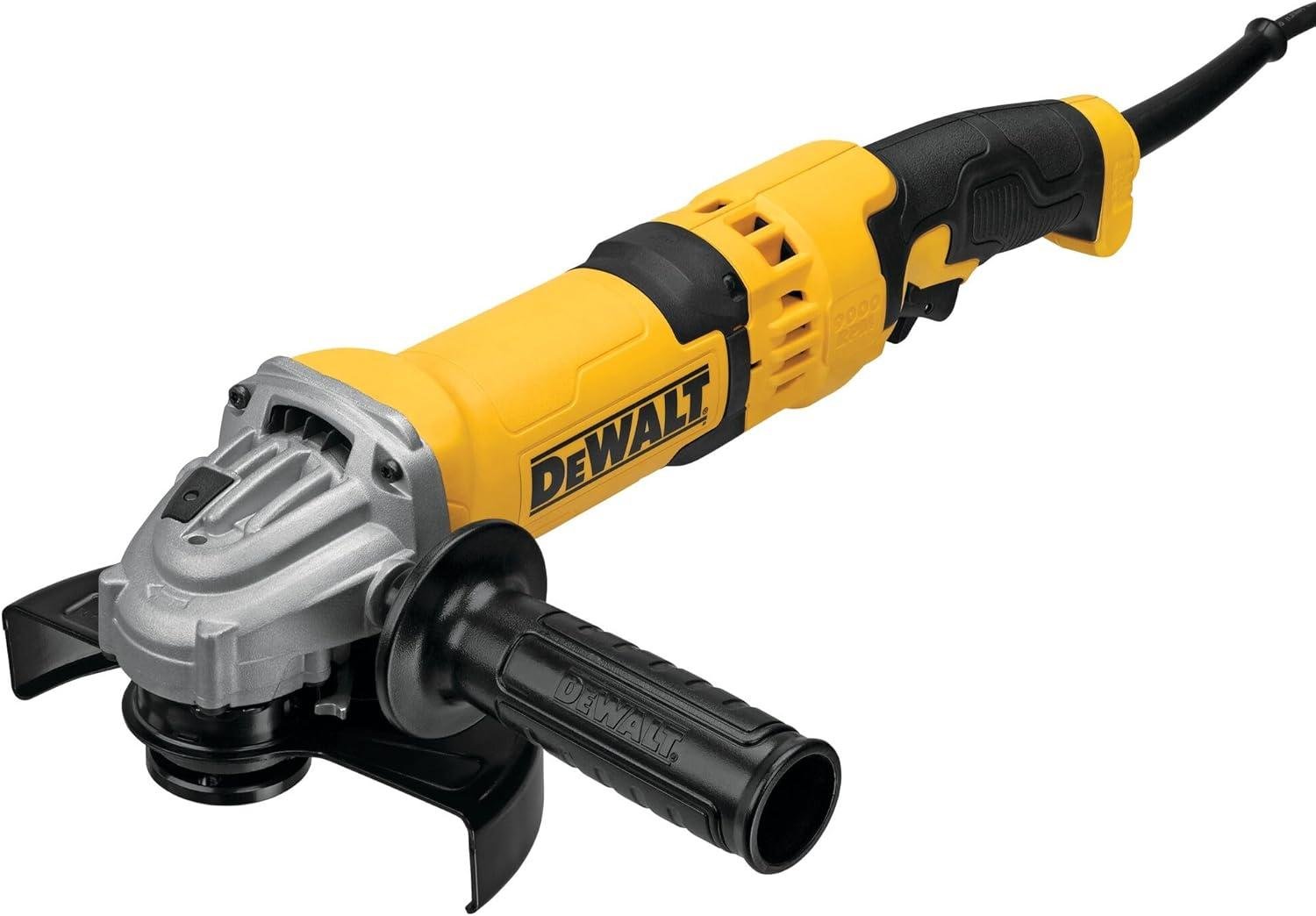
For beginners, the DEWALT DWE43116 feels approachable because there isn’t much “assembly” beyond installing the guard and handle, then mounting the right disc for the job. Out of the box, we get a 13-amp motor with a 9,000 RPM rating and a relatively manageable 5.7 lb weight—enough power for shaping and cleanup tasks without feeling like a bulky demolition tool in our hands. In practical woodworking terms, that power means we can use it for things like flushing proud tenons with a flap disc, easing sharp edges on shop jigs, or cleaning up epoxy squeeze-out on metal clamps (with the correct accessory). Customer feedback commonly circles around “plenty of power” and “solid,smooth operation,” while some also note that angle grinders are inherently “loud” and can feel aggressive until we learn to let the disc do the work.The tool’s Dust Ejection System is also a beginner-friendly feature—not a substitute for a dust shroud, but it’s designed to help keep internal grit from shortening tool life when we’re sanding, grinding, or cutting in a messy shop environment.
For experienced woodworkers, the DWE43116’s real ease-of-use advantage is how quickly we can adapt it to different tasks: the included multi-size guards support 4-1/2 in. to 6 in.Type 27 wheels, and the trigger grip gives us more nuanced control when feathering a bevel or refining a shape. Reviews often emphasize that it “handles heavy work well,” which matters when we’re doing repeated passes on hardware, shop-made fixtures, or timber framing cleanup—while still being light enough to maneuver. That said, precision work with an angle grinder is always technique-driven: we’ll get cleaner results by keeping the grinder moving, working at a shallow angle with flap discs, and using two hands (side handle installed) to reduce the chance of gouging. Safety and maintenance are part of the learning curve for all skill levels—eye/ear protection, a face shield, and careful disc selection are non-negotiable, and we should periodically check flanges/guards for tightness and inspect cords and discs for damage before each session.
- Included accessories
- (1) Side handle
- (1) Inner and outer flange
- (1) 5 in. Type 27 guard
- (1) 4.5 in. Type 27 guard
- (1) 6 in. Type 27 guard
- (1) Grinder
- Compatible attachments/accessories (commonly used for woodworking-adjacent tasks)
- Flap sanding discs (for edge easing and shaping)
- Fiber discs + backing pad (for controlled surface prep)
- Cut-off wheels (for bolts, brackets, and hardware trimming)
- Wire wheels/cups (for rust/paint removal on metal fixtures)
- Dust shroud (recommended if doing frequent sanding/grinding in-shop)
- Ideal project types
- Shop jig and fixture cleanup (edge easing, corner rounding)
- Hardware fitting and trimming (bolts, brackets, angle iron)
- Timber framing cleanup (select shaping tasks with appropriate abrasives)
- Refinishing prep on metal components (stands, vises, clamps)
- Wood types tested by customers
- Not consistently specified in customer reviews (most feedback focuses on power, handling, and durability rather than species)
| Spec | DEWALT DWE43116 | What it means in our shop |
|---|---|---|
| Motor | 13 amps | More headroom for sustained grinding/cutoff tasks |
| No-load speed | 9,000 RPM | Fast stock removal; requires a light touch on wood-related shaping |
| Weight | 5.7 lbs | Manageable for two-handed control during shaping and cleanup |
| Wheel/guard support | 4.5 in, 5 in, 6 in (Type 27 guards included) | Flexible disc sizing for different access and cut depth needs |
| Dust management (tool) | Dust Ejection System | Helps protect internals; not a replacement for dust extraction |
| Accessory Type | Typical Use | Fit Note |
|---|---|---|
| Flap disc | Sanding/shaping edges and contours | Match disc diameter to installed guard (4.5–6 in) |
| Cut-off wheel | Trimming bolts, brackets, metal stock | Use the correct guard and wheel rating for 9,000 RPM |
| Wire cup/wheel | Cleaning rust/paint from metal | Expect more vibration; maintain firm two-hand control |
| Fiber disc + backing pad | Surface prep with more control | Choose compatible backing pad size for the disc |
| Dust shroud (aftermarket) | Reducing airborne dust during grinding/sanding | Highly recommended for in-shop sanding work |
| Task | Recommended Approach | Actual Tool Capability (based on specs) |
|---|---|---|
| Edge easing / shaping | Flap disc, shallow angle, constant motion | Well-suited due to 13A power and 5.7 lb handling |
| Hardware trimming | Cut-off wheel, correct Type 27 guard, secure clamping | Well-suited with 9,000 RPM and multi-guard support |
| Fine joinery fitting | prefer hand tools or small sanders for precision | Possible but not ideal; grinder is inherently aggressive |
See Full Specifications & Customer Photos
Customer Reviews Analysis

what Woodworkers Are Saying: DEWALT Angle Grinder Tool (DWE43116)
1. Overall sentiment from woodworking customers
woodworking-leaning reviewers tend to view the DWE43116 as a strong, professional-feeling grinder that’s especially useful as a “shop support tool” (surface prep, shaping, quick material removal) rather than a precision woodworking machine. Several woodworkers mentioned they trust DEWALT for consistent power and day-to-day reliability, and common praise includes solid performance under load and a confident, controlled feel with the trigger switch.
Having mentioned that, some users reported challenges with expectations—particularly if they were hoping it would behave like a purpose-built sander or a dust-free solution for indoor woodworking.
2. Performance feedback (accuracy, power, results)
Power & cutting/grinding results:
Multiple reviews highlight strong power for its size class, with users noting it keeps speed up when leaning into the work. Woodworkers commonly framed this as a benefit for aggressive stock removal—things like knocking down welds on jigs/stands, shaping metal hardware, or removing heavy coatings.
Sanding & surface prep:
Several woodworkers mentioned using flap discs or sanding attachments for fast surface prep (e.g., stripping finishes or smoothing outdoor lumber), and common praise includes quick results and efficient material removal. However, reviewers also cautioned that an angle grinder can be “too aggressive” for fine woodworking surfaces—great for roughing and prep, less ideal for final finish sanding where swirl marks or gouging can happen if technique isn’t controlled.
Precision & control:
Woodworking customers who care about finesse tended to focus on controllability: the trigger switch was frequently enough viewed as helpful for starting/stopping quickly and maintaining control during short bursts. Some users reported that precision depends heavily on accessory choice (flap disc vs. grinding wheel) and practice, rather than on the tool itself being “precision-focused.”
3. build quality and durability observations
construction & longevity:
Several woodworkers mentioned the tool feels rugged and “jobsite-grade.” Multiple reviews highlight confidence in the motor and housing, suggesting it’s built for repeated use rather than occasional hobby tasks.
Wear items & real-world durability:
Some users reported that longevity depends heavily on how dusty the work environment is and how hard the grinder is pushed for extended sessions (continuous heavy grinding generates heat and accelerates wear). A few reviewers noted that grinders are inherently hard on consumables (discs) and can be hard on the operator if used for long sessions without breaks.
4. Ease of use for different skill levels
Beginners / DIY woodworkers:
Beginners appreciated the straightforward “grab-and-go” nature—mount a disc, clamp the work, and it’s ready. That said, some diyers found the learning curve steep when using it on wood: controlling bite, preventing chatter, and avoiding accidental divots takes practice. for newcomers, several reviews implicitly recommend starting on scrap and using less aggressive abrasives (like flap discs) before attempting visible surfaces.
Experienced woodworkers / shop users:
Reviewers with more experience found it a practical complement to other tools—especially for tasks where speed matters more than ultra-fine accuracy. Experienced users also emphasized safe handling habits and accessory selection as the key to consistent outcomes.
Comfort & fatigue:
Multiple reviews highlight that grinders can be tiring during long sessions (vibration, grip fatigue, sustained noise). Several users appreciated having a trigger-style switch for quick shutoff and better control,especially when repositioning.
5. Common project types and success stories
While this is not a traditional “wood-only” tool, customers successfully used this for a range of shop and woodworking-adjacent tasks, including:
- Finish/coating removal and surface prep: Several reviewers mentioned stripping paint/rust or cleaning up surfaces where a sander would be slow.
- Outdoor projects: Some users described using it for heavy prep work on weathered lumber (where speed matters and a perfect finish is less critical).
- Hardware and shop fabrication: Multiple reviews highlight using it to cut/grind metal parts used in woodworking (brackets, bolts, tool stands, jigs).
- Shaping and quick beveling: A few woodworkers described using abrasive wheels for fast edge shaping—often followed by refined sanding with other tools.
When woodworkers called it a “success,” it was usually as it saved time on rough prep and let them move faster to the next step (planing, sanding, or finishing with more precise tools).
6. Issues or limitations reported
Some users reported challenges that are especially relevant in woodworking settings:
- Dust control limitations: Woodworking customers frequently care about clean indoor air; several reviewers noted that grinders can generate a lot of airborne dust, especially when used on finishes or wood—frequently enough more than typical sanders.
- Not a finish-sanding tool: Common feedback is that it’s easy to remove too much material too quickly. Some users reported swirl marks or gouges when trying to “sand like a random orbit sander.”
- Noise and fatigue: Multiple reviews highlight that extended use can be loud and physically demanding.
- Accessory-dependent experience: Results vary widely by wheel/disc choice; some users reported frustration until they found the right attachment for their task.
| Aspect | Common Feedback |
|---|---|
| Overall Sentiment | Mostly positive as a rugged, powerful “support tool” for the shop; not a replacement for precision sanding tools |
| Performance | praised for strong power under load and fast material removal; can be too aggressive for fine surfaces |
| Precision | Control improves with experience and disc choice; trigger switch seen as helpful for controlled starts/stops |
| Durability | Frequently enough described as solid/jobsite-grade; longevity tied to dust exposure and heavy continuous use |
| Ease of use | Beginner-friendly setup, but technique takes practice—especially on wood to avoid gouging/swirl marks |
| Project fit | Surface prep, coating removal, outdoor lumber prep, and metal hardware fabrication for shop projects |
| Limitations | Dusty, loud, and tiring for long sessions; not ideal for finish-ready sanding without follow-up tools |
If you want, paste in the specific review text or star-review bullets you have, and I’ll re-write this section anchored to those exact woodworking phrases/project mentions (with a few short, representative quotes).
Pros & Cons

Pros & Cons
After putting the DEWALT DWE43116 through the kind of real-world cutting and grinding we actually do,here’s where it shines—and where it asks us to compromise.
Pros
- strong, steady power: The 13-amp motor feels confident under load, especially when we’re leaning into tougher material.
- Dust ejection that actually matters: The Dust Ejection System is the kind of feature we appreciate most after a long, gritty day—less dust hanging around where it can cause trouble.
- Versatile guard options in the box: We like that it includes 4.5″, 5″, and 6″ Type 27 guards, making it easier to match the setup to the job without extra shopping.
- Trigger grip control: The trigger switch gives us a more “tool-in-hand” feel—nice for feathering starts and staying intentional through a cut.
- Comfortably portable: At about 5.7 lbs, it doesn’t feel like a brick in our bag or our hand.
- Solid speed for common tasks: The 9,000 RPM rating lands in a practical zone for general grinding and cutting where control matters.
- Starter kit essentials included: We get the side handle plus inner/outer flanges,which keeps setup straightforward.
Cons
- Not the highest RPM in the category: If we’re looking for maximum speed for certain applications, 9,000 RPM may feel a touch conservative.
- Trigger preference is personal: Some of us love a trigger; others prefer a slider for certain overhead or extended-use situations. It’s a “fit” thing.
- Guards add options—but also choices: Having three guards is great, but it also means we have more parts to keep track of (and more chances to pick the wrong one when we’re in a hurry).
- Weight can still add up over time: While 5.7 lbs is reasonable, we still feel it during longer sessions—especially when working above shoulder height.
At-a-Glance
| What We Noticed | Why It Matters to Us |
|---|---|
| 13-amp motor | More confidence when the workpiece fights back |
| Dust Ejection System | Better durability for messy, dusty jobs |
| 4.5″ / 5″ / 6″ Type 27 guards included | Flexible setups without buying extras instantly |
| Trigger switch | Control-focused handling (but not everyone’s favorite) |
| 5.7 lbs + 9,000 RPM | A practical balance of portability and control |
Q&A

Is this powerful enough for hardwoods like oak or maple (for shaping/carving,not cutting joinery)?
For woodworking uses that make sense for an angle grinder—like rough shaping,carving,aggressive stock removal with a carving wheel,or smoothing with flap discs—the 13‑amp motor and 9,000 RPM rating provide plenty of power,even on dense hardwoods like oak and maple. Where it’s not ideal is precision work like joinery or clean, controlled trimming on a line; an angle grinder removes material fast and can gouge hardwood quickly if you linger in one spot.
What wood types can this handle effectively?
This grinder can be used on softwoods, hardwoods, reclaimed lumber, and even epoxy/wood combinations—provided that you’re using the correct accessory (wood carving wheel, flap disc, sanding disc, etc.). It’s commonly chosen for rough sculpting, live-edge cleanup, and contour shaping where you don’t need furniture-grade precision. For thin veneers or delicate surfaces, it’s usually too aggressive unless you’re extremely careful and using a fine sanding setup.
How does it perform on plywood and veneers?
Plywood and veneer are the “high-risk” materials for an angle grinder.The tool’s 9,000 RPM and fast material removal can tear face plies,chip edges,and overheat glue lines. If you must use it, a fine flap disc or sanding disc with light pressure is the safer route, and you’ll want to treat it like rough prep work only—then finish with an orbital sander for consistent, swirl-free results.
Does it work with standard accessories, and what disc sizes fit?
Yes—this model is designed around the common 4-1/2″ to 6″ grinder format and includes Type 27 guards in 4.5″, 5″, and 6″ sizes plus inner/outer flanges. That means it’s set up for widely available wheels/discs in those sizes (matching the guard). For woodworking, many users pair grinders like this with flap sanding discs, fiber discs (with the right backing pad), or specialty carving wheels—just make sure the accessory is rated for at least 9,000 RPM and is intended for the material you’re shaping.
How difficult is the initial setup and changing guards/discs?
Initial setup is typically straightforward: attach the side handle, install the correct Type 27 guard for the disc size you plan to run, and mount the disc using the included flanges. Disc changes are the standard grinder process (lock the spindle and swap the wheel/flanges). The main “setup” learning curve for woodworkers is choosing the right guard/disc combination and getting used to how quickly a grinder can remove wood compared to sanders or carving tools.
Will this fit a small workshop, and can it be mounted to a bench?
It’s handheld and relatively light at 5.7 lbs, so it stores easily and doesn’t require floor space like stationary tools. It isn’t designed to be permanently mounted like a bench grinder; however, many woodworkers use a vise, clamps, or a carving stand to secure the workpiece instead (which is usually safer than trying to “turn it into” a fixed machine). If you do any jigging, focus on stabilizing the work—not the grinder.
Do I need special dust collection for woodworking use?
Plan on serious dust control. While DEWALT’s Dust Ejection system helps protect the tool by ejecting dust/debris from the air intake, it’s not a dust collector for your shop. Grinding or sanding wood—especially reclaimed wood or epoxy—can create very fine airborne dust. A shop vac with a hood/shroud (if your accessory supports it), a good respirator, and strong ventilation are highly recommended for indoor woodworking.
Is this suitable for beginners, or is the learning curve steep?
Beginner-friendly in terms of basic operation, but it demands respect. A 13‑amp grinder at 9,000 RPM can remove wood extremely fast and can cause deep gouges (or kickback) if the disc catches an edge. Beginners generally do best using it for rough shaping on larger pieces, practicing on scrap first, and avoiding delicate furniture parts until they’ve learned tool control. Many experienced woodworkers keep a grinder like this as a “material removal” tool, not a precision tool.
Unleash Your True Potential
Tool Summary: The DEWALT DWE43116 is a high-performance angle grinder built around a 13‑amp motor, a 9,000 RPM rating, and compatibility from 4‑1/2″ to 5″ wheels (with included Type 27 guards up to 6″).At 5.7 lbs, it balances power with manageable weight, and DEWALT’s Dust Ejection System is a standout for keeping abrasive dust from shortening tool life. Customer feedback commonly highlights strong cutting/grinding power, dependable durability, and the control of the trigger switch, with some noting it can feel bulky for tight, detailed work.
Best For: Designed for professionals requiring daily durability, and ideal for hobby woodworkers with small to medium projects who need a grinder for sharpening, rust removal, hardware trimming, or cleanup.
Consider Alternatives If: Small shop owners prefer a more compact design, or if you primarily work with thick hardwoods and want a higher-RPM specialty tool for finer control.
Final Assessment: The DWE43116 delivers solid power and dust-focused durability, with a few size/weight tradeoffs—making it a dependable shop companion rather than a precision-detail tool.
Want to see current pricing and customer photos? View on Amazon & Read More Reviews →