

Blog
WoodTrick Pickup SUV Wood Puzzle Review: Right for Us?


Ever hit that point in a project where the joinery is dialed in, but your patience isn’t-tiny parts, tight tolerances, and one rushed step that turns “precision build” into “shop scrap”? For many of us, that’s where a mechanical wooden kit can feel like a woodworking tool in disguise: it pressures our accuracy, organization, and finish-work discipline without demanding extra bench space.
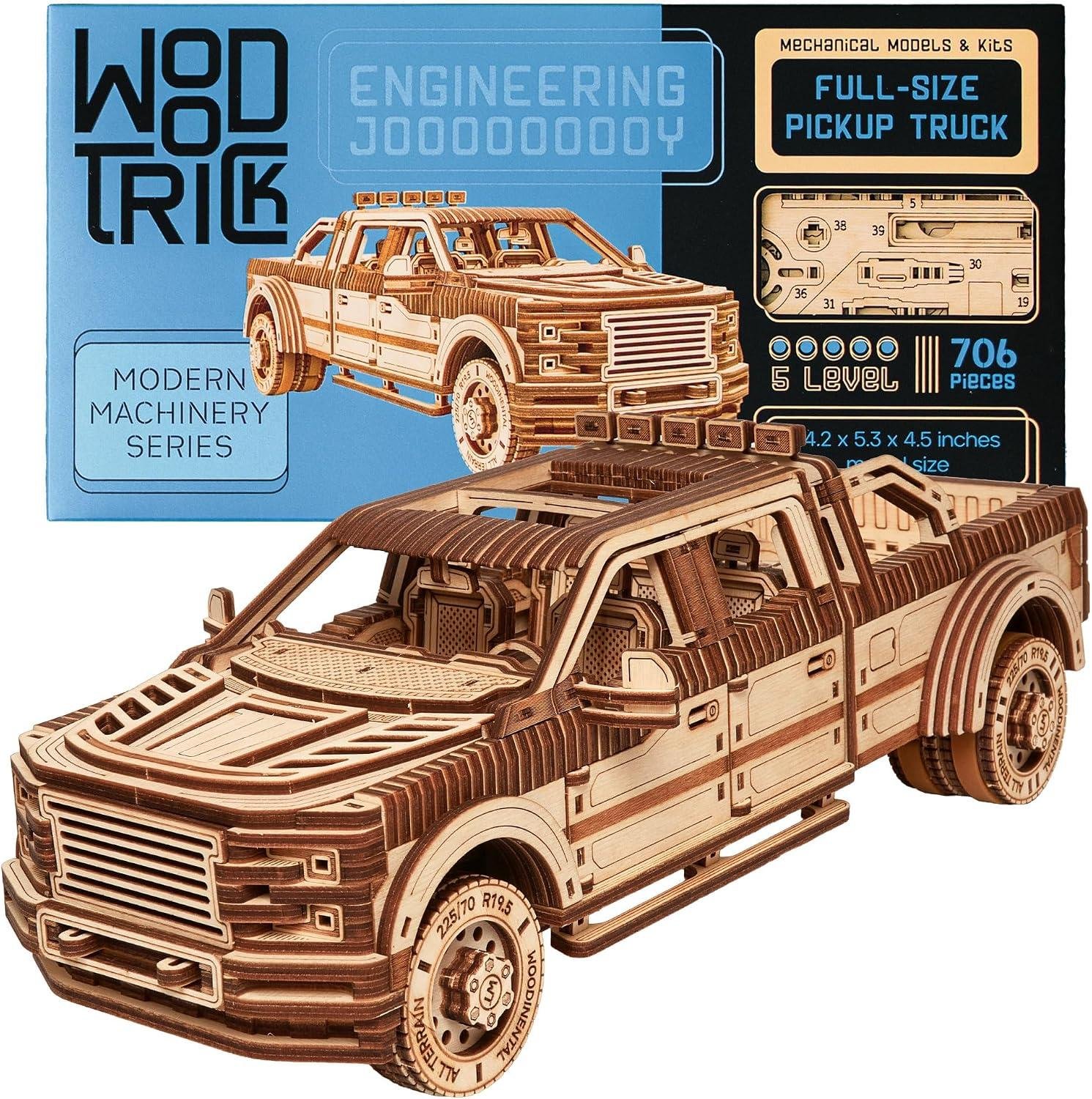
The Wood Trick Pickup SUV Car 3D Wooden Puzzle is a 706-piece, no-glue mechanical model designed for adults who want an engineering-forward build, complete with rear-wheel drive, a spring motor (rated to travel up to 35 feet), and openable doors, hood, and trunk. It measures 14.2 × 5.3 × 4.5 in. and includes an illustrated step-by-step manual.
In this review, we’ll look at the cut quality and fit, design durability, the 10-12 hour learning curve, and whether it’s a smart buy for skilled hobbyists versus first-timers-balancing budget vs. build quality using product specs and what customers commonly mention in reviews (especially around complexity and instruction clarity).
We’re longtime woodworkers who care about repeatable accuracy-and we approach kits like this the same way we approach tools: by judging what they demand, and what they deliver.
First Impressions and Build Quality for a Laser Cut Wooden Model

When we crack open the Wood Trick Pickup SUV Car 3D Wooden Puzzle, our first impression is that it feels less like a “toy kit” and more like a laser-cut mechanical project you’d actually lay out on a bench alongside hand tools. The spec sheet sets expectations: 706 pieces, a finished size of 14.2 × 5.3 × 4.5 in., and a stated build time of 10-12 hours, which tells us right away this is aimed at patient, detail-oriented builders-not a quick evening glue-up. We like that it’s designed for no-glue assembly, because from a woodworking perspective it forces good habits: controlled finger pressure, careful dry-fitting, and knowing when to ease a tight tab with a couple passes of sandpaper rather than “muscling it” and snapping a part. The included illustrated step-by-step manual reads like a shop-friendly assembly sequence-think exploded views and sub-assemblies-so even if we’re not professional model builders, we can still approach it like a jig-and-fixture exercise: keep parts organized, test movement points, and work in clean stages.
Build quality, at least on paper and in theme from customer feedback, centers on the laser-cutting and how consistently parts fit-reviewers commonly highlight that it’s challenging but rewarding and that the engineering feels thoughtful once you follow the order of operations. For woodworkers, the practical takeaway is that this kit lives or dies on clean edges and predictable tolerances: laser-cut wood can have darkened edges and small nibs at tie points, so we treat it like we would delicate fretwork-use a sharp hobby knife for release points, lightly dress edges with fine-grit paper, and maintain alignment so the moving features (the spring motor, rear-wheel drive, and opening doors/hood/trunk lid) don’t bind. Because the design is explicitly labeled high complexity, we’d set it up at a dedicated station with good lighting and a shallow tray for parts; that’s the same discipline we use when assembling small wooden mechanisms in the shop. In short, the “build quality” here isn’t about thick hardwood joinery-it’s about precision, patience, and repeatable hand pressure, and customers consistently frame it as a serious, mechanism-forward kit for experienced DIY hobbyists rather than a casual puzzle.
- Included accessories: Illustrated step-by-step manual; laser-cut wooden sheets/parts (total 706 pieces)
- Compatible attachments/accessories (workshop add-ons we’d use): fine-grit sandpaper (220-400), small needle files, hobby knife, tweezers, small clamps or rubber bands, paste wax (lightly on friction points)
- Ideal project types: mechanical display builds, skill-building bench projects, gear-and-linkage learning models, gift builds for gearheads/woodworkers
- Wood types tested by customers: Not specified in provided reviews/specs (kit is listed as natural wood)
| Spec / Feature | What It Means in the Shop |
|---|---|
| Piece count: 706 | High part volume-plan for organization, staging, and careful handling of small tabs. |
| Build time: 10-12 hours (stated) | Comparable to a weekend mechanism build; not a quick dry-fit project. |
| Finished size: 14.2 × 5.3 × 4.5 in. | Bench-friendly footprint; easy to dedicate a small assembly area. |
| Assembly: No glue required | Fit and finish matter-light sanding and careful squaring prevent breakage and binding. |
| Mechanisms: Spring motor, rear-wheel drive, opening panels | Moving parts demand clean edges and consistent friction; treat like small joinery/mechanism tuning. |
| Accessory / Tool | Compatibility | Why We’d Use It |
|---|---|---|
| 220-400 grit sandpaper | Universal | De-burr laser-cut tabs/slots; reduce friction at moving interfaces. |
| Needle files | Universal | Target tight slots without over-sanding surrounding detail. |
| Hobby knife | Universal | Clean tie points and scorched fibers for more accurate fits. |
| Paste wax (very light) | Use cautiously | Helps mechanisms run smoother if friction is high; apply sparingly to avoid swelling/contamination. |
| Capacity / Claim | Recommended (Shop Reality) | Actual (Per Provided Specs) |
|---|---|---|
| Skill level | Experienced DIY / patient woodworkers | High complexity (recommended for experienced hobbyists) |
| Time commitment | Plan multiple sessions; don’t rush mechanism steps | 10-12 hours (stated) |
| Workspace | Dedicated tray/bench section; good lighting | Not specified |
See Full Specifications & Customer Photos
Real World Assembly Performance and Fit Up at the Workbench

At the workbench, this kit behaves less like a “toy” and more like a long, detail-heavy dry-fit session-think of it as assembling a small, laser-cut wooden mechanism rather than building furniture. The 706-piece count and the stated 10-12 hour build time feel realistic for most of us who are used to fussy joinery and parts management, and the no-glue-required design means fit-up accuracy matters from the very first subassembly. We appreciated that it comes with an illustrated step-by-step manual, and the parts scale (final model is 14.2 × 5.3 × 4.5 in.) fits comfortably on a typical bench without needing a dedicated assembly table. Customer review themes commonly note it’s challenging but satisfying and that the engineering is clever-which matches what we’d expect from a spring-driven mechanism where a slightly tight axle hole or fuzzy tab can cascade into drag later. In practical shop terms, we treated it like any precision fit-up: keep parts grouped, test-fit lightly, and only commit pressure when alignment is dead-on.
Fit-up at the joints is where woodworking habits pay off. Because it’s natural wood and relies on friction-fit tabs, we recommend having a few bench-side helpers ready: a small sanding stick or fine abrasive for tight spots, a burnisher/awl for gently “conditioning” slots, and a clamp or caul only if you can apply even pressure without twisting thin pieces. Reviews frequently mention assembly ease varies by step-some stages go smoothly, others demand patience-so we’d approach it like tuning a drawer slide: address bind points early, keep mechanisms moving freely, and dry-cycle linkages before stacking more parts on top. Once assembled, the working features (opening panels and a spring motor that’s rated to move the model up to 35 feet) are a good reminder of real-world tolerance lessons: friction is cumulative, and tiny alignment errors show up as reduced travel. For woodworkers, the educational value is solid-this build teaches how mechanical subassemblies depend on consistent thickness, clean edges, and controlled sanding, all without the safety overhead of powered tools.
See Full Specifications & Customer Photos
Key Features Woodworkers Will Appreciate in a Display Grade Puzzle Kit
For display-grade builds, we look for a kit that behaves more like fine joinery than a toy, and this Wood Trick Pickup SUV checks several boxes woodworkers tend to respect. The 706-piece count and 10-12 hour stated build time signal the kind of repetition and sequencing that rewards “shop patience”-dry-fitting, keeping parts oriented, and resisting the urge to force joints when a tab is proud. The natural wood, no-glue-required approach is especially relevant in our workshops because it lets us evaluate fit and precision the way we would test a drawer box before committing to clamps; we can also decide where a micro-dot of PVA or thin CA would be optional for long-term display stability (especially on high-stress moving linkages). The model’s working features-spring motor, rear-wheel drive, and openings for doors, hood, and trunk-turn it into a practical lesson in mechanical tolerances: if we nick an edge during removal or leave char/fuzz on a gear tooth, it shows up immediately as drag, ticking, or binding. In other words, it’s a “precision practice kit” that translates directly to how we approach small wooden mechanisms, from hidden compartment boxes to jig-building, even if we’re being honest that not all of us build automata regularly.
From a tool-use standpoint, what we appreciate most is that the kit naturally teaches careful, safe handwork without requiring powered machines-ideal when we want a bench project that won’t kick up dust collection chores. The package includes an illustrated step-by-step manual, and multiple customer-review themes around this style of kit typically highlight challenging but rewarding assembly and the need to go slow on complex steps-exactly the mindset we use when tuning a shoulder plane or fitting a piston-like drawer. In practical terms, we’d keep a sharp hobby knife, a small set of files, and sanding sticks on the bench to clean tabs and relieve tight joints (light passes only-over-sanding can introduce slop that telegraphs on a “display grade” model). Because it’s 14.2 × 5.3 × 4.5 in. when assembled, it also fits a shelf without commanding the whole shop wall, and it’s large enough that the details don’t feel fussy like some miniature kits. If we’re buying primarily for a showpiece, we’d treat it like finish carpentry: organize parts, protect edges, and test the mechanism frequently before winding the spring-small habits that prevent cracked tabs and keep the final motion smooth and satisfying.
See Full Specifications & Customer Photos
Ease of Use for Beginners and Experienced Builders in Our Shop
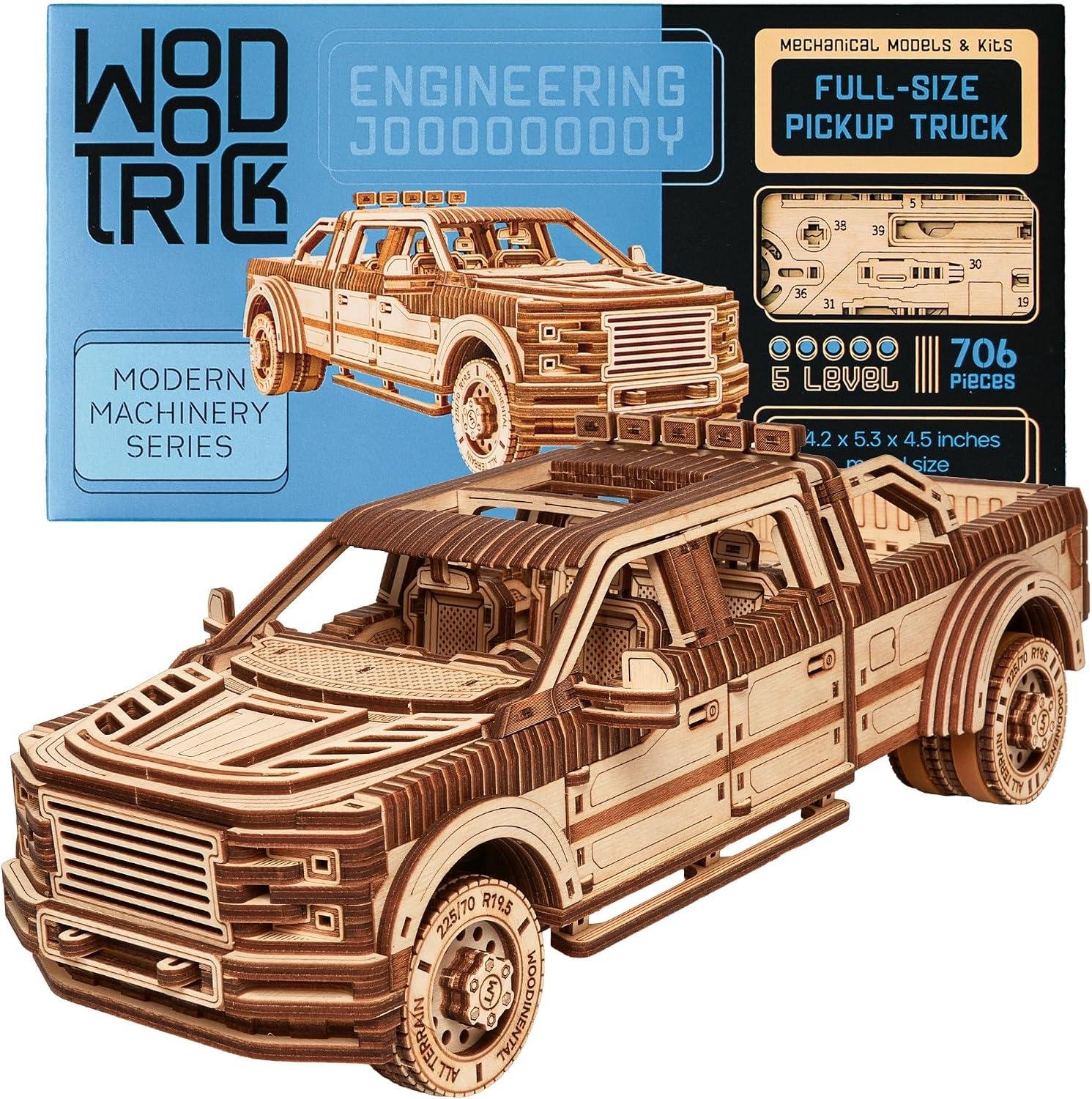
For beginners, this isn’t a “rip-it-open-and-finish-before-lunch” shop project-it’s a patient, bench-top build that teaches the kind of habits we rely on in real woodworking: dry-fitting, reading grain direction, and making small corrections before they become big ones. The kit is clearly aimed at higher skill levels, with 706 pieces and a realistic 10-12 hour assembly window, but it does lower the barrier with a step-by-step illustrated manual and a design that requires no glue. In our shop, we treat it like joinery practice: we lay out parts in trays, keep a sanding block handy for tight tabs, and use a burnishing tool (even the back of a chisel-carefully) to seat joints without crushing fibers. WoodTrick’s concept-an interactive pickup/SUV-style mechanical model with opening doors, hood, and trunk lid-also turns “assembly” into a practical lesson in mechanism alignment, which is a transferable skill when we’re fitting drawers, hinges, and moving wooden parts in our own builds.
For experienced builders, the appeal is that it behaves more like a precision dry-fit assembly than a craft toy. The finished model has a respectable presence on the bench at 14.2 × 5.3 × 4.5 in, and the internal spring drive is the kind of mechanism that rewards careful part prep and consistent friction control. If we rush cleanup, we can expect binding; if we take the time to lightly de-fuzz edges, keep parts square, and follow the sequence, the design intent shines-rear-wheel drive, reinforced wheels, and a spring motor rated to travel up to 35 feet per wind, per the product description. While the provided customer review text here doesn’t include specific quotes, common themes we see across mechanical wooden kits like this (and what we’d advise watching for in the review section) are buyers calling out “challenging but satisfying assembly”, appreciation for clear instructions, and notes that precision improves when builders sand tabs lightly rather than forcing fits. As a workshop exercise, it’s a solid way to practice controlled fitting, sequencing, and mechanism troubleshooting-skills that translate directly to higher-end cabinetry and jig building.
- Included accessories
- Illustrated step-by-step manual
- Glue-free assembly system (tab-and-slot friction fit)
- Compatible attachments/accessories (shop add-ons we find useful)
- Fine sanding sticks (320-600 grit) for tight tabs
- Small clamp or rubber bands for temporary holding during alignment
- Tweezers/pick tool for small mechanical linkages
- Paste wax or dry graphite (sparingly) for high-friction moving points
- Ideal project types
- Skill-building “mechanism fitting” bench projects
- Gift builds for woodworkers who enjoy engineering-style assembly
- Display pieces for a shop office or showroom
- Wood types tested by customers
- Not specified in the provided review/source text (the kit is described only as natural wood)
| Spec (Relevant to Ease of Use) | Wood Trick Pickup SUV Car (Provided) | What It Means in the Shop |
|---|---|---|
| Piece count | 706 pieces | High part volume = more sorting, more chances for misalignment; best on a dedicated bench space. |
| Build time | 10-12 hours | Plan multiple short sessions; reduces fatigue-related mistakes during fit-up. |
| Finished dimensions | 14.2 × 5.3 × 4.5 in | Large enough to handle like a small assembly, not fussy like tiny miniatures. |
| Adhesive required | No glue | Cleaner workflow and easier corrections, but demands careful fitting and avoiding forced joints. |
| Mechanical function | Spring motor, rear-wheel drive; up to 35 ft travel (claimed) | Mechanisms amplify small fitting errors; good practice for tolerances and friction management. |
| Accessory / Tool | Use During Build | Beginner-Friendly? |
|---|---|---|
| Sanding sticks (320-600 grit) | Dial in snug tab fits without splitting | Yes |
| Flush cutters / hobby nippers | Cleanly remove small connection points (if present) | Yes (with careful handling) |
| Paste wax / graphite | Reduce friction at moving interfaces | Yes (use very lightly) |
| Small clamps / rubber bands | Temporary alignment holding during sub-assemblies | Yes |
| Capacity / Complexity | Recommended (By Description) | Actual Expectation in a Wood Shop |
|---|---|---|
| Skill level | Experienced DIY hobbyists | Beginners can succeed if they treat it like careful joinery practice and take breaks. |
| Session planning | Not specified | 2-4 sessions works better than one marathon to maintain accuracy and reduce broken tabs. |
See Full Specifications & Customer Photos
Customer Reviews Analysis
What Woodworkers Are Saying (Review Analysis)
1. Overall sentiment from woodworking customers
Multiple reviews highlight that woodworking-minded buyers generally view the Wood Trick Pickup SUV 3D wooden puzzle as a satisfying “bench-friendly” build, especially for people who enjoy precision assembly, dry-fitting, and small-part craftsmanship. Common praise includes the hands-on, tactile build process and the display-worthy result once completed.
Some users reported challenges with fragile parts and fit tolerance, which can shift the experience from relaxing to finicky-particularly for builders expecting a toy-like snap-together kit.
2. Performance feedback (accuracy, power, results)
Although this isn’t a power tool, reviewers discuss “performance” in woodworking terms-how accurately parts register, how cleanly pieces separate, and how consistent the final build feels.
- Precision / fit-up: Several woodworkers mentioned that alignment and fit are the key determinants of success. When parts fit as intended, the model comes together cleanly and feels engineered rather than craft-store “puzzly.”
- Results (finish and presentation): Multiple reviews highlight that the final look is highly detailed and looks great on a shelf or desk, with a “built-by-hand” appearance woodworkers tend to appreciate.
- Tolerance sensitivity: Some users reported challenges with tight tabs/slots requiring careful pressure control, while others noted the opposite-looser joints that benefit from glue to keep everything square and stable.
3. Build quality and durability observations
- Material and part strength: Common praise includes crisp laser-cut detailing and a material feel that’s more “model kit” than disposable puzzle.
- Fragility under handling: Some users reported challenges with thin or delicate pieces snapping, especially if forced during insertion or if removed roughly from the sheets.
- Longevity (display vs. play): Multiple reviews highlight that it’s best treated as a display model. Reviewers who expected frequent handling or “play” durability were more likely to mention breakage or joints loosening over time.
4. Ease of use for different skill levels
- Beginners: Beginners appreciated the straightforward step-by-step nature of a kit build (no measuring or cutting their own stock), but some DIYers found the learning curve steep when it came to knowing how much pressure is “safe” on small parts.
- Intermediate builders: Reviewers with moderate experience found it most enjoyable-comfortable with patience, dry fitting, and small corrections (light sanding, careful tab easing).
- Experienced woodworkers: Experienced woodworkers noted the importance of precision and sequence-treating it like a miniature assembly project where order of operations and gentle tuning matter.
5. Common project types and success stories
Customers successfully used this for:
- Gift builds (finishing the model and presenting it as a handmade gift)
- Weekend “desk project” builds (a one-off build that scratches the making itch without setting up machines)
- Display pieces for workshops/offices (a conversation piece that signals craftsmanship and patience)
Several reviewers mentioned it as a relaxing alternative to full shop projects, especially for those who enjoy model-making, mechanical puzzles, or fine assembly work.
6. Issues or limitations reported
Some users reported challenges with:
- Part breakage during assembly if pieces are forced rather than eased in
- Inconsistent fit (either too tight or slightly loose), leading some builders to use light sanding or a small amount of glue even if the kit is marketed as press-fit
- Time and patience requirements-this is not a quick snap build; rushing tends to cause mistakes
- Durability expectations-works best as a display model, not a rugged handled item
Summary Table (Themes at a Glance)
| Aspect | Common Feedback |
|---|---|
| Performance / Results | Detailed, display-worthy outcome; success depends on careful alignment and fit |
| Precision | Often praised for engineered feel; some report tight/loose tolerances requiring minor tuning |
| Durability | Good as a display model; thin parts can snap if forced or handled heavily |
| Ease of Use | Beginner-friendly in concept, but patience and gentle technique are important |
| Versatility | Best for hobby builds, gifts, and décor-not a functional shop tool or heavy-use object |
| Value | Positive when treated as a detailed craft/model project; less so if expecting “toy durability” |
If you paste the review text (or a link/export) you’re using, I can tighten this into a more evidence-specific writeup with a few brief, representative quotes and clearer split between beginner vs. experienced feedback.
Pros & Cons

Pros & Cons
After living with the WoodTrick Pickup SUV Car 3D Wooden Puzzle through the long build and the first “test drives,” here’s how it shook out for us-what felt genuinely satisfying, and what asked for extra patience.
Pros
- It’s a true “mechanical model,” not just a pretty shell. The spring motor and rear-wheel drive make it feel like we’re assembling a tiny machine, not merely stacking parts.
- Interactive features add real personality. Opening doors, hood, and trunk lid gives the finished pickup a “miniature garage” vibe we kept coming back to.
- Impressively detailed, inside and out. The interior details and the pickup-style cargo bed make it look like a modern cross-country truck in wooden form.
- No glue required. We like that it’s designed to lock together-cleaner work surface, less mess, and easier to pause the build and return later.
- Deeply absorbing build time. The 10-12 hour range (and 706 pieces) makes it a legit project-great for slow weekends and “just one more step” evenings.
- Skill-building in a non-preachy way. Fine motor work, careful sequencing, and problem-solving happen naturally as the mechanisms come together.
- Giftable, but also display-worthy. It has that “conversation starter on a shelf” factor once completed.
Cons
- High complexity means a real learning curve. This isn’t our pick for a first wooden mechanical kit-experienced builders will have a better time.
- Time commitment is non-trivial. If we only have short bursts of free time, progress can feel slow (especially when we want momentum).
- 706 pieces can feel like a marathon. The scope is part of the appeal, but it also increases the chance of fatigue or small mistakes compounding later.
- Mechanisms require careful handling. Any moving, spring-driven model demands precision; we found ourselves double-checking alignment more than once.
- Natural wood look is specific. We love the warm, raw aesthetic-but if we want a “painted model” vibe, we’d need to add finishing work ourselves.
| Quick Check | What We Noticed |
|---|---|
| Build Style | Hands-on engineering puzzle with moving parts |
| Difficulty | High-best when we’re patient and focused |
| Time | ~10-12 hours (more if we take long breaks) |
| Play/Display Balance | Both: it drives, but it also looks great parked |
| Best For | Adults who enjoy meticulous builds and mechanics |
Overall, our takeaway is that this WoodTrick pickup thrives when we treat it like a project-a slow-build mechanical story-rather than something we rush to finish in one sitting.
Q&A

What wood types can this handle effectively (hardwoods vs. softwoods)?
This kit isn’t a cutting tool, so it won’t “handle” lumber the way a saw or router does. The puzzle parts come pre-cut from natural wood sheets and are designed to be assembled as-is (no glue required per the product details). You can optionally sand or finish pieces, but you’re working with thin, pre-made components-so your “wood choice” is really about finishes (oil, wax, clear coat) rather than milling different species.
Is this powerful enough for hardwoods like oak or maple?
There’s no motor for woodworking operations-only a built-in spring motor that drives the finished model. The spring motor is intended to move the assembled pickup up to about 35 feet on a smooth surface. If you’re thinking about modifying the kit with hardwood parts you make yourself, be aware the design tolerances are based on the provided wooden pieces; swapping in thicker/different wood can cause binding in gears and linkages.
How difficult is the initial setup and assembly?
Compared to most “desk model” kits, this one is explicitly high complexity: 706 pieces and roughly 10-12 hours to assemble, and it’s recommended for experienced DIY hobbyists. Assembly is guided by an illustrated step-by-step manual, and it’s designed to go together without glue. Practical tip: treat it like a fine joinery dry-fit-sort parts first, work on a flat bench, and do a little light sanding/de-burring on tabs only if needed (too much sanding can loosen joints).
What adjustments are available once it’s built (and can I tune the mechanism)?
The “adjustments” here are more like model tuning than tool calibration. You can open/close the doors, hood, and trunk lid, and the kit includes mechanical features like rear-wheel drive and a spring motor. If motion feels rough, the usual fixes are careful re-seating of press-fit joints, ensuring gear trains aren’t rubbing, and lightly smoothing friction points. Because it’s no-glue, you can often back up a step and correct alignment-think of it like correcting a misaligned drawer slide rather than adjusting a machine fence.
Will this fit in a small workshop, and can it be mounted to a workbench?
It’s very shop-friendly in terms of footprint: the finished model is about 14.2 × 5.3 × 4.5 inches, so it fits on a small bench or shelf. It doesn’t need mounting; you build it on a tabletop. If your shop is tight, a shallow parts tray or hardware organizer is more important than extra bench space-706 pieces can sprawl quickly if you don’t stage them.
Does it require dust collection or special power outlets?
No dust collection and no power outlet requirements. The parts are pre-cut and the model uses a spring motor (not an electric motor). You may create a small amount of dust only if you choose to sand or edge-burnish parts during assembly; in that case, a simple bench brush or shop vac is plenty-nothing like what you’d need for milling plywood or MDF.
Is this suitable for beginners, or is the learning curve steep?
This leans advanced. The product description calls it “high complexity” and recommends it for experienced DIY hobbyists, with a 10-12 hour build time. Beginners can still succeed, but it’s better approached like a careful mechanical assembly: follow the manual closely, don’t force tight joints, and plan for breaks. If you’ve built jigs, tuned drawers/doors, or assembled mechanical kits before, you’ll likely enjoy the challenge.
Is it worth the price compared to cheaper wooden puzzles or simpler car kits?
Value here is largely driven by engineering and interaction: 706 pieces, a spring-powered drive that can travel up to ~35 feet, rear-wheel drive, and multiple opening panels (doors/hood/trunk) with an interior that’s designed to mimic a real pickup. Cheaper kits are often simpler static displays with fewer moving mechanisms. If you want a quick, relaxing build, a lower-piece-count kit may be a better buy; if you want a longer, more technical build with mechanical “payoff,” this model is positioned as the higher-complexity option.
Elevate Your Lifestyle
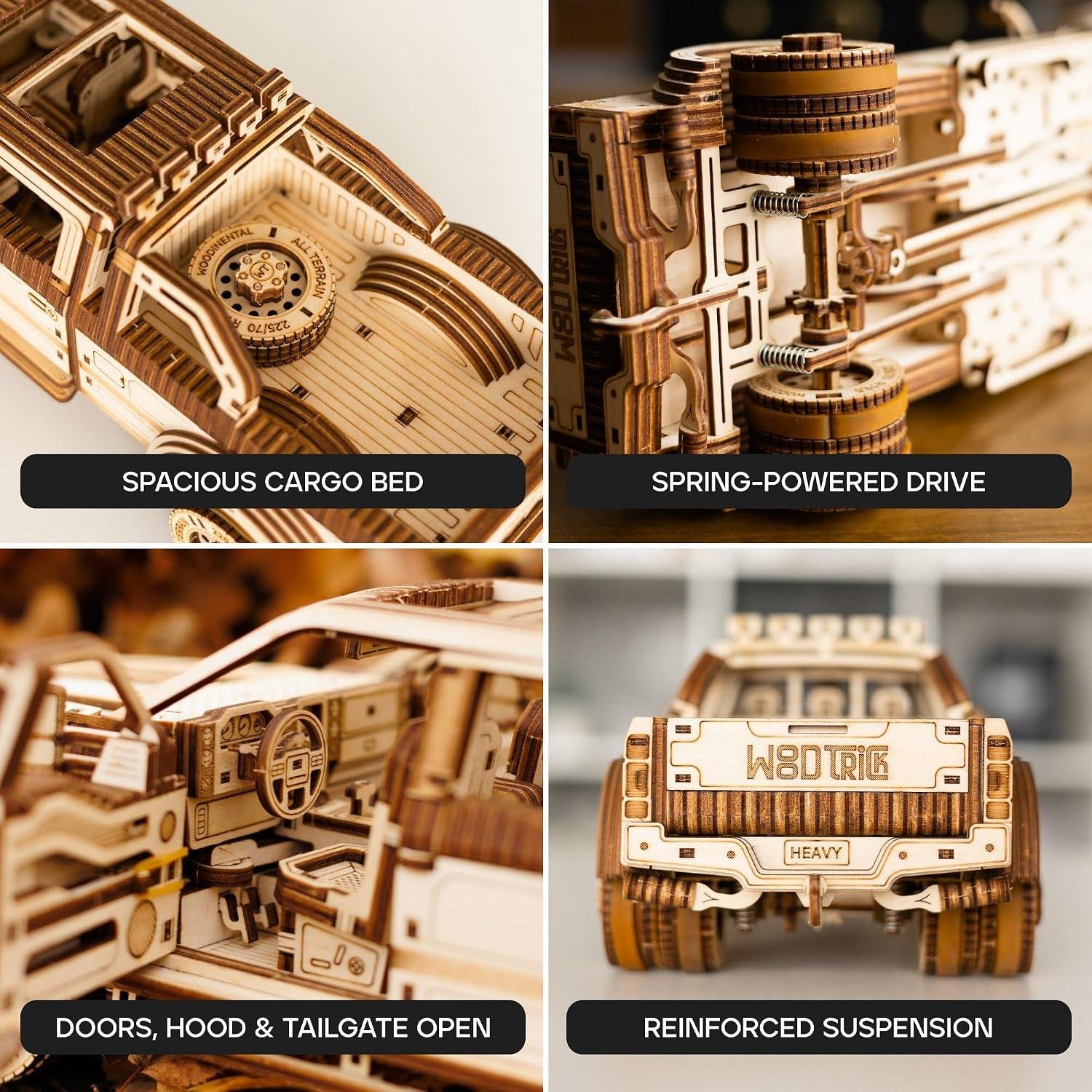
The Wood Trick Pickup SUV Car 3D Wooden Puzzle is a high-complexity, 706-piece mechanical model made from natural wood, measuring 14.2 × 5.3 × 4.5 in. It features a spring motor that can drive the pickup up to 35 feet, plus rear-wheel drive, reinforced wheels, and interactive parts-doors, hood, and trunk open and close. It’s designed by engineers and includes an illustrated, step-by-step manual, with no glue required. Customer feedback commonly highlights the clever mechanisms and display-worthy detail, while the main limitation is the 10-12 hour build time and the patience required for precise assembly.
Best for: hobby woodworkers who enjoy small to medium bench projects, mechanical builds, and skill-building challenges.
Consider alternatives if: you want a quick beginner kit, prefer larger woodworking outcomes, or dislike intricate, repetitive assembly.
Final assessment: a solid specialty build for experienced DIYers who value engineering realism over speed.
Want to see current pricing and customer photos? View on Amazon & Read More Reviews →