

Blog
Wood Trick Marble Run Model Kit Review: Right for Us?


Ever hit that point in the shop where you want a satisfying build, but don’t have room (or budget) for another benchtop machine—and you’re still craving precision parts that actually fit the first time? Small projects can be just as demanding: tight tolerances, clean edges, and hardware that runs smoothly without constant tweaking.
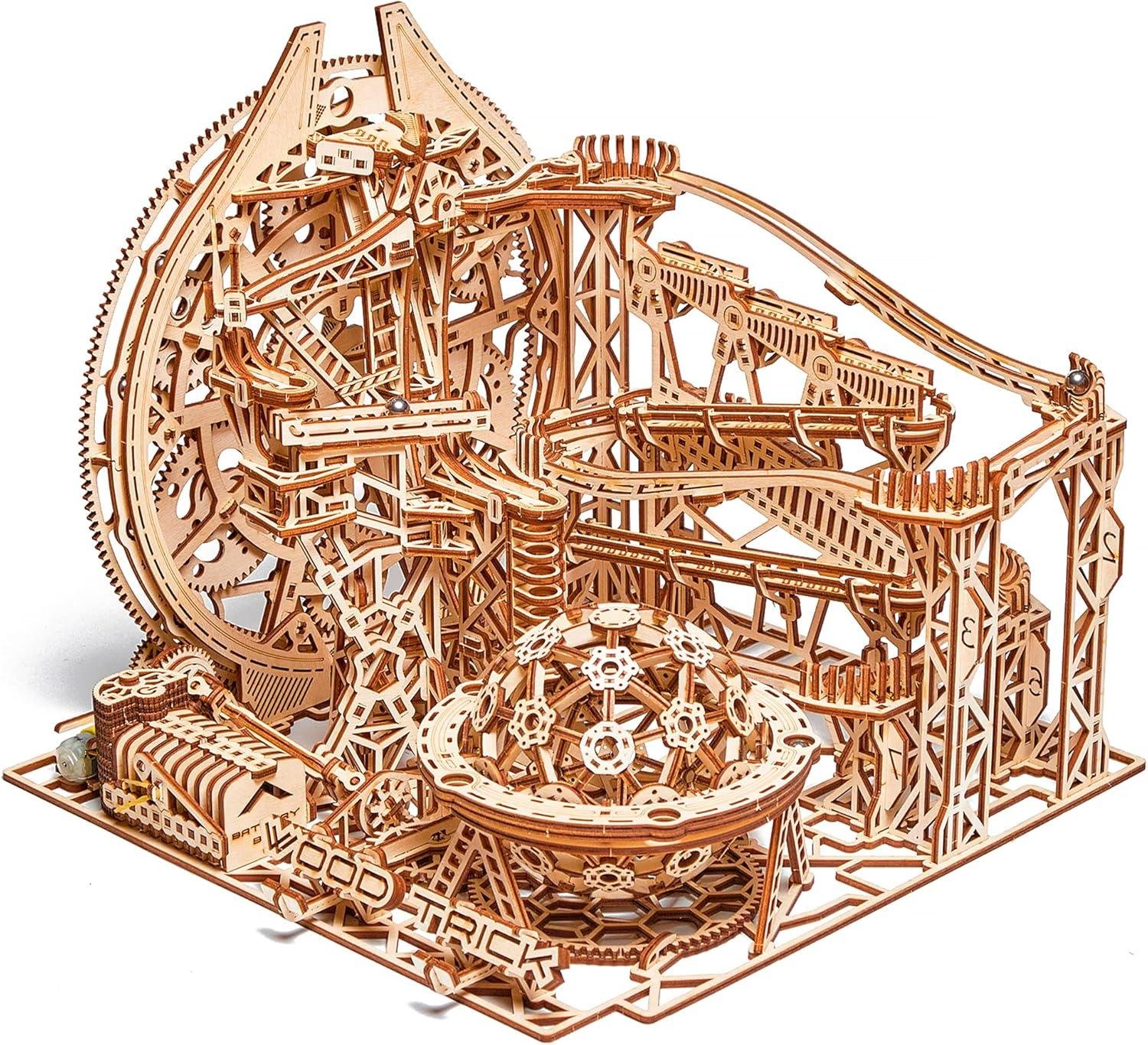
That’s where the Wood Trick Wooden Marble Run Electric motorized kit comes in. It’s a motor-driven 3D wooden puzzle for adults that assembles into a large roller-coaster-style marble run (about 15 x 12.6 x 14.4 in) with 678 wooden pieces, 12 metal marbles, and an electric motor powered by 4 AA batteries (not included). The design features moving mechanisms that lift, drop, and rotate, sending marbles through three connected tracks.
In this review, we’ll look at the engineering and build quality, how approachable the 6–8 hour, high-complexity assembly is, and what customers report about fit, durability, and the learning curve—especially for woodworkers weighing “toy” kits versus genuinely well-made mechanical builds. We’re approaching it with the same mindset we bring to jigs and joinery: if it’s worth our time, it should be worth yours.
Tool Overview and Build Quality on the Bench

On our bench, the Wood Trick Galaxy Marble Run reads less like a “tool” and more like a precision-fit woodworking exercise—678 laser-cut wooden pieces that assemble into a motorized mechanism with a finished footprint around 15 x 12.6 x 14.4 in. The motion is driven by an electric motor powered by 4× AA batteries (1.5V each) (batteries not included), and the kit includes 12 metal marbles that cycle across three connected tracks with lifts, drops, and rotating elements.Build quality, as reported by multiple customers, centers on “astonishing” laser-cut accuracy and snug, precise fit; several reviewers noted that “everything fit together as it is supposed to,” and that the engineering is “amazing.” From a woodworker’s perspective, that tight tolerance is a double-edged sword: it’s satisfying when your parts seat cleanly, but it also means our shop habits—dry-fitting, reading grain/ply direction, and cleaning up fuzz—directly impact performance. reviewers repeatedly highlight that this is high complexity and typically takes 6–8 hours per the manufacturer (with some customers reporting longer sessions), so it’s best treated like a careful assembly and tuning job rather than a swift weekend trinket.
Setup on the bench is straightforward,but the “build quality” you end up with depends on technique.Customer themes we see over and over: remove parts carefully (some use the included tool plus an X-Acto knife), sand/fettle moving interfaces (gear teeth, pivots), and wax/graphite where needed—with more than one reviewer saying the included wax isn’t enough and recommending a candle/paraffin. When things go wrong,it’s often not catastrophic failure but woodworking-adjacent tuning: marbles “flying off the course” due to a turn piece not fully seated,a diverter that needs a touch more travel,or a base area near the motor/large wheel that can flex enough for gears to slip out of mesh under load. The educational takeaway for our shop is that this kit rewards the same best practices as fine joinery: don’t force pegs (chamfering corners lightly can help), press evenly (bent-nose or long-nose pliers are commonly mentioned), and treat lubrication and alignment as part of the build—not an afterthought. It’s not a replacement for a woodworking machine, but it’s a surprisingly relevant bench project for anyone who enjoys tight-fit assembly, mechanical alignment, and dialing in smooth wooden motion.
- 678 laser-cut wooden pieces (no glue required by design)
- 12 metal marbles
- Electric motor + battery box/switch wiring (powered by 4× AA 1.5V, batteries not included)
- Instruction booklet (customers describe it as elaborate with clear images)
- Part removal tool and small sandpaper (commonly described as minimal)
- Spare parts (multiple reviewers mention many spares)
- Hobby knife (X-Acto style) for clean tab trimming
- Bent-nose/long-nose pliers for controlled seating pressure
- Small files/emery boards for precise fettling in tight areas
- Paraffin/candle wax and/or graphite for gears and sliding surfaces
- Wood glue (only for repairs or optional reinforcement; several reviewers used it sparingly)
- Skill-building bench project for precision assembly and mechanical tuning
- Shop display model that demonstrates gears, lifts, and gravity-fed track design
- Gift build for experienced DIYers who enjoy complex instructions and fine motor work
- Finishing practice (customers mention staining/painting for a showpiece look)
- Natural wood (kit material per manufacturer)
- Laser-cut plywood/wood sheets (inferred from “boards/cards” in customer reviews)
| bench Spec | What We Can Confirm | Why It Matters in a Wood Shop |
|---|---|---|
| Overall size | 15 x 12.6 x 14.4 in (manufacturer) | Plan for a stable, flat assembly area and a display spot that won’t get bumped. |
| Piece count | 678 pieces (manufacturer) | Higher part count = more opportunities for fitment error; association helps. |
| Power system | Motor powered by 4× AA (1.5V); batteries not included | No cord management,but be prepared for battery swaps and checking wiring connections. |
| Marbles | 12 metal marbles included (manufacturer) | Metal marbles amplify any misalignment—great for diagnosing track and diverter accuracy. |
| Build time | 6–8 hours (manufacturer); some customers report longer | Realistically,plan multiple sessions and don’t rush moving assemblies. |
| Accessory / Shop Aid | Included? | Use on This Kit |
|---|---|---|
| Part removal tool | Yes (customer mentions) | Helps push pieces out cleanly; still benefit from a knife for tabs. |
| Sandpaper (small) | Yes (customer mentions) | Light smoothing; many reviewers prefer files/emery boards for control. |
| Wax/lube | Some provided (customer mentions) | Critical for gears/sliders; customers frequently enough supplement with candle/paraffin. |
| Spare parts | Yes (multiple customer mentions) | Reduces stress when a thin piece snaps during removal or rework. |
| Capacity / expectation | Recommended (From Maker & Reviews) | what Customers Actually Report |
|---|---|---|
| Assembly difficulty | Experienced DIY; high complexity | Very rewarding, but “patience” comes up repeatedly; not for kids/impulsive builders. |
| Adhesive use | No glue by design | Most run it glue-free; some use small glue repairs or optional reinforcement/tweaks. |
| Out-of-box operation | Should run when assembled correctly | Many say it works smoothly; some report minor tuning (seating turns, diverter travel, gear mesh). |
See Full Specifications & Customer Photos
Real World Performance of the Motorized Marble Run Mechanism
In real shop terms, the “performance” of this kit hinges on how well its battery drive can keep the lift and gear train synchronized with the three tracks. The manufacturer doesn’t publish amps/horsepower/RPM (this isn’t a corded tool), but we do know it’s an electric motor powered by 4×AA batteries (1.5V each) driving a surprisingly large model—about 15 × 12.6 × 14.4 in—with 678 wooden pieces and 12 metal marbles.Once assembled square and seated correctly, customer feedback frequently describes the mechanism as “runs smoothly” and “works perfectly”, and we agree that the motion can be very consistent for something made from friction-fit wood. The flipside is also echoed in reviews: if a turn or guide isn’t fully seated,marbles can “fly off the course”,and if the motor/gear box shifts,gears can misalign and bind. From a woodworker’s perspective, that’s a familiar lesson—mechanical success here is less about “power” and more about joinery-like precision: alignment, clean edges, and controlled friction.
What translates best to the workshop is the tuning process. Reviewers repeatedly mention that light sanding on gear teeth and rotating parts plus wax/graphite/paraffin on friction surfaces is the difference between a sluggish mechanism and a reliable one; several also note the included wax is limited, so having a candle/paraffin on the bench helps. We also saw consistent “maker” themes: take parts out carefully (some used X-Acto knives), use bent/long-nose pliers to press tight joints, and expect an advanced build—often 6–8 hours per the description, but some customers reported much longer sessions depending on pace and rework.A few users addressed real mechanical issues with classic shop fixes: reinforcing a flexible base area so the pinion stays meshed, or adjusting a diverter so marbles don’t stack up—good reminders that wood moves and flexes, and that any gear-driven wooden mechanism rewards careful dry-fitting, micro-fettling, and testing before final “lock-in.”
- Included accessories
- 12 metal marbles
- 678 laser-cut wooden pieces (no glue/toothpicks required by design)
- Wax (customers often say it’s not enough for the whole build)
- Spare parts (multiple reviewers mention generous spares)
- Instruction booklet with detailed diagrams
- Compatible attachments/accessories (shop-friendly add-ons customers used)
- 4×AA batteries (not included)
- X-Acto / craft knife for cleaner part release
- Long-nose or bent-nose pliers for tight presses and controlled disassembly
- emery board / needle files for localized smoothing and chamfers on pegs
- Graphite or paraffin/candle wax for lubrication
- Wood glue (optional; some use it only for reinforcement or repairs)
- ideal project types
- Fine-motor “tuning” builds where alignment and friction control matter
- Gear-and-linkage learning models for understanding mechanical motion in wood
- Display builds for a shop office or client conversation piece
- Wood types tested by customers
- Not specified in reviews/specs (kit is natural wood laser-cut; species not disclosed)
| Spec Area | What’s Stated for This Kit | What It Means in the Shop |
|---|---|---|
| Power | Electric motor, 4×AA (1.5V) batteries (not included); no RPM/amps listed | Expect “toy motor” torque—assembly accuracy and lubrication matter more than raw power |
| Size | 15 × 12.6 × 14.4 in | Large enough to reveal alignment issues; needs a flat assembly surface like a bench top |
| Complexity | 678 pieces; 6–8 hours claimed (many report longer) | Plan it like a multi-evening shop project; labeling/organizing parts improves workflow |
| Operating system | 3 connected tracks, lift/drop/rotation actions | Multiple transfer points = more places where a slightly proud joint can cause derailments |
| Accessory | Purpose | Notes from Customer themes |
|---|---|---|
| Paraffin/candle wax | Reduce friction on sliding/rotating surfaces | Common tip: included wax may be insufficient; wax “where necessary” helps smooth running |
| Graphite | Dry lubrication for gears | Some reviewers recommend graphite + paraffin on gear trains |
| Emery board / small files | Fettling tight pegs, smoothing gear teeth | Praised as easier than the small sandpaper sheet |
| Long-nose/bent-nose pliers | Controlled pressing and repositioning | Repeatedly mentioned for snug fits without crushing delicate parts |
| Area | Recommended (Practical) | Actual (From Reviews/Experience Themes) |
|---|---|---|
| Build time | 6–8 hours (product description) | Often longer; one reviewer reported about 18 hours depending on pace and rework |
| “No glue” approach | Friction-fit assembly by design | Mostly true, but some users used small glue reinforcements or repairs where flex/binding appeared |
| Out-of-box running | Should run once assembled correctly | Many report smooth operation; some required minor tweaking (seating turns, diverter adjustment, base stiffening) |
See Full Specifications & Customer Photos
Key Features Woodworkers Will Appreciate in the Kit Design

From a woodworker’s standpoint, the kit design we appreciate most is how it leans into precision joinery without relying on glue. Wood Trick calls out “Natural wood—no glue, no toothpicks” and, in reviews, multiple builders echo that the parts “fit together nicely and snug” and that the laser cutting accuracy is “astonishing.” That matters in the shop as the whole build becomes a lesson in fit,shoulder alignment,and clean seating—skills we use daily when a tenon won’t quite draw home or a mechanical assembly needs to run true. The finished footprint is about 15 x 12.6 x 14.4 inches (often listed around 15 x 14 inches), so it’s big enough to justify setting up a dedicated assembly station. And with 678 pieces, we’re essentially working through a small-scale “manufactured wood” workflow: careful part removal, light edge cleanup, and dry-fitting before committing. Reviewers repeatedly stress patience and not forcing parts; one notes they only broke pieces when they forced them instead of sliding them in as instructed—exactly the kind of grain-respecting handling we try to teach when dealing with thin profiles and fragile tabs.
Mechanically, this is where the “woodworking education” starts to pay off: the marble run has three connected tracks, multiple moving assemblies (lift/drop/rotate), and an electric motor powered by 4 AA 1.5V batteries (batteries not included). While the motor’s RPM/amps/horsepower aren’t specified, the practical implication is clear—this is low-voltage drive where gear mesh, axle friction, and lubrication determine whether it runs smoothly. Customer themes line up with what we’d expect from timber mechanisms: waxing and burnishing are critical, and several reviewers recommend paraffin/candle wax (because the included wax may be “not enough”) and light sanding on gear teeth and rotating parts. We also see realistic “tuning” notes: some report marbles flying off the course until turns where properly seated; others mention tweaking a diverter or stabilizing the motor/gear assembly to prevent misalignment and binding under load—a great reminder that thin wooden base panels can flex, and that reinforcement (even temporary clamping or careful shimming) is sometimes the difference between a display model and a reliable runner.
- Included accessories
- 12 metal marbles
- 678 wooden pieces (laser-cut boards/cards)
- Instruction booklet (large, image-forward)
- Small sanding/polishing item (noted by reviewers as minimal)
- Electric motor + wiring + switch + battery box (4x AA 1.5V, batteries not included)
- Spare parts on the sheets (multiple reviewers mention many spares)
- Compatible attachments/accessories (shop-friendly)
- X-Acto/utility knife for clean part release (reviewer-recommended)
- Needle files / emery board for fine “fettling” (reviewer-recommended)
- Bent/long-nose pliers for pressing joints without crushing tabs (reviewer-recommended)
- Paraffin/candle wax or graphite for lubrication (reviewer-recommended)
- Wood glue or CA glue for repairs only (used by some reviewers when parts broke or to lock a gear)
- Small trays/boxes to organize numbered boards (reviewer-made card organizer)
- Ideal project types
- Bench-top “mechanical joinery” practice (tight fits,alignment,sequencing)
- Gear train and linkage learning model (great for teaching friction and tolerance)
- Gift build for experienced DIY/woodworking hobbyists (noted as high complexity)
- Display piece for a shop or office that actually moves (motorized marble run)
- Wood types tested by customers
- Not specified in reviews (kit is described as natural wood; species not stated)
| Spec / Feature | what the kit provides | Why woodworkers care (practical takeaway) |
|---|---|---|
| finished size | 15 x 12.6 x 14.4 in (often listed ~15 x 14 in) | Plan bench space; it’s a “station” build, not a tiny puzzle. |
| Piece count | 678 pieces | Expect careful prep/organization and long assembly sessions. |
| Drive | Electric motor + gearbox; 4 AA 1.5V power | alignment and lubrication matter more than raw motor specs. |
| Tracks | 3 connected tracks | More interactions = more tuning; seating parts fully prevents “fly-offs.” |
| Assembly method | No glue (by design) | Teaches clean fits; if glue is “required,” something’s misfit (review theme). |
| Accessory / Consumable | Included? | Use in the build |
|---|---|---|
| Wax (paraffin) | Small amount (reviewers say may not be enough) | Reduces friction on slides/gears; prevents binding. |
| Knife (X-Acto) | No | Cleanly frees delicate parts; minimizes tear-out on tabs. |
| Needle files / emery board | No | Finesses tight pegs, chamfers corners, smooths gear teeth. |
| Long-nose / bent-nose pliers | No | Press-fit support without crushing thin parts; helps disassembly for corrections. |
| AA batteries | No (not included) | Powers motor; keep fresh cells on hand for consistent torque. |
| Capacity / Expectation | Recommended (from reviews + specs) | Actual experience reported |
|---|---|---|
| Build time | 6–8 hours (product description) | Some finish near that; others report much longer (e.g., ~18 hours) depending on pacing and tuning. |
| Skill level | Experienced DIY (high complexity) | reviewers repeatedly emphasize patience,careful part removal,and methodical sequencing. |
See Full Specifications & Customer Photos
Ease of Use for Beginners Versus Experienced Builders
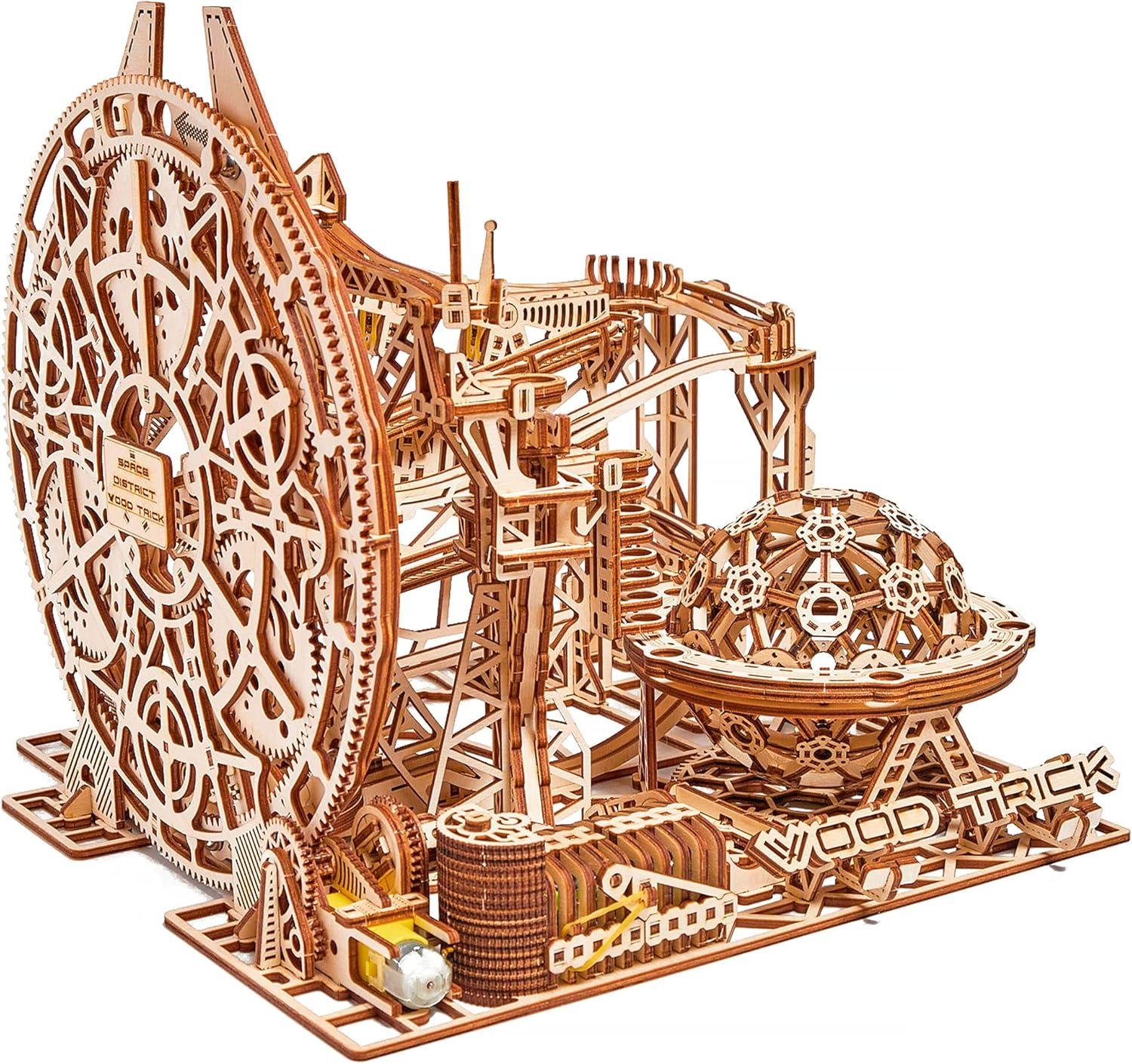
for beginners, we’d frame the Wood Trick Wooden Marble Run as a “precision assembly” project rather than a typical forgiving shop build. The kit is large at 15 × 12.6 × 14.4 in and uses 678 wooden pieces with no glue intended, which means fit-up and alignment matter the way they do when we’re dry-fitting joinery. The drive system is an electric motor powered by 4× AA batteries (1.5V each) (batteries not included), so there’s no corded-tool learning curve—but there is a mechanical one: if a rail, gear, or diverter isn’t fully seated, the whole run can misbehave. That matches customer themes: several reviewers say the build is “extremely satisfying” and “very well designed,” yet they also stress patience and careful part removal; a common beginner pitfall is marbles “flying off the course” until small track pieces are seated correctly (one reviewer specifically notes sliding a turn piece in from the side instead of forcing it from the top). In practical workshop terms, we’d treat this like a careful layout-and-fit exercise: keep a small file/emery board handy, lightly dress fuzz on moving parts (especially gear teeth), and test mechanisms as subassemblies before stacking the next layer on top.
For experienced builders—especially those of us who’ve assembled other laser-cut mechanisms—this kit rewards disciplined technique and troubleshooting. The manufacturer calls it high complexity and estimates 6–8 hours, but customer reports commonly land higher (one cited ~18 hours over multiple evenings), which feels realistic if we’re doing the “woodworker things”: organizing parts, breaking sharp laser edges, and tuning motion. Reviewers consistently praise snug, accurate fit and “astonishing” laser accuracy, but they also mention specific advanced gotchas that seasoned hands will recognize: a diverter that may need slight modification to throw reliably, and occasional gear binding/misalignment if the motor/large-wheel area flexes under load. The better reviews read like a shop log—use bent/needle-nose pliers to press joints, wax/paraffin/graphite on friction points, don’t rush, and check the spare-parts sheet before reaching for glue. We also saw feedback that the wiring diagram isn’t fully spelled out (color-to-color connections beyond what’s pictured), so anyone comfortable with basic low-voltage wiring will feel at home, while true first-timers may want to go slow and verify each step before closing up the motor box.
- Included accessories
- 12 metal marbles
- Electric motor (battery-powered)
- Instruction booklet with detailed diagrams
- Spare parts (customers report many spares for some pieces)
- Small sandpaper (customers often upgrade to emery boards/files)
- compatible attachments/accessories (shop add-ons customers commonly use)
- X-Acto/precision knife for clean part removal
- Needle-nose or bent-nose pliers for controlled pressure
- Candle/paraffin wax or graphite for lubricating moving wood parts
- Small files/emery boards for tuning pegs and gear teeth
- AA batteries (4 total, 1.5V each)
- Ideal project types
- Mechanism-focused “bench projects” for weekends/evenings
- Display builds for a shop office or client waiting area
- Skill-builders for fit-up, alignment, and low-friction wooden motion
- Gift builds where craftsmanship and presentation matter
- Wood types tested by customers
- Not specified in reviews (kit uses natural wood parts supplied by the manufacturer)
| Beginner vs Experienced | What Feels Easy | What Usually Trips People Up (per review themes) |
|---|---|---|
| beginners | Clear pictures; satisfying “click-fit” progress; battery motor avoids corded setup | Part removal without breaking, reading mirrored diagrams, fully seating track/turn pieces so marbles don’t fly off |
| experienced builders | Organizing parts; tuning friction points; diagnosing binding/misalignment | diverter throw and occasional gear mesh issues; interpreting incomplete wiring notes; resisting needless glue |
| Compatible Accessories (Shop Tools) | Use Case | Why It Helps |
|---|---|---|
| Emery board / small needle files | Deburring pegs, smoothing gear teeth | Reduces friction and prevents forced fits that crack parts |
| Needle-nose / bent-nose pliers | Pressing joints and removing misfit parts | Applies pressure exactly where needed (less breakage) |
| Paraffin/candle wax or graphite | Lubing sliding/rotating wood interfaces | Many reviewers note smoother operation after waxing |
| Organizer box for part sheets | Staging numbered boards | Customers report faster part-finding and fewer lost pieces |
| Capacity / Time | Recommended (Manufacturer) | Actual (Customer Themes) |
|---|---|---|
| Assembly time | 6–8 hours | Often longer (one report: ~18 hours), especially with careful tuning |
| Skill level | Experienced DIY fans | Beginners can succeed with patience, but many say it’s “not for the faint-hearted” |
See Full Specifications & customer Photos
Customer Reviews Analysis

What Woodworkers Are Saying (Review Analysis)
| Aspect | Common Feedback |
|---|---|
| Overall Sentiment | Strongly positive among patient, detail-oriented builders; most feel it’s “worth the effort” and very satisfying when dialed in |
| Performance | Smooth running once waxed/sanded and properly seated; occasional marbles flying off or gear binding until tweaked |
| Precision | Multiple reviews highlight excellent laser-cut accuracy and snug fits; mistakes usually traced to assembly sequencing or part seating |
| Durability | Generally solid parts with many spares, but thin/“flimsy” track pieces and a flexible base area near the motor show up as weak points |
| Ease of Use | Not beginner-friendly for impatient users; instructions are detailed but require careful interpretation (mirror images/flip steps) |
| Value | Price hesitation comes up, but many conclude the engineering, finish, and build experience justify the cost |
1. Overall sentiment from woodworking customers
Several woodworkers mentioned going in skeptical due to the price, then changing their minds once they saw the engineering and fit-up. Common praise includes the build being “satisfying and rewarding,” with multiple reviewers calling it one of their favorite Wood Trick builds and a standout compared to other brands. The recurring theme is that it’s excellent—but only if you bring patience,careful technique,and a willingness to fine-tune.
2. performance feedback (accuracy, power, results)
Multiple reviews highlight that the marble run performs smoothly after the usual woodworking-style prep: light sanding on moving parts, waxing/paraffin/graphite on gear interfaces, and ensuring joints are fully seated.
- Smooth operation once tuned: Reviewers report it “ran smoothly” on the first start when they cleaned up gear teeth/rotating parts and used wax where needed.
- Under-load behavior: Some users reported challenges with the drivetrain under load—specifically gears lifting out of mesh near the motor/large wheel area, causing binding.
- Track performance: A known symptom in negative reviews is marbles “flying off the course,” but at least one builder traced it to track-turn pieces not being fully seated and fixed it by sliding parts in correctly rather than forcing them.
One reviewer summarized the “dial-in” nature well: it “works great after some minor tweaking.”
3.Build quality and durability observations
Common praise includes clean laser cutting and very consistent sizing for tight joinery. Reviewers with an engineering/precision mindset called the laser accuracy “astonishing,” and several noted parts “fit together nicely and snug.”
That said, a few durability/rigidity issues show up:
- Delicate parts: Some pieces are tricky to remove from the sheets without breaking—several woodworkers recommend using an X-Acto knife, careful punch-out technique, and pliers for controlled pressure.
- flexible base near motor/drive: Multiple reviews highlight the baseboard between the motor unit and wheel/gear train can flex, which can let gears climb out of mesh. Fixes included adding reinforcement (sometimes glued) or mechanically tying/strapping the motor assembly down with wire.
- Spare parts are a real advantage: More than one reviewer emphasized the kit includes many spares—sometimes saving the build without needing glue.
4. Ease of use for different skill levels
Reviewers with prior model/wood puzzle experience found it manageable and even “quite easy to follow,” while beginners (or impatient builders) are likely to struggle.
- Beginners / first-time builders: Some DIYers found the learning curve steep. Part removal and delicate assemblies demand a light touch and the ability to correct mistakes without damaging parts.
- Experienced builders: Reviewers with experience level “collection of 8 marble run puzzles” or engineering backgrounds tend to praise the design and methodically work through issues.
- Instruction clarity: The manual is often described as elaborate and image-heavy, with clear part callouts—but it can be confusing due to mirrored diagrams and steps that require flipping assemblies without always explicitly warning you. One user also noted the wiring diagram is incomplete, requiring some inference (color-to-color connections).
5. Common project types and success stories
customers successfully used this primarily as:
- A showcase mechanical build/display model (often described as a “collection” piece and something impressive to watch run).
- A family “maker” project (several users mentioned kids enjoying the finished model—though they stress it’s not for children to assemble).
Success stories tend to follow the same formula: organize parts,go slow,prep moving interfaces (sand/wax/graphite),and correct alignment issues rather than forcing joints. One reviewer put it simply: “Have fun and a lot of patience.”
6.Issues or limitations reported
Some users reported challenges with:
- Marbles leaving the track if turn/track elements aren’t fully seated (an issue that can look like a “bad kit” until corrected).
- Drive/gear binding or misalignment due to base flex or motor assembly movement, especially under load—requiring reinforcement, restraint (wire), or selective gluing.
- A specific diverter not opening far enough, causing marble backups; one builder modified the diverter arms with small scrap triangles from the punch-outs to restore reliable switching.
- Part removal breakage risk if rushed; forcing pegs instead of sliding parts per the instructions is repeatedly flagged.
- Consumables and tooling expectations: The included sandpaper is widely seen as insufficient for “fettling,” and the included wax may not be enough—users supplemented with candle/paraffin and better files/emery boards.
- Not a “no-glue” guarantee in practice: While some insist “if you require glue, something is wrong,” others used glue strategically (or tried to avoid it for future serviceability). Either way, many acknowledge occasional reinforcement may be necessary for long-term reliable running.
Quoted sparingly,the tone across reviews is consistent: it’s “excellent… but not for the faint hearted,” and the payoff is a smooth,impressive working marble run once built with careful woodworking-level attention to fit,friction,and alignment.
Pros & Cons
Pros & Cons
| What We Loved | What We Didn’t |
|---|---|
| Mesmerizing “planetary” marble motion that’s genuinely hard to stop watching. | High complexity means it’s not the most relaxing “one-evening” build. |
| Electric motor keeps the run alive without constant reloading by hand. | needs 4 AA batteries (not included), so we had to plan ahead. |
| Three connected tracks + lifts/drops/rotation make it feel like a mini kinetic exhibit. | 6–8 hours is realistic for us—longer if we’re perfectionists or multitasking. |
| All-wood construction with a satisfying “maker” vibe; no glue required. | With 678 pieces, we needed a clean workspace and patience to avoid mix-ups. |
| Big,display-worthy footprint (about 15 x 12.6 x 14.4 in) that looks like functional décor. | Its size also means it claims real shelf space once completed. |
| Includes 12 metal marbles, which adds a nice weight and smoothness to the run. | Metal marbles + moving parts can be a bit noisy in a quiet room. |
| Strong “entertaining science” feel—physics and mechanics you can see working. | Not ideal for absolute beginners; we’d recommend some prior model-kit confidence. |
Pros
- Captivating kinetic show: We get that “perpetual motion” illusion—marbles circling like tiny planets on repeat.
- Motorized momentum: The electric motor (4 x AA) adds a set-it-and-enjoy-it rhythm that keeps the build from becoming a manual toy.
- Interactive engineering: Elevation, drops, and rotating elements make the coaster feel designed, not just assembled.
- Glue-free wooden build: Natural wood and no glue feels cleaner and more “mechanical,” like we’re building a real machine.
- Display-friendly scale: Once finished, it’s large enough to be a conversation piece, not a desk trinket.
- Giftable for makers: For adults who enjoy complex puzzles, it reads like a hands-on experience, not just a product.
Cons
- Not beginner territory: the difficulty is real—678 pieces means we had to stay organized and focused.
- Time commitment: The 6–8 hour estimate feels fair, but it’s not “build it between dinner and bedtime.”
- Batteries not included: Small detail, but it matters when we want instant gratification after finishing.
- Space + sound: The finished model is sizeable, and the metal marbles can be noticeably audible during continuous runs.
Q&A
What “wood types” can this kit handle—can I stain, paint, or clear-coat it?
This model is made entirely from natural, laser-cut wood parts (678 pieces). Since it’s unfinished wood, you can absolutely customize it like a small woodworking project—sanding fuzz off edges, staining, painting, or applying a clear finish. Just keep finishes thin on moving/precision-fit parts (gears, axles, track interfaces), because several builders note the tolerances are tight and extra thickness can cause binding.Many builders prefer to finish after test-fitting, or finish only the non-moving panels.
Is the electric motor “powerful enough,” and what actually powers it?
The motion is driven by an electric motor powered by 4 AA 1.5V batteries (not included). It’s designed to cycle marbles and run the lifts/rotating elements continuously—more like a display mechanism than a high-torque “shop motor.” Reviews suggest it runs smoothly when the drivetrain is properly seated and lubricated, but if gears bind from rough edges or misalignment, the motor can struggle (marbles may fly off, gears can chatter/bind). Proper sanding of gear teeth and lubrication/waxing are key to getting reliable performance.
How arduous is setup/assembly—beginner friendly or more like an advanced build?
This is a high-complexity kit and is recommended for experienced DIY builders. The listed build time is about 6–8 hours, but real-world reviewers report longer builds (some around 18 hours) depending on pace, cleanup, and tweaks. The instructions are generally described as elaborate and clear, but you’ll need patience and careful part orientation (some steps use mirrored images, and some reviewers mention paying attention to when sections must be flipped). If you’ve built other mechanical wooden puzzles before, the learning curve is much smoother.
What adjustments/tuning might I need to keep marbles from flying off the track or stacking up?
expect some “woodworking-style” tuning. Common fixes from accomplished builders include: fully seating turn/track pieces (one reviewer solved fly-offs by sliding a turn piece in from the side rather than forcing it from the top), lightly sanding contact points on moving parts, and waxing/lubricating where the manual calls for it (several people said the included wax may not be enough and used a candle/paraffin). One reviewer also reported a diverter that didn’t swing far enough, causing backups; they extended the diverter arms with small scrap triangles from the punch-out sheets to increase throw. In short: if it’s misfeeding marbles, it’s usually fit, friction, or alignment—not “more power.”
Do I need special tools, or will standard shop/bench accessories help?
You don’t need specialty tools, but common bench tools make the build noticeably easier. Reviewers mention using an X-Acto/utility knife to release parts cleanly, long/bent-nose pliers to press tight joints together (and to back parts out without snapping them), and small files/emery boards for precise cleanup on pegs and gear teeth. Glue is not required (the kit is designed for no glue), but a small amount of wood glue can repair mistakes—multiple builders mentioned breaking an occasional piece during removal or forcing a joint.Also note the kit includes spare parts for at least some commonly broken pieces.
Will this fit in a small workshop,and can it live on a bench or shelf?
Yes—its footprint is manageable for most benches and shelves. The finished size is roughly 15 × 12.6 × 14.4 inches (often listed as about 15 × 14 inches).It’s a good “corner project” for a small shop as there’s no need for clamps, large jigs, or power tools—just a clear work surface to keep parts organized. A practical tip from a frequent builder: make a simple “card organizer” box with slots so the numbered sheets stand upright and don’t shed parts before you need them.
What maintenance does it need once built (and what causes most long-term issues)?
Maintenance is mostly friction management and alignment checks. Builders recommend: keeping gears and sliding interfaces smooth (light sanding if needed),reapplying wax/paraffin or graphite on high-friction points,and occasionally re-seating joints that loosen with vibration. A few reviews mention drivetrain misalignment if the base flexes near the motor/large wheel area—under load, gears can lift and bind. Some users reinforced the area (one used a small reinforcing strip; another used wire to hold assemblies down) to keep gears in mesh without permanently gluing major sections.
Is it worth the price compared to cheaper wooden marble runs?
If you want a large, motorized, engineering-style build, many owners consider it worth it for the precision laser-cut fit, the complexity, and the “finished machine” payoff (multiple reviewers called it one of their most satisfying builds). The tradeoff is that it’s not a quick,forgiving kit—some buyers who expected a simple puzzle were frustrated by tuning needs (track seating,diverter action,gear lubrication). Cheaper kits might potentially be easier or more “toy-like,” but this one is better viewed as a mechanical model-building project where careful assembly techniques directly determine how well it runs.
Experience the Difference
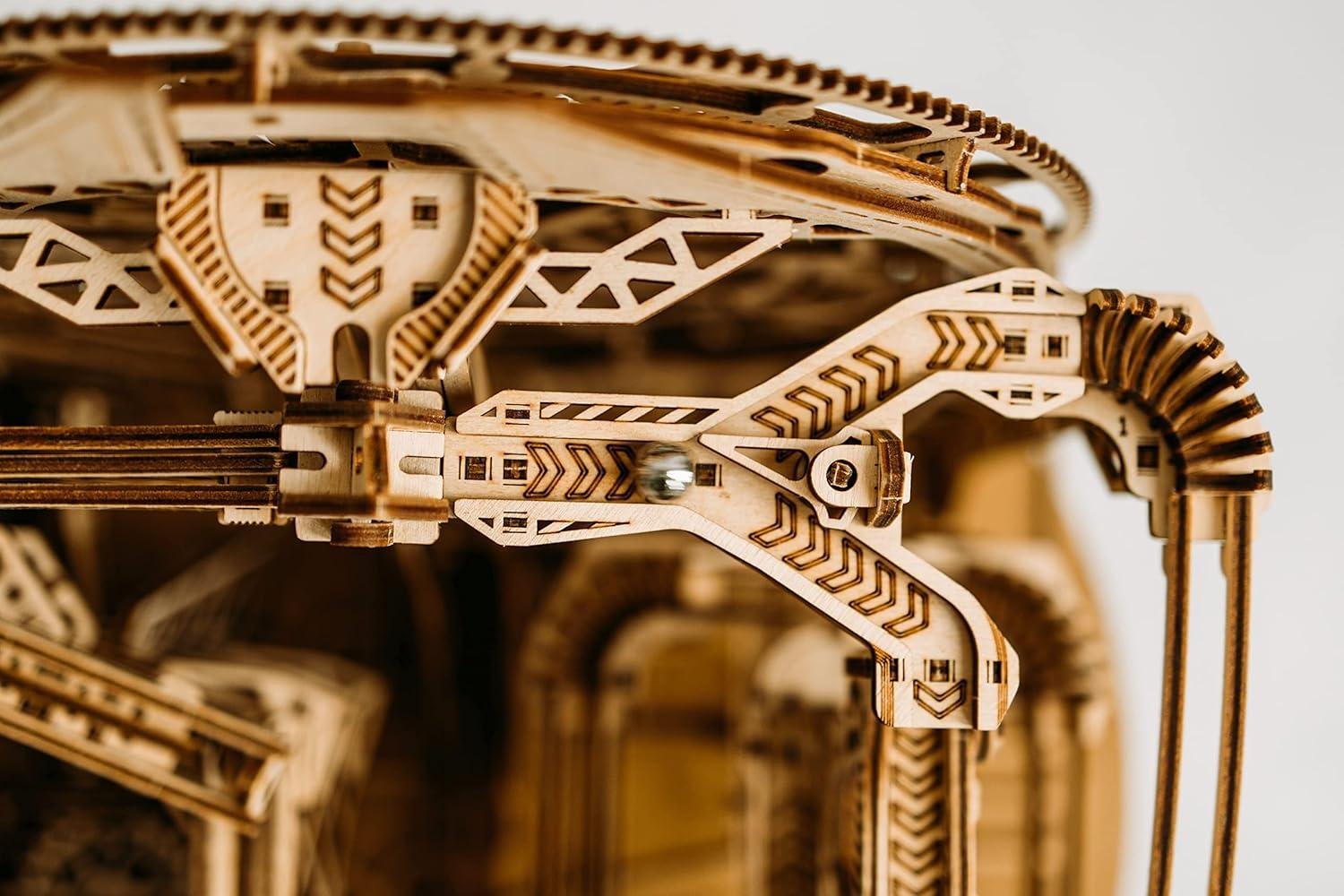
The Wood Trick Wooden Marble Run Electric Motorized is a large-format 3D wooden puzzle/roller-coaster kit measuring about 15 x 12.6 x 14.4 in, built from 678 laser-cut wooden pieces and running 12 metal marbles across three connected tracks. Motion comes from an electric motor powered by 4 AA (1.5V) batteries (not included), with interactive elements that lift, drop, and rotate to keep the run moving. customer feedback consistently praises the tight-fitting parts, impressive engineering, and satisfying build, while noting it can require waxing/sanding, careful seating of pieces, and occasional tweaks to prevent marbles flying off or gears binding.
Best for: hobby woodworkers and experienced DIY builders who enjoy small-to-medium bench projects, mechanical models, and precision assembly.
Consider alternatives if: you want a quick, beginner-friendly build, dislike troubleshooting, or prefer a purely woodworking-focused “tool” rather than a display model.
Final assessment: This kit delivers a rewarding, motorized kinetic build with standout fit and design, but patience and fine-tuning are part of ownership.
want to see current pricing and customer photos? View on Amazon & read More Reviews →