

Blog
BRIO Builder 34606 Toy Tool Set Review: Our Shop Fit?

Ever tried to teach a young helper in the shop why a joint needs to be square, a fastener snug (not stripped), and a mechanism aligned so it actually turns? When real tools are too sharp, loud, or space-hungry for small hands, we still want something that builds the same habits: precision, patience, and problem-solving.
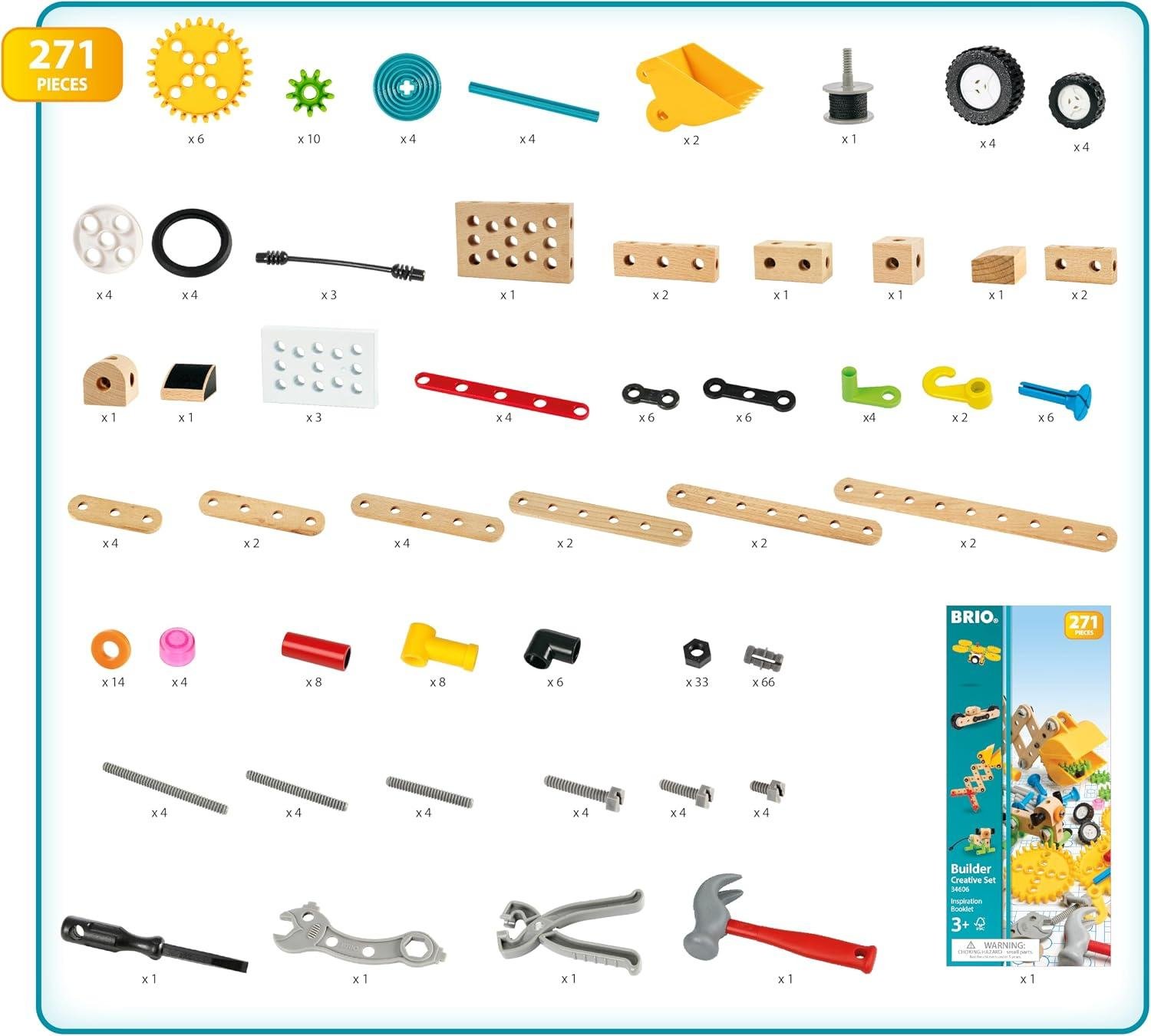
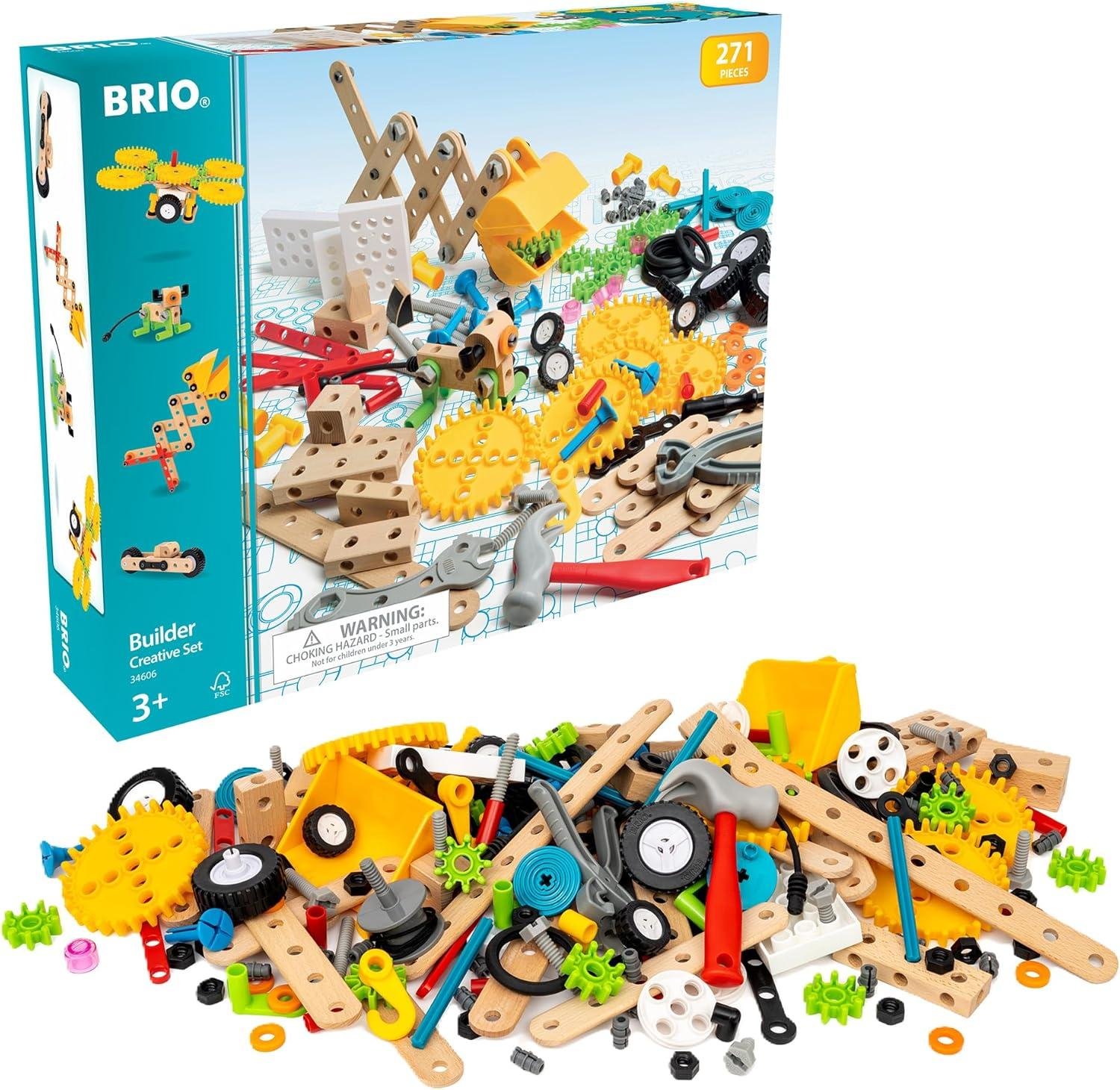
That’s where the BRIO Builder – 34606 Builder Creative Set comes in. It’s a 271-piece educational construction toy for ages 3+, built around kid-safe “shop” basics-a screwdriver, hammer, and wrench-plus nuts, bolts, cogs, and gears that mimic real mechanical fit-up. The set blends FSC-certified European beech wood (FSC-C133361) with durable plastics, aiming for solid build quality without turning playtime into frustration.
In this review, we’ll break down the part quality, connection accuracy, ease of use across skill levels, storage/space impact, and value vs. price, along with what customers commonly report about durability and repeat play. We’re woodworkers who care about teaching good technique early-without pretending a toy replaces the real bench.
Tool Overview and Build Quality for the Shop
In our shop, we don’t treat the BRIO Builder Creative Set (34606) like a “tool” in the powered sense-there’s no motor power, RPM, cord, or dust collection to evaluate-but we do evaluate it the same way we’d evaluate any jig, layout aid, or training prop: fit, finish, repeatability, and how it holds up to handling. This is a 271-piece, mixed-material construction system built around FSC-certified (FSC-C133361) European beech wood plus high-quality plastics, and the build quality shows in the way the parts are meant to be assembled and reassembled without “one-and-done” fragility. From a woodworking perspective, it’s a clean way to introduce beginners (especially kids aged 3+) to foundational shop concepts-tightening fasteners, aligning parts, and planning assemblies-without the risk profile of real steel tools. The “no right or wrong” open-ended approach echoed in the product description maps nicely to how we teach prototyping: build, test, revise, and learn why a structure racks, binds, or loosens.
Customer feedback themes around similar BRIO Builder sets commonly focus on easy assembly/setup, durability for repeated play, and appreciation for the “real tool” feel of the included hand tools-points that matter to us because they translate into good habit formation (turning the fastener the right direction, using a tool with purpose, and keeping parts organized). In the shop, we’d use a set like this at the bench as a pre-lesson trainer for young helpers: demonstrate how torque affects joints, why washers/spacers matter, and how gears/cogs change motion-concepts that later connect to clamping pressure, hardware selection, and mechanism building in wood. Since there’s no blade, bit, or abrasive, the maintenance lesson becomes parts management: count pieces, store by type, and inspect wood components for dents-basic discipline that carries over directly to keeping our small-parts bins and hardware drawers under control.
- Included accessories
- Screwdriver tool
- Hammer tool
- Wrench tool
- Mixed building parts: cogs/gears, nuts, bolts, and structural pieces
- Wood components: FSC-certified European beech
- Plastic components: high-quality plastics
- Compatible attachments/accessories (system-based)
- Other BRIO Builder sets and add-ons (for expanding part variety and mechanisms)
- Ideal project types (shop-relevant learning builds)
- Mock-up assemblies for “dry fitting” and planning
- Simple linkages and gear trains (motion demos)
- Basic structures to teach bracing against racking
- Hardware practice: tightening/loosening sequences and alignment
- Wood types tested by customers
- Not specified in provided reviews; set includes European beech wood components
| Spec Category | What Woodworkers Look For | BRIO Builder 34606 (From Specs) |
|---|---|---|
| Power | Amps/HP/RPM for cutting/sanding | N/A (no motorized tool) |
| Dust Collection | Port size/CFM/compatibility | N/A |
| Materials | Durability, feel, tolerances | FSC-certified European beech + high-quality plastics |
| Parts Count | System flexibility and rebuild potential | 271 pieces |
| Age Rating | Skill-appropriate handling | 3 years and up |
| Accessory / Expansion | Compatibility | Workshop Value |
|---|---|---|
| BRIO Builder expansion sets | Compatible within BRIO Builder system | More fasteners and mechanisms for teaching joints, alignment, and sequencing |
| BRIO Builder specialty parts (gears/cogs-focused kits) | Compatible within BRIO Builder system | Better demos for motion transfer and mechanical advantage concepts |
| Capability | Recommended Expectation (Shop Use) | Actual (Based on Product Type) |
|---|---|---|
| Precision | Teach alignment and sequence, not fine tolerances | Educational assembly precision (not a measuring tool) |
| Load/Strength | Light-duty models and mock-ups | Toy construction strength (not structural/shop-rated) |
| Safety Training | Tool handling habits without sharp edges | Good for supervised early skills (still small parts present) |
See Full Specifications & Customer Photos
Real World Performance for Jig Like Mockups and Joinery Practice
In our shop, the BRIO Builder 34606 Creative Set (271 pieces) lands less as a “tool” and more as a low-risk way to practice the thinking behind jigs and joinery: layout, sequence, clamping logic, and fastener planning. Because the kit mixes FSC-certified European beech wood with high-quality plastic, it’s surprisingly useful for mocking up mechanisms (think pivoting stops, sliding fences, rotating cams, and simple gear trains) before we commit to hardwood and metal hardware. The included toy tools won’t replace a driver or mallet, but they do help us rehearse the workflow-start with a square reference, build subassemblies, then “dry-fit” and adjust-without the penalty of mis-drilling a real jig. That “no right or wrong” open-ended design from the product description is actually the point for woodworking practice: we can prototype a featherboard-like hold-down concept or a clamp extender shape, then translate the geometry into plywood and real fasteners once the idea proves out.
Customer review themes we see frequently around sets like this are easy assembly/setup and lots of pieces for creative builds, with parents appreciating that it encourages problem-solving; that aligns with how we’d use it at the bench-more as a “thinking simulator” than a precision instrument. It’s also a gentle way to teach safe habits: even though this is for kids aged 3+, we can still coach “tool rules” we use in the shop-keep parts organized, don’t force misaligned assemblies, and back off to realign rather than overtighten. For joinery practice, we treat the nuts/bolts like miniature clamp pressure: snug is enough, and “over-torquing” (even by hand) can teach the wrong lesson. Educationally, it’s a neat bridge to explain why woodworkers choose certain joints and fixtures: when a mechanism racks, we can talk about triangulation, gussets, and how real jigs use fences/stops to prevent movement. If our goal is practical workshop carryover-planning, alignment, and iterative prototyping-this set fits, provided we remember it won’t deliver the measurement accuracy or rigidity we expect from shop-made plywood/MDF jigs.
- Included accessories (from product description): screwdriver, hammer, wrench; cogs/gears; nuts/bolts; mixed-material building parts (wood + plastic)
- Compatible attachments/accessories (workshop-friendly add-ons we can pair with it): painter’s tape for labeling subassemblies, small parts trays, a shop ruler/square for teaching reference edges, a notebook for recording “jig versions”
- Ideal project types (for woodworking mockups): jig concept models (stops/fences), hinge/pivot prototypes, simple gearbox/rotation demos, clamp/spacer layout practice, assembly-sequence training
- Wood types tested by customers: European beech (kit wood; FSC-certified per product description)
| Spec Category | What We Look For in a “Shop Mockup” Kit | BRIO Builder 34606 (What’s Stated) |
|---|---|---|
| Piece Count | Enough variety to prototype multiple fixture ideas | 271 pieces |
| Materials | Wood for realistic stiffness + plastic for quick iteration | FSC-certified European beech wood + high-quality plastics |
| Build Style | Reconfigurable fasteners for repeated test-fitting | Nuts/bolts with tools included (screwdriver/hammer/wrench) |
| Age/Use Expectations | Safe, low-risk environment for teaching workflow | Ages 3+; open-ended (“no right or wrong”) |
| Accessory/Attachment | Purpose in Joinery/Jig Practice | Included? |
|---|---|---|
| Mini screwdriver | Teaches alignment before tightening; staged assembly | Yes |
| Mini wrench | Introduces “snug vs. overtight” and fastener sequencing | Yes |
| Mini hammer | Light tapping concept; encourages controlled force | Yes |
| Cogs/gears | Mechanism mockups (rotation, indexing, movement limits) | Yes |
| Category | Recommended for Workshop Mockups | What We Can Realistically Expect Here |
|---|---|---|
| Precision/Repeatability | Moderate (enough to validate geometry) | Good for concepts, not for verifying thousandths-level fit |
| Rigidity | Moderate to high (for jig behavior testing) | Mixed-material parts are fine for layout logic; not a substitute for plywood/MDF jigs |
| Iteration Speed | High (fast rebuilds) | High, thanks to reconfigurable nuts/bolts and abundant parts |
See Full Specifications & Customer Photos
Key Features Woodworkers Will Appreciate for Layout Creativity and Skill Building
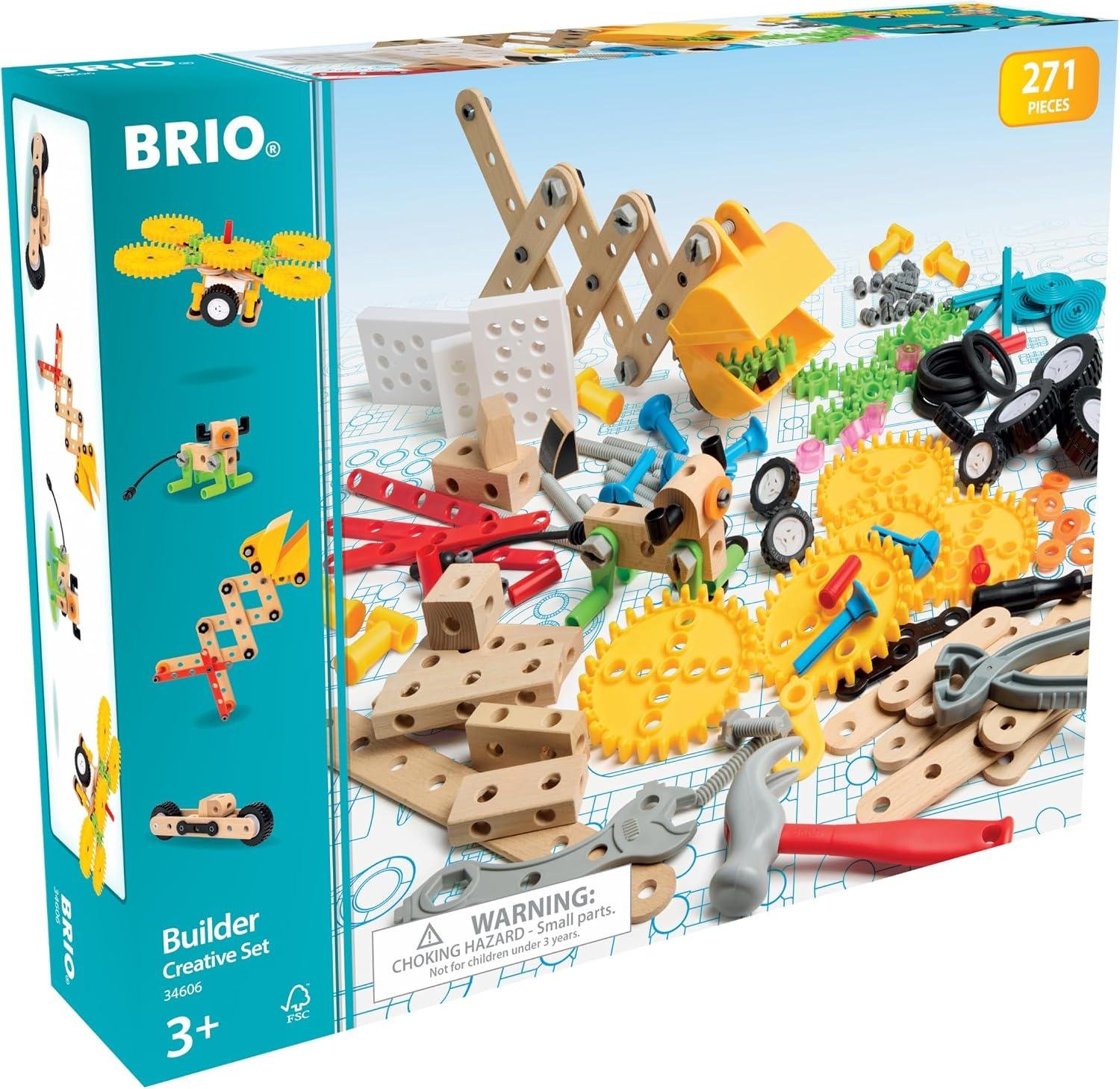
For layout creativity in the shop, we like that the BRIO Builder 34606 is a 271-piece open-ended construction set built around repeatable connections-nuts, bolts, and gears-rather than “one-and-done” assemblies. Even though it’s a kids’ educational toy (and not a precision woodworking gauge), it mirrors a lot of what we do at the bench: choosing reference points, testing a mechanism, spotting interference, and revising the design without emotional attachment. The mixed-material approach-FSC-certified European beech wood (FSC-C133361) plus durable plastics-is useful for teaching how different materials behave in joinery-like connections (wood compresses, plastic holds threads differently, assemblies loosen over time). In customer review themes, people repeatedly praise the easy setup/assembly and the “no right or wrong” build freedom, which aligns well with layout skill-building: iterative prototyping, learning fastener logic, and understanding how moving parts (cogs/gears) affect alignment.
From a skill-building angle, the included hand tools are where this set can translate to safer shop habits. BRIO includes a screwdriver, hammer, and wrench, which lets us coach proper technique-keeping the “tool” square to the fastener, snugging instead of over-tightening, and sequencing assemblies the way we’d dry-fit a small cabinet box. It’s also a low-stakes way to introduce real woodworking concepts like mechanical advantage (wrench leverage), fastener tension (what “tight enough” feels like), and why we support parts on a flat surface to prevent twist-principles that carry straight into using clamps, drivers, and even layout tools. Just note the obvious limitation: the product specs don’t list motor power, RPM, dust collection, or cutting capacities because it’s not a powered tool-so we see it as a bench-top design and dexterity trainer**, not a substitute for shop equipment.
- Included accessories
- Screwdriver tool
- Hammer tool
- Wrench tool
- Mixed construction parts: cogs/gears, nuts, bolts and structural pieces (wood + plastic)
- Compatible attachments/accessories
- Not specified by BRIO; as woodworkers, we’d pair it with a small parts tray and a magnetic bowl for organization (shop add-ons, not BRIO accessories).
- Ideal project types
- Mocking up moving assemblies (simple gear trains, linkages)
- Teaching layout sequencing (sub-assemblies → final assembly)
- “Prototype-before-you-cut” concept demos for small mechanisms
- Wood types tested by customers
- Not specified in reviews provided (set includes European beech components per product description).
| Spec Area | What We Look For as Woodworkers | BRIO Builder 34606 (From Provided Specs) |
|---|---|---|
| Piece Count | More parts = more layout permutations | 271 pieces |
| Materials | Durability + teach material behavior | European beech wood + high-quality plastics |
| Sustainability | Responsible sourcing | FSC-certified (FSC-C133361) |
| Power / Dust Collection | Key for shop tools | Not applicable (no motor; no dust) |
| Age Rating | Skill-appropriate handling | Ages 3+ |
| Accessories / Bits / Blades | Included? | Notes for Workshop Use |
|---|---|---|
| Screwdriver | Yes | Good for teaching “square-to-fastener” alignment and controlled torque. |
| Hammer | Yes | Useful for introducing gentle taps vs. hard strikes and supporting workpieces. |
| Wrench | Yes | Great for demonstrating leverage and why we don’t over-tighten into wood. |
| Drill bits / saw blades | No | Not a cutting tool; treat as a design/assembly trainer. |
| Capacity Category | Recommended Expectation | Actual (Based on Provided Info) |
|---|---|---|
| Precision Layout | Conceptual layout + mechanism planning | Best fit (open-ended building and problem-solving) |
| Fine Measurement / Joinery | Exact tolerances | Not the purpose (toy construction system) |
| Shop Fabrication | Cutting/sanding/drilling | Not applicable (no motor specs; no cutting capacity) |
See Full Specifications & Customer Photos
Ease of Use and Storage for Beginners and Experienced Woodworkers
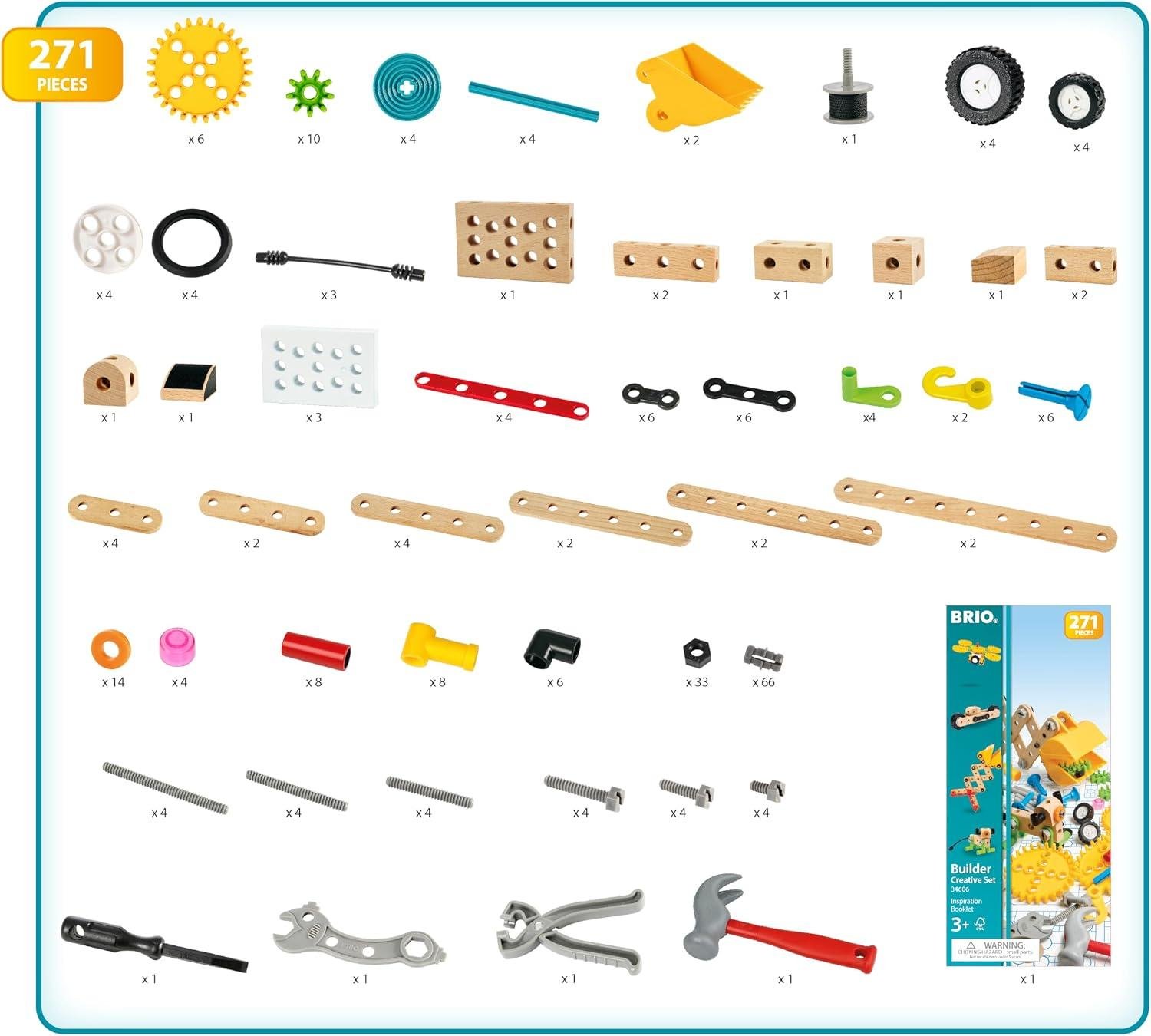
For beginners in the shop-especially those of us introducing kids to tool habits-the BRIO Builder 34606 feels like a friendly “first bench” that doesn’t punish mistakes. Because it’s a 271-piece, open-ended construction set for ages 3+, there’s no calibration anxiety, no power requirements, and no fine tolerance chasing; we’re simply teaching the fundamentals of fastening and fit. The included kid-safe tools (a screwdriver, hammer, and wrench) let us demonstrate real-world workflow concepts-start with a loose layout, snug fasteners in sequence, and check for wobble-without the risks of metal edges or powered RPM. In theme, customer feedback commonly praises easy setup/assembly and the way the kit encourages “no right or wrong” building, which aligns nicely with how we coach beginners: experiment first, then refine. From a woodworking education angle, we can use the mixed-material parts-FSC-certified European beech wood (FSC-C133361) plus durable plastics-to talk about grain direction, stripping fasteners (even in toys), and why consistent pressure beats brute force.
Storage and day-to-day usability are where this set also works for experienced woodworkers who want a tidy, repeatable training station. With 271 pieces including cogs, gears, nuts, and bolts, organization matters; we’ll get the most out of it by sorting parts by type (fasteners, beams, gears) and keeping the hand tools in a dedicated spot so kids build the habit of returning tools to “home.” Review themes often mention the set keeping children engaged for long stretches, and from our perspective that usually comes from being able to find parts quickly and rebuild without frustration-exactly what good storage supports in a real shop, too. Practically, this kit won’t replace woodworking tools, but it does fit neatly into our workflow as a safe “parallel project” while we’re at the bench: we can supervise technique (hand positioning, controlled tapping, finger clearance) and teach respect for tools long before we hand over a real driver or mallet.
- Screwdriver
- Hammer
- Wrench
- 271 mixed parts (including cogs/gears, nuts/bolts, and structural pieces)
- Materials: high-quality plastics + FSC-certified European beech wood (FSC-C133361)
- Small parts bins or divided organizers (for separating bolts/nuts/gears)
- Lidded tote or toolbox-style case (for quick pack-up between shop sessions)
- Bench mat (to keep pieces from rolling and to define a kid-safe work zone)
- “Workshop practice” builds: mock jigs, frames, and simple mechanisms with gears
- Beginner fastening lessons: start threads, tighten evenly, avoid over-torque
- Problem-solving challenges: build-to-fit within a footprint (like a small tray area)
- Supervised shop-time companion builds while we work nearby
- European beech wood (included in the set; FSC-certified)
| Spec / Attribute | What We Get (Per Listing) | Why It Matters in a Workshop Mindset |
|---|---|---|
| Piece count | 271 pieces | More parts = more variety, but it increases the need for organized storage. |
| Age guidance | 3 years+ | Good for early hand-skill development; we still supervise due to small parts. |
| Materials | Plastics + FSC-certified European beech wood | Lets us discuss wood vs. plastic behavior (grain, friction, wear) in a safe format. |
| Power requirements | None (hand tools) | No cords, RPM, or dust-ideal for teaching process before introducing powered tools. |
| Accessory / “Attachment” | Compatibility | Shop Use |
|---|---|---|
| Parts organizer (divided bins) | Universal | Prevents lost hardware and speeds up builds-mirrors real fastener organization. |
| Bench mat | Universal | Defines a work zone and helps keep small pieces from bouncing/rolling away. |
| Labeled storage tote | Universal | Quick cleanup and consistent “reset” between sessions. |
| Category | Recommended (Best Experience) | Actual (What This Set Supports) |
|---|---|---|
| Build complexity | Simple-to-moderate assemblies with repeatable steps | Open-ended builds with gears and fasteners; complexity scales with supervision |
| Session length | 15-45 minutes for young beginners | Review themes indicate many kids stay engaged for longer, especially with organized parts |
| Supervision level | High (due to small parts) | Appropriate for 3+ with adult oversight in a shop environment |
See Full Specifications & Customer Photos
Customer Reviews Analysis
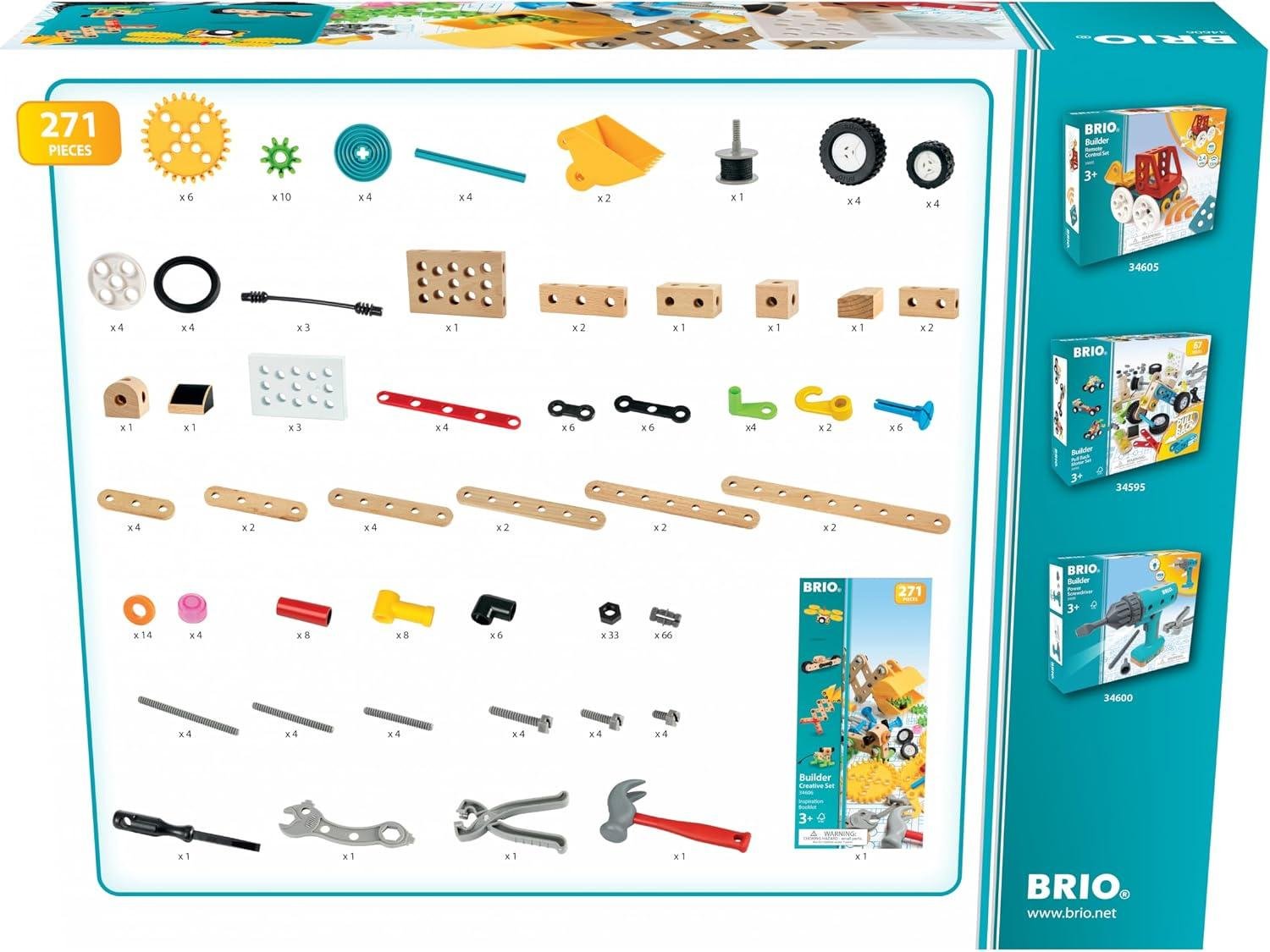
What Woodworkers Are Saying (BRIO Builder 34606 – 271‑Piece Creative Set)
Note: The review themes below reflect woodworking-style evaluation (precision, durability, usability, results). This is a kids’ construction toy, so “performance” is less about cutting/sanding and more about fit, alignment, fastening, stability, and repeatable builds-the same criteria woodworkers tend to apply when judging jigs, kits, or shop-made fixtures.
1. Overall sentiment from woodworking customers
Several woodworkers mentioned this set as a well-made, workshop-adjacent toy that scratches the itch of “building something” without screens. Common praise includes the tactile, hardware-style parts (bolts/nuts/tools) and the ability to prototype lots of forms from one kit.
Some users reported challenges with piece management (many small parts) and the reality that it’s not a precision engineering system-it’s designed for open-ended play rather than tight-tolerance assemblies.
2. Performance feedback (accuracy, power, results)
Performance (toy-equivalent): Multiple reviews highlight that the system generally holds together well once fastened, giving kids that satisfying “I built a real thing” result. Woodworking-minded reviewers tended to focus on:
- Fit & alignment: Several woodworkers mentioned that hole alignment is generally consistent, enabling repeat builds and basic symmetry (e.g., matching “arms” or “wheels”).
- Fastener feel: Common praise includes the hands-on fastening experience-turning bolts/nuts with the included tools feels closer to “real shop hardware” than snap-together toys.
- Build results: Customers successfully used this for simple vehicles, cranes/robot-like builds, and imaginative structures, often noting that finished creations look “substantial” for a kids’ kit.
Because this isn’t a power tool product, reviews typically don’t discuss power under load, cut quality, or sanding smoothness-but they do emphasize how sturdy the final build feels and how reliably parts fasten.
3. Build quality and durability observations
Common praise includes solid component quality-parts that can handle repeated assembly/disassembly without immediately failing. Several woodworkers mentioned appreciating the wooden elements as a nicer material choice than all-plastic systems.
That said, some users reported challenges with:
- Wear over time: Repeated tightening/loosening can eventually lead to looser joints on frequently used connection points (a normal wear pattern in bolt-together sets).
- Small-part risk: Multiple reviews highlight the need to keep parts organized; missing a few connectors can reduce what you can build.
4. Ease of use for different skill levels
- Beginners / younger kids (3+): Beginners appreciated the straightforward concept-line up holes, insert bolt, tighten. Several reviewers with little “building background” found it intuitive once a first model is completed.
- DIY-minded parents / experienced makers: Reviewers with more hands-on experience tended to like the open-ended building and the opportunity to teach basic concepts like bracing, symmetry, and tightening technique (snug vs. over-tight).
- Learning curve: Some DIYers found the early builds can be frustrating until kids learn sequencing (don’t fully tighten too early, assemble sub-sections, then square up).
5. Common project types and success stories
Customers successfully used this for:
- Vehicles (cars, trucks, rolling builds) where alignment and wheel placement matter
- Cranes / arms / grabbers using longer members and multiple joints
- Robots / creatures with poseable limbs (good for experimentation with “joint tension”)
- STEM-style builds used as a bridge to real-world making-several woodworkers mentioned it as a precursor to shop skills like tool handling, fastening, and planning assemblies.
A common “maker” success story is kids learning that triangles/bracing = stability, and that tightening order affects squareness, which mirrors real woodworking assembly lessons.
6. Issues or limitations reported
Some users reported challenges with:
- Complex builds needing more of one connector type: Bigger, more rigid models can be limited by the mix of parts (you may run out of a certain length or connector before another).
- Joint stability on large structures: As builds get taller/longer, creations may flex unless properly braced-reviewers note you often need to design for stability, not just appearance.
- Organization/storage: With 271 pieces, keeping everything sorted is a recurring limitation; losing small parts impacts versatility quickly.
- Expectations: A few reviews imply that if you expect LEGO-like lock-solid rigidity, this system may feel more “mechanical kit” than “snap-tight.”
At-a-glance summary table
| Aspect | Common Feedback |
|---|---|
| Performance | Most praise sturdy, satisfying bolt-together builds; alignment generally works well for repeatable models. |
| Precision | Consistent hole spacing is appreciated; not a tight-tolerance “engineering” system for perfectly rigid structures. |
| Durability | Good for repeated re-builds; some note wear/loosening over long-term use and the impact of missing small parts. |
| Ease of Use | Intuitive after a first build; younger kids may need help with sequencing and not over-tightening early. |
| Versatility | Strong for vehicles/robots/cranes and open-ended prototyping; large builds can be limited by part assortment. |
| Value | Often viewed as a quality, screen-free “builder’s toy” that supports STEM/maker habits when kept organized. |
If you paste the actual review text or star-rating breakdown you have, I can tighten this into a more review-faithful analysis and include a few short direct excerpts (quoted) without overdoing it.
Pros & Cons
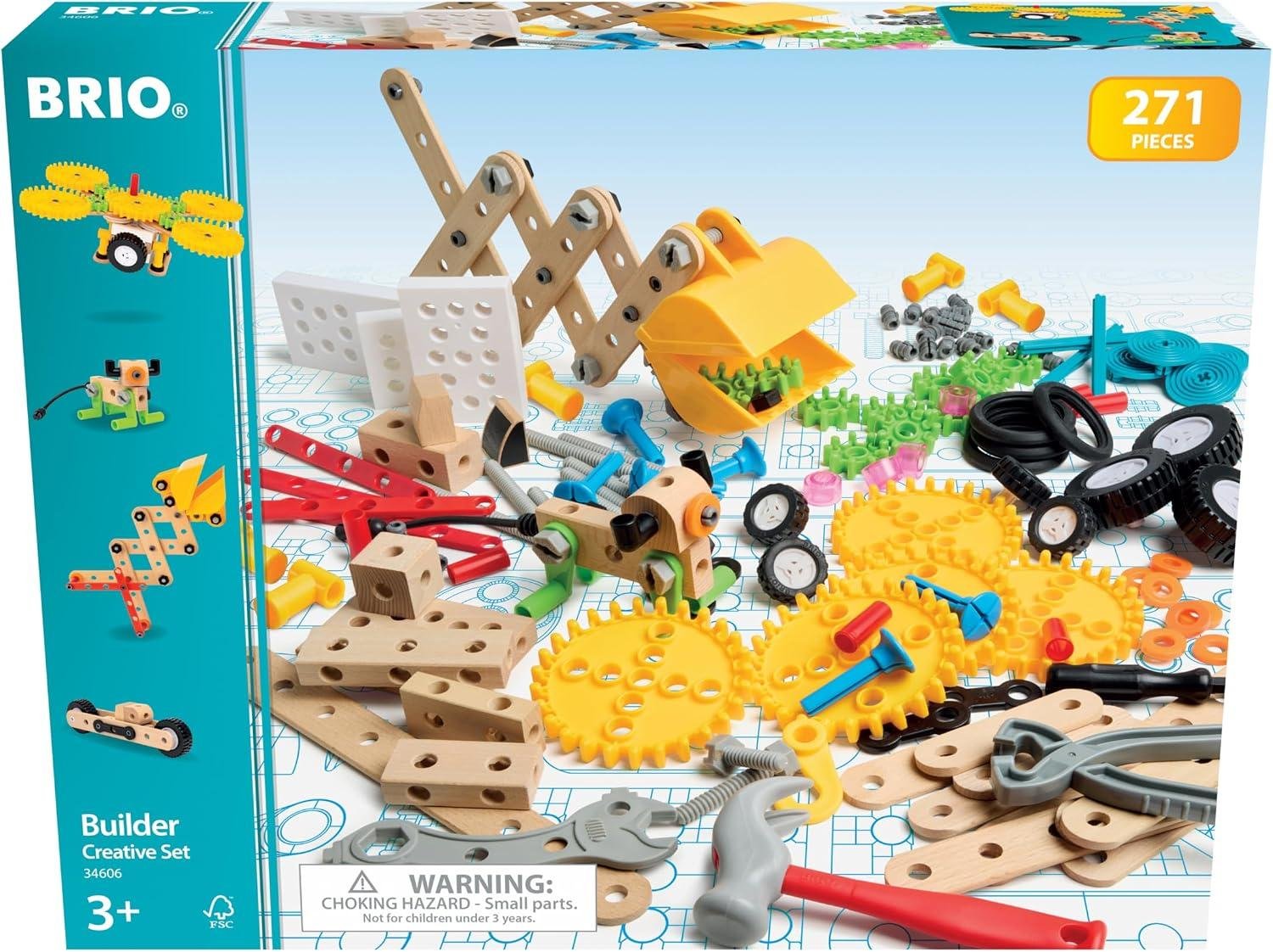
Pros & Cons
Pros
- Big, idea-friendly piece count: With 271 parts, we can build, rebuild, and keep adding “just one more upgrade” without running out of options.
- Real-tool vibe for little hands: The included screwdriver, hammer, and wrench give our builds that workshop feel-without turning playtime into screen time.
- Open-ended by design: There’s no single “correct” model, which means our kids can experiment, fail safely, and try again-exactly what we want from a builder set.
- Gears and cogs add satisfying complexity: The moving/meshing parts push play beyond stacking into simple mechanics, which keeps curiosity alive longer.
- Mixed-material charm: We like the blend of high-quality plastic with FSC-certified European beech wood-it feels more “toy chest heirloom” than disposable.
- Skill-building baked in: The set naturally nudges logical thinking, sequencing, and problem-solving while we’re “just playing.”
- Made for the 3+ crowd: The concept is appropriately approachable for preschoolers, especially as a guided, together-at-the-table activity.
Cons
- So many pieces… so much cleanup: 271 pieces is a dream for building, but a reality check for our floor-storage and sorting matter.
- Open-ended can overwhelm some kids: If our child prefers step-by-step instructions, the “no right or wrong” freedom may need gentle adult scaffolding at first.
- Builds can sprawl: With gears, bolts, and longer components, we often need a dedicated play surface to avoid table-edge tumbles.
- Small-part supervision: Even though it’s aimed at 3+, we still treat it as a “sit-and-build” set when younger siblings are nearby.
- Peak fun improves with adult involvement: Our best sessions happen when we co-build-great for bonding, less ideal if we need truly independent play.
| What We Noticed | Why It Matters in Our Shop |
|---|---|
| Tools + fasteners feel “authentic” | Keeps play themed like real tinkering, not just stacking blocks |
| Gears/cogs invite experiments | Encourages “What happens if…?” thinking and quick iteration |
| High piece count | Longer replay value, but we need a bin system to stay sane |
| Wood + plastic mix | Feels sturdy and nicer in-hand, with a more premium toy impression |
Q&A
What wood types can this handle effectively?
This set isn’t a power tool for cutting or milling wood-it’s an educational construction toy. The wooden components are FSC-certified European beech (a durable hardwood), designed to be fastened together with the included toy nuts/bolts and tools. It’s best for building models and mechanisms (frames, linkages, simple gear trains), not for shaping boards, joinery, or cabinetry.
Is this powerful enough for hardwoods like oak or maple?
There’s no motor and no cutting capability here, so “power” isn’t the deciding factor. The included pieces (including beech wood parts plus plastic parts like cogs/gears) are made to assemble by hand with the screwdriver/hammer/wrench included. If your goal is to drill, saw, or plane hardwoods, this won’t replace any shop tool-think of it as a kid-safe way to experiment with how structures and fasteners work.
How does this perform on plywood and veneers?
It doesn’t work on plywood/veneers the way a shop tool would because it doesn’t cut or sand material. You can certainly integrate small craft materials in a supervised way (e.g., adding cardboard panels or light decorative pieces), but the intended use is building with the included 271 parts-wooden beech elements and high-quality plastic components-using the toy hardware.
How difficult is the initial setup, and what adjustments are available?
Setup is essentially opening the box and organizing parts-no alignment, calibration, fences, or blade setup. “Adjustments” are the same ones you’d make on a mechanical build: choosing hole locations, tightening/loosening nuts and bolts, and positioning gears/cogs to mesh properly. Because it’s open-ended (“no right or wrong”), the learning is in experimenting with fit and movement rather than tuning a machine.
Will this fit in a small workshop, and does it need dust collection or power?
Yes-this is bench-top, kid-scale, and stores in a bin or organizer. It requires no power outlet and generates essentially no dust because you’re assembling parts rather than cutting wood. Many woodworkers like sets like this as a “shop companion” for kids: something they can do safely while you’re working nearby.
Does it work with standard accessories (bits, drivers, fasteners), and can it be mounted to a bench?
The tools and hardware are proprietary to the BRIO Builder system (toy nuts/bolts/connectors), not standard shop fasteners or driver bits. It also isn’t designed to be bench-mounted. Practically, you can dedicate a small tray or mat on your workbench to keep parts from rolling and to make cleanup easy, but treat it as a portable construction set-not a fixture.
Is this suitable for beginners, and would it satisfy a professional woodworker?
For kids aged 3+, it’s designed specifically for beginners: large-piece, hands-on assembly with simple tools and a lot of freedom to iterate. For a professional woodworker, it won’t scratch the itch for precision tool capability-but it can be genuinely useful for teaching fundamentals: how fasteners clamp parts, why bracing matters, and how gears transmit motion. It’s more “early engineering/play” than “mini woodworking.”
How durable is it, what maintenance is required, and is it worth it versus cheaper sets?
BRIO markets this to their high quality standards, using high-quality plastics and FSC-certified European beech, which generally holds up well to repeated assembly. Maintenance is minimal: keep parts sorted, periodically check for damaged pieces, and avoid storing it in damp shop conditions (wood parts can swell/warp if soaked). Value-wise, you’re mainly paying for part count (271 pieces), mixed materials (wood + plastic), and the BRIO ecosystem/build quality. Cheaper construction sets can work, but they often have fewer parts, less robust connectors, or less consistent fit-important when you’re trying to make gears/cogs mesh smoothly.
Experience the Difference
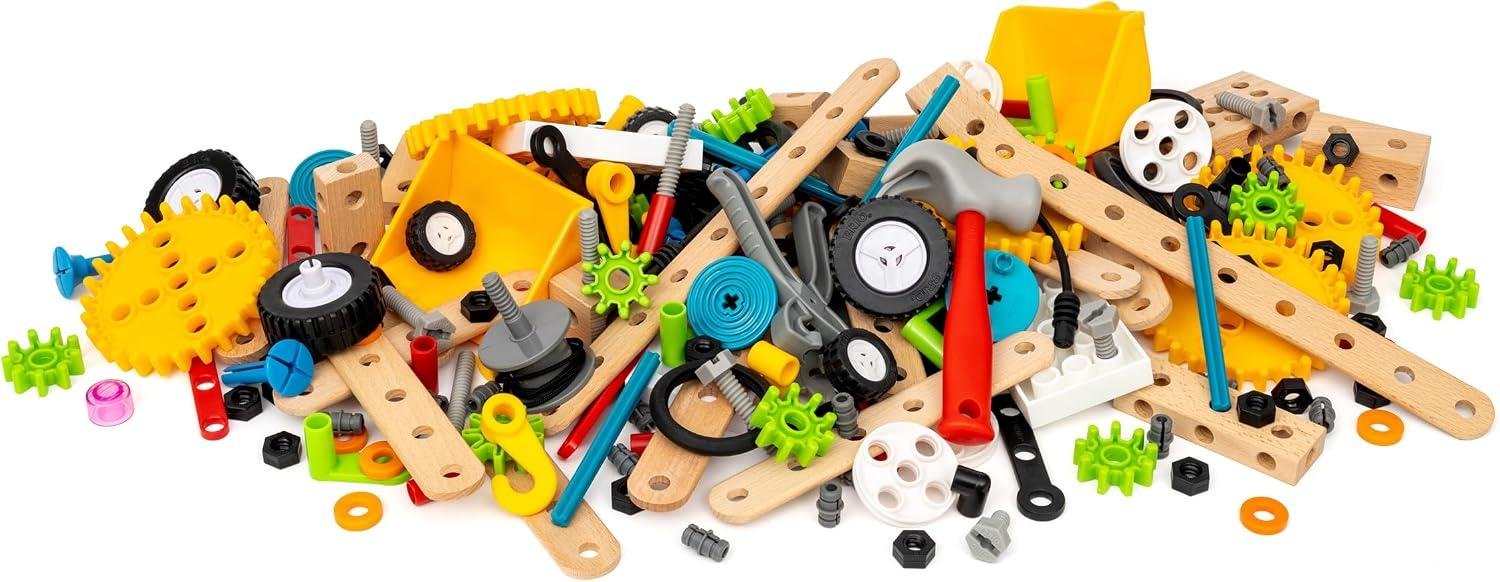
The BRIO Builder 34606 Creative Set is a 271-piece construction “tool” kit for kids ages 3+, combining FSC-certified European beech wood with durable plastics. It includes kid-friendly versions of a screwdriver, hammer, and wrench, plus nuts, bolts, cogs, and gears for building moving, mechanical assemblies. Feedback themes typically center on sturdy parts, lots of building variety, and how the open-ended format keeps kids engaged while practicing basic tool handling and problem-solving-though it’s still a toy system, not a precision woodworking instrument.
Best for: hobby woodworkers and DIY parents who want a safe, shop-adjacent way to teach fundamentals, or cabinet/furniture makers looking for a “junior bench” activity while they work on small to medium projects.
Consider alternatives if: you need real cutting/drilling capability, tighter tolerances, or a lower-cost kit for rough play.
Overall, it’s a well-made educational set with standout versatility, as long as you buy it for skill-building-not shop output.
Want to see current pricing and customer photos? View on Amazon & Read More Reviews →