
Blog
Electric Hot Wire Cutter Pen Review: Right for Our Shop?


Ever tried mocking up a curved cabinet valance, a jig, or a router template in foam—only to end up with ragged edges, melted craters, and a pile of static-clinging crumbs all over the shop? When our workspace is tight and our time is limited, precision matters, even in “temporary” materials.
The FIRElood Electric Hot Wire Cutter Pen is a 5 cm hot-melt cutting and engraving pen designed for shaping low-density foam materials like styrofoam, KT board, and EPE foam. It runs on a 12V adapter, heats up quickly (the brand notes high temperature in about 10 seconds), and includes a metal stand so we’ve got a safer place to set it down between cuts.
In this review, we’ll look at core features, build and ergonomics (including the anti-slip handle), and what customers report about cut cleanliness and ease of use—along with the real limitations, like the 30-minute duty cycle and materials it’s not meant to cut. We’re approaching this as woodworkers who regularly balance budget, accuracy, and learning curve when adding a niche tool to the bench.
Tool Overview and First Impressions in the Woodshop

In our woodshop, a hot-wire pen like this isn’t competing with a jigsaw or bandsaw—it’s more of a layout-and-template helper for anyone who builds curved jigs, mock-ups, or packaging-style forms out of foam. This kit is essentially a 12V powered hot melt cutting pen with a 5 cm heating section (some customers mention a “10 cm hot wire,” so there’s clearly listing confusion—worth double-checking what arrives). Setup is straightforward: plug the pen into the 12V adapter, hit the switch on the handle, and the manufacturer claims it gets very hot in about 10 seconds. First impressions match common review themes: many users say it “works very well” for trimming Styrofoam and that it “did the job without making a mess or cracking,” which is exactly why we’d reach for it when we want a clean foam pattern without the bead-and-dust mess a knife or rasp can leave behind.
used correctly, the educational takeaway is that this tool cuts by melting, not slicing—so we get best results when we let the heat do the work and move at a steady feed rate instead of forcing it. the included metal holder is a practical touch for the bench because the heated rod is near the head (not the very tip),and the manual specifically warns against touching metal parts and against running it more than 30 minutes continuously (cool-down recommended). Reviews also provide useful cautions for woodworkers: several buyers describe cheap build quality, some report it quitting after one use or needing an exchange, and others note it may not hold heat consistently and can collect stubborn residue on the rod; there are also mentions of a short cord and noticeable odor, so we’d plan on strong ventilation and thoughtful cord management at the bench. Importantly for shop fit, the manufacturer says it’s intended for low-density polystyrene foam and similar hot-melt materials and is not recommended for high-density boards—and it’s also not a woodworking “engraver” for actual wood the way a pyrography pen is, so it’s best viewed as an inexpensive foam-cutting specialist for small, controlled template work.
- Hot wire cutting pen
- 12V power adapter
- Metal bracket/holder
- User manual
- replacement cutting rods/tips (if available from the seller; reviews suggest the rod can bend or fail)
- High-ventilation support (shop fan or fume extraction near the bench)
- Heat-safe resting pad as a secondary parking spot (in addition to the included holder)
- Foam templates for routing patterns and curved jigs
- mock-ups for checking proportions before committing to hardwood
- protective foam inserts for tool drawers or case association
- Sign/layout prototypes before cutting wood or MDF
- Not applicable (customers report success on foam materials; this is not meant for cutting wood species)
| Spec / feature | What’s Stated | Why It Matters in a Woodshop |
|---|---|---|
| Power | 12V (with included adapter) | low-voltage tool—good for bench use,but heat output is limited vs. larger hot-wire stations. |
| Heat-up time | ~10 seconds (per description) | Quick starts help when we’re doing multiple short cuts for templates. |
| Heating length | 5 cm stated; some reviews mention 10 cm | Determines max practical cut reach and how tight we can work around curves. |
| Temperature control | No adjustment (per review theme) | Limits finesse across different foam densities/thicknesses. |
| Duty cycle guidance | Max 30 min then cool 5 min | Helps prevent overheating failures—relevant given durability complaints. |
| Accessory / Add-On | Compatibility | Notes for Woodworkers |
|---|---|---|
| Replacement hot rod/tip | Seller-dependent | Worth sourcing early; customers mention bending and early failure. |
| Metal holder (included) | Yes | Use it every time—this pen stays dangerously hot near the head. |
| Ventilation / fan | Worldwide | Reviews mention odor; foam fumes don’t belong in our lungs or on finishing projects. |
| Capacity Topic | Recommended / Intended | What Users Actually Report |
|---|---|---|
| Materials | Low-density Styrofoam/polystyrene, KT board, EPE foam, chemical fabric (hot-melt) | Common success: “cut through polystyrene like a hot knife through butter,” “clean edges,” “no mess.” |
| Continuous work | ≤ 30 min then rest | Some say it needs pauses to reheat; others report it stopped working early. |
| Cut control | Steady feed, light pressure | Good for small/detail work; limited by no temp adjustment and possible heat inconsistency. |
See Full Specifications & Customer Photos
Key Features We Will Actually Use for Foam Templates and Inlay Layouts
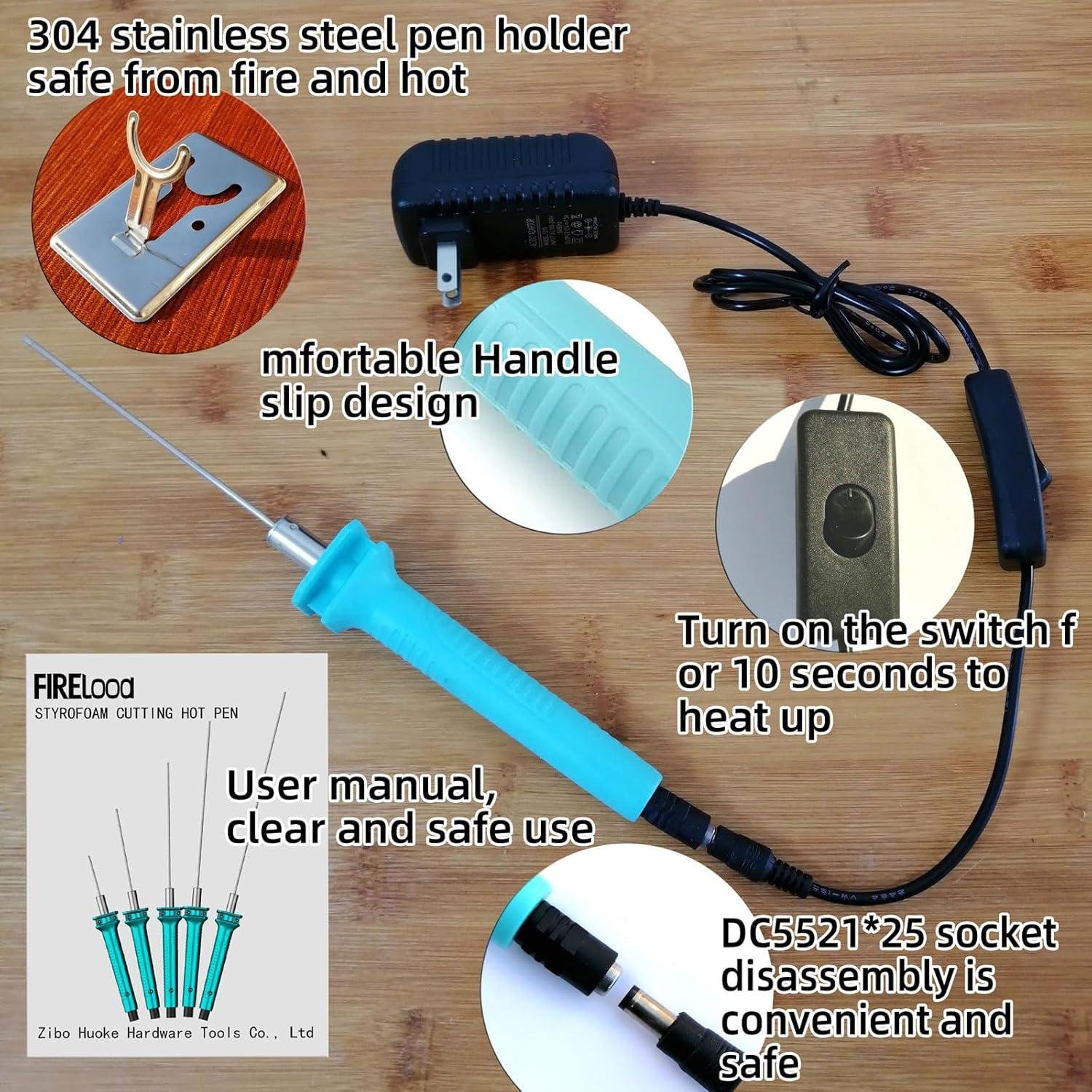
For foam templates and inlay layouts, the features we’ll actually lean on are the ones that keep our patterns clean and our shop time predictable. This kit is essentially a small hot-knife pen with a 5 cm heating tip length (the listing calls out 5 cm, tho some customer comments mention “10 cm,” so we’d verify what arrives), powered by a 12V adapter and controlled with a simple on/off switch on the handle. In practical woodworking terms, that fast heat-up—advertised as ready in ~10 seconds—is what lets us rough out a repeatable foam caul, mock up a curved inlay channel, or trace a jig profile without shredding the edges the way a utility knife can. Multiple reviewers echo that it “did the job without making a mess or cracking” and “cut…like a hot knife through butter,” which matches what we want when templates need crisp edges to transfer accurately onto MDF, hardboard, or directly onto a workpiece for layout.
Where we see the limits (and plan our workflow accordingly) is control and durability. There’s no temperature adjustment, and several reviews call out “cheap quality,” units that “quit working after one use,” and a tip/rod that “bends easily,” so we’d treat it as a light-duty template tool—not a production cutter. For layout work, technique matters: we’ll let the tip melt before feeding, keep a steady speed with minimal pressure, and avoid running it vertically to reduce that “chimney effect” heat rising into the handle (straight from the manufacturer’s guidance). We’d also plan on ventilation—reviewers mention a noticeable odor—and use the included metal bracket/stand every time we set it down to keep hot parts off the bench. Bottom line: it’s a handy way to make foam patterns for inlay and jigs when we need clean, low-mess cuts, but it’s best suited for careful hobby-level use rather than heavy, daily shop abuse.
- Hot wire cutter pen
- 12V power adapter
- Metal holder/stand
- User manual
- Replacement hot tips/rods (same style/connector as the included pen)
- Ventilation support (small fume fan or open-window airflow)
- Heat-safe work surface (silicone mat or scrap MDF under foam)
- Layout tools (French curves, template guides, fine-tip markers)
- Foam routing templates for inlay positioning and test-fits
- Mock-up cauls for odd clamp-ups and shaped glue blocks
- Jig prototypes (before committing to plywood/MDF)
- Relief cutouts in EPS for protecting fragile parts during finishing
- Not applicable (customers report success on styrofoam/polystyrene/KT board/EPE, not wood species)
| Spec / Feature | What It Means for Foam Templates | What We’d Watch Out For |
|---|---|---|
| Heating tip length: 5 cm (listing) | Better control on tight curves and small layout parts | Some reviews mention “10 cm”; confirm actual length on arrival |
| Power: 12V adapter | Portable, simple plug-in use at the bench | One reviewer complained the cord is too short |
| heat-up: ~10 seconds | Quick start for iterative template trimming | No indicator light; easy to forget it’s on |
| No temp adjustment | Fewer knobs to fuss with for basic EPS cutting | Less control on thicker/denser foams; can pause to reheat |
| Included metal stand | Safer set-downs between pattern passes | Still requires a heat-safe surface and attention |
| Accessory / Add-on | compatible? | Why We’d Use It |
|---|---|---|
| Replacement heating tip/rod | Likely (match connector + length) | Reviews mention bending/residue and occasional failures |
| Silicone heat mat | Yes | Protects benches and helps manage hot set-downs |
| Small fume fan / ventilation | Yes | addresses the “noticeable odor” reviewers report |
| Use Case | Recommended Capacity (Realistic) | “Actual” Capacity Hinted by Reviews |
|---|---|---|
| Foam template trimming | Short sessions, light pressure, controlled curves | Ofen “works grate,” but some report needing pauses to reheat |
| Long continuous cutting | ≤ 30 minutes, then cool-down (per guidance) | Durability complaints suggest keeping sessions shorter is smarter |
| Dense/high-melt materials | Not recommended (per manufacturer) | Reviews align: best on styrofoam/polystyrene only |
See Full Specifications & Customer Photos
Real World Performance on Styrofoam Patterns and Light Craft Materials

In our shop, a hot wire pen like this is most useful when we’re prototyping patterns and templates before committing good lumber—think curved forms for jigs, mockups for bandsaw shapes, or spacing layouts where cardboard would fray and a knife would tear. This kit is a 12V hot-wire cutter pen with a stated 5CM heated cutting length (some customer feedback also references a 10 cm hot wire, so we’d verify what version ships), and it’s designed specifically for low-density polystyrene and other hot-melt craft foams. In real-world handling, reviewers consistently say it heats up fast (about 10 seconds) and makes clean, sealed edges that don’t crumble—one theme we see repeatedly is “no mess or cracking” compared to fighting an X-Acto blade. That’s exactly the advantage for woodworking layout work: the foam doesn’t shed beads all over the bench, and the cut line stays crisp enough to trace onto MDF, plywood, or hardboard.
Where we’d temper expectations is durability and control. Several customer reviews mention it working “perfectly for a small project,” while others report it quit after one use or needed an exchange because it stopped working, and a few note it feels cheaply made with a rod that bends easily. That lines up with the design notes: you’re told not to apply pressure, not to bend sharp angles (keep bends > R5MM and only once), and not to run it continuously for more than 30 minutes before a cool-down. Practically,we’d use a “let the heat do the work” feed rate—pause until the foam melts,then move at a steady speed—as forcing it can break the tip and also leaves more residue on the rod (another review theme: buildup that’s hard to remove and heat that doesn’t hold on longer sessions). Also plan for the realities of hot-cut foam: customers mention a noticeable odor, so we’d only run it with good ventilation, and remember there’s no temperature adjustment (and reportedly no power indicator), which makes it better suited to simple pattern work than precision production cutting.
- Included accessories: hot wire pen, 12V adapter, metal holder/stand, manual
- Compatible attachments/accessories: Replacement hot-wire/rod tips (matching the shipped length), additional stands or silicone rests, fume extraction fan (shop-made), heat-resistant mat
- Ideal project types: Foam mockups for jigs, layout templates, sign/lettering prototypes, cosplay-style pattern parts, model-making forms before transferring to MDF/plywood
- Wood types tested by customers: None reported (this tool is for foam/hot-melt craft materials, not wood)
| Spec / Feature | What’s Stated | What It Means in a Woodshop |
|---|---|---|
| Power | 12V (adapter included) | Bench-friendly for light template work; not a substitute for saws on wood |
| Heat-up time | ~10 seconds | Quick starts for iterative pattern trimming and fitting |
| Hot wire length | 5CM (reviews sometimes cite 10 cm) | Shorter length favors controlled detail cuts over deep foam blocks—verify before buying |
| Duty cycle guidance | Max 30 min then 5 min rest | Better for small batches and hobby use than all-day shop workflows |
| Temperature control | No adjustment | Limited tuning for different foam densities/thicknesses |
| Accessory | Fit/Use | Why We’d Add It |
|---|---|---|
| Replacement heating rod/hot wire | Must match the pen’s connector and length | Helps if residue buildup or bending shortens usable life |
| Heat-resistant mat | Universal | Protects benches; complements the included metal holder |
| Small ventilation fan / fume capture | Universal | Addresses the odor reviewers mention when cutting foam |
| Capacity | Recommended | What Users Actually Report |
|---|---|---|
| Project size | Small craft/template jobs; short sessions | Often praised for small projects; mixed feedback on longer use (heat holding, residue) |
| Material type | Low-density polystyrene, KT board, EPE, hot-melt craft materials | Strong results on styrofoam/polystyrene sheets; explicitly not for dense/high-melt materials |
See Full Specifications & Customer Photos
Ease of Use and workshop Setup for Beginners and Seasoned Woodworkers

For beginner-friendly setup, this hot wire cutter is about as plug-and-go as a specialty shaping tool gets: we connect the included 12V adapter, set the pen into the metal holder when we’re not actively cutting, and flip the on/off switch on the handle. The maker claims it reaches working temperature in about 10 seconds, and customer feedback aligns with that “heats up quickly” theme—especially for trimming and shaping low-density polystyrene (Styrofoam) without the cracking you can get from knives or saws. In a woodworking shop, that ease matters when we’re mocking up curved parts, building jigs, or fitting foam for casework packaging—several reviewers specifically praised the clean edges and less mess versus an X-Acto blade. That said,seasoned woodworkers will want to treat it like a dedicated foam tool: it’s designed for hot-melt materials (foam board,KT board,EPE foam,chemical fabrics) and the manufacturer explicitly notes it cannot cut cardboard,paper film,plastic boards,PU boards,sponges,rubber,or other high-density/high-melting-point sheets.
from a workshop workflow standpoint, the learning curve is more about technique and safety than “assembly.” We get the best results when we let the wire/rod melt first and then feed at a steady pace—forcing it can damage the tip,and customers mention the tool feels “on the cheaper side,” with multiple reports of units that quit working or broke after light use. The maker also warns not to run it continuously for more than 30 minutes (then cool for 5), to avoid bending the heated rod sharply (keep bends greater than R5mm, and only bend once), and not to operate it vertically to prevent heat rising into the handle.For seasoned shops, two practical setup notes stand out from review themes: there’s no temperature adjustment (limits finesse on thicker foam) and some users report a noticeable odor, so we’d plan on good ventilation and keeping it off the main bench near sawdust piles. Also, buyers complained the cord is far too short, so we’d route a cord safely or use a properly rated outlet placement—especially since one reviewer noted there’s no indicator light to confirm it’s powered on.
- Included accessories
- Hot wire cutting pen (listed as 5CM length in the title/specs)
- 12V power adapter
- metal holder/bracket
- Manual
- Compatible attachments/accessories (shop add-ons we’d consider)
- Heat-resistant cutting mat or ceramic tile for a safe rest surface
- Small bench hook/clamp setup to stabilize foam sheets
- Ventilation fan or fume extractor (helpful given “noticeable odor” comments)
- Ideal project types
- Template/mock-up shaping for curved woodworking parts
- Foam packaging inserts for finished pieces
- Jig prototyping in low-density foam before committing to plywood/MDF
- Prop/craft shaping where clean foam edges matter (reviewers mention costume/model work)
- Wood types tested by customers
- None reported — reviewers primarily mention Styrofoam/polystyrene and similar foams
| Spec / Feature | What We Get | What It Means in the Shop |
|---|---|---|
| Power requirement | 12V adapter (plug-in) | Easy bench power, but plan cord routing; some users call the cord too short. |
| Heat-up time | ~10 seconds (per description) | Quick starts for layout tweaks and small foam fitting tasks. |
| Adjustment | No temperature adjustment (per reviews) | Less finesse on varying foam densities/thicknesses; speed control is mainly by feed rate. |
| Duty cycle guidance | 30 min on / cool 5 min (per description) | Better for short sessions than production runs. |
| Accessory / Add-on | Compatible? | Why We’d Use It |
|---|---|---|
| Heat-resistant mat/tile | Yes | Safer parking/setting down between cuts (even with the included metal holder). |
| Bench clamps/hold-downs | Yes | Prevents foam chatter and helps keep cuts straight and controlled. |
| Ventilation/fume control | Recommended | addresses “noticeable odor” feedback while cutting foam. |
| Capacity Topic | Recommended (Realistic) | Actual Notes (From Specs/Reviews) |
|---|---|---|
| material type | low-density polystyrene (styrofoam) and similar hot-melt foams | Reviewers consistently report it cuts polystyrene/Styrofoam cleanly; manufacturer warns against higher-density/high-melt materials. |
| Session length | Short shaping sessions with breaks | Maker says don’t exceed 30 minutes continuous; some users mention it doesn’t “hold heat” consistently. |
See Full Specifications & Customer Photos
Customer Reviews Analysis

What Woodworkers Are Saying (Review Analysis)
1. Overall sentiment from woodworking customers
Overall sentiment is mixed but generally practical: several woodworkers and DIY makers liked how cleanly it cuts foam compared with knives, but multiple reviews highlight budget-level durability and occasional early failures. Common praise includes “no mess” foam trimming and clean edges, while some users reported challenges with reliability and heat consistency.
2. Performance feedback (accuracy, power, results)
Cut quality & results
- Several woodworkers mentioned it cuts styrofoam/polystyrene cleanly without cracking, tearing, or the bead-mess you get from blades.
- Customers successfully used this for small, detailed shaping, with one review describing it cutting “like a hot knife through butter.”
heat/power consistency
- Some users reported challenges with holding heat under continuous use, needing pauses to “let [it] heat back up every few minutes.”
- Multiple reviews highlight no temperature adjustment, which limits control when switching foam thicknesses or trying to slow-melt for finer detail.
Precision
- Common praise includes clean, controlled cuts for craft-scale work. Reviewers mentioned “clean and precise cuts” and that the wire length provides manageable control for smaller pieces.
3. Build quality and durability observations
Durability is the most frequent negative theme.
- Several woodworkers mentioned the tool stopping after light use (including one that “quit working after one use”).
- Some users reported having to exchange a dead unit, with the replacement working fine afterward.
- Multiple reviews highlight cheap construction, including a “metal stick”/rod that bends easily and a general “cheaply made” feel.
- One reviewer noted the heating element/rod can burn and collect residue that’s challenging to remove, reducing usable lifespan.
4. ease of use for different skill levels
Beginner-friendly handling
- Beginners and casual DIYers appreciated the straightforward, pen-like handling and fast heat-up for quick tasks.
- Reviewers with basic experience found it worked “perfectly for the small project” and “what I needed.”
workflow considerations
- Some DIYers found the process interrupted by heat recovery time,which can be frustrating when trying to make repeated cuts.
- Multiple reviews highlight safety/usability gaps: no indicator light for powered-on status, so extra care is needed.
5. Common project types and success stories
Reviews skew heavily toward foam and craft builds rather than wood stock—still relevant for woodworkers doing templates, mockups, props, forms, and modeling:
- Several reviewers mentioned styrofoam/polystyrene sheet cutting and trimming (insulation-style foam work).
- customers report using this for modeling styrofoam and “anime”/craft foam shaping.
- one user described it being helpful for a five Nights at Freddy’s costume build, emphasizing easier foam cutting and “nice clean edges.”
6.Issues or limitations reported
Some users reported challenges with:
- Early failures / inconsistent reliability (dead after one use, broke after light use).
- Heat stability (doesn’t “hold heat well,” requires frequent pauses).
- Odor while cutting, with reviewers recommending good ventilation.
- No temperature control, limiting finesse across different foam densities/thicknesses.
- No power indicator light, which makes it easier to forget it’s on.
- Short cord getting in the way during positioning and longer cuts.
- Residue buildup on the heated rod/wire and difficulty cleaning it off.
| Aspect | Common feedback |
|---|---|
| Performance | Clean foam cuts with less mess than knives; some report weak heat retention and no temp control |
| Precision | Good for small, controlled cuts; limited by fixed temperature and occasional heat drop-offs |
| Durability | Mixed—several early failures; rod/wire can bend and collect residue |
| ease of Use | Generally simple to handle; drawbacks include short cord and no power indicator |
| Value | Budget-friendly and effective when it works; multiple reviews suggest spending more for longer life |
Bottom line (from reviews): Woodworkers and makers liked it as an inexpensive way to get clean foam cuts for templates, mockups, and craft builds, but multiple reviews highlight quality control and longevity as the main reasons it may not hold up for frequent shop use.
Pros & Cons

Pros & Cons
| What We Liked | What We Didn’t |
|---|---|
| Heats up fast (we’re cutting within ~10 seconds) | Not for everything—high-density foams and many plastics are a no-go |
| Smooth, sealed cuts with very little mess | Has a learning curve: speed/angle matter for clean results |
| Handy “pen” format for curves, details, and freehand shaping | Tip/wire can be fragile if we push, twist, or bend sharply |
| Includes a metal stand, which actually helps us work safer | Duty cycle limits: recommended breaks after ~30 minutes |
Pros
- quick heat-up, quick momentum. Once plugged in and switched on,it reaches working temperature fast,so we’re not waiting around between cuts.
- Cuts foam cleanly and “seals” edges. On low-density styrofoam and similar hot-melt materials, it glides through and leaves a tidy edge without the bead-y debris we get from tearing or sawing.
- Great control for DIY shapes. The pen-style body makes it feel more like drawing than cutting—useful for bevels, curves, lettering, and small model-making details.
- Stand + grippy handle = more practical than it sounds. The included metal bracket gives us a dedicated “parking spot” during pauses, and the anti-slip grip helps during longer sessions.
- Kit is ready-to-run. We get the hot wire pen, 12V adapter, holder, and manual—no scavenger hunt for basic essentials.
Cons
- Material limits are real. It’s intended for low-density polystyrene foam,KT board,EPE/pearl cotton,and other hot-melt materials—not cardboard,paper,PU board,sponge,rubber,plastic boards,or high-density insulation boards.
- Paper-faced boards are risky. Anything with a paper film is specifically discouraged due to ignition risk—so we have to be picky about our foam stock.
- Fragility if we force it. If we push too hard, try to cut before it fully melts, or bend the tip sharply (or repeatedly), we can damage the tip/wire or even short the internal circuit.
- Heat creep is a safety consideration. The heating area is near the pen head, and operating vertically can drive heat upward (“chimney effect”), potentially warming the handle—so our technique matters.
- Not built for marathon sessions. The maker recommends not running it continuously for more than 30 minutes and taking a cool-down break,which can slow down production-style workflows.
Q&A

What wood types can this handle effectively?
This hot wire cutter pen isn’t a wood-cutting tool—it’s designed for hot-melt materials like low-density polystyrene (Styrofoam), KT board, EPE foam (“pearl cotton”), and some chemical fabrics. Per the manufacturer notes, it cannot cut wood, plywood, veneers, cardboard/paper, plastic boards, PU boards, sponge, rubber, or high-density insulation boards. For woodworking, it’s best viewed as a layout/model-making tool for foam mockups, templates, and jig prototypes before you commit to wood.
Is this powerful enough for hardwoods like oak or maple?
No. Even though it heats up fast (the listing claims very high temp in about 10 seconds), it works by melting material, not by shearing fibers. Hardwood (oak/maple) won’t melt, and attempting to “cut” wood with it will just scorch the tip and create a burn hazard. If you need to shape hardwood, you’ll be happier with proper cutting tools (saws/routers) or carving tools, not a hot wire pen.
How does this perform on plywood and veneers—could it be used for inlay templates?
It won’t cut plywood or veneer. where it can help woodworkers is making foam templates/mockups for inlay layouts, curved forms, or test-fitting designs. Reviews consistently mention it makes clean cuts on polystyrene with less mess than knives (“hot knife through butter”), which is handy for quick proof-of-concept work before you move to MDF or acrylic templates.
How difficult is the initial setup and operation?
Setup is simple: the kit includes the hot wire pen, 12V adapter, metal holder (stand), and manual. Plug in, then use the switch on the handle. The maker notes you should ensure the DC connector is fully inserted or it may not heat correctly. In use, you’ll get the best cut by waiting for the foam to melt and moving at a steady pace—don’t force it, because excessive pressure can break the tip.
Are there adjustments (temperature/speed) and does it work with standard accessories?
This is a basic, fixed-output style tool: customer feedback notes there’s no temperature adjustment, which limits control on different foam thicknesses/densities. It also isn’t a “standard hot knife system” with lots of interchangeable blades—treat it as a simple pen-style cutter. If you need repeatable production results or multiple tip styles, a higher-end foam cutter system with temperature control is a better match.
Will this fit in a small workshop,and what power/outlet does it need?
Yes—this is very small-bench friendly. It runs from the included 12V adapter, so you’re using a normal wall outlet for the adapter and low-voltage power at the tool. The included metal bracket/stand is useful in a crowded shop as you can set the pen down between cuts to reduce burn risk.
Do I need dust collection or special ventilation?
You won’t make “sawdust,” but you will create fumes/odor melting foam—one reviewer specifically mentioned a noticeable odor and recommended good ventilation. Practical shop advice: work near an open door/window or use a small fan to move fumes away from your breathing zone, and avoid cutting any foam with paper film (the manufacturer warns it can ignite).
Is it suitable for beginners, and is it durable enough for production use?
Beginner-friendly for light DIY foam work: many users report it “worked perfectly” on small projects and produced clean edges with less mess than an X-Acto. Durability is mixed, though—multiple reviews mention units stopping after one use or breaking with light use, and others note the rod bends easily or doesn’t hold heat consistently. Also, the manufacturer recommends no more than 30 minutes continuous use (then cool for 5 minutes), which makes it better for hobby/modeling tasks than continuous production.
Reveal the Unusual

The Electric Hot Wire Cutter 5CM hot Melt Pen Kit is a compact, plug-in 12V hot wire/heat cutting pen designed for shaping low-density foams (styrofoam, KT board, EPE/pearl cotton) with clean, sealed edges and far less debris than knives. It heats fast (about 10 seconds), includes a metal safety stand and non-slip handle, and is meant for short sessions (avoid 30+ minutes continuous use). Customer feedback most frequently enough praises the mess-free, smooth cuts and ease of use, while common complaints mention cheap build quality, bending tips, short cord, odor, and occasional early failure.
Best for: hobby woodworkers doing small to medium projects like foam mock-ups, templates, routing patterns, cosplay props, or craft detailing where precision shaping matters.
Consider alternatives if: you need daily durability,temperature control,longer run times,or you primarily cut dense foams/wood/plastics (this isn’t for hardwood work).
Final assessment: a solid budget option for occasional foam shaping,but quality consistency limits it as a “shop staple.”
Want to see current pricing and customer photos? View on Amazon & Read more Reviews →