

Blog
ROKR LK602 Printing Press Kit Review: Shop-Worthy?

Ever find yourself in the shop craving a “small win”—something precise and satisfying—only to realize your latest project needs more space, more clamps, and more time than you’ve got? When bench space is tight and we still want accuracy, a well-made kit can scratch that joinery itch without firing up a single machine.
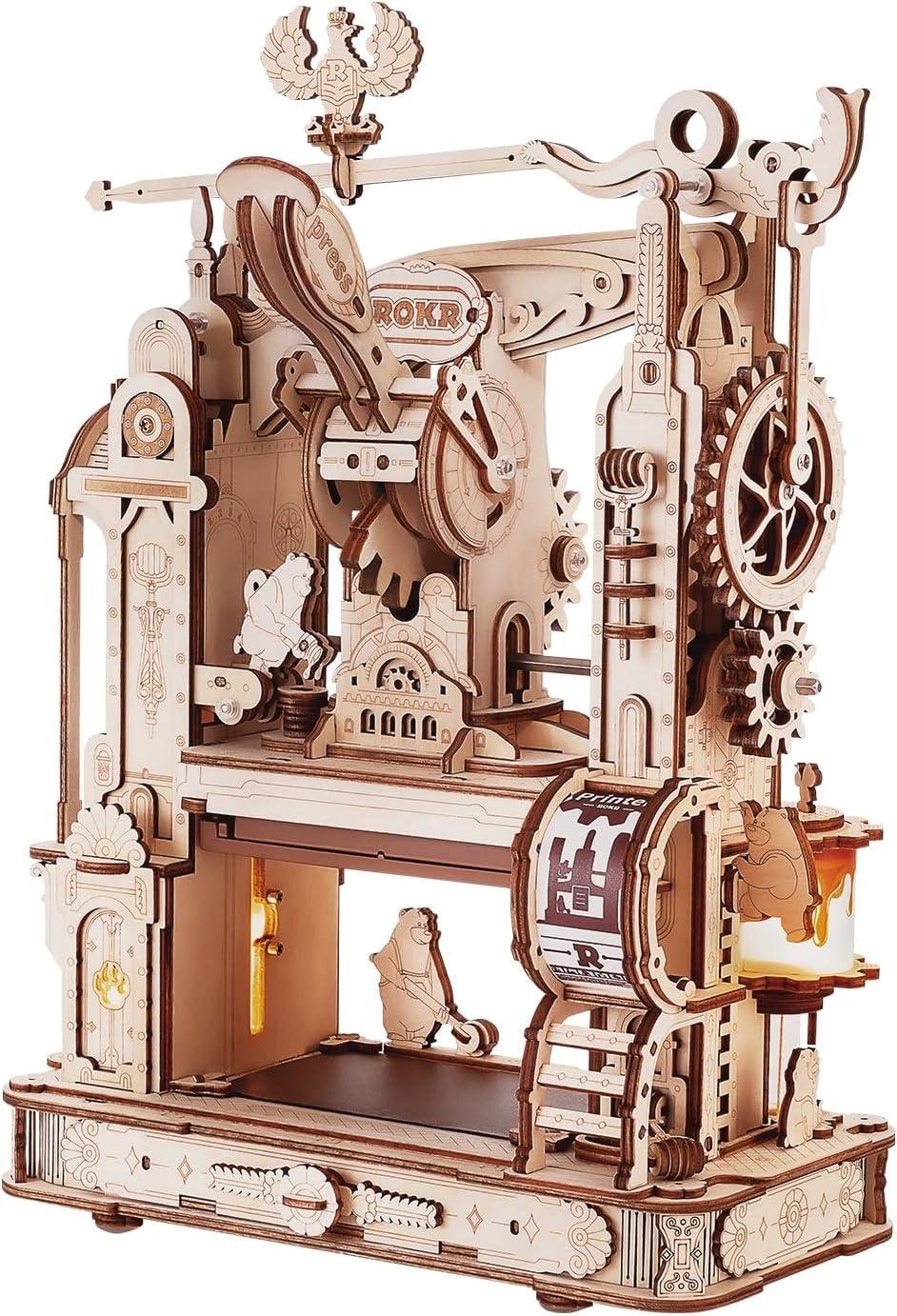
The ROKR 3D Puzzle for Adults Classic printing Press (LK602) is a laser-cut wooden model kit designed to build a working, vintage-style press complete with gears, a 45° hand-press handle, a drawer for paper storage, and even water-based ink, rubber stamps, and 20 sheets of small writing paper. It’s a 303-piece build with an illustrated manual and basic tools included.
In this review, we’ll look at the kit’s cut precision, fit-up consistency, build quality, learning curve, and overall value, plus what customers report about assembly difficulty and the “working” printing action (including the optional LED that requires two separate batteries). From years around sawdust and tolerances, we know: good projects start with good parts—and this one aims to deliver that, at a hobby-pleasant scale.
First Impressions and Build Quality for a Laser Cut Wooden Press Kit
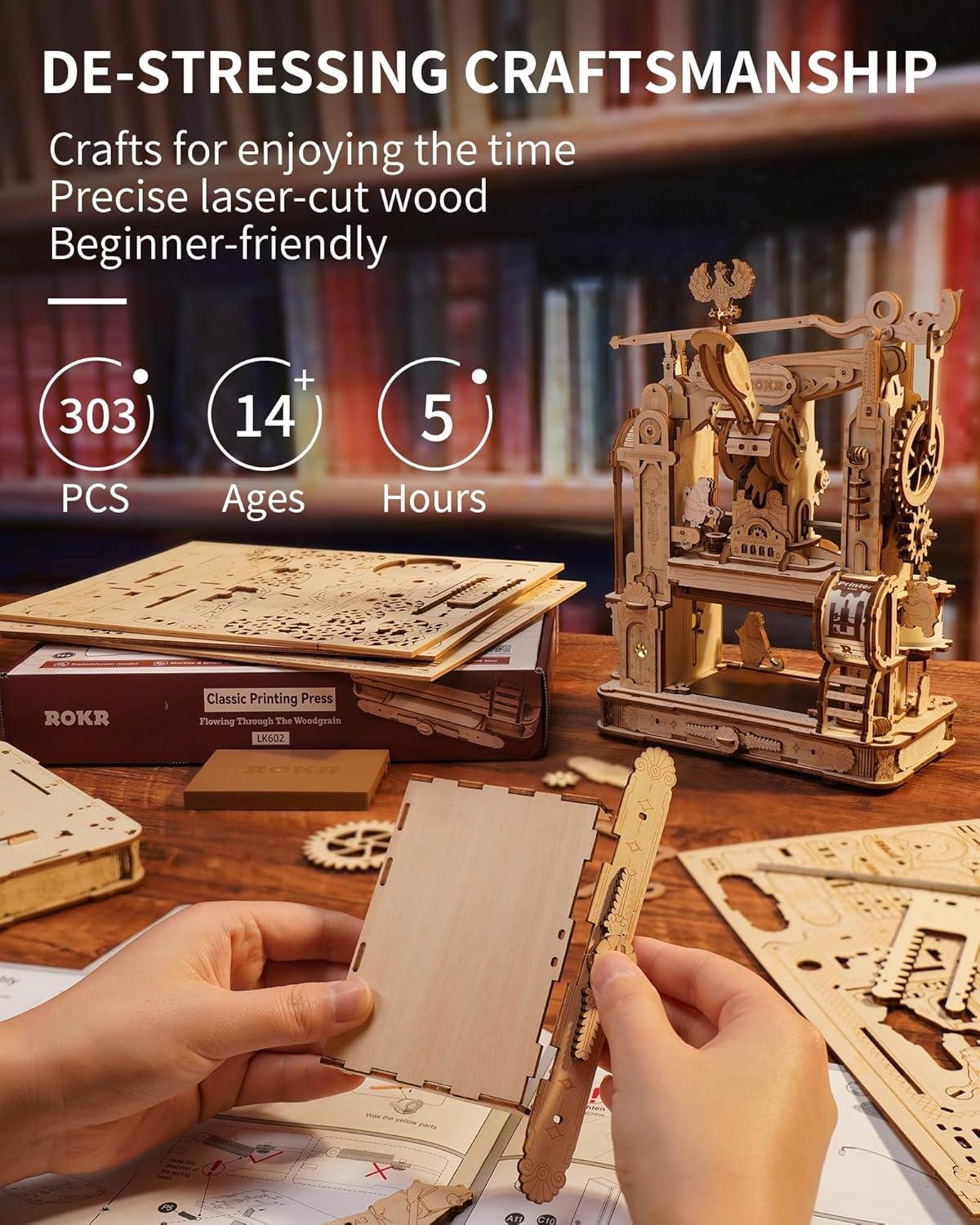
Out of the box, the ROKR Classic Printing press (LK602) reads more like a small laser-cut wooden press kit than a “tool,” and that’s a helpful mindset for woodworkers: we’re assembling a precision fit-up of 303 parts that have been laser etched/pre-cut and meant to “pop out” from the sheets with light pressure. Multiple reviewers echo the same first impression—“pieces fit well together” and “looks gorgeous when put together”—and in our shop terms, that usually means the tab-and-slot geometry is consistent and the kerf allowance is predictable. The parts are described as smooth and “thicker” than typical balsa model kits, which matters in practice: thicker stock tends to resist splitting during press-fit, but we still want to treat it like thin, brittle hardwood ply—support the back, don’t twist parts out, and keep a sharp knife handy for the occasional stubborn micro-tab. One experienced builder even noted using an X-Acto only on “a very few small and intricate pieces,” which tracks with how we’d approach delicate fretwork in the shop.
Build quality, though, isn’t just how it looks—it’s how it behaves under load when we actually “run” the press. This is a hand-operated mechanism with a 45° handle, gear train, and a small platen/paper area, and customer feedback is candid about its limits: the paper tray is effectively capped at 3.5″ × 2″ (business-card size), and several folks wanted a bigger tray, more paper, and more letters/symbols. On the mechanical side, reviewers report it’s “challenging but doable,” with real-world assembly times closer to 8–10 hours than the 5 hours claimed in the description—useful information for us if we’re thinking of this as a weekend bench project. A couple of practical workshop lessons show up in the reviews too: one builder made a small tweak to keep gears from slipping, and another mentioned needing a bit of extra pressure to get full ink transfer—both reminders that alignment, friction, and even a touch of lubrication matter in wood mechanisms. The manufacturer specifically recommends lubricating the gear section with a wax block and capping/removing the ink cartridge for storage, which is basically the same maintenance logic we use for wooden jigs: reduce friction, prevent drying, and avoid forcing parts that can snap.
- Included accessories
- Illustrated instruction manual + parts list
- Screwdriver
- Wax block (for gear lubrication)
- Sandpaper
- Metric ruler
- Screws + spring
- Rubber stamps/characters (numbers, kaomoji, cartoons, letters)
- Water-based ink
- 20 sheets of paper sized 3.5″ × 2.1″ (stores in the bottom drawer)
- Compatible attachments/accessories (practical add-ons woodworkers may already own)
- Hobby knife (X-acto style) for clean part release
- Fine needle files or sanding sticks for tight slots
- Paste wax/candle wax (if you misplace the included wax block)
- Small trays/parts organizers for tiny rubber letters
- 2 batteries (required separately for the LED light)
- Ideal project types
- Bench-top mechanical model build with functional output (printing)
- Shop-made “maker demo” piece for teaching gears, cams, and alignment
- Small-card printing: labels, thank-you notes, mini stationery
- Wood types tested by customers
- Not specified in reviews (kit wood described only as pollution-free, smooth, laser-cut)
| Spec / Build Metric | What’s Stated in Listing | What Reviewers Commonly Report |
|---|---|---|
| Part count | 303 pieces | Fit-up generally good; “all the pieces fit well together” |
| Assembly time | ~5 hours (claimed) | Often 8–10 hours; “challenging but doable” |
| Paper capacity | 3.5″ × 2.1″ included paper | Tray feels limiting; manny want a bigger print area |
| Operation | Manual press with 45° handle + gears | Sometimes needs careful adjustment; occasional gear slip fixes mentioned |
| Accessory | Included? | Workshop Use |
|---|---|---|
| Wax block | Yes | Lubricates gears; reduces binding in wood mechanisms |
| Sandpaper | yes | De-fuzz tabs/slots; fine-tune press-fit without forcing |
| Screwdriver + screws | yes | Controls clamping force more safely than “muscling” press joints |
| hobby knife | No | Cleanly severs micro-tabs; prevents tear-out on delicate parts |
| 2 batteries for LED | No | Powers the light feature; not required for mechanical function |
| Capacity / Limit | Recommended (Practical) | Actual (From Specs/Reviews) |
|---|---|---|
| Print size | Plan projects around business-card formats | ~3.5″ × 2″ effective tray size; 3.5″ × 2.1″ paper included |
| Press force | Firm, even hand pressure; avoid levering aggressively | Some report needing extra pressure for full ink transfer |
See Full Specifications & Customer Photos
Real World Performance in Assembly fit Tolerances and Moving Mechanisms
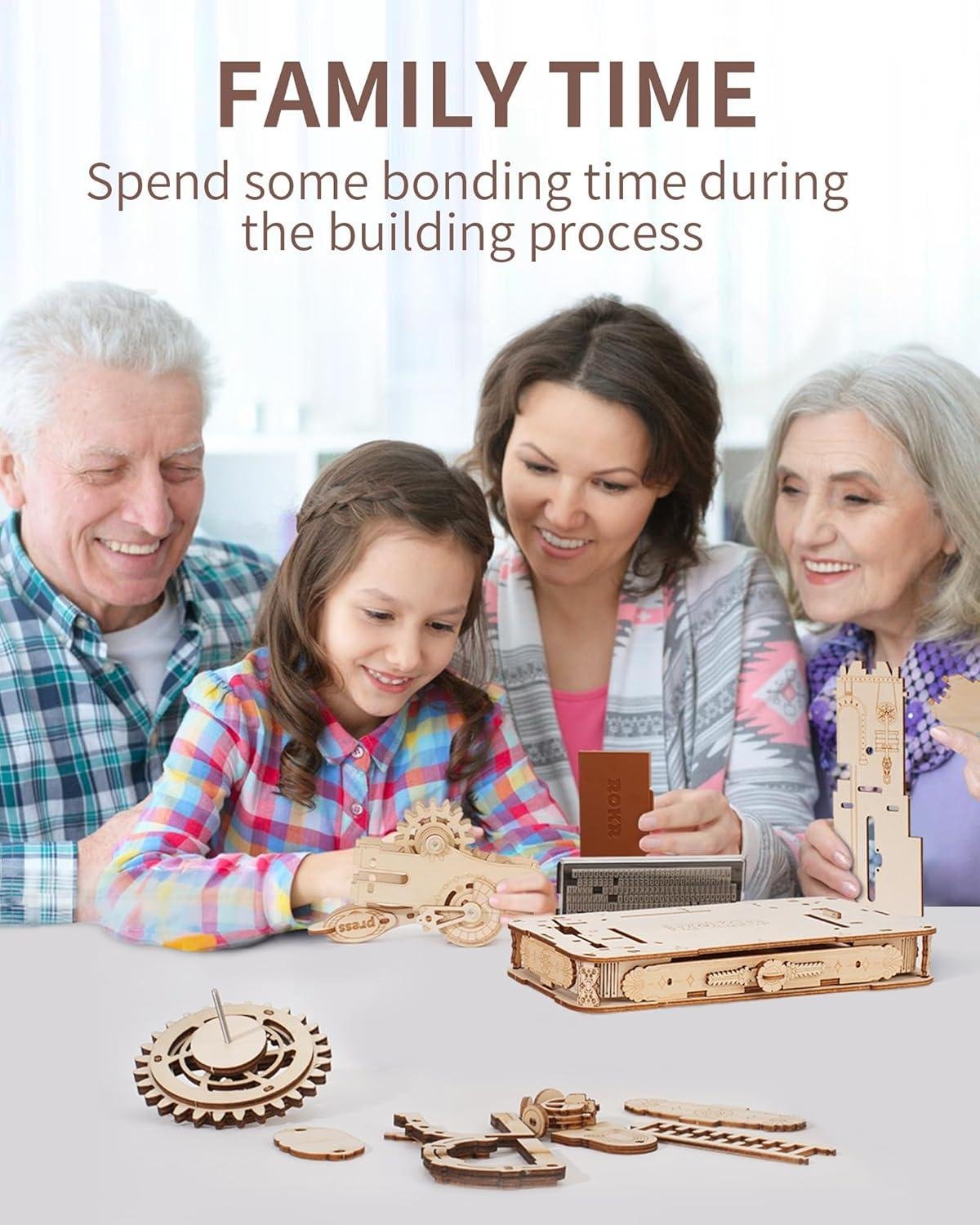
In our shop, the first thing we look for in a laser-cut kit like the ROKR Printing press (LK602) is whether the 303 pre-cut wooden parts behave more like accurate joinery or like “model-kit close enough.” Here, the general theme from customers—“all the pieces fit well together” and “well cut”—tracks with what we’d expect from precise laser cutting: parts typically “pop out” cleanly with slight pressure, and only the most intricate bits may need a knife to avoid tear-out.Having mentioned that, we also see consistent real-world timing feedback that’s more honest than the advertised ~5 hour assembly: multiple builders report 8–10 hours, especially if you work in short sessions (which we recommend for accuracy). From a woodworking technique standpoint, treat it like a dry-fit-heavy assembly: keep a small sanding block handy for fuzz on tabs, use light finger pressure rather of forcing joints, and test gear alignment before committing anything—as once a tight press-fit is over-stressed, thin wood can split in a way that feels a lot like blowing out an edge on a too-tight mortise.
Where this kit gets interesting for us as woodworkers is the functional mechanism: it’s not just a display, it’s a small moving press with gears and a hand lever. Users frequently describe it as “works as described” and “super fun once you get the hang of setting the lettering”, but a few real-world tolerance notes matter. One reviewer had to make a minor adjustment to keep gears from slipping (they tightened a holder using a bent paperclip), which is a classic sign of borderline backlash or shaft retention in small wooden gear trains. The manufacturer’s own tip to lubricate the mechanical section with a wax block is worth following—waxing wooden gear teeth is the same principle we use on stiff wooden drawers and wooden jigs: it reduces friction and evens out imperfect contact. Printing performance also reveals fit/pressure limitations: customers mention needing extra pressure on the text plate to get consistent ink transfer,and the paper system is intentionally small—20 sheets of 3.5 × 2.1 in are included, and multiple reviewers note the tray effectively tops out around 3.5″ × 2″ (business card size). Simply put, it’s a novelty mechanism with real tolerances: great for learning how small mechanical assemblies behave, but not something we’d treat like a precision jig without expecting a bit of tuning.
- Included accessories: illustrated instruction manual, parts list, screwdriver, spring, screws, sandpaper, metric ruler, wax block, rubber stamps (numbers/kaomoji/cartoon), water-based ink, 20 sheets of 3.5 × 2.1 in paper
- Compatible attachments/accessories (practical workshop add-ons): hobby knife (X-Acto), fine sanding block (220–400 grit), tweezers for small stamp pieces, paste wax (backup to included wax), small clamp or rubber bands for gentle holding during alignment, two batteries for LED lighting (not included)
- Ideal project types: business-card-sized thank-you notes, maker’s marks on small cards, collage/junk-journal inserts, classroom STEM demos of gear trains and presses, display piece for a workbench shelf
- Wood types tested by customers: not specified in reviews (kit material described as smooth, pollution-free wood with laser cutting)
| Spec / Real-World Metric | What We Know (Specs/Reviews) | Why It Matters in Assembly & Motion |
|---|---|---|
| Piece count | 303 parts | More joints = more opportunities for tolerance stacking; dry-fit and align gear trains before final seating. |
| Claimed assembly time | ~5 hours (manufacturer claim) | Plan extra time if you’re careful—rushing increases the chance of broken tabs and misaligned gears. |
| Typical real assembly time | 8–10 hours (multiple customer reports) | Matches a careful, workshop-like approach (short sessions, re-checking alignment). |
| Paper capacity | 20 sheets, 3.5 × 2.1 in; tray noted as ~3.5″ × 2″ | Mechanism is built around small format; pressure and platen contact are tuned for business-card size. |
| mechanism lubrication | Wax block recommended | Wax reduces friction and helps “average out” tight spots in gear mesh and sliding faces. |
| Accessory / “Bit” Equivalent | Included? | Use in Fit/Tolerance Tuning |
|---|---|---|
| Wax block | Yes | Lubricates gear teeth and sliding parts to reduce binding. |
| Sandpaper | Yes | Knocks off laser-cut fuzz so press-fits don’t seize or mis-seat. |
| Screwdriver / screws | Yes | Helps keep assemblies square where mechanical alignment matters. |
| Hobby knife (X-Acto) | No (reviewers often use one) | Cleaner part removal reduces tear-out that can change fit and gear alignment. |
| Extra ink/paper | No (customers wish it were available) | Consumables affect printing consistency; having spares keeps the mechanism in use without improvising. |
| Capacity Area | Recommended (Practical Expectation) | Actual (Specs/Reviews) |
|---|---|---|
| Print size | Plan for business-card formats | 3.5 × 2.1 in paper included; tray reported to fit about 3.5″ × 2″ |
| Pressure/transfer | Light-to-moderate lever force; avoid stressing wood | Some users report needing extra pressure on the text plate for full imprint |
See Full Specifications & Customer Photos
Key Features Woodworkers Will Appreciate in the Printing Press Design
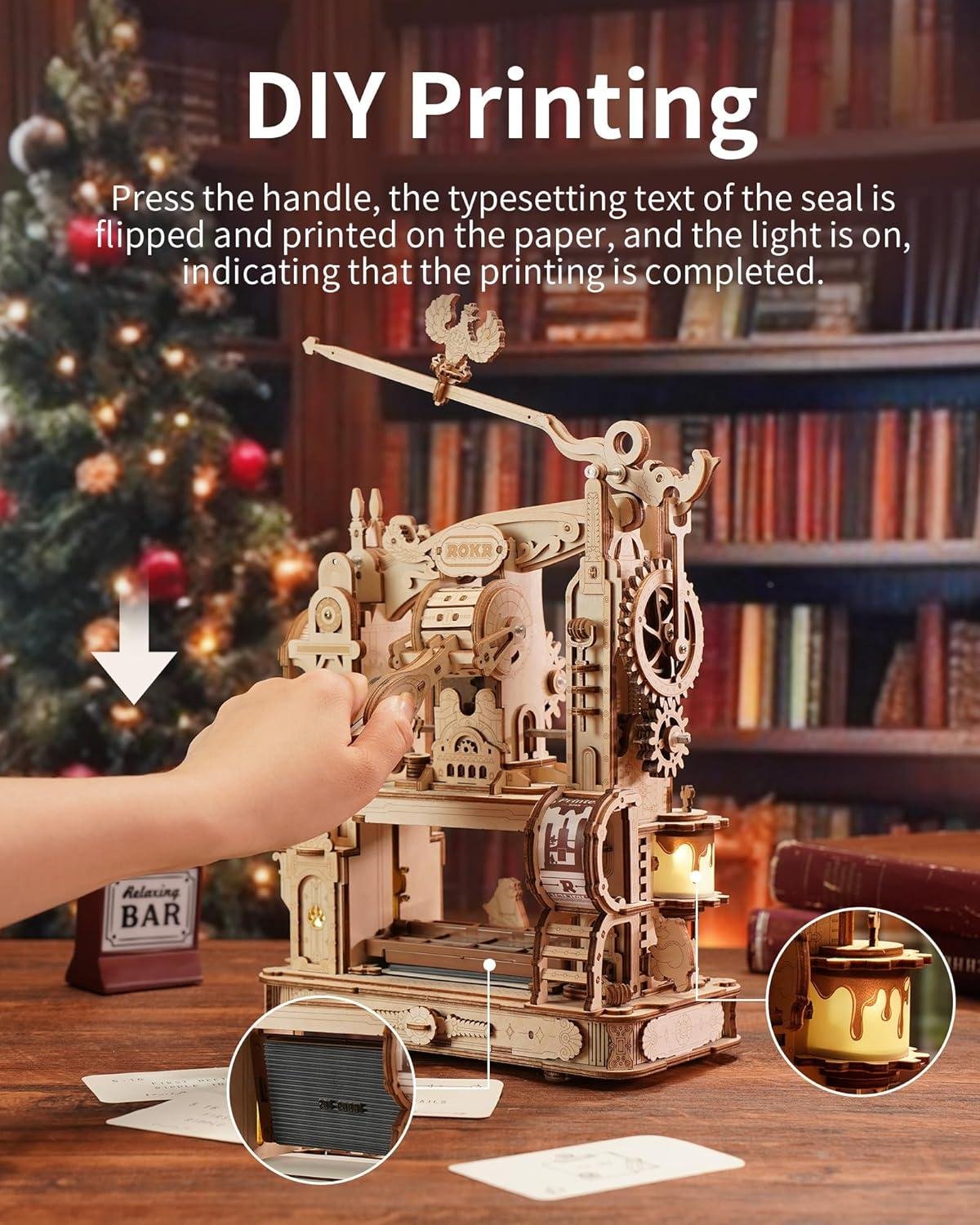
In our shop, what stands out first is the laser-cut, thicker-than-balsa wood construction and the way the press is essentially a small, hand-operated mechanism we can study like a joinery mock-up. The kit includes 303 pre-cut pieces and is designed around a 45° hand lever that drives the gears and platen action—great for understanding how leverage, gear timing, and alignment affect “print” quality in the same way they affect jigs, clamps, and toggle fixtures.Multiple reviewers echo that the parts are “well cut,” “fit well together,” and “looks beautiful when put together,” and we like that it rewards careful dry-fitting and patient sequencing (more like a fussy glue-up than a toy).Reviewers commonly report build times closer to 8–10 hours despite a 5-hour claim, which tracks with how long it takes us to work cleanly—lightly sanding tabs, easing tight slots, and checking gear mesh before committing. One “newbie” even mentioned making a small tweak to stop gear slip, which is a useful reminder: in wood mechanisms, tolerance stacking is real, and tiny alignment errors can show up as skipped teeth or uneven pressure.
from a practical woodworking standpoint, the printing features also teach real shop lessons about pressure distribution, registration, and repeatability. The press uses rubber stamps/letters with water-based ink, and includes a small drawer with 20 sheets of 3.5 × 2.1 in paper—a “business card size” limit that reviews call out as a constraint (several wish the tray were bigger and came with more paper/letters). We see it as more of a bench-top novelty tool than a production aid, but it’s genuinely relevant for woodworkers who label projects, stamp small tags, or want to prototype maker’s marks on paper before committing to branding irons. Review themes are consistent: it “works as described,” but some users need “a little extra pressure” to get a full impression—our takeaway is to avoid overloading the wooden lever and instead improve results the safe way: ensure the type plate is seated flat, ink lightly and evenly, and check that the paper is square in the tray. Maintenance is also shop-familiar: the maker recommends lubricating gears with a wax block and storing the ink cartridge capped to prevent drying—good habits that mirror how we keep wooden planes,screw mechanisms,and shop-made jigs running smoothly.
- Illustrated instruction manual + parts list
- Screwdriver
- Sandpaper (reviewers mention it’s included)
- Metric ruler (reviewers mention it’s included)
- Wax block for gear lubrication
- Screws + spring
- Rubber stamps/letters (numbers, kaomoji, cartoons)
- Water-based ink (ink cartridge)
- 20 sheets of paper (3.5 × 2.1 in) stored in the drawer
- LED light feature (requires 2 batteries, not included)
- Hobby knife/X-Acto (reviewers used one for intricate parts)
- Wood glue (optional, for reinforcement—use sparingly to avoid binding moving parts)
- Fine needle file or small sanding sticks (for tuning tight joints)
- Extra water-based ink pads (reviewers wish refills were easier to source)
- Small parts tray or organizer (letters are “small” and easy to lose)
- Mini thank-you notes and workshop cards (common reviewer use)
- Project labels and small batch tags
- Collage/journal elements using custom prints
- STEM display builds for shop classrooms or maker spaces
- Not specified by customer tests (kit uses pre-cut engineered/ply-like wooden sheets)
| Spec / Design Detail | What We get (Per Listing/Reviews) | Why Woodworkers Care |
|---|---|---|
| Piece count | 303 pieces | More parts means more opportunities to practice clean assembly and tolerance control. |
| Handle geometry | 45° hand lever | Teaches leverage and controlled force—useful when designing jigs and presses. |
| paper/tray capacity | 3.5 × 2.1 in (reviewers note ~3.5 × 2 in) | Sets expectations: ideal for tags/cards, not larger labels or posters. |
| Ink type | Water-based ink + cartridge | Lower-odor cleanup, but can dry out—cap and store like any shop finish. |
| Lighting | LED requires 2 batteries (not included) | Nice display feature; not a functional “tool” spec, but good to know before gifting. |
| Assembly time | Claimed ~5 hours; reviewers commonly report 8–10 hours | Helps plan shop time; treat it like a careful mechanism build, not a quick project. |
| Accessory / Attachment | Included? | Notes |
|---|---|---|
| Rubber stamps/letters set | Yes | Swappable; reviewers like having more than just letters, but note pieces are small. |
| Extra paper packs | No | Some reviewers wish extra paper was sold separately; tray is sized to 3.5 × 2.1 in. |
| Replacement ink/cartridge | No | Reviewers ask for easier refills; keep cartridge capped to prevent drying. |
| Wax lubrication | Yes | Use lightly on gears—too much can attract dust like wax on wooden runners. |
| Capacity Item | Recommended / Expected | Actual (Per Specs/Reviews) |
|---|---|---|
| Paper size | “Card-sized” prints | 3.5 × 2.1 in (tray limitation frequently mentioned) |
| Effort per impression | Light hand pressure | Some users report needing extra pressure for full transfer—best addressed with alignment/inking, not force. |
see Full Specifications & Customer Photos
Ease of Use for Different Skill Levels from First Timers to Shop Veterans
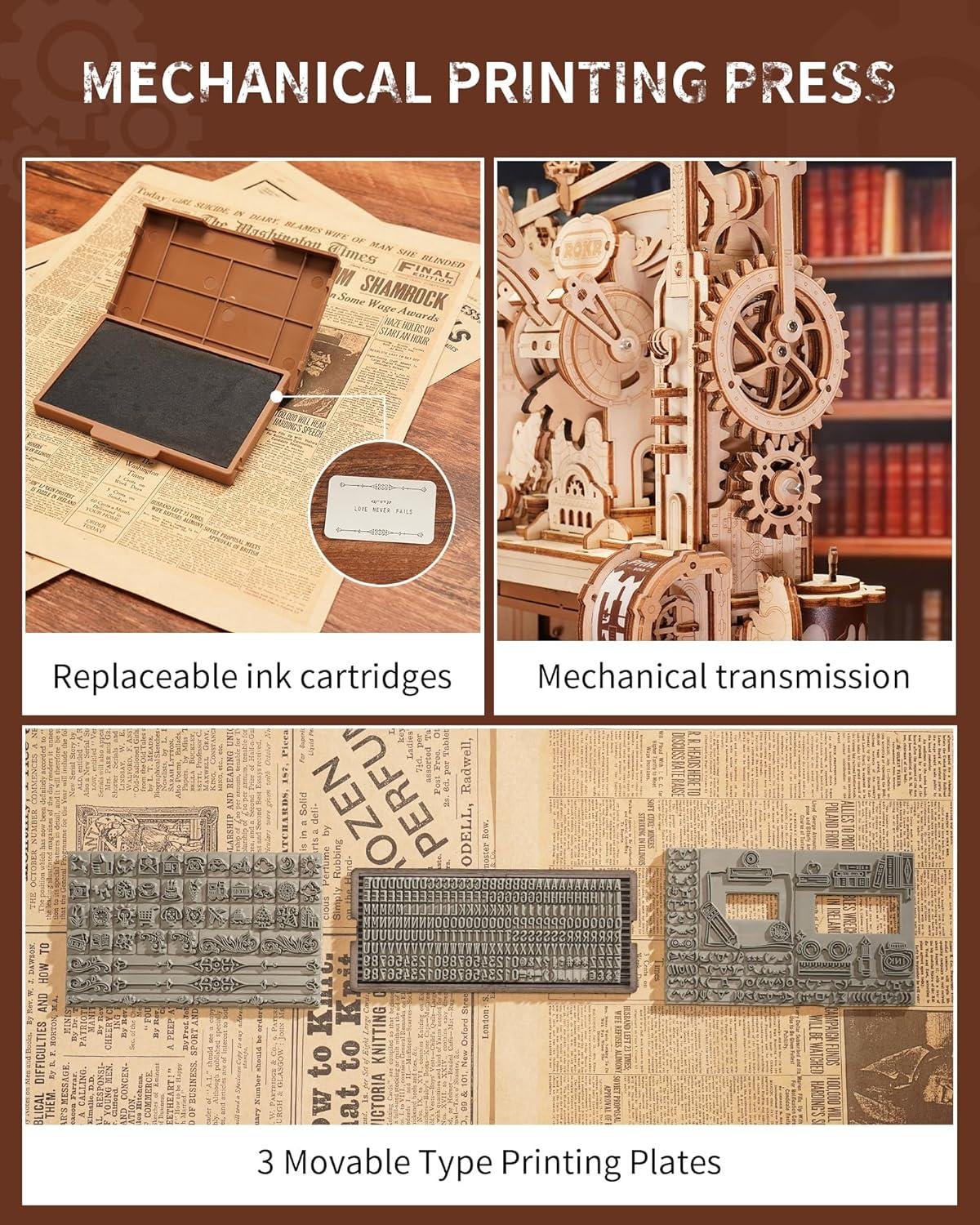
For first-timers, this kit feels less like “shop work” and more like a controlled introduction to it—303 laser-cut parts in thicker, cleanly cut sheets that “pop out…with slight pressure,” as multiple reviewers note. We still recommend treating it like any delicate woodworking assembly: work over a flat bench, dry-fit before committing force, and use a light touch when freeing intricate pieces (several customers mention using an X-Acto knife only occasionally). The included illustrated manual is generally described as clear and easy to follow, though one common theme is that it’s “not as good as Lego,” meaning the diagrams do most of the talking and you’ll want patience more than prior model experience. ROKR’s 5-hour claim is optimistic in real-world pacing—reviewers report anything from ~8 to 10 hours, especially when we take breaks to avoid rushing tiny assemblies.
For shop veterans, the appeal is in the mechanical fidelity and the “tune-up” mindset: reviewers consistently say it’s challenging but doable, with parts that “fit well together” and a finished model that “looks beautiful.” Where experienced hands will feel at home is in troubleshooting tolerances—one builder had to make a minor gear adjustment to prevent slipping (a paperclip tweak), and others mention needing a bit of extra pressure to get full ink transfer without stressing the wooden lever. The practical workshop takeaway is that this is a precision assembly exercise: lubricate the gear train with the included wax block, keep the water-based ink capped when stored, and stage the tiny rubber type carefully because “the letters are SMALL” and easy to lose. It’s not a power tool and there are no motor specs to weigh,but as a bench-side STEM build it rewards the same skills we use in the shop—alignment,sequencing,and knowing when to sand,wax,or gently re-seat a joint rather than forcing it.
- Included accessories: Illustrated instruction manual, parts list, screwdriver, spring, screws, sandpaper, metric ruler, wax block
- Included printing consumables: rubber stamps (letters/symbols), water-based ink, 20 sheets of writing paper (3.5 × 2.1 in) stored in the drawer
- Compatible attachments/accessories: X-Acto knife (for clean part release), tweezers (for small stamps), paste wax (light re-waxing), small organizer tray (for tiny letters)
- Ideal project types: Desk/display build for the shop or office, hands-on STEM demo, custom business-card-size notes/labels, small collage/journal stationery
- Wood types tested by customers: Not specified in reviews (kit uses factory laser-cut wood sheets per product description)
| Spec / Limitation | What It Means in Practice |
|---|---|
| 303 pieces | high part count; expect careful sequencing and more time than typical “quick” models |
| Claimed 5-hour assembly | Reviewers commonly report ~8–10 hours depending on pace and rechecks |
| Paper size: 3.5 × 2.1 in | Small output—great for tags/thank-you notes; several reviewers wish the tray were bigger |
| 45° handle press | Hand-powered printing action; some users apply extra pressure carefully for full ink transfer |
| LED requires 2 batteries (not included) | Plan ahead if the light feature matters to your display |
| Accessory | Included? | Why We’d Use It |
|---|---|---|
| Wax block | Yes | Keeps gears running smoother and reduces binding during operation |
| Water-based ink | yes | Printing function; store capped to prevent drying (per tips) |
| Extra paper/extra letters | No (common request) | Reviewers frequently wish for more paper and more symbols/letters |
| Capacity Item | Recommended Expectation | Actual / Reported by Customers |
|---|---|---|
| Build time | Set aside multiple short sessions | ~8–10 hours is commonly reported; 5 hours feels fast-paced |
| Print area | Plan for business-card-size outputs | Tray fits about 3.5″ × 2″; users call out the small tray as a limitation |
| Mechanical tuning | Expect light adjustments like a model machine | Some report minor fixes to prevent gear slip or improve ink transfer |
See Full Specifications & Customer Photos
Customer Reviews Analysis
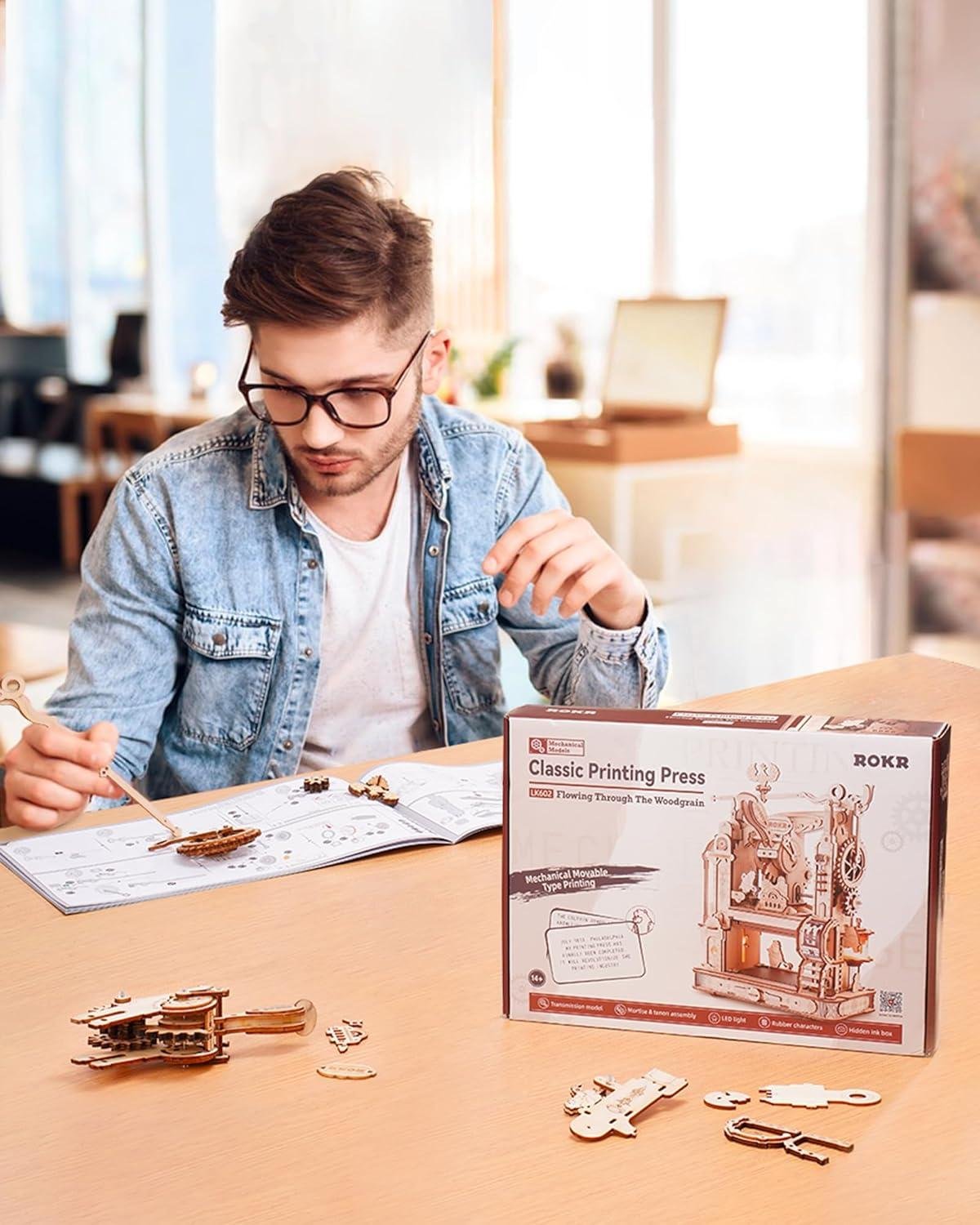
What Woodworkers Are Saying (ROKR classic Printing Press LK602)
1. Overall sentiment from woodworking customers
Several woodworkers and DIY-minded builders described this as a highly satisfying, “challenge-but-worth-it” kit. Common praise includes the finished look (“looks beautiful,” “cute”) and the novelty of a model that actually functions as a small printing press. Value also comes up repeatedly—multiple reviews highlight it as a fun, skill-building build for the price (often compared favorably to pricier hobby kits).
2. Performance feedback (accuracy,power,results)
Multiple reviews highlight that the mechanism does work once built correctly (“works great,” “works as described,” “still works great,” “got it together and it works”).Having mentioned that, some users reported challenges with consistent print results:
- Pressure/transfer: One reviewer mentioned needing extra pressure on the text plate to get a full print, noting hesitation to push hard on the wood lever.
- Gear engagement: A newbie builder reported gears slipping until they made a small tweak (they “bent a paperclip” to hold a gear holder tighter).
In woodworking terms, reviewers frame performance more like mechanical alignment and consistent contact, rather than “power under load.”
3.Build quality and durability observations
Common praise includes cleanly cut parts and good fit-up:
- “All the pieces fit well together.”
- “They were well cut… I didn’t end up breaking anything.”
- Multiple reviews mention the wood being thicker and sturdier than expected, with parts that pop out cleanly from laser-cut sheets.
At the same time, some users echoed a theme common to small wooden mechanisms: it can be easy to break pieces if rushed, and careful assembly matters. One parent noted that reviews saying these kits can be “difficult to assemble and easy to break” are “true,” though their build still held up and “still works great.”
4. Ease of use for different skill levels
Skill level feedback is mixed and depends on patience and prior model-building experience:
- Beginners: Some DIYers found the learning curve real—one “newbie” took about 8 hours and needed a minor adjustment to prevent slipping. Another reviewer said it’s “probably not for a beginner into wooden models” as it’s complex and requires care.
- Intermediate hobbyists / detail-oriented builders: Reviewers with experience in model kits (including Lego and older balsa kits) found it challenging but doable, with parts and included tools helping a lot.
- Younger builders (with interest/patience): Several reviewers reported successful builds by kids/teens (12–13), but the overall theme is that it’s best for those who enjoy a careful, intricate build.
Instructions were generally called clear,though one reviewer felt they were not as step-by-step as Lego.
5.Common project types and success stories
Customers successfully used this for small-format printing projects rather than woodworking projects like cabinets or furniture. Common success stories include:
- Custom mini cards and notes: Several reviewers mentioned printing business-card-sized pieces, “small cards,” and “little thank you notes.”
- Working novelty press: Multiple reviews emphasize the satisfaction of building something that functions, not just a display model—“She made the little printing press work,” and “Very satisfying to complete and to produce small cards with your own custom text.”
6. Issues or limitations reported
Some users reported challenges with or limitations in the kit that matter for “shop realism” and repeat use:
- Small print size / limited capacity: The paper tray is commonly cited as limiting—one reviewer noted it only fits 3.5″ × 2″ (business card size) and wished the tray were bigger.
- Consumables and expandability: Several woodworkers wanted more letters/symbols, plus extra paper and ink pads available separately.
- Tiny parts management: The “rubber letters are SMALL” and can be easy to lose (especially on carpet).
- Time expectations: The suggested build time (5 hours) was seen as optimistic; multiple reviews report 8–10 hours, frequently enough split into shorter sessions due to concentration demands.
- Occasional tuning needed: Minor mechanical adjustment might potentially be needed for best results (e.g., gear slip fixes, ensuring adequate print pressure).
At-a-glance review themes
| Aspect | Common Feedback |
|---|---|
| Performance | Generally works as a real mini press; some users needed extra pressure for full ink transfer and occasional gear-slip tuning |
| Precision | Parts fit well; success depends on careful alignment of gears and print plate |
| Durability | Laser-cut pieces praised as sturdy and well-cut; can be fragile if forced—patience helps prevent breakage |
| Ease of Use | Clear instructions but not as guided as Lego; beginners may find it complex and time-consuming |
| Results | Best for small cards/notes; prints can look good once dialed in, though coverage may require extra pressure |
| Value | Frequently praised as a rewarding challenge and good price compared with other hobby kits |
If you want, I can rewrite this section in a tighter “product page” voice,or tailor it specifically to a woodworking audience (joinery/fit,sanding time,glue-free vs glue-required feel,etc.).
Pros & cons
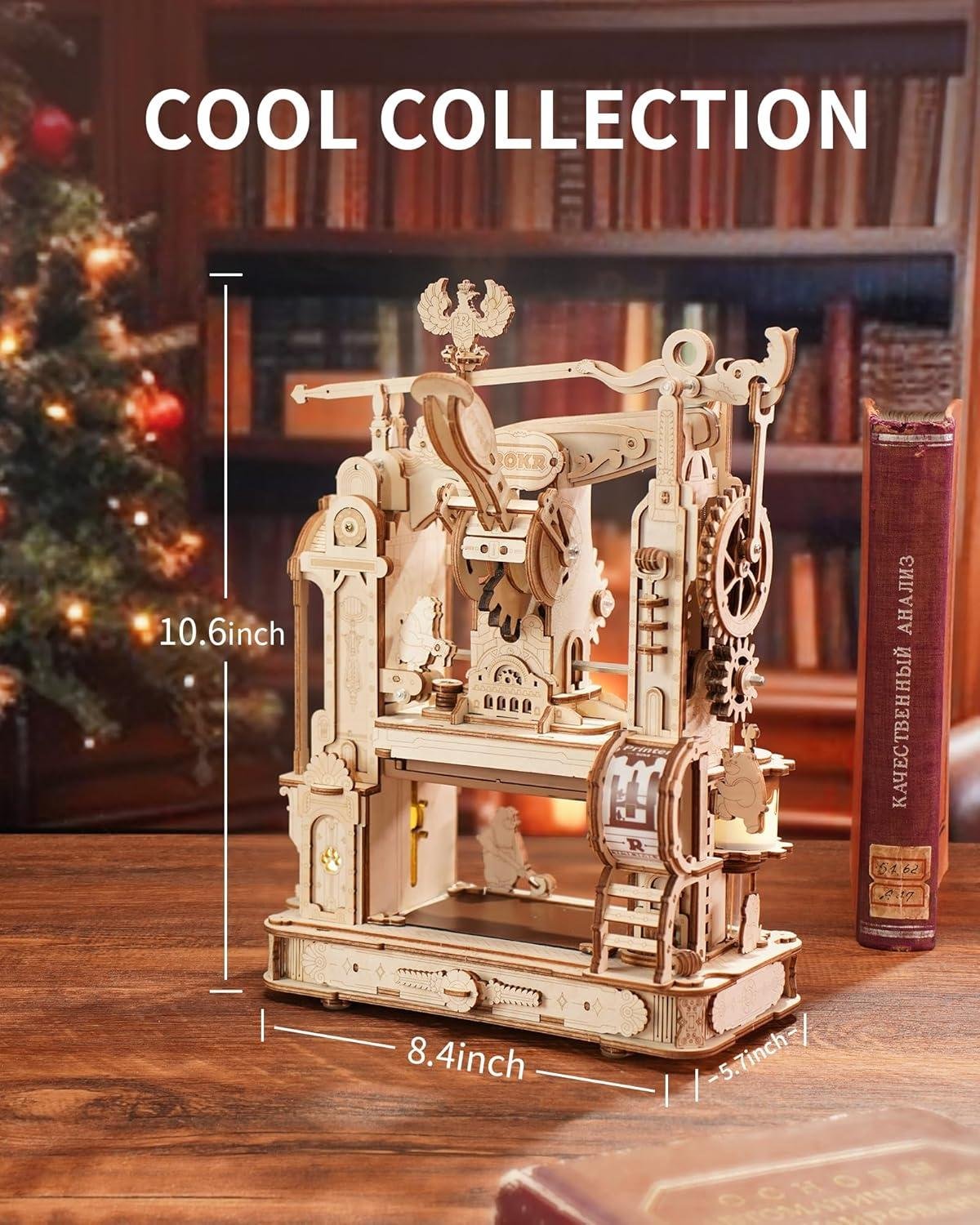
Pros & Cons
After spending time with the ROKR LK602 Printing Press, we’d describe it as part model kit, part desk collectible, and part tiny “print shop” that actually makes marks on paper. It’s not a museum-grade press (nor does it pretend to be), but it does have a surprisingly cohesive build-and-use loop: assemble, ink, press, repeat.
| What We Liked | What Could Be Better |
|---|---|
| Laser-cut wooden parts feel precise and satisfyingly “clicky” during assembly. | Ink and mechanics need a bit of upkeep (cap the ink, lubricate gears) to keep it smooth. |
| The moving bear + gearwork sells the “mini industrial-age machine” fantasy. | Not a speed build—303 pieces can test patience if we rush. |
| Printing is genuinely interactive: press the handle, ink transfers, pattern appears. | Stamp results vary; alignment and pressure take practice for crisp prints. |
| Swappable stamp set (numbers, kaomoji, cartoons) keeps it playful and reusable. | paper is small (3.5 × 2.1 in), so outputs feel more like notes/labels than full cards. |
| Drawer storage for the included papers is a clever, “shop tool” detail. | LED requires two batteries we must provide separately. |
Pros
- Well-made wooden kit: Smooth, pollution-free wood with clean laser cuts makes the build feel deliberate rather than fiddly.
- A build with a purpose: We don’t just assemble a model—we end up with something that “does a thing,” which boosts the payoff.
- Delightfully theatrical mechanics: The 45° press handle, rolling motion, and bear-print vibe create a mini performance every time we print.
- Creative replay value: Multiple stamps + included water-based ink encourage experimenting with labels, journal snippets, and collage bits.
- STEM-meets-craft energy: Gears, motion, and alignment naturally pull us into spatial thinking and hands-on problem solving.
Cons
- Maintenance is part of the deal: To keep the press feeling “shop-worthy,” we’ll want to store the ink cartridge properly and use wax/lube for gears.
- Print quality has a learning curve: We may need a few test presses to nail consistent pressure and placement.
- Time commitment is real: The stated ~5 hours can stretch longer depending on our pace and comfort with small parts.
- Extras required for the full effect: The warm LED feature is nice, but we’ll need to bring our own batteries.
- Scale is charming but limiting: The included paper size is great for mini notes, less ideal if we’re imagining larger art prints.
Q&A
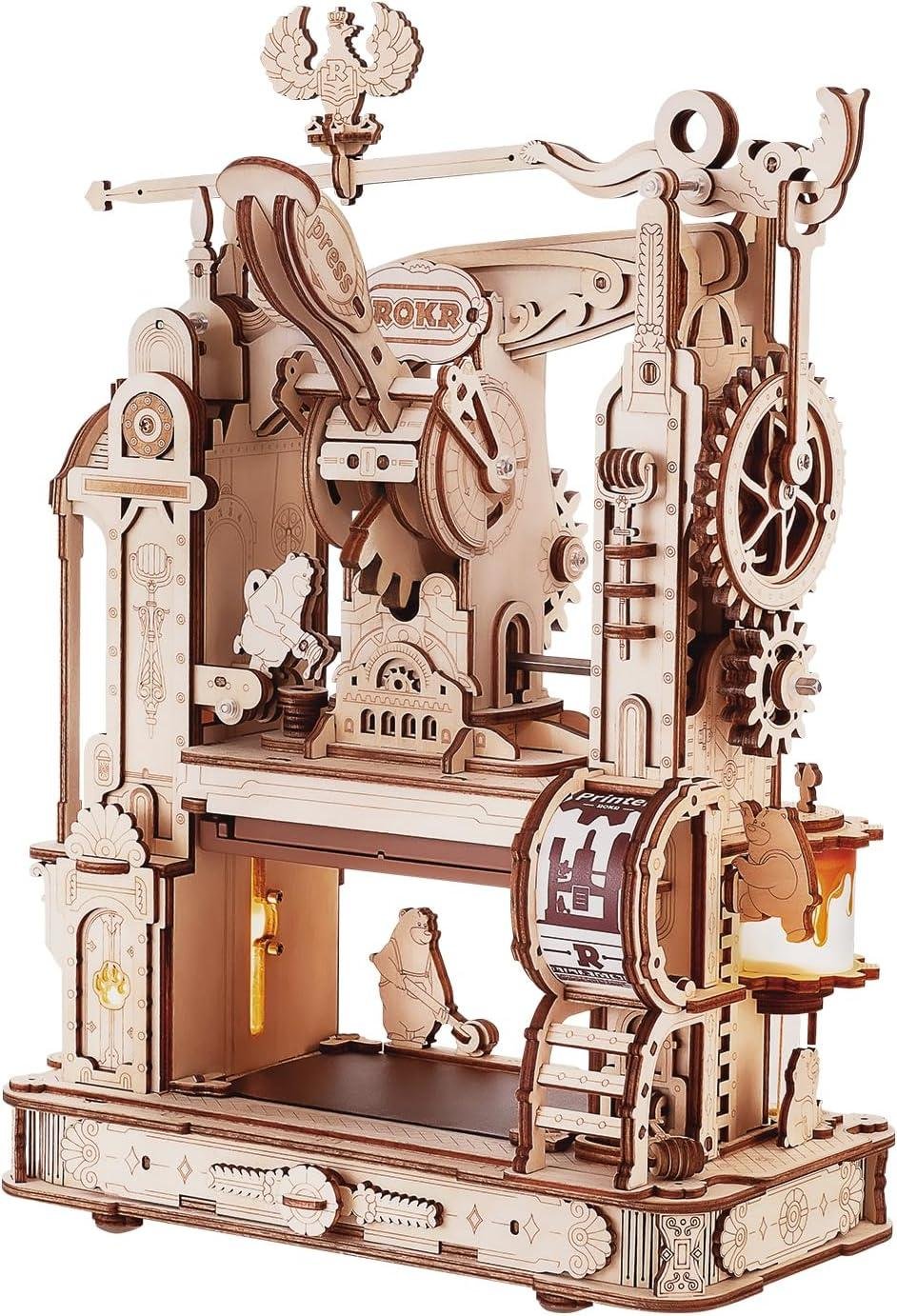
What wood types can this handle effectively—hardwoods like oak/maple, plywood, veneers?
this isn’t a cutting tool, so it won’t “handle” wood the way a saw or router does. The kit comes with pre-finished, laser-cut wooden sheets (pollution-free wood per the listing) that you pop parts out of and assemble. You’re not expected to mill hardwoods, cut plywood panels, or work veneers—everything is already sized and etched. If you want to customize it (stain/clear coat), treat it like thin craft plywood: use light sanding and avoid soaking finishes that could swell joints.
Is this powerful enough for production work, or just hobby projects?
It’s firmly a hobby/collector build. The “printing press” function is a novelty-style stamping/printing mechanism using included rubber stamps, water-based ink, and small cards (about 3.5″ × 2.1″). Reviews describe it as fun and functional for small notes, but not consistent like a real press—some users mention needing extra pressure to get full ink transfer while trying not to stress the wooden lever.
How difficult is the initial setup and assembly?
Expect a careful, multi-hour build. The kit is listed as 303 pieces and “about 5 hours,” but customer experiences commonly land closer to 8–10 hours depending on pace and experience. Parts are laser-cut and generally fit well, and the kit includes an illustrated manual plus tools (e.g., screwdriver, wax, sandpaper). Several builders found it “challenging but doable,” with the instructions good (though not “LEGO-level” per one review).
What adjustments are available if gears slip or the print isn’t coming out clean?
There aren’t precision machine adjustments like you’d find on a real press—most “tuning” is basic fit-and-alignment during assembly. One reviewer reported minor gear slip and fixed it with a small DIY tweak (tightening the gear holder—improvised with a bent paperclip). For print quality, users mention applying a bit more pressure on the text plate to improve transfer, but the wooden lever limits how hard you’ll want to press. Practical tip: keep everything square, fully seated, and wax the moving gear areas as recommended to reduce binding.
Does it work with standard accessories (ink pads, paper, stamps), or only what’s included?
it’s designed around included consumables: a water-based ink cartridge/ink setup, rubber stamps (letters/symbols), and 20 sheets of small “writing paper” that store in the bottom drawer. Reviews note the print tray/paper size is limited (business-card size),and some wish they could buy extra paper/ink that fits the machine well. You can experiment with similarly sized cardstock, but expect some trial-and-error with thickness and absorbency.
How easy are “changes” during use—like swapping letters/symbols or switching designs?
Swapping the rubber stamps is part of the fun, but it’s small-scale and fiddly like setting type.Reviewers mention “once you get the hang of setting the lettering…it’s super fun,” but also warn the letters are tiny and easy to lose (especially on carpet).If you’re a woodworker used to jigs and repeatability, think of it more like delicate model work than tool-free production.
Will this fit in a small workshop, and does it need power, outlets, or dust collection?
Yes—this is bench-top friendly and doesn’t require dust collection or a power outlet for operation. The only optional “powered” feature is the LED light, which needs two batteries (not included). During assembly you may create a little dust from light sanding or cleanup, but it’s nothing like machining wood—more like typical model-kit debris.
Is this suitable for beginners, and would it satisfy a serious woodworker?
Beginner-friendly depends on your patience with small parts. Some families report kids/teens successfully building it and loving the challenge, while another review cautions it may be “not for a beginner into wooden models” because correct assembly matters for the mechanism to run smoothly. For serious woodworkers, it’s a satisfying precision assembly project and a neat mechanical display piece—just don’t expect it to replace shop time or deliver “tool-like” capability.It’s closer to a mechanical wooden model kit with a working stamping feature.
What maintenance is required, and how durable is it over time?
Basic upkeep is simple: lubricate the mechanical gear parts with the included wax block (recommended in the listing) to keep motion smooth, and cap/store the ink cartridge if you won’t use it for a while so it doesn’t dry out. Durability is typical of laser-cut wooden models—strong enough for careful use, but you’ll want to avoid forcing joints or over-pressing the handle. Several reviewers note it “still works great” after assembly, but it’s not built for heavy repetitive pressing like a real press.
Elevate Your Lifestyle
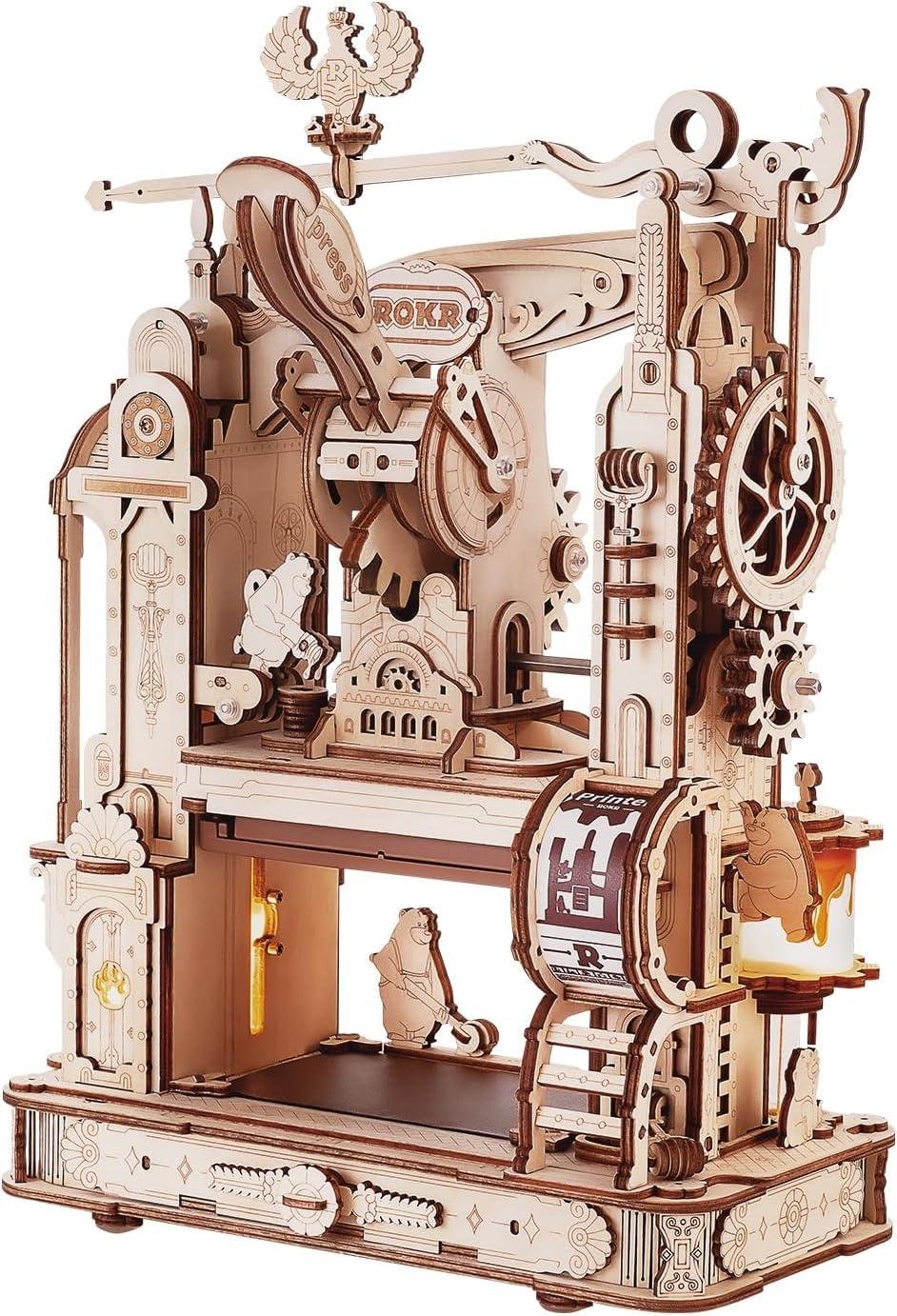
Tool Summary: The ROKR LK602 Classic Printing Press is a 303-piece, laser-cut wooden model kit that assembles into a hand-operated mini press with a 45° lever, interchangeable rubber stamps, water-based ink, a small paper drawer, and an LED “finished” light (requires two batteries).Builders consistently praise the clean fit of the parts, satisfying gear-driven motion, and “works as described” printing—while noting the realistic build time (often 8–10+ hours), small stamp pieces, and a business-card-sized print bed (about 3.5″ x 2″).
Best For: Ideal for hobby woodworkers, makers, and beginners learning fundamentals of careful assembly, plus gift builds and small craft projects like custom notes, tags, and collage journaling.
Consider alternatives If: You want larger-format printing, faster setup, or a rugged, daily-use shop tool—this is a detailed craft kit, not production equipment.
Final Assessment: The LK602 delivers a charming, mechanically engaging build with genuinely usable small prints, but its size and precision demands set clear limits.
Want to see current pricing and customer photos? View on Amazon & Read More Reviews →