

Blog
Luna’s Magic House Craft Kit Review: Right for Our Shop?


Ever tried dialing in a perfect fit on tiny parts, only to realize your “normal” shop tools feel like sledgehammers at miniature scale? When the work shifts from cabinet doors to delicate trim, precision, patience, and clean alignment matter more than horsepower—and bench space suddenly feels very limited.
That’s where the DIY Miniature House Kit with LED Light (Luna’s magic House) comes in. It’s a 3D wooden puzzle–style dollhouse/bookshelf insert kit that has you build and furnish a small scene using wood, paper, metal, and plastic parts, finishing at about 9.4 × 7.5 × 7.9 in and 2.2 lb. It includes an LED light, but you’ll need silicone liquid glue and two AAA batteries (not included).
In this review, we’ll cover what the kit includes, how user-friendly the instructions and fit-up appear, durability and build quality based on materials, and what customers report about the 9–15 hour assembly time and learning curve. From years around sawdust and jigs, we’ve learned small projects can teach big lessons—this one may be a budget-friendly way to sharpen them.
First Impressions and Build Quality of the Wooden Puzzle Components

Out of the box, Luna’s Magic House reads less like a “toy” and more like a small-batch craft bundle we’d stage on a bench for careful layout work. The finished insert is listed at 9.4 × 7.5 × 7.9 inches and the kit weighs about 2.2 lb (not including a dust cover or music box),which is just enough mass to feel substantial without being cumbersome to move around the shop. Material-wise, the kit mixes wood, paper, metal, and plastic, and that blend matters for first impressions: we’re not judging it like hardwood joinery stock, but like thin craft panel and laser-cut components that need clean handling and controlled glue-up. Multiple reviewers describe the project as “VERY detailed” with “a LOT [of] pieces/parts” and recommend having space to lay out parts—exactly how we’d approach it in a woodworking workflow: sort, label, dry-fit, than commit with adhesive.
on build quality, customer themes are split between excellent fit/detail and fragility/missing items. Several reviewers praise that “every part fits perfectly” and the labeling and detail were awesome, while others report boards that felt “thin as a tortilla shell” and pieces that break easily. From a woodworker’s standpoint, thin stock is workable—but it changes the tool plan: we’d treat these like veneer-thin parts, using a sharp hobby knife/X-Acto (a reviewer specifically notes you “definitely need glue and a exacto knife”) and light sanding rather than any aggressive trimming that could crush fibers or split corners. Adhesive choice also shows up repeatedly: the listing notes you should prepare silicone liquid glue, some customers say it didn’t come with glue, others report receiving a small bottle of school glue, and several prefer super glue to prevent drift while parts set. For workshop technique, we’d recommend test-fitting first, then using minimal glue, and pinning/clamping gently (think painter’s tape or miniature spring clamps) to avoid warping thin pieces. One practical caution from reviews: some boxes reportedly lacked the music box or screws, so inventorying the contents before we start is the same best practice we’d apply to any hardware kit.
- Included accessories (per listing/reviews): LED lighting components (kit includes LED); assorted miniature furniture/decor parts (wood/paper/metal/plastic); instruction booklet with photos and written steps (review theme); glue may vary by box (some report none, some report a small school-glue bottle)
- Compatible attachments/accessories (shop-ready add-ons): X-Acto/hobby knife + spare blades; fine sanding sticks/320–600 grit paper; tweezers; small spring clamps/clothespins; painter’s tape; silicone liquid glue or CA (super glue) + accelerator; AAA batteries (2) for lighting
- Ideal project types: bookshelf “book nook” inserts; miniature display builds; skills practice for layout, dry-fitting, precision trimming, and clean glue-up; parent/teen craft builds (rated 14+)
- Wood types tested by customers: Not specified in reviews (components are described generally as thin craft wood/boards)
| Spec / component | What the listing says | What it means in the shop |
|---|---|---|
| Finished size | 9.4 × 7.5 × 7.9 in | Plan a benchtop tray or mat for layout; it’s big enough to sprawl parts during assembly. |
| Weight | 2.2 lb (no dust cover/music box) | Lightweight build—handle parts gently; avoid heavy clamping pressure. |
| Materials | Paper, wood, metal, plastic | Use mixed-material adhesives thoughtfully; keep blades sharp to prevent tearing and fuzzing. |
| Power / electronics | LED light; requires 2× AAA (not included) | Test the light circuit early, before final closure, like we would with any hidden wiring. |
| Estimated build time | 9–15 hours (listing) | Batch tasks (cut/sand/glue) to reduce setup time; expect longer if you finish like fine model work. |
| Accessory / “Bit or Blade” Equivalent | Recommended | Why |
|---|---|---|
| Hobby knife (X-Acto) + #11 blades | Yes | Cleaner cuts on thin craft wood/paper; reduces splitting compared to forcing parts. |
| Fine sanding sticks (320–600 grit) | Yes | Breaks edges and improves fit without removing too much material. |
| CA glue (super glue) + accelerator | Optional | Reviewers used it to keep parts from shifting; use sparingly to avoid frosting. |
| Silicone liquid glue / craft glue | Yes | More working time for alignment; matches the listing’s prep note. |
| Tweezers | Yes | Precise placement of tiny parts without crushing them. |
| Capacity Topic | Recommended (for best results) | Actual (based on listing/reviews) |
|---|---|---|
| Work surface | at least 24″ × 18″ clear space | reviewers note it’s large with a LOT of pieces and needs room to lay out. |
| adhesive readiness | Have glue on-hand before starting | Listing says prepare silicone liquid glue; reviews disagree on whether glue is included. |
| Hardware/electronics check | Inventory parts at the start | Some reviews report missing music box, screws (even near the end of the build). |
See Full Specifications & Customer Photos
Real World Performance in Precision Fitting Gluing and Finishing

In our shop, “precision fitting” with Luna’s Magic House feels closer to fine model-making than traditional casework, but the same woodworking habits apply: dry-fit, mark, trim, and repeat. The kit’s finished footprint is listed at 9.4 × 7.5 × 7.9 inches and the box weight at 2.2 lb, which sounds small until we’re sorting many tiny subassemblies across a bench. Customer review themes line up with that reality—multiple buyers call it a “VERY detailed project” with “a LOT of pieces/parts”, and several recommend having space to lay out parts. When tolerances get fussy (thin panels and miniature joinery), we’ve found it’s best treated like test-fitting drawer parts: use a sharp hobby knife for controlled paring, a small sanding stick for edge tuning, and a light clamp strategy (painter’s tape works surprisingly well) so we don’t crush delicate components that reviewers describe as “thin as a tortilla shell” and prone to breaking if forced.
For gluing and finishing, this kit teaches good adhesive discipline. The listing notes we must supply silicone liquid glue and 2× AAA batteries for the LED light (batteries can’t ship by air), and reviews repeatedly mention the glue situation: some report it “didn’t come with glue” while others say they received a small bottle of school glue and still preferred super glue. In practical terms, we’d use PVA/school glue where we want working time and squeeze-out control, and reserve CA (super glue) for speedy tacks—keeping in mind CA can frost clear plastics and leave shiny halos on paper if we overdo it. Finishing is mostly about clean assembly rather than film builds: burnish paper edges, scrape dried squeeze-out before it turns rubbery, and consider a very light matte clear coat only if we’re confident it won’t warp printed parts. The instructions are widely praised as photo-rich and step-by-step, though at least one reviewer found them “a little difficult to read”, so we’d treat it like any plan set: read ahead, stage parts, and don’t glue until alignment is proven. Also note the real-world QC risk—several reviewers mention missing music box/screws—so inventorying contents before we start is as crucial here as checking hardware bags before a cabinet install.
- Included accessories: Pre-cut/assorted miniature materials and parts (paper, wood, metal, plastic), LED light components (battery-powered)
- Not included / may vary by box (per listing & reviews): silicone liquid glue, 2× AAA batteries; some reviewers report missing music box/screws
- Compatible attachments/accessories: hobby knife/X-Acto, sanding sticks/files, fine tweezers, small squares, painter’s tape, spring clamps (light pressure), PVA/school glue, CA glue, silicone liquid glue, cutting mat
- Ideal project types: bookshelf “book nook” inserts, precision craft builds, skills practice for layout/fit-up, gift builds for detail-oriented makers
- Wood types tested by customers: Not specified in reviews; components are described as thin wood sheets rather than named species
| Spec / build Factor | What the Kit Provides | What It Means for Precision Gluing & Fit |
|---|---|---|
| Finished size | 9.4 × 7.5 × 7.9 in | Small footprint, but many micro-parts—bench organization matters |
| Weight | 2.2 lb | Light assemblies shift easily; use tape/clamps to hold square while glue sets |
| Materials | Paper, wood, metal, plastic | Mixed substrates require glue choice discipline (PVA vs CA vs silicone) |
| Build time (listed) | 9–15 hours | Plan staging and drying time; avoid rushing glue-ups |
| Power/lighting | LED, needs 2× AAA (not included) | Test-fit wiring/LED placement before final close-up |
| Accessory / Tool | Recommended Use | why It Helps |
|---|---|---|
| hobby knife (X-Acto) | Trimming tabs/edges, freeing delicate parts | Cleaner, safer control than forcing pieces (reviews note parts can break) |
| Sanding sticks / needle files | Dialing in tight fits | Micro-adjustments prevent misalignment before glue cures |
| PVA/school glue | Paper-to-paper, porous bonds | Longer open time, easier squeeze-out cleanup |
| CA (super glue) | Fast tacking and spot bonds | Matches reviewer behavior (“used super glue to make sure nothing would move”) |
| Silicone liquid glue | Flexible bonds on mixed materials | Explicitly required by the listing for completion |
| Category | Recommended (Workshop Reality) | actual (Per Listing/Reviews) |
|---|---|---|
| Work surface | Tray or mat with parts bins | Many pieces; reviewers advise having room to lay parts out |
| Adhesives on hand | PVA + CA + silicone glue | Silicone glue required; glue inclusion appears inconsistent in reviews |
| Completion readiness | Inventory all parts before starting | Some reports of missing music box/screws |
See Full Specifications & Customer Photos
Key features Woodworkers Will Appreciate in the Furniture Details and LED Lighting

From a woodworker’s outlook, the furniture details in Luna’s Magic House feel like a “small-scale joinery lab” where precision matters more than power. The kit’s finished footprint—9.4 × 7.5 × 7.9 in with a listed 2.2 lb weight—means we can treat it like a benchtop layout exercise: dry-fit, label, and batch-build subassemblies without swallowing a whole workbench. Multiple reviewers call the project “VERY detailed” with a “LOT [of] pieces/parts”, and we agree that this is where woodworking habits pay off: a parts tray, painter’s tape labels, and a cutting mat keep the workflow clean. reviewers repeatedly mention it doesn’t come with glue (or that they preferred their own), and one specifically notes you’ll want “glue and a exacto knife”, which is absolutely true in a shop setting—this kit rewards sharp blades, light cuts, and careful scoring to avoid tear-out on thin stock. Some customers describe boards as “thin as a tortilla shell”, so we’d treat components like delicate veneer: back up cuts with a sacrificial board and use minimal clamping pressure to prevent crushing or snap-breaks.
On the LED side, we appreciate that the lighting turns this into a practical mini lesson in wire management and finishing discipline—as lighting exposes gaps, glue squeeze-out, and misalignment that ambient room light hides. the specs call out that you’ll need 2× AAA batteries (not included), and several reviews mention missing items like the music box or screws, so we’d inventory everything before we start building and before we commit to routing wires through tight spaces. In the shop, our go-to is silicone liquid glue or CA glue sparingly (one reviewer used super glue “to make sure nothing would move”), but we’d still dry-fit first so we’re not fighting locked-in errors once the LED leads are in place.If you’re a woodworker who enjoys jigs, this kit is a good excuse to make a quick “mini assembly board” with double-stick tape for holding tiny parts square while adhesive cures—especially helpful if you found the instructions “a little difficult to read” as one customer did. the combination of fine furniture parts and lighting is best for patient builders who enjoy meticulous layout,careful cutting,and clean glue technique more than fast results (the product description estimates 9–15 hours,and reviewers often describe it taking days or even weeks).
- included accessories: Pre-cut miniature components (paper/wood/metal/plastic),LED lighting components (battery-powered)
- Not included (you must provide): Silicone liquid glue (recommended in product notes),2× AAA batteries (required for LED),hobby knife (commonly recommended by reviewers)
- Compatible attachments/accessories: X-Acto/hobby knife,self-healing cutting mat,fine tweezers,needle files,pin vise,small squares,CA glue + accelerator (optional),silicone liquid glue,parts trays,painter’s tape labels
- Ideal project types: Bookshelf insert décor builds,miniature furniture assembly practice,precision cutting & glue-up exercises,“detail-immersion” craft sessions
- Wood types tested by customers: Not specified in reviews (components are described as thin wood pieces rather than named species)
| Spec | What It Means in the Shop |
|---|---|
| Overall size: 9.4 × 7.5 × 7.9 in | Small footprint; we can dedicate a tray or corner of the bench for staged subassemblies. |
| Weight: 2.2 lb (does not include dust cover/music box) | Light enough that a stable base or assembly board helps prevent shifting while cutting/gluing. |
| Build time: 9–15 hours (listed) | Plan for multiple sessions; best results come from letting adhesives cure fully between steps. |
| Power: 2× AAA batteries (not included) | Inventory batteries early; test LEDs before permanent routing/attachment. |
| Accessory | Why Woodworkers Use It Here | notes |
|---|---|---|
| Hobby knife (X-Acto) | Clean scoring and trimming on thin parts | Reviewer theme: “you definitely need… an exacto knife.” |
| Silicone liquid glue | Controlled open time for alignment and repositioning | Called out in product notes; often not included. |
| CA glue (super glue) | fast tack for tiny joints and quick fixture-less bonds | Reviewer theme: used to keep parts from moving. |
| Tweezers + small square | Accurate placement and squaring of miniature assemblies | Helps prevent cumulative alignment errors. |
| Capacity Category | recommended (for sanity) | Actual (from kit/reviews) |
|---|---|---|
| Workspace needed | A tray or ~18×24 in cutting area for layout | Reviewers note it’s “large” with a “LOT [of] pieces/parts,” so spread-out organization helps. |
| Skill/patience level | Patient beginner to intermediate maker | Reviewers: “VERY detailed,” “not… for young kids,” can take weeks. |
| Inventory tolerance | Pre-check parts before assembly | Multiple reviews mention missing music box/screws; inspect before you start. |
See Full Specifications & Customer Photos
Ease of Use for Beginners and Experienced Woodworkers in Our Shop workflow
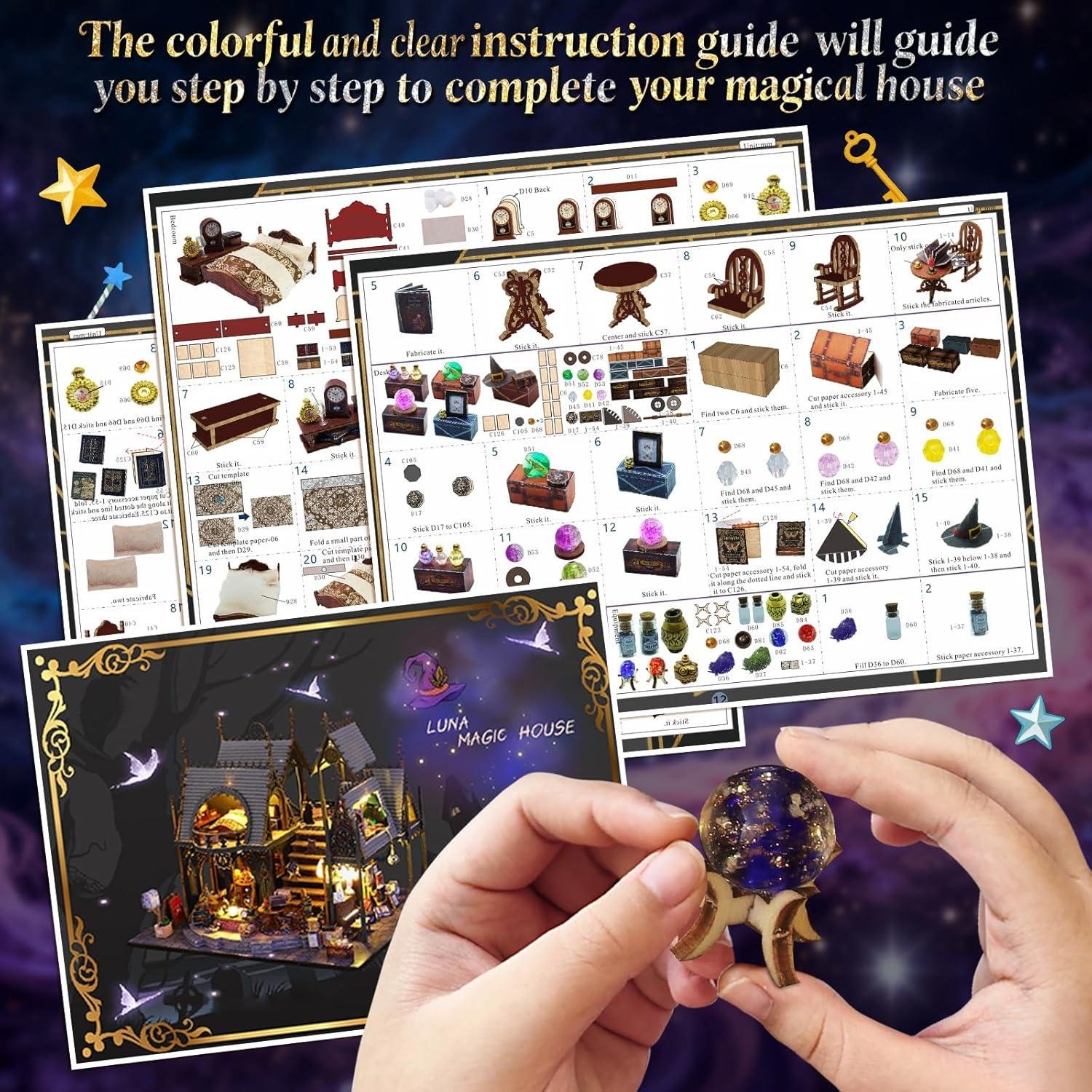
In our shop workflow, we treat the Luna’s Magic House kit less like a “toy” and more like a bench-top finery exercise: it’s a 9.4 × 7.5 × 7.9 in miniature build that weighs about 2.2 lb, and the work is dominated by layout, clean trimming, and repeatable glue-ups rather than machine milling. For beginners, the learning curve is mostly about patience and organization, not power-tool skill—multiple customers call out the instruction booklet as a major plus, noting it has photos + written steps and even lists the parts required for each subassembly. That format fits how we teach new hands in the shop: stage parts, dry-fit, then commit. The same reviews also warn it’s “VERY detailed,” with “a LOT of pieces/parts,” and needs a dedicated layout space—practically, we’d clear a small assembly tray or a shallow parts bin system so nothing disappears under shavings.
For experienced woodworkers, the kit is easy to “use” but demanding to execute cleanly: it includes mixed materials (paper, wood, metal, plastic) and involves “cutting, stitching, and sticking,” with the product estimating 9–15 hours (and some reviewers stretching it to weeks). Review themes are consistent: many builders prefer super glue for fast lock-in, while others mention you’ll “definitely need glue and an exacto knife,” and that pieces can “break easily” with heavy hands—so we’d treat the thin wooden parts like delicate veneer: score lightly, support the cut, and sand only with a backer to avoid snapping. The only real beginner trap is missing consumables and occasional missing components; the listing notes you must supply silicone liquid glue and 2× AAA batteries,and several reviews mention missing music box/screws (while others report everything fit perfectly). In our workflow, we’d inventory the box before starting and choose adhesives based on open time: slower glue for alignment, faster CA only after the dry-fit proves true.
- Included accessories (per listing/reviews themes)
- Pre-cut miniature components across paper, wood, metal, plastic
- LED light components (requires power)
- Printed instruction booklet with photos + written steps
- Glue may vary by batch (one reviewer mentions a small bottle of school glue; others note it “didn’t come with glue”)
- Compatible attachments/accessories (what we use at the bench)
- Precision knife (X-Acto) + spare blades
- Silicone liquid glue and/or CA (super glue)
- Fine tweezers, small clamps, wax paper for glue control
- Sandpaper 320–600 grit on a flat block
- 2× AAA batteries for the LED
- Ideal project types
- Bookshelf insert decor builds (reviewers mention “bookshelf” display use)
- Skill-building for precision cutting, dry-fitting, and glue discipline
- Detail-oriented hobby work when the shop schedule allows longer assembly time
- Wood types tested by customers
- Not specified in customer reviews; parts are described only as thin wood pieces
| Spec / Requirement | what We Know (From Listing/Reviews) | why It Matters in Our Shop |
|---|---|---|
| Finished size | 9.4 × 7.5 × 7.9 in | Plan a dedicated assembly footprint and a dust-free shelf for curing glue. |
| Weight | 2.2 lb (no dust cover/music box) | Light enough for a bench tray; stability comes from fixturing, not mass. |
| Time to build | 9–15 hours (some reviewers: weeks) | Not a “one-evening” shop task—best run as staged subassemblies. |
| Power/consumables | Needs silicone liquid glue + 2× AAA batteries | Inventory before start so the workflow doesn’t stall mid-build. |
| Accessory | Included? | Our Suggestion |
|---|---|---|
| Silicone liquid glue | No (must prepare per listing) | Use for longer open time and cleaner alignment on larger assemblies. |
| CA (super glue) | No | Use sparingly after dry-fit; great for quick tacks (reviewers prefer it). |
| X-acto knife | No | Essential for clean trimming; multiple reviewers say you “definitely need” it. |
| AAA batteries (2) | No (must prepare per listing) | Test the LED circuit before final closure so you don’t reopen finished work. |
| Task | Recommended Approach | Actual Demand (Per Reviews) |
|---|---|---|
| Cutting/trimming parts | Light scoring cuts + supported backer | “So much to cut and glue” and pieces can “break easily” if forced. |
| Assembly | Dry-fit → align → glue → clamp/hold | Many found it “super fun,” some found it “difficult,” largely due to detail level. |
| Completeness check | Inventory parts before starting | Some report missing music box/screws; others report perfect fit. |
See Full Specifications & Customer Photos
Customer Reviews analysis

What Woodworkers Are saying (Review Analysis for Luna’s Magic House)
| Aspect | Common feedback |
|---|---|
| Overall Sentiment | Mostly positive on design/detail and satisfaction, with recurring frustration about missing parts and fragile pieces. |
| Performance (fit/results) | Multiple reviews highlight strong fit and a display-worthy finished look; others say there’s a lot of cutting/gluing and occasional difficulty. |
| Build Quality | Mixed: several praised parts fitting “perfectly,” while some users reported very thin boards and pieces that break easily. |
| Ease of Use | Mixed by skill level: some called it “super easy,” others found it difficult and recommended extra tools/adhesives. |
| Completeness | Most common complaint: missing music box/screws in some boxes, which prevents full assembly/finishing. |
1.Overall sentiment from woodworking customers
Several woodworkers and hands-on DIYers mentioned the kit is fun, highly detailed, and rewarding—especially for people who enjoy slow, immersive builds rather than quick weekend projects.Common praise includes the visual design and the sense that the finished piece is “worthy of any display.”
At the same time, some users reported challenges with missing components (especially the music box and screws), which can turn an otherwise enjoyable build into a disappointing one.
2.Performance feedback (accuracy, power, results)
This isn’t a powered woodworking tool, so “performance” in the review sense shows up as fit accuracy, consistency of parts, and final results:
- Precision / Fit: Multiple reviews highlight that parts fit perfectly and labeling/detail help keep the build on track.
- Results / Finish quality: Reviewers commonly describe the end result as displayable (often as a bookshelf insert), with one user building it specifically for a “dark romance bookshelf.”
- Process workload: Some users reported there is “so much to cut and glue” that you may spend a large chunk of the project time on prep and assembly steps rather than “building” in the traditional sense.
3. Build quality and durability observations
Build quality feedback is notably split:
- Positive: Several woodworkers mentioned clean fitment and a sturdy-looking final display when assembled carefully.
- Negative / delicate parts: some users reported the boards are very thin (“thin as a tortilla shell”) and that pieces break easily, which matters to woodworkers used to more forgiving stock. This suggests careful handling, dry-fitting, and controlled gluing are important to avoid snapping small elements.
4. Ease of use for different skill levels
Reviewers with different experience levels had different takeaways:
- Beginners and casual crafters: Some users called it “super easy to put together” and “a lot of fun,” especially when following the manual closely.
- Detail-oriented hobbyists: Several reviewers mentioned the instructions are very detailed, listing needed parts for each subassembly and guiding step-by-step—something meticulous builders appreciate.
- Those expecting a simple kit: Some DIYers found the build difficult, especially due to tiny parts, reading the instructions (“a little difficult to read”), and the sheer number of steps. One reviewer explicitly noted you “definitely need glue and an exacto knife.”
5. Common project types and success stories
Customers successfully used this for bookshelf insert decor and display builds. Success stories tend to follow a similar pattern:
- Builders who like slow, multi-day/multi-week projects enjoyed it most, with one reviewer estimating it could take weeks to a month due to the detail level.
- Several reviewers mentioned using super glue to lock parts in place (“to make sure nothing would move”), and others appreciated that the instructions include photos plus written steps, which supports careful, craft-style assembly.
6. Issues or limitations reported
Some users reported challenges with the following (these are the most repeated “watch-outs”):
- Missing parts: multiple reviews highlight missing music box and/or screws, leaving the kit feeling “incomplete” or impractical to fully assemble.
- Adhesives/tools not fully covered: Reviewers disagreed on glue—one said it didn’t come with glue,another said it included a small bottle of school glue—either way,several builders preferred their own adhesive (often super glue) and recommended having an X-Acto knife.
- Fragility: Thin materials and break-prone small pieces were called out, which may frustrate builders who expect thicker, more durable wood components.
- Time and workspace needs: The kit is described as large with lots of parts, and reviewers recommend having a dedicated workspace to lay items out and avoid losing or damaging pieces.
If you want, I can rewrite this section in a more “woodworking blog” voice (more shop-talk: dry-fit, clamping alternatives, glue strategy, and how to avoid tear-out/breakage on thin laser-cut parts).
Pros & Cons

Pros & Cons
| What We Noticed | Why It Matters in Our Shop |
|---|---|
| 9–15 hour build time | Great “weekend project” appeal, but not for quick-craft customers. |
| LED lighting (needs 2× AAA) | Creates a display-worthy finish; batteries are an extra step at checkout. |
| Furniture + décor are fully DIY | More hands-on value, but a higher chance of frustration without patience. |
| Bookshelf insert look | Strong impulse-buy potential for readers and home décor shoppers. |
Pros
- Display-first payoff. Once finished,Luna’s Magic House reads like a tiny lit scene—something we’d happily style on a shelf or feature in a storefront vignette.
- Highly engaging build. cutting, stitching, and sticking keeps the project active the whole way through, so we’re not just assembling bricks—we’re crafting a miniature world.
- Good gifting energy. The “meaningful present” angle fits holidays and birthdays, especially for teens (14+) and adults who enjoy slow, detailed hobbies.
- Mixed materials add texture. Paper, wood, metal, and plastic create variety in the finished look and make the miniature furnishings feel layered rather than flat.
- LED detail elevates the final scene. The light turns it from a daytime diorama into a cozy “book-nook” moment—great for décor-minded customers.
- Collectible feel. It’s not just “done and gone”; it has shelf presence, which helps justify the time investment.
Cons
- Not beginner-fast. The 9–15 hour estimate feels accurate for careful builders; we’d position it as a patience-required kit rather than a casual craft.
- Requires extra supplies. We need to plan for silicone liquid glue and 2× AAA batteries since they’re not included—easy to miss if we don’t mention it clearly.
- No dust cover included. For a bookshelf insert, dust protection is a common customer expectation, so we’d anticipate questions (and possibly offer add-ons).
- Precision work can be fiddly. Small parts and detailed steps are rewarding, but they can also amplify mistakes—less ideal for shoppers who dislike tiny, delicate tasks.
- Age guidance is specific. The 14+ focus is reasonable, but it limits the “family craft night” market unless adults are leading the build.
Our takeaway: In our shop, we’d treat Luna’s Magic House as a “slow craft” statement kit—best for detail-lovers and décor shoppers, with clear signage about the time commitment and the needed glue/batteries.
Q&A

What “wood types” are in this kit—real wood or craft wood—and how does it cut?
This is a miniature DIY craft kit that includes thin craft-wood pieces along with paper,plastic,and metal parts (per the product details). Think laser-cut/basswood-style sheets and small strips—not furniture-grade lumber.It cuts best with light passes using a sharp hobby knife (X-Acto) or fine sandpaper for fitting. Several reviewers mention “so much to cut and glue,” and at least one noted some boards felt very thin,so treat the wood like veneer: support it close to the cut line and avoid forcing it to prevent snapping.
Is this “powerful enough for hardwoods like oak or maple” (can I swap in my own hardwood parts)?
The kit itself isn’t designed around hardwood machining—it’s built around lightweight craft materials and small joints. You can replace or upgrade parts with hardwood if you want, but expect extra fitting work and potential tolerance issues because the instructions and dimensions assume thin craft wood. If you do substitute hardwood, use very thin stock, pre-drill any holes, and be ready to sand-to-fit so you don’t split tiny pieces or throw off alignment.
How does it perform on plywood and veneers—will the pieces delaminate or fuzz out?
Because the kit uses thin, delicate pieces, the main risk isn’t “performance” so much as tear-out and delamination during trimming. Reviewers mention pieces can break easily, which tracks with thin sheet goods. Use a fresh blade, score first, then cut through in multiple shallow passes. For sanding, use a small block and light pressure. If you add your own veneer/plywood accents, seal the edges (thin CA or sanding sealer) to reduce fuzzing and keep corners crisp.
How difficult is the initial setup and what adjustments are available?
There’s no machine setup—this is a hands-on assembly project. “Setup” is mostly organizing parts and staging sub-assemblies. The kit is described as taking about 9–15 hours, and one reviewer said it could take weeks if you take your time. Instructions are generally praised as detailed with photos and written steps, even though a few reviewers found the print a little hard to read. Adjustment-wise,you’ll be dry-fitting,trimming,and sanding for fit,plus tweaking glue open-time and clamp/hold methods to keep parts square.
Does it work with standard woodworking accessories—clamps, CA glue, sanding tools, knives?
Yes, and many woodworkers will feel at home here. You’ll want a sharp hobby knife, small sanding sticks or fine paper (220–400), tweezers, and a small square. Adhesive choice matters: the listing notes you should prepare silicone liquid glue, and reviews mention using super glue (CA) to prevent movement. CA is fast but unforgiving; a clear craft glue gives more working time. Either way, a few micro-clamps, clothespins, or painter’s tape are useful for holding parts without crushing thin pieces.
Will this fit in a small workshop, and does it need dust collection?
it’s small—finished size is about 9.4 × 7.5 × 7.9 in and weighs ~2.2 lb—so it fits easily on a benchtop. The bigger “space” requirement is layout: one reviewer recommended having room to spread out because there are a lot of pieces/parts. Dust collection isn’t required, but light sanding of craft wood creates fine dust; a small bench vac or wearing a dust mask during sanding is sensible.
What power does it need for the LED, and can I integrate it into a shop display?
The LED lighting runs on 2 AAA batteries (not included, per the product notes). No special outlet is needed.From a display standpoint, it’s a good “bookshelf insert” style decor piece; reviewers mention buying it specifically for a bookshelf. If you want a cleaner setup, you can route a discreet battery access method or swap to a regulated low-voltage supply, but that’s a customization beyond the kit instructions.
Is it beginner-friendly, and would it satisfy a professional woodworker—or is it just a hobby kit?
It’s best for patient beginners to intermediate hobbyists (the listing recommends ages 14+). The skills are more like fine model-making than joinery: careful measuring,cutting,dry-fitting,and neat glue work. Reviews are mixed: many found it “super fun” with great instructions, while others said it’s difficult, parts can break, and you “definitely need glue and an exacto knife.” A professional woodworker may enjoy it as a detail-focused, low-stakes project, but it’s not a substitute for a precision woodworking tool or a production workflow.
How durable is it, what maintenance is required, and are replacement parts available?
durability is display-level: once assembled and glued, it should hold up well on a shelf, but it’s not meant for handling like a toy. “Maintenance” is mainly keeping dust off (a soft brush or canned air). The listing notes kits are inspected for completeness, but reviews mention occasional missing components (e.g., music box/screws). If something is missing,your best route is contacting the seller promptly; otherwise you may need to fabricate small substitutes from scrap wood/paper or source miniature hardware.
Experience the Difference
Tool Summary: Luna’s Magic House is a 3D wooden miniature house/bookshelf insert kit (approx. 9.4 × 7.5 × 7.9 in., 2.2 lb) that combines thin wood sheets with paper, metal, plastic parts, furniture details, and an LED light. Assembly is fully DIY—cutting, stitching, and gluing—typically taking 9–15+ hours. Customer feedback consistently praises the immersive detail and generally clear, photo-backed instructions, while common complaints focus on fragile pieces and occasional missing items (notably music box/screws). Note: you’ll need your own silicone glue and two AAA batteries.
best For: Ideal for hobby woodworkers with small to medium projects, beginners learning careful fitting and layout, and detail-oriented crafters wanting a display-worthy bookshelf insert.
Consider Alternatives If: You want thicker,sturdier wood parts,dislike extensive gluing,need guaranteed included accessories,or prefer fast builds.
Final Assessment: Luna’s Magic House delivers a rewarding, precision-focused build with standout visual results, but quality consistency and delicate components mean patience (and a sharp knife) are required.
Want to see current pricing and customer photos? view on Amazon & Read More Reviews →