

Blog
KAKURI Coping Saw Review: Worth It for Our Home Shop?

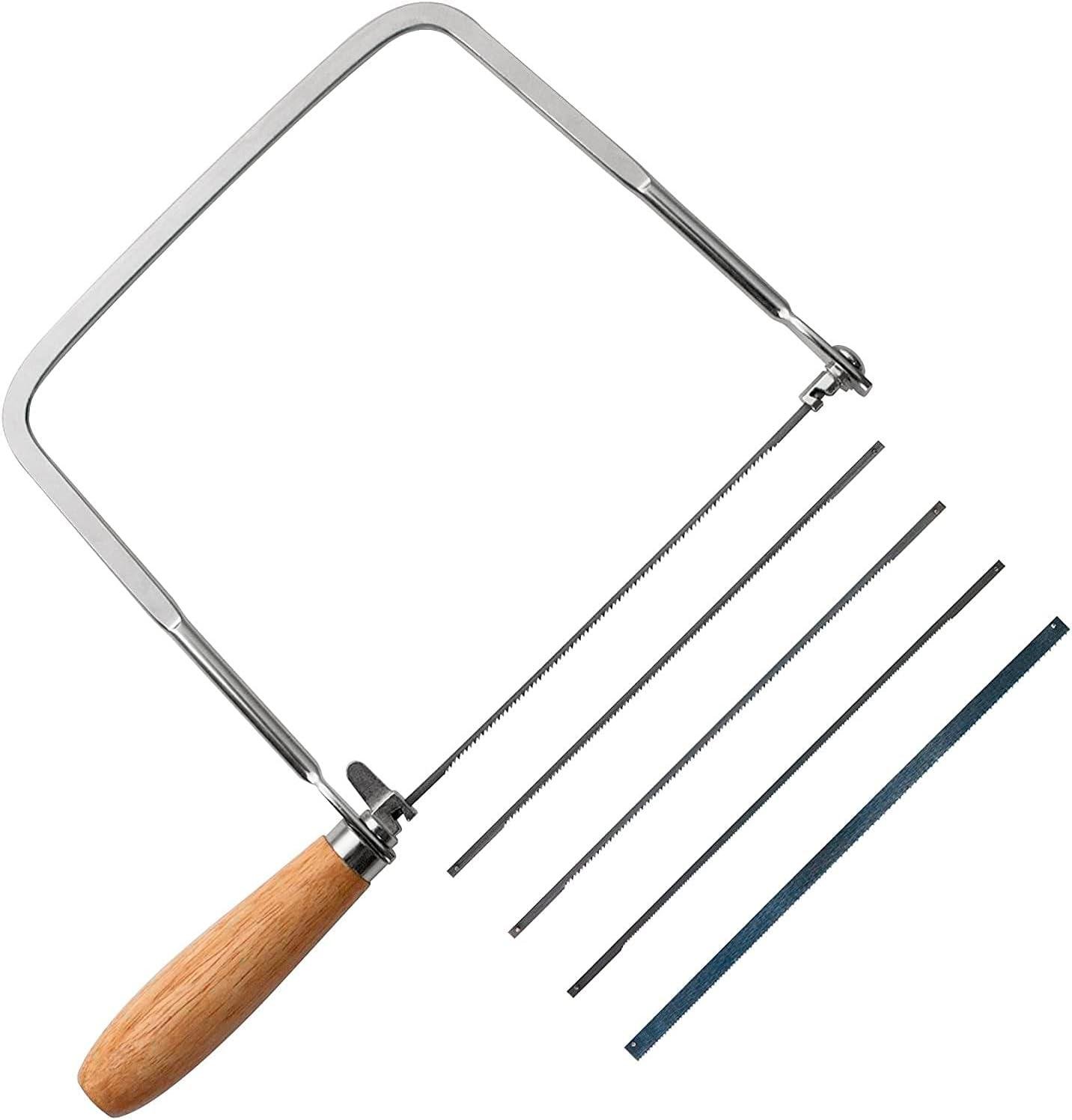
Ever tried shaping a tight inside curve for trim or a small craft cutout—only to watch the blade wander, bind, or snap right when the line matters most? In a crowded shop (or a tiny DIY corner), we often need a tool that’s precise enough for detail work, yet compact and affordable enough to justify keeping within arm’s reach.
The KAKURI Coping Saw Coping Frame and 5 Replacement Blades Set is a multi-purpose, replaceable-blade coping saw designed for wood, wood board, plastic/PVC, and light metals like aluminum. Its deep frame design (6.3″ / 160 mm) is meant to clear wider stock, while the 5.1″ blades and tool-free blade changing—done by rotating the handle—aim to keep the learning curve manageable.
In this review, we’ll look at the specs, blade selection, ergonomics, build quality, and what real customers report: good value and solid functionality, with mixed opinions on sturdiness and some complaints about blade behaviour and blade changes.Our perspective comes from general woodworking experience—cutting curves, fitting joints, and choosing tools that balance budget with reliability.
Tool Overview and Build Quality in the Hand
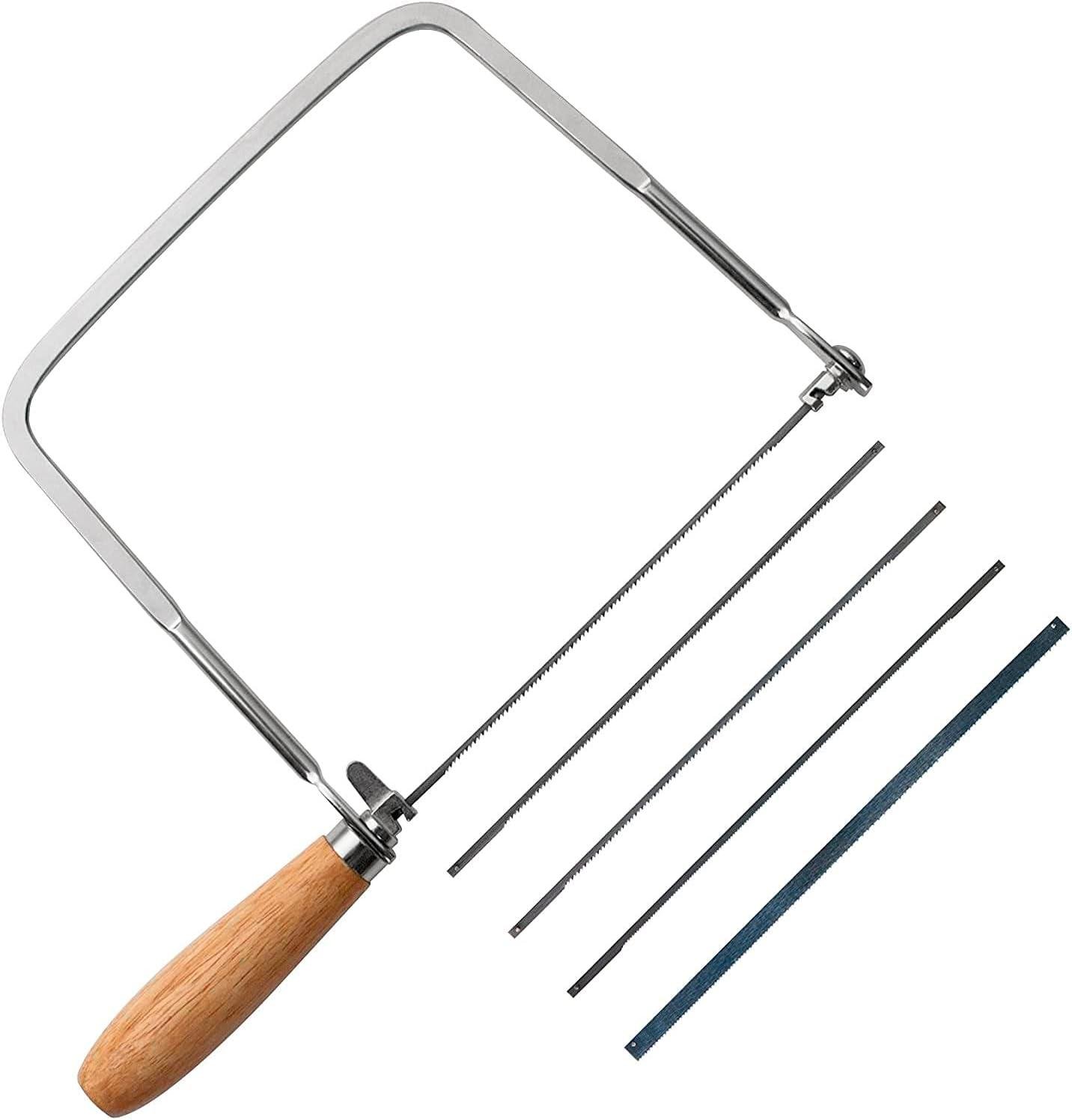
In the hand, the KAKURI coping saw feels like the kind of light-duty, always-within-reach hand tool we keep around for quick inside cuts and tight curves that would be overkill for a jigsaw. The numbers back up that “grab-and-go” vibe: an overall size of 6.9×1.1×11.8 in and a featherweight 7.4 oz, with a 6.3 in (160 mm) deep frame that gives us more throat clearance than many budget coping saws when we’re cutting window openings, inside radii, or coping trim. The 5.1 in blade length is typical for this class, and the set is intended to cover more than just wood—handy when a shop task turns into “also cut that PVC spacer” or “trim that light aluminum strip” without switching tools. Most customer feedback aligns with that practical role: reviewers repeatedly call it “good quality” and “good value for money,” and several mention it cuts smoothly and is easy to use, especially for occasional coping-saw jobs.
Build quality, however, is where we should set expectations like woodworkers: a coping saw works best when the frame is stiff enough to keep the blade tracking true under tension, and reviews are split on whether this one feels “built to last” or “cheap and flimsy.” that mixed impression likely comes down to how hard we push it and how well we tension and steer the blade—coping saws reward a lighter touch and frequent turning rather than brute force. KAKURI’s tool-free blade swap (rotate the handle to release) sounds simple on paper, but multiple reviewers note the blade can be “a little hard to change” and at least one points out the screw into the handle is a bit too short, meaning we may need to “spring” the frame to install a blade.The blade mounts can also rotate 360 degrees, which is useful for coping profiles, but one translated review warns the angle can shift if we try to twist through a curve instead of drilling relief holes and pivoting properly.Educational takeaway: if we’re cutting tight interior curves in plywood or hardwood, we’ll get cleaner, safer control by drilling small relief holes, tensioning the blade firmly, and letting the teeth do the work—especially since one customer complaint specifically mentions blades that “twist/bend/deform” under load.
- Included accessories: general woodworking blades ×2; Wooden board blade ×1; Plastic blade ×1; Light metals blade ×1
- Compatible attachments/accessories: Replacement coping-saw blades in 5.1 in length (pinless style typical for coping saws); small drill bits (for relief holes before tight turns); bench hook or clamp support for steadier coping
- Ideal project types: Coping trim and molding; inside cutouts in thin boards; craftwork and DIY; dismantling tasks; quick shop fixes involving PVC or light metal
- Wood types tested by customers: Plywood (合板); general “timber”/lumber (woodworking use reported)
| Spec | KAKURI Coping Saw (B000ALF4FA) | What It Means in the shop |
|---|---|---|
| Frame depth (throat) | 6.3 in (160 mm) | more clearance for wider stock and deeper interior cutouts before the frame interferes. |
| Blade length | 5.1 in | Standard coping-saw blade length; affects kerf reach and turning control. |
| Overall size | 6.9×1.1×11.8 in | Compact storage; easy to keep in a toolbox for trim work and repairs. |
| Weight | 7.4 oz | Low fatigue for light-duty coping, though lighter frames can feel less rigid under heavy tension. |
| Blade rotation | 360° (per customer feedback) | Useful for coping profiles; can shift if we force turns—technique matters. |
| Blade / Accessory | Included? | Best Use |
|---|---|---|
| General woodworking blade | Yes (×2) | General curves and coping in solid wood and common shop boards. |
| Wood board blade | Yes (×1) | Panel goods and thinner sheet stock where tooth form can matter. |
| Plastic blade | Yes (×1) | PVC and plastics; slower strokes help prevent chatter and melting. |
| Light metals blade | Yes (×1) | Aluminum and light metal cutting; use lubricant/wax and controlled strokes. |
| 5.1 in replacement blades | Optional | Restocking after dulling/breakage; choose tooth count suited to material. |
| Capacity / Use Case | recommended | Actual / Realistic Expectation |
|---|---|---|
| Interior cutout depth (from edge) | Up to 6.3 in throat depth | Achievable, but tighter curves still benefit from relief holes and patient turning. |
| Material range | Wood, board, plastic, light metals (blade set) | Works across materials per reviews, but pushing hard can cause blade twist/bend; keep tension high and strokes light. |
| Skill level | Beginner to intermediate hand-tool users | Beginner-kind, though blade changes may take practice (short screw / springing frame mentioned). |
Check Current Price & Reviews on Amazon
Real world Performance on tight Curves in Wood Plastic and Thin Metal

When we’re shaping tight inside curves—think cope cuts on baseboard returns, scroll-ish cutouts in shop jigs, or trimming patterns in thin sheet goods—the KAKURI coping saw behaves more like a “small, simple scroll saw” than a brute-force hand saw.The big advantage is the deep frame depth of 6.3 in (160 mm), which gives us clearance so the frame doesn’t crash into the work as quickly while turning curves or hollowing out a center area. With the included 5.1-inch blades and the ability for the blade to rotate 360°, we can steer the cut by aiming the teeth where we want to go while keeping our wrist in a comfortable stroke. Reviewers repeatedly echo that it “cuts smoothly” and “works as expected”, and at least one customer specifically reported it helped with “dive rails and trim work”—exactly the kind of fussy, tight-radius work where a coping saw earns its keep.For best results on tight curves, we get cleaner lines by relieving the waste with short “escape cuts,” taking lighter strokes, and letting the blade follow the kerf instead of twisting it under tension.
On wood plastic and thin metal, the real-world difference comes down to blade choice and how aggressively we try to turn. The set includes blades for general woodworking (x2), wooden board (x1), plastic/PVC (x1), and light metals (x1), and customers consistently appreciate the extra blades for different materials—though one theme we see is that tooth pattern labeling can be unclear (“writing was in Chinese… you don’t know the tooth size”). For plastic, reviewers mention cutting poly-type items successfully, but also warn that if we try to “muscle” a direction change, the blade end can rotate slightly during the cut; our workaround is to pre-drill small turn holes (one reviewer suggests about 4 mm) at sharp inside corners so we’re turning gently, not prying. For thin metal and light metals, one reviewer reported cutting a metal clothesline pole/pipe and said it “cut well” without obvious chipping or wear in that job—still, we’d keep expectations realistic: this is a 7.4 oz, hand-powered coping saw, so slow strokes, wax on the blade, firm clamping, and patience matter more than force. Also worth noting for tight-curve work: several buyers mention it’s “a little hard to change the blade” or that the screw is too short, requiring us to “spring” the frame—so we plan blade swaps before we start detail cuts, and we tension the blade carefully to avoid wandering or pop-outs.
- Included accessories: Coping frame + 5 replacement blades (general woodworking x2,wooden board x1,plastic x1,light metals x1)
- Compatible attachments/accessories: replacement coping saw blades sized for a 5.1-inch blade mount (standard coping-saw style)
- Ideal project types:
- Coped trim joints (base/shoe/crown returns)
- Curved cutouts in plywood/templates
- DIY dismantling and sizing plastic/PVC
- Light-duty cuts in thin metal/aluminum-type materials
- Wood types tested by customers: Plywood (customers report it “cut well” on curved plywood)
| Spec / Feature | KAKURI Coping Saw (B000ALF4FA) | What It Means on Tight Curves |
|---|---|---|
| Frame depth | 6.3 in (160 mm) | More clearance before the frame interferes during inside cutouts and tight turns |
| Blade length | 5.1 in | Shorter blade helps control,but turning radius still depends on technique and tooth set |
| Blade rotation | 360° | we can steer direction without re-clamping constantly; avoid prying or it may creep |
| Overall size | 6.9 × 1.1 × 11.8 in | Compact enough for trim bags and small shop drawers |
| Weight | 7.4 oz | Low fatigue for detail work; use controlled strokes for accuracy |
| Blade Type (Included) | Best Use | Technique Tip for Tight Curves |
|---|---|---|
| General woodworking (x2) | Solid wood trim, general coping | Make relief cuts in the waste so the blade doesn’t bind on tight radii |
| Wooden board (x1) | Plywood/board goods | Support both faces to reduce tear-out; turn gradually |
| Plastic/PVC (x1) | PVC pipe/sheet plastics | Use light pressure to avoid melting and wandering; consider pre-drilled turn holes |
| Light metals (x1) | Aluminum/light metal thin sections | Wax the blade and slow down; clamp firmly to prevent chatter |
| Task | Recommended Approach | Actual “Real-World” Expectation |
|---|---|---|
| Very tight inside corners | Drill a small pivot hole (reviewers mention ~4 mm) and connect with short segments | Works well if we don’t force the turn; forcing can cause slight blade rotation |
| Plastic sheet/PVC | Fine strokes, correct blade, steady clamp support | Good control; avoid twisting to prevent the blade from drifting |
| Thin metal/light metal | Metal blade, lubrication, patience | Reported to cut thin pipe well, but it’s still a hand tool—expect slower progress |
See Full Specifications & Customer Photos
Key Features Woodworkers Will Appreciate for Precision Fretwork

For precision fretwork and inside cutouts, the KAKURI’s deep frame design is the feature we notice frist: at 6.3 in (160 mm) frame depth, it gives us more throat clearance than many small coping saws, so the frame is less likely to bump into wide stock while we’re following a tight curve. In practice, that extra space matters when we’re coping crown profiles, trimming notches, or cleaning up curved plywood parts—jobs several reviewers summed up as “cuts smoothly” and “worked well.” we also appreciate that both blade ends can be oriented in 360 degrees, which is handy when we want the handle and frame out of our way during a long inside cut; the tradeoff, echoed in reviews, is that if we force a direction change by twisting hard, the blade angle can creep. For cleaner results, we get better control by letting the teeth do the work, rotating the saw in small increments, and—on complex patterns—pre-drilling small relief holes (one reviewer specifically advises frequent small drill holes on tight curves) to avoid binding and broken blades.
For day-to-day shop convenience, the saw’s tool-free blade swap (rotate the handle to release and tighten) is genuinely useful, especially when we’re switching between materials or tooth patterns mid-project. The set includes blades that cover most “odd job” scenarios we run into: two general woodworking blades plus dedicated blades for wood board, plastic/PVC, and light metals (aluminum, etc.)—and customers repeatedly call out the extra blades as a value add (“comes with extra blades for different materials”). It’s also easy to keep near the bench because it’s compact at 6.9 × 1.1 × 11.8 in and light at 7.4 oz, which helps reduce fatigue when we’re walking a blade along delicate layout lines. Having mentioned that, real-world feedback is mixed on robustness: some users describe it as “built to last” or “feels sturdy,” while others call it “cheap/flimsy,” and at least one notes the handle screw is short, making blade changes a little fiddly as we may need to “spring” the frame to seat a blade. For us, that places it squarely in the camp of a practical, budget-friendly coping saw for occasional to moderate fretwork—excellent when we prioritize versatility and portability, but it rewards careful setup and gentle technique for best precision.
- Included accessories: (5) blades — General woodworking ×2, Wooden board ×1, Plastic ×1, Light metals ×1
- Compatible attachments/accessories: 5.1-inch coping saw blades (pin/end style intended for this frame; match length and end type when buying spares)
- Ideal project types: coping trim profiles, inside cutouts in boards, light curve work in plywood, DIY dismantling/cut-down tasks, craft templates
- Wood types tested by customers: plywood (curved cuts reported); general “timber/lumber” use is discussed, but specific hardwood species are not consistently identified in reviews
| Spec / Feature | KAKURI Coping saw (B000ALF4FA) | Why it matters for precision fretwork |
|---|---|---|
| Frame depth (throat) | 6.3 in (160 mm) | More clearance for wider stock and interior cutouts without the frame colliding with the work. |
| Blade length | 5.1 in | Dictates replacement blade compatibility and how tight a curve we can manage without over-flexing. |
| Overall size | 6.9 × 1.1 × 11.8 in | Compact enough for tool chest storage and quick grab-and-go detail cuts. |
| Weight | 7.4 oz | Light weight helps control on fine lines, but can feel less rigid if we over-torque the cut. |
| Blade rotation | 360° orientation (reported by customers) | Lets us keep the frame out of the way on awkward curves; avoid twisting hard to prevent angle creep. |
| Accessory / Blade Type | Included? | Best use in the shop |
|---|---|---|
| General woodworking blades | Yes (×2) | Everyday coping, trim back-cuts, and moderate curve work in typical lumber. |
| Wood board blade | Yes (×1) | Sheet goods and board stock where tooth geometry can help reduce tear-out when paired with light strokes. |
| Plastic/PVC blade | Yes (×1) | PVC pipe and plastics; use slower strokes to avoid melting and clogging. |
| Light metal blade | Yes (×1) | aluminum and similar light metals; use steady tension and let the blade cut to prevent tooth damage. |
| Capacity Consideration | Recommended (for best precision) | Actual / Rated (from specs & reviews) |
|---|---|---|
| Workpiece “reach” for interior cuts | Keep patterns within comfortable control; reposition frequently enough | 6.3 in frame depth supports wider stock without frame interference. |
| Curve complexity | Relief holes for tight turns; rotate gradually | Customers report curves in plywood cut well; also warn tight turns can bind without relief holes. |
| Blade changes during a project | Fast swaps, consistent tension, minimal fiddling | Tool-free swap design, but some reviews mention the screw is short and changes can be a bit arduous. |
Ease of Use for Beginners and Control for Experienced Hands

With the KAKURI coping saw, we found the learning curve stays friendly as the tool is simple, light, and predictable in the cut. The whole saw is only 7.4 oz with an overall size of 6.9 × 1.1 × 11.8 in, so it doesn’t fight us in tight corners the way heavier frames can. for beginners who are just starting to shape inside curves or trim small parts at the bench, the 6.3 in (160 mm) deep frame is a real advantage—it keeps the frame from bumping into the work when we’re hollowing an interior cutout or coping a wider board. Customer feedback lines up with that “pick it up and get going” feel: multiple reviewers call it “very easy to use” and say it “cuts smoothly”, with one mentioning it helped with dive rails and trim work. Educationally, the biggest beginner tip is to let the blade do the work: keep the strokes long, keep the frame square to the face of the board, and steer curves by gradually rotating the saw rather than twisting the blade in the kerf (that’s how blades kink or pop loose).
For more experienced hands, the control comes from how the blade can be oriented—reviews note the ends can rotate through 360 degrees, which lets us set the cut direction for coping profiles or reaching into awkward inside corners. Having mentioned that, the same blade system is also where skill matters: while KAKURI advertises an easy interchangeable style with no extra tools, some users report it can be “a little hard to change the blade” and mention a short screw that requires us to “spring” the frame to tension the blade. In practice, that means we get the best results when we tension the blade firmly, start with a shallow guiding groove, and drill relief holes for tighter turns (one reviewer specifically warns that complex curves benefit from small pre-drilled holes so we don’t get stuck mid-cut). Review themes are mixed on robustness—some say it’s “built to last” while others call it “cheap” or “flimsy”—so in a pro shop we’d treat it as a capable, budget-friendly coping saw rather than a forever frame, and we’d keep spare blades on hand if we’re pushing harder materials like plastic or light metals.
See full specifications & Customer photos
Customer Reviews Analysis
What Woodworkers Are Saying: KAKURI Coping Saw + 5 Replacement Blades
1. Overall sentiment from woodworking customers
Overall feedback trends positive, especially from DIYers and occasional woodworkers looking for an affordable coping saw that “just works.” Several woodworkers mentioned it feels sturdy for the price and delivers smooth cuts without needing a premium-grade tool.Value is a recurring theme—customers repeatedly framed it as a practical buy rather than a showpiece (“not gorgeous,but didn’t buy it for the beauty”).
2. Performance feedback (accuracy, power, results)
Common praise includes smooth cutting and solid real-world results on typical shop tasks. Multiple reviews highlight clean, controlled cutting on wood and plywood, with one noting it “cuts smoothly” and another reporting it “did my sawing job well.”
That said, some users reported challenges with tight curve work and directional control. One reviewer cautioned that while the blade ends can rotate 360°, forcing direction changes can cause slight unwanted rotation. Another noted it behaves more like a coping saw meant for straight/segmented cuts rather than a true “freestyle” fret-style saw blade that can travel any direction—advising drilled relief holes (around 4mm) to manage complex curves.
3. Build quality and durability observations
Build impressions generally land in the “good to better-than-expected” category for the low price point.
- Several woodworkers mentioned it feels sturdy and “built to last.”
- Others described it as “a little on the cheap side,” but still functional and acceptable given the cost.
- On longevity, one user cutting metal pipe reported no noticeable blade chipping or wear after segmenting multiple sections—suggesting the included blades can hold up with appropriate use.
Recurring durability/build nit: multiple comments point to the blade-holding screw/handle screw being too short, which affects blade installation more than day-to-day cutting strength.
4. Ease of use for different skill levels
- Beginners and casual DIYers appreciated the straightforward usefulness and affordability—especially those who don’t need a coping saw frequently enough.
- Some DIYers found the learning curve steeper around blade changes and setup. One reviewer said you have to “spring” the frame to insert a new blade, and wished for a lever-style adjustment for blade angle.
- Instructions/packaging were reported as not very helpful for English readers—one review noted the documentation appeared Japanese (and the tool is made in Taiwan).This can add friction for first-time users.
5. Common project types and success stories
Customers successfully used this for a range of practical cut-down and trim tasks, including:
- Trim work / rail work: One reviewer bought it for “dive rails and trim work” and said it made their day “much more triumphant.”
- Curved cuts in plywood: Several reviewers mentioned it cut curved plywood well (“合板の曲線でも良く切れました”).
- Shop/household cutting beyond wood:
- Cutting a poly cutting board (plastic) was specifically mentioned.
- Cutting metal pipe (a clothesline pole) into shorter pieces for disposal—reported to cut well with no obvious blade wear.
The extra blades for different materials were frequently called out as a practical bonus and part of the value.
6. Issues or limitations reported
Multiple reviews highlight a few consistent drawbacks:
- Blade installation tension / short screw: Several users said the screw used to secure the blade (or the screw into the handle) is short, making blade setup harder than it needs to be.
- Angle control could be better: While the blade can be set at various angles (up to 360°), some users wished for more positive indexing (e.g., fixed 90° positions) to prevent slight rotation when turning under load.
- Not ideal for complex curves without prep: For intricate curves, reviewers recommend drilling relief holes in advance; otherwise, turning can be difficult and can lead to binding.
- Documentation language: Packaging/instructions not being in English was a frustration for at least one buyer.
At-a-glance review themes
| Aspect | Common Feedback |
|---|---|
| Performance | Generally smooth cutting on wood/plywood; handles plastic and even light metal cutting with the right blade. Tight curves may require relief holes and careful steering. |
| Precision | Good basic control; blade angle is adjustable, but some report slight rotation if forced during direction changes. |
| Durability | Often described as sturdy and “built to last,” especially for the price; blades held up well in at least one metal-cutting report. |
| Ease of Use | Simple for occasional use, but blade changes can be fiddly due to a short screw and the need to flex (“spring”) the frame. |
| Versatility | Extra blades are a key advantage; used across wood, plywood curves, plastic cutting boards, and metal pipe. |
| Value | Strong value sentiment—buyers accept modest finish/looks as performance meets expectations at a low cost. |
Pros & Cons
Pros & Cons
After putting the KAKURI Coping Saw Coping Frame and 5 Replacement Blades Set through the kind of mixed DIY tasks our home shop always seems to generate, here’s the balanced rundown of what felt genuinely helpful—and what felt like the “budget tool reality check.”
Pros
- Versatile right out of the box: We like that it includes multiple blade types for woodworking, wood board, plastic, and light metal, which makes it feel like a small kit rather of a single-purpose purchase.
- Deep frame = fewer awkward collisions: The ~6.3″ frame depth gives us more clearance for wider stock and interior cutouts, and the frame tends to stay out of the way on curves.
- Works well for “small saw” jobs: For trim tweaks, craft cuts, quick notches, and occasional coping, it does what we need without dragging out louder tools.
- Comfortable wooden handle: The grip feels friendly for longer sessions,especially when we’re steering the saw through curves.
- Good value if we’re not using it daily: Many homeowners don’t need a coping saw constantly; for occasional use, the price-to-performance equation feels reasonable.
- Blade angle flexibility: Being able to rotate the blade orientation (360°) can help us reach odd angles—when it stays put.
Cons
- Build quality can feel inconsistent: Some units feel sturdy, others feel a bit flimsy.We’d call it “home-shop fine,” not “jobsite confident.”
- Blade changes aren’t always effortless: While it’s designed to be tool-free, we still found swapping blades can take patience, especially when tensioning and seating the blade.
- short screw / spring-to-fit tensioning: That “bend the frame slightly to fit the blade” moment can feel awkward until we get used to it (and it’s not everyone’s favorite design).
- Blades might potentially be a weak link for some users: We’ve seen reports of blades twisting or popping out. Even if ours behave, we’d still treat the included blades as “starter blades.”
- Blade labeling/documentation can be unclear: If packaging/instructions aren’t in English (or blade tooth counts aren’t obvious), we end up doing the classic shop method: guess, test, adjust.
- Not ideal for forcing tight turns: If we try to “muscle” the saw around a curve, the blade can wander or the orientation can shift slightly—better technique helps, but it’s something we noticed.
Quick Pros vs. Cons Snapshot
| What We Noticed | Why It Matters in a Home Shop | Verdict |
|---|---|---|
| Includes 5 blades for different materials | We can handle mixed projects without extra shopping | Big plus |
| Deep 6.3″ frame | More clearance for wider boards and interior cuts | Helpful feature |
| Tool-free blade swap (in theory) | Great when it’s quick; annoying when it isn’t | Mixed |
| Quality varies by user experience | We may get a “tank” or a “temporary helper” | Watch-out |
| Affordable | Easy to justify for occasional use | Strong value |
Q&A
What wood types can this handle effectively—and is it strong enough for hardwoods like oak or maple?
This is a hand-powered coping saw, so “power” is really about blade choice, sharpness, and technique. For most common shop woods (pine, poplar, fir, cedar) it cuts smoothly with the included general woodworking blades. It can handle hardwoods (like oak or maple) for trim, joinery clean-up, and curved cutouts, but expect slower cutting and lighter pressure—forcing the cut is what makes thin blades wander or snap. Several customers describe it as working well for trim work and general DIY, but not a fast production solution for thick, dense stock.
How does it perform on plywood, veneers, and thin wood board?
Plywood and thin “wood board” are a good match for a coping saw, especially for curves and interior cutouts. One reviewer specifically mentioned it cut plywood curves well. For clean edges on ply/veneers, use a fine-tooth blade, keep tension high, and support the work close to the cut to reduce tear-out. Like most coping saws,it’s best for controlled,detailed cuts—not long straight rips where a panel saw or jigsaw will be faster and straighter.
Can it cut plastic and light metal, or is that just marketing?
The set includes dedicated blades for plastic and light metals (the product list calls out PVC/plastic and aluminum/light metals), and customer feedback supports real-world use—one reviewer reports successfully cutting a metal clothesline pole/pipe into multiple pieces with minimal wear. The limitation is thickness and patience: it’s well-suited to thin-wall aluminum, light-gauge metal, and plastic sheet/pipe. For steel or thick metal, a hacksaw or angle grinder will be more appropriate and much faster.
How difficult is initial setup, and how easy are blade changes?
There’s very little “setup” beyond installing and tensioning a blade. The tool is designed for tool-free blade swaps: the manufacturer states you rotate the handle to remove/attach the blade, no wrench or screwdriver required. In customer reviews, functionality is consistently praised, but blade changes get mixed comments—at least one user noted it can be “a little hard to change the blade,” and another mentioned the clamping screw felt short and required “springing” the frame to install a blade.Practically, it gets easier after the first few swaps; keep the blade centered, tension it evenly, and avoid over-torquing the clamp.
What adjustments are available (blade angle/rotation), and will it stay put?
This style of coping saw allows the blade to be set at different angles to reach awkward cuts; one review notes the ends can rotate through 360°. That’s helpful for coping baseboard/crown or cutting inside shapes without the frame hitting the work.The tradeoff is that if you “muscle” tight turns by twisting the saw instead of steering the cut with gentle strokes,the blade orientation can creep slightly.For best control,keep the blade tensioned,steer with the workpiece (or make relief cuts/drill small turn holes for tight curves),and avoid side-loading the blade.
Will this fit in a small workshop, and does it need dust collection or power?
Yes—this is a compact, manual tool (overall size listed at about 6.9 × 1.1 × 11.8 in., weight about 7.4 oz), so it stores easily in a drawer or tool chest and works anywhere. no power outlet needed and no dust collection required. That said,fine sawdust from plywood/MDF-like sheet goods can still be irritating—woodworkers often add a simple bench hook or use a small shop vac nearby when doing a lot of cuts.
Is it beginner-friendly, and what’s the learning curve?
Most beginners can get usable results quickly as the tool is simple and forgiving for small cuts. Reviews frequently describe it as easy to use and good value. The main learning curve is coping-saw technique (light pressure, let the teeth do the work, turn gradually) and blade handling (tension and installation). If you’re new, start on softwood scraps, practice turning on a gentle curve, and drill a starter hole for interior cutouts so you don’t fight the frame.
Is it durable enough for professional use, and is it worth it compared to cheaper options?
Customer opinions on build quality are mixed: some say it feels sturdy and “built to last,” while others describe it as a bit flimsy or “works in a pinch.” That pattern usually means it’s a strong value for occasional or moderate use (DIY, trim coping, hobby woodworking), especially since it includes five blades for different materials and the blades are described as hardened/tempered for durability. For daily professional coping work where speed, rigidity, and ultra-reliable clamps matter, many pros still prefer a heavier-duty coping saw with a more robust tensioning/clamping mechanism and readily labeled blade specs. If you only need a coping saw periodically,this one tends to make sense on price-to-performance.
Discover the power
The KAKURI Coping Saw coping frame and 5 Replacement blades set is a lightweight (7.4 oz) hand coping saw with a 6.3″ deep frame, 5.1″ blades, and a wooden handle. It includes five blades—two general woodworking, plus dedicated options for wood board, plastic, and light metals—making it a versatile choice for curves, cutouts, and quick trim work. Customer feedback commonly praises its value, smooth cutting, and the usefulness of the extra blades, while opinions on overall sturdiness are mixed and some note the blade-changing hardware can be finicky.Best for hobby woodworkers with small to medium projects, beginners learning fundamentals, and cabinet or trim work where controlled, precise coping cuts matter.
Consider alternatives if you routinely cut thick hardwoods, want faster production throughput, or need a more robust frame and easier tensioning for daily professional use.
it’s a solid budget-friendly option with practical blade variety—reliable for occasional use, but not the most durable heavy-duty coping saw.
Want to see current pricing and customer photos? View on Amazon & read More Reviews →