

Blog
EZARC Obsidian Oscillating Saw Blades: Our Shop?

Ever start a “quick” trim-out or cabinet fit-up, only to hit a hidden nail, a stubborn screw, or a tight corner where a full-size saw just won’t fit? In those moments, precision matters—one wandering plunge cut can scar a face frame, and a dull blade can turn clean work into torn fibers and frustration, especially in a cramped shop where we don’t want to juggle a dozen specialty blades.
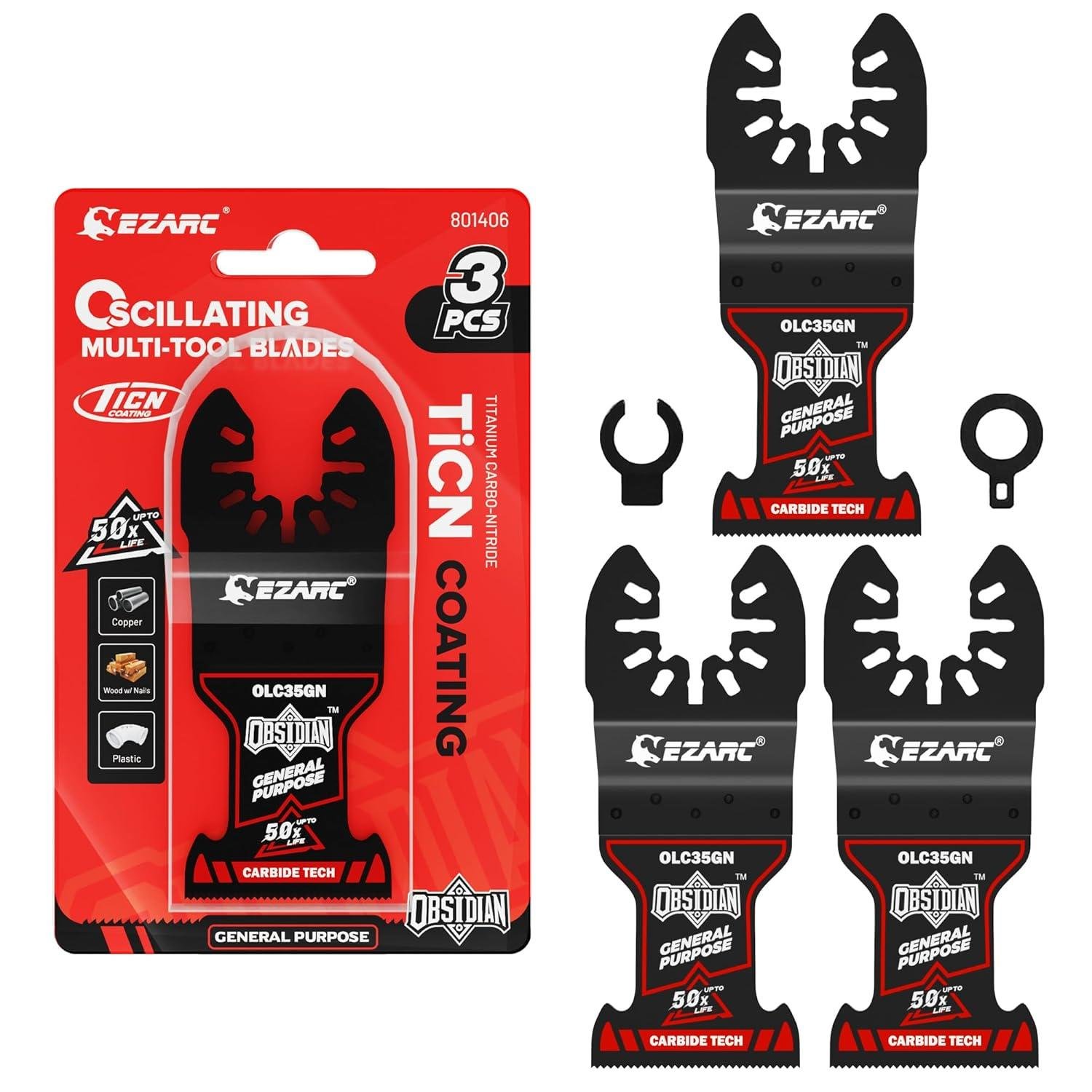
That’s where the EZARC Obsidian Carbide Oscillating Saw Blades (Multi‑Material, 3‑Pack) aim to help. These are carbide-tooth oscillating tool blades with a quick-release, global-style mount (note: not Starlock) designed for cutting wood, nail-embedded wood, metal, plaster/drywall, and PVC. EZARC also highlights a TiCN coating and a 20% thinner kerf for potentially faster cutting.
In this review, we’ll look at the key design features, compatibility, and what customer feedback suggests about durability, cut control, and value—so we can decide who these blades make sense for, from DIYers to seasoned remodel/woodshop crews. Our perspective comes from years of typical woodworking and renovation reality: tight tolerances, mixed materials, and budgets that still demand quality.
Tool Overview and First Impressions in Our Shop

In our shop, the EZARC Obsidian Carbide Oscillating Saw Blades show up as a straightforward, job-focused consumable: a 3-pack of carbide-tooth oscillating plunge-cut blades meant to stay on the tool when the work gets unpredictable—think wood one second and a hidden fastener the next. The big spec story is the blade build itself: carbide teeth paired with a TiCN (Titanium Carbo-Nitride) coating, plus EZARC’s claim of a 20% thinner design (to reduce kerf) for up to 50% faster cutting than typical carbide multi-tool blades. They’re also listed as quick release with a universal interface that fits most common oscillating tools (Fein, Ryobi, Milwaukee, Rockwell, Black & Decker, Porter-Cable, Craftsman, etc.), with one critically important caveat: not compatible with Starlock interface systems. For woodworking,that compatibility note matters more than the coating—before we get excited,we make sure our oscillating tool isn’t a Starlock-only setup.
First impressions are largely shaped by what woodworkers and remodelers keep repeating in customer feedback: “high quality,” “cuts everything,” and “very durable,” especially when nails and screws crash the party. Multiple reviewers describe cutting hard fasteners—everything from roof nails to 1/4×20 bolts—and themes like “cut up to 50 nails per blade” and even “cut 85 nails and screws… still works great” pop up, alongside praise that it handles stainless steel “like butter.” We treat those numbers as anecdotal, but they do line up with what we look for in a multi-material blade: predictable plunge control, a tooth edge that doesn’t instantly turn to dust on metal contact, and a kerf thin enough to keep the tool from chattering. The educational takeaway for our crew is simple: oscillating blades cut by rapid side-to-side motion, so technique matters—light pressure, let the carbide do the work, and use small “pecking” plunges to manage heat (especially in metal) and keep the cut tracking straight in tight joinery-adjacent spots like trimming shims, notching casing, or cleaning out glue blocks.
- Included accessories: 3× EZARC Obsidian carbide oscillating saw blades (multi-material), quick-release style
- Compatible attachments/accessories: universal-fit oscillating tools (Fein, Ryobi, Milwaukee, Rockwell, Black & Decker, Porter-Cable, Craftsman, and more); not compatible with Starlock interface system
- Ideal project types: trimming nail-embedded studs during repairs, plunge-cutting openings in drywall/plaster, undercutting jambs, flush-cutting screws/bolts near surfaces, PVC trimming, jobsite punch-list work where material changes mid-cut
- Wood types tested by customers: not consistently specified in reviews (customers mention “lumber” and nail-embedded wood rather than named species)
| Spec / Claim | EZARC Obsidian Carbide (per listing) | Why it matters in a wood shop |
|---|---|---|
| Blade pack size | 3-pack | Enough for rotation: one for dirty demo cuts, one for cleaner trim work, one as a spare. |
| Tooth material | Carbide teeth | Better odds of surviving nails/screws than standard bi-metal when you hit hidden fasteners. |
| Coating | TiCN coating | Aims to reduce wear/heat; useful when oscillating through metal where heat buildup is common. |
| Kerf / thickness claim | 20% thinner design (claim) | Thinner kerf can mean less vibration and faster plunge cuts—helpful for control in tight work. |
| Compatibility | Universal interface; not Starlock | Determines whether the blade even mounts to your tool—check before buying. |
| Accessory / System | Compatibility | Notes |
|---|---|---|
| Universal-fit oscillating tools | Yes (per listing) | Supported brands listed include Fein, Ryobi, Milwaukee, Rockwell, B&D, Porter-Cable, Craftsman, etc. |
| Starlock interface system | No | Listing explicitly notes incompatibility—verify your tool’s mount type. |
| Capacity Guidance | Recommended (best practice) | What we can actually confirm |
|---|---|---|
| Metal cutting workload per blade | Work in short bursts; avoid overheating; expect wear when cutting hardened fasteners | Customers report examples like “cut up to 50 nails per blade” and “85 nails and screws… still works great” (anecdotal) |
| Multi-material use | Use for mixed/dirty cuts; switch to a dedicated wood blade for cleaner finish work | Listed for wood, nail-embedded wood, screws, metal, plasterboard/drywall, PVC |
see Full Specifications & Customer Photos
Real World Performance on wood Metal and Nail Embedded Cuts

In real shop use, these EZARC Obsidian carbide oscillating blades behave like the “one blade we keep on the bench” for mixed-material punch-list work—flush-cutting shims, trimming casing returns, and making careful plunge cuts where a circular saw or recip just can’t fit. The headline spec that matters here is the carbide teeth design paired with the new TiCN coating, and EZARC also claims a 20% thinner blade body for up to 50% faster cutting versus standard carbide blades. On clean wood, that thin-kerf feel typically translates to less heat and less “stalling” when we keep the tool moving and let the oscillation do the work—especially in softer species and plywood where plunge cuts can scorch if we linger. Where these blades really earn their keep for woodworking is nail-embedded lumber: customers repeatedly mention they “cut nails or whatever gets in the way” and “keep an edge,” which lines up with the practical reality of remodel stock,pallet wood,and reclaimed framing where hidden surprises are the norm.
On metal and fasteners,the customer feedback is unusually specific: multiple reviewers report cutting dozens of nails/screws per blade (one mentions “cut 85 nails and screws”,another says “cut up to 50 nails per blade”),and several call out bolts—like cutting “15 1/4×20 bolts flush to some t-nuts” with a single blade,and even stainless/grade fasteners being cut “with ease.” We always treat that as a theme rather than a guarantee—blade life varies wildly with pressure, oscillation speed, and whether we’re rubbing the sides of the kerf—but it’s still a strong indicator that these are aimed at real multi-material abuse rather than just “wood only” trim work. For best results (and fewer chipped teeth), we do two things: (1) start plunge cuts gently to establish a track before pushing, and (2) on metal, keep the blade moving side-to-side slightly so the teeth don’t dwell in one spot and overheat. Also note the fitment spec: these have a universal interface that works with most common oscillating tools (Fein,Ryobi,Milwaukee,etc.) but they’re not compatible with Starlock, which matters if our shop uses Starlock-only machines.
Check Current Price & Reviews on Amazon
Key Features Woodworkers Will Appreciate for Remodel and Trim Work

In remodel and trim work, what we appreciate most about the EZARC obsidian set is how it’s built to stay on the tool instead of forcing us to swap blades every time the job shifts from casing to fasteners. These are carbide-tooth,TiCN-coated oscillating blades designed for multi-material cutting—wood,nail-embedded wood,screws/metal,plasterboard/drywall,and PVC—so they make sense for the kind of “surprise” cuts we run into when opening walls or trimming around old jambs. EZARC also claims a 20% thinner blade design for up to 50% faster cutting, which matters when we’re doing repeated plunge cuts for undercutting door casings, trimming shims flush, or cutting back baseboard to slip flooring under. Customer review themes line up with that multi-material pitch: multiple reviewers say the blades are “high quality”, cut through nails and bolts easily, and hold an edge; one even reports cutting “50 nails per blade” (and others mention 80+ fasteners), which is exactly the kind of real-world abuse remodel blades see.
For precision-focused trim tasks,we still want to use good oscillating technique—let the tool oscillations do the work,start with a light touch to establish the kerf,and avoid side-loading the blade so we don’t wander off a scribe line or chip teeth. The thinner-kerf design can help plunge cuts feel less “grabby,” but it also means we should keep the blade straight and control heat when crossing metal (short bursts, back off, re-engage). Compatibility is also a practical feature here: the blades use a universal interface that fits most common oscillating tools (Fein, Ryobi, Milwaukee, Rockwell, Black & Decker, Porter Cable, Craftsman, and more), with an critically important caveat that they’re not compatible with Starlock—so we need to confirm our tool’s mount before banking on these for jobsite trim fixes. if our work regularly includes paint-stuck trim removal, outlet cutouts in drywall, and nails hiding behind casing, the reviews suggesting they “cut everything” and are “best bang for your buck” point to a solid fit—while the few durability complaints about teeth chipping remind us carbide blades still reward careful feed pressure and controlled contact with hardened fasteners.
See Full Specifications & Customer Photos
Ease of Use and Blade Changes for Beginners and Experienced Woodworkers

For beginners, the biggest “ease of use” win with the EZARC Obsidian set is that it’s a 3-pack of multi-material carbide oscillating blades designed to stay on the tool longer instead of forcing constant blade swaps mid-task. In our shop, that matters most on real-world jobs like trimming a jamb, flushing a proud plug, or plunge-cutting a patch opening where you might hit a hidden brad or drywall screw. The blades use a quick-release, universal interface (fits most non-Starlock oscillating tools), so the learning curve is mostly about your tool—not the blade. Customer review themes line up with that “grab one blade and keep moving” feeling: multiple buyers say these blades “cut nails or whatever gets in the way” and “cut everything,” and several mention they don’t have to baby them when the cut transitions from wood to fasteners.
For more experienced woodworkers, blade changes become less about “can we install it?” and more about workflow and control—especially when we’re switching between a fine plunge cut in trim and a demolition-style cut through nail-embedded stock. EZARC’s pitch here is the combination of carbide teeth plus a TiCN coating, along with a 20% thinner design that’s claimed to cut up to 50% faster than standard carbide blades. In practice, that thinner kerf can help reduce push force and heat buildup, which makes tool handling steadier—useful when we’re trying to keep a plunge cut square in hardwood or avoid bouncing on plaster/drywall edges. Reviewers repeatedly report strong real-world cutting on metal hardware—like cutting “15 1/4×20 bolts flush” with one blade, and one customer claiming “cut 85 nails and screws” on a single blade—though there are also a few durability complaints (some mention tooth chipping), so we’d still recommend standard carbide best practices: let the oscillations do the work, use lighter pressure on metal, and pause to manage heat if the blade starts to discolor.
- Included accessories: 3x EZARC Obsidian Carbide Oscillating Saw Blades (multi-material)
- Compatible attachments/accessories: most universal-fit oscillating tools (Fein, Ryobi, Milwaukee, Rockwell, Black & Decker, Porter Cable, Craftsman, and more)
- Not compatible: Starlock interface systems
- Ideal project types: Flush-cutting nails/screws in remodel work, plunge cuts for outlet/vent openings, trimming door jambs/baseboard, cutting nail-embedded lumber, drywall/plaster patch prep, PVC trimming
- Wood types tested by customers: Not specified in reviews (most feedback centers on nail-embedded lumber and mixed-material cuts)
| Feature | EZARC Obsidian carbide (This Set) | what It Means in the Shop |
|---|---|---|
| Blade pack size | 3-pack | enough spares for mixed cuts without rationing a single blade. |
| Tooth material / coating | Carbide teeth + TiCN coating | Aimed at holding an edge when you inevitably hit fasteners. |
| Kerf / thickness claim | 20% thinner design | Potentially less grab and faster plunge cutting with less pressure. |
| Fitment | Universal interface (non-Starlock) | Quick install on many common tools; verify before ordering. |
| Accessory Type | Compatibility | Notes |
|---|---|---|
| universal oscillating tool mounts | Yes | Fits most brands listed by EZARC; tool-specific washer/bolt systems vary. |
| Starlock mounts | No | Explicitly listed as incompatible—double-check your tool head. |
| Application | Recommended Use | What Customers Report |
|---|---|---|
| Nail-embedded wood | Use moderate pressure; keep the blade moving to manage heat | Repeated success cutting nails/screws; some report 85+ fasteners per blade |
| Bolts / hard metal | Light pressure, short passes to reduce overheating | Reports of cutting 1/4×20 bolts and even stainless “like butter” |
| Drywall / plaster | Score first; use shallow plunges to avoid blowout | Described as working well across materials; fewer specifics than metal feedback |
Check Current Price & Reviews on Amazon
Customer Reviews Analysis
What Woodworkers Are Saying (Review Analysis)
| Aspect | Common Feedback |
|---|---|
| Overall Sentiment | Strongly positive—reviews repeatedly emphasize “cuts like crazy,” long edge life,and solid value vs. big-box pricing. |
| Performance | High praise for fast cutting through metal fasteners (nails, screws, bolts) and “cuts with ease” even on harder metals. |
| Durability | Multiple reviews highlight longevity—users report dozens of cuts on a single blade while still holding an edge. |
| Ease of Use | Generally straightforward: users describe it as “works great” and effective right away, with a note that durability improves “if you’re careful.” |
| Versatility | Common praise includes multi-material capability—wood, metal, and more—often framed as “cuts really everything.” |
| Limitations | Few negatives; the main tradeoff mentioned is price vs. general-purpose blades (but many still call it worth it). |
1. Overall sentiment from woodworking customers
Several woodworkers (and general DIY users working in wood-and-fastener scenarios) mentioned being impressed by how aggressively these blades cut and how long they last.Common praise includes repeat-purchase intent (“I’ll buy them again”) and value comparisons, with one reviewer noting the price is “about 40% less than buying in the big box stores.”
2. Performance feedback (accuracy, power, results)
Multiple reviews highlight strong cutting performance under real jobsite-style loads—especially when a woodworking cut hits hidden metal.
- Cuts through metal fasteners cleanly: Customers successfully used this for cutting nails and screws that “get in the way,” a common problem during demo, remodels, and repair work.
- Harder metal capability stood out: Some users reported challenges with standard metal blades on tougher hardware, but said these carbide blades “exceeded my expectations” and “cut through the bolts with ease.”
- Results-focused feedback: While reviews don’t go deep into fine-joinery accuracy,they consistently describe decisive,effective cutting. One short excerpt captures the tone: “These things last a long time even when cutting screws and nails off.”
3. Build quality and durability observations
Durability is the dominant theme.
- Several woodworkers mentioned long edge life after heavy use: one reviewer reports cutting “85 nails and screws” with the blade still working great.
- Another user cut about 15 1/4×20 bolts flush to T-nuts using one blade.
- Reviewers also compared longevity favorably versus cheaper alternatives (example: “cheaper titanium metal cutting blades… didn’t last long”).
- A couple of reviews add a practical note that longevity depends on technique—one says it’s durable “if you’re careful,” implying abuse or overheating can still shorten life (as with most oscillating blades).
4. Ease of use for different skill levels
Reviewers with DIY and general shop experience found the learning curve low—several comments are essentially “works great” with no tuning or troubleshooting. There’s no repeated complaint about fitment or setup in the provided reviews, and the “quick release” style appears to be hassle-free in practice based on the lack of negative mentions.
that said, the “durable if you’re careful” comment suggests beginners will benefit from standard best practices (steady pressure, letting the blade do the work, avoiding excessive prying).
5. Common project types and success stories
While most reviews focus on materials rather than specific furniture builds, there are clear, project-relevant use cases woodworkers will recognize:
- Remodel/demolition and repair: cutting through nails and screws encountered in wood assemblies.
- Hardware and install work: trimming bolts flush to T-nuts (shop jigs, benches, fixtures, and hardware installs).
- Metal-heavy tasks adjacent to woodworking: cutting hinges and tougher bolts (including stainless hardware).
Several international-language reviews reinforce the same “multi-material” success story—users describe cutting everything from wood to metal and still retaining sharpness.
6. Issues or limitations reported
Some users reported challenges mainly around cost comparison:
- One reviewer notes these are “pricey compared to general-purpose blades,” though they still conclude they’re “worth it.”
- Beyond price, the review set contains very few negatives—no repeated complaints about wobble, poor fit, or premature tooth loss. The only soft limitation is that durability is best when used with care (suggesting technique and heat management still matter).
Bottom line from reviewers: If your woodworking often runs into hidden fasteners—or you do remodel/repair work—multiple reviews highlight these EZARC carbide blades as a durable, high-performing option that can save time (and blades) compared to cheaper metal-cutting options.
pros & cons

Pros & Cons
In our shop, oscillating blades tend to live short, dramatic lives—especially when nails, screws, and mystery metal get involved.
The EZARC Obsidian Carbide Oscillating Saw Blades (3-Pack) aim to be the “leave-one-blade-on” solution, and they come surprisingly close.
Pros
- Multi-material confidence. We can jump between nail-embedded wood, PVC, drywall, and metal without promptly swapping blades.
- Strong metal performance. Real-world feedback points to easy cuts through nails,bolts,and even stainless—exactly where many “general purpose” blades surrender.
- Durability that feels earned. Multiple users report dozens of nail/screw cuts per blade, which is the kind of mileage we actually care about on a job.
- Fast cutting design. the thinner kerf (claimed ~20% thinner) helps the blade feel more eager in plunge cuts and reduces the “buzz-and-polish” effect on tougher materials.
- Good value for carbide. Compared with big-box pricing on carbide options,these frequently enough land in the “worth it” zone,especially if we’re cutting metal regularly.
- Wide compatibility. The universal interface should fit most common oscillating tools in the shop (Fein-style mounts, etc.).
- TiCN coating upgrade. The Titanium Carbo-Nitride coating is a legit durability play on abrasive materials, at least in theory—and reviews suggest it’s not just marketing glitter.
Cons
- Not Starlock-compatible. If our tool is Starlock-only, this is a full stop—no adapter magic promised here.
- “Multi-material” can still mean trade-offs. One blade doing everything usually means it won’t be the absolute best at any single specialty cut (e.g.,ultra-clean wood finish work).
- Potential tooth chipping reports. A minority of users mention early chipping; carbide is tough, but it can be brittle if we twist, pry, or hit hardened fasteners at bad angles.
- Only three blades per pack. If we’re feeding an oscillating tool all week, a 3-pack can vanish quickly—great performance doesn’t stop time.
- Price can feel “premium” vs. basic bi-metal. We’re paying for carbide endurance; if we’re mostly cutting soft wood, cheaper blades may be more sensible.
At-a-Glance (How It Lands in Our Shop)
| Category | Our Take | What That Means on the Job |
|---|---|---|
| Metal Cutting | Strong | We can tackle nails/bolts without instantly sacrificing the teeth. |
| Multi-Material Flex | High | Fewer blade swaps when the wall cavity holds “surprises.” |
| Speed | Above average | Plunge cuts feel quicker, especially in mixed materials. |
| Compatibility | Wide (non-Starlock) | Works with most common tools—unless we’re on Starlock-only. |
| Value | Good for carbide | If we cut metal frequently enough, the longer life can pay for itself. |
Q&A

What wood types can these handle effectively?
These are designed as a multi-material carbide blade, so they’re a good fit for common shop and jobsite woods: softwoods (pine, fir), typical hardwoods, plywood, and nail-embedded lumber. In customer feedback, peopel specifically call out that they “work well on lumber” and keep cutting after hitting fasteners—useful for renovation wood where you don’t always know what’s inside.
is this powerful enough for hardwoods like oak or maple?
The blades themselves are capable (carbide teeth + TiCN coating), but the limiting factor is usually your oscillating tool’s power and technique. for dense hardwoods, expect best results with light pressure and letting the teeth do the work—bearing down tends to overheat and dull any blade faster. While many reviews focus on metal cutting, users consistently report strong cutting power (including bolts and stainless), which generally translates to “no problem” on hardwoods provided that your tool has adequate torque.
How do these perform on plywood, veneers, and finish work?
They’re built for speed and durability (EZARC claims a 20% thinner design for up to 50% faster cutting), which is great for plunge cuts in plywood, flooring, and underlayment. For veneer or furniture-grade plywood, note the tradeoff: oscillating tools can splinter face veneers, and a fast, aggressive carbide tooth pattern isn’t the same as a fine-tooth “clean cut” blade. Use painter’s tape on the cut line, score with a knife when possible, and cut from the “good face” side to minimize tear-out.
Can these handle production work or are they more for hobby/repair tasks?
They’re more “heavy-duty utility” than fine production joinery. Where they shine is repetitive remodel-style tasks: trimming casing, cutting nail-embedded studs, flush-cutting screws/bolts, and mixed-material openings (drywall/plaster/PVC). reviews emphasize durability and longevity—one customer reported cutting roughly 50 nails per blade, another mentioned 85 nails/screws on a blade still “working great,” and another cut multiple bolts flush—so for a small shop doing installs/repairs, they can hold up well. For high-volume cabinet production, you’ll still rely on table saws/track saws for speed and finish quality, using these as a specialty problem-solver.
How tough is setup, and how easy are blade changes?
There’s essentially no setup—these are quick-release oscillating blades.Blade changes depend on your tool (tool-free lever vs. Allen bolt), but the blade itself is designed for fast swaps. Practical tip: when moving between metal and wood, let the blade cool and brush off pitch/metal filings—heat and debris are a common reason plunge cuts start to feel slow.
Will these work with my oscillating tool—do they fit standard accessories?
EZARC lists a “universal interface system” compatible with most major oscillating tool brands (Fein, Ryobi, Milwaukee, Rockwell, Black & Decker, Porter Cable, Craftsman, and more). The critically important limitation: they are noted as incompatible with Starlock interface systems. If your tool is Starlock-only, you’ll need Starlock blades; if your tool accepts universal/OIS-style blades, these should fit.
Do these need special dust collection, and are they OK in a small workshop?
No special dust collection is required, but oscillating tools create fine dust—especially in drywall/plaster and in MDF/plywood plunge cuts.In a small shop, it’s worth pairing your tool with a vac attachment if you have one, or at minimum using a shop vac nearby and wearing a respirator. Also be mindful that cutting metal (nails/screws) can throw hot chips; keep sawdust piles and finishes away from the cutting area.
Are these beginner-friendly, and would a pro woodworker be satisfied?
Beginners usually do well with oscillating blades because the tool is controllable and plunge cuts are straightforward—just go slower than you think and avoid forcing the cut. Pros tend to care about two things: (1) speed through mixed materials and (2) blade life. Reviews repeatedly praise these on tough fasteners (“cuts through nails and bolts easily” and even “stainless steel like butter”), plus good value compared with big-box/store brands. The main “pro” caveat is compatibility (not Starlock) and that a multi-material blade won’t always deliver the cleanest finish cuts compared to dedicated fine-tooth wood blades.
Transform Your World

The EZARC Obsidian Carbide Oscillating Saw Blades (3-pack) are quick-release, carbide-tooth multi-material blades with a TiCN coating and a thin-kerf design (about 20% thinner) aimed at faster cuts. They’re built to handle wood (including nail-embedded wood), screws, metal, plaster/drywall, and PVC, and they fit most common oscillating tools—but not Starlock systems. Customer feedback consistently highlights extraordinary metal-cutting ability (nails, bolts, stainless), good edge life, and strong value, with a few reports of early tooth chipping.
Best for: hobby woodworkers with small to medium projects, cabinet installers doing trim/flush cuts, and pros who routinely hit hidden fasteners in remodel work.
Consider alternatives if: you use Starlock-only tools, primarily do delicate finish work where a dedicated wood blade leaves a cleaner surface, or need ultra-consistent teeth for daily production.
these are a solid mid-range, high-durability pick for mixed-material cutting—especially where nails and screws are unavoidable.
Want to see current pricing and customer photos? View on Amazon & Read More Reviews →