

Blog
Baltic Birch Plywood for Laser Cutter: Our Shop Fit?


Ever dial in a laser cut, hit “start,” and then watch a thin plywood sheet lift, cup, or scorch—turning a clean design into extra sanding, re-cuts, and wasted shop time? When we’re working in small spaces and on tight material budgets, sheet goods need to be predictable: flat enough to stay put, consistent enough for accurate joinery, and clean enough to finish without a fight.
That’s the promise behind the Baltic Birch Plywood 1/8 x 11.8 x 20 inch (≈3mm) rectangle sheets—20 pack. It’s marketed for laser cutting and engraving, with A-grade veneer on both sides, a void-free core, and individually wrapped sheets meant to reduce moisture damage during shipping.
In this review, we’ll look at the specs that matter—thickness consistency, flatness, surface quality, and practical value—alongside what customers report: many praise the flat packing and cut quality, while others mention warping, broken corners, uneven cuts, and scorching marks.
We’ve spent years building from plywood and thin panels, and we know the difference between “craft-ready” and “project-stalling.”
First impressions and Sheet Quality

When we opened the 20-pack of Baltic birch sheets (listed at 1/8 inch / ~3 mm thickness and sized 11.8 x 20 inches),our first workshop impression was that this is clearly aimed at laser and craft-scale woodworking where repeatability matters more then big-panel yield. The packaging is a standout detail in real-world shop handling: each sheet is individually wrapped, which multiple customers also called out as “packaged nicely” and “a nice touch” for keeping faces clean and reducing shipping scuffs.Face veneer is marketed as A-grade on both sides, and reviewer themes generally support that—many describe the panels as “very flat” and even “better than big box store plywood,” with several noting clean-looking surfaces right out of the wrap. From a woodworker’s perspective, that clean face matters for anything that’s going straight to finish (small boxes, inlays, templates), as 3 mm material doesn’t leave much room for sanding out dents or stains without risking a sand-through.
That said, sheet quality is the make-or-break factor with thin plywood, and the customer review pattern here is mixed in ways we’d wont to know before committing to a production run. A notable portion of reviewers report warping “within hours” or boards arriving “cupped” and “twisted,” while others say theirs were flat with no warping—so we’d treat this as batch-sensitive and plan to acclimate the sheets in the shop (unwrapped, stickered, and weighted) before laser cutting or template routing. Thickness consistency also comes up: one detailed review measured variation (roughly 2.9 mm to 3.11 mm), while another reported sheets as thin as ~2.6 mm despite the 3 mm claim; for woodworking, that impacts tab-and-slot fit, kerf allowances, and any joinery relying on “true” 1/8-inch stock. On the faces and core,customers mention occasional “bad spots,” glue-filled areas,scorching/char,and split layers,plus some broken corners—all of which can show up as incomplete laser cuts or fragile edges when we’re handling small parts. practically, we’d recommend using a swift caliper check, test cuts, and reserving the cleanest sheets for visible work, while using blemished sheets for jigs, paint-grade parts, or prototypes.
- Included accessories: None (sheets only; 20-pack of plywood)
- Compatible attachments/accessories: Laser honeycomb bed, hold-down pins/magnets, masking tape transfer paper, calipers, sharp hobby knife (for occasional back-scoring), small clamps/cauls for flattening
- Ideal project types: Laser-cut ornaments, layered mandalas, small box panels, templates/patterns, light-duty drawer dividers, craft-scale jigs, earrings and small accessories
- Wood types tested by customers: Baltic birch plywood (3 mm / “1/8 inch” class)
| Spec / Attribute | Listed (Product specs) | What Customers Commonly Report |
|---|---|---|
| sheet size | 11.8 x 20 in | Generally as described |
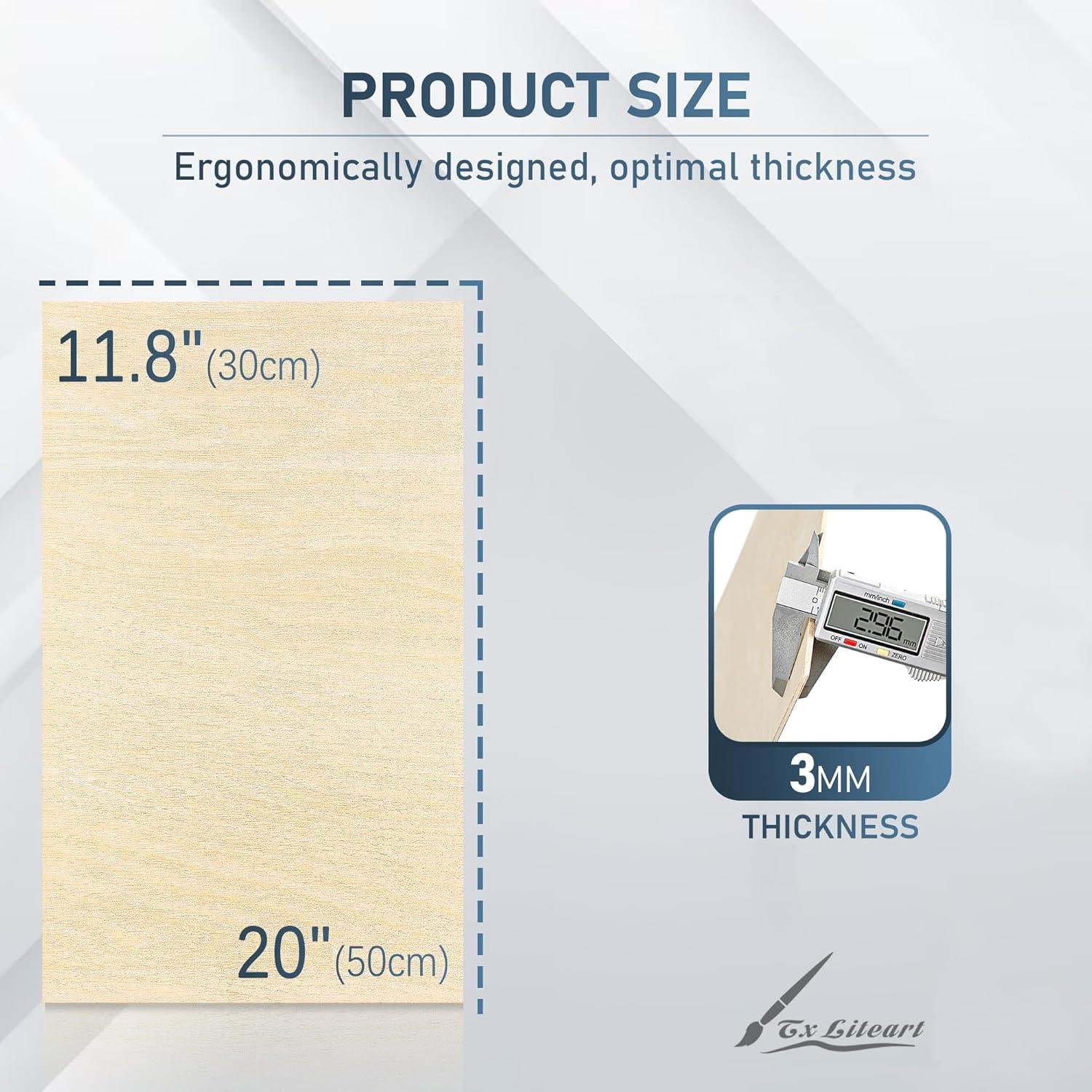
| Thickness | ~3 mm (1/8″) | Some report variation; a few report undersized (down to ~2.6 mm) |
| Face quality | A-grade обе sides (per listing) | Often praised as clean; some report blemishes/scorching |
| Flatness | Not quantified | Mixed: many say very flat; others report warped/cupped |
| Packaging | Individually wrapped | Frequently praised for cleanliness; a few question why it’s wrapped |
| Accessory / Consumable | Why We’d Use It | Notes for Best Results |
|---|---|---|
| Digital calipers | Verify actual thickness before tight-fit work | Measure multiple sheets; sort into thickness groups |
| Masking/transfer tape | Reduce smoke staining on faces during laser work | Burnish edges; remove after cutting/engraving |
| Hold-down magnets/pins | Keep thin sheets flat while cutting | Especially helpful if sheets show any cup |
| Sharp hobby knife | Clean up occasional spots that don’t cut through | Some reviewers mention back-scoring to free parts |
| Capacity / Expectation | Recommended Approach | reality Noted in Reviews |
|---|---|---|
| Dimensional consistency for joinery | Plan for kerf + thickness checks; test-fit tabs | Some report meaningful thickness variation |
| Flatness for laser accuracy | Acclimate, weight, and hold down sheets | Many flat packs; others report warping/cupping |
| Clean faces for finishing | Reserve best sheets for show surfaces | Some report scorch marks/blemishes |
See Full Specifications & customer Photos
Real World Performance for Laser Cutting Scroll Sawing and Craft Work
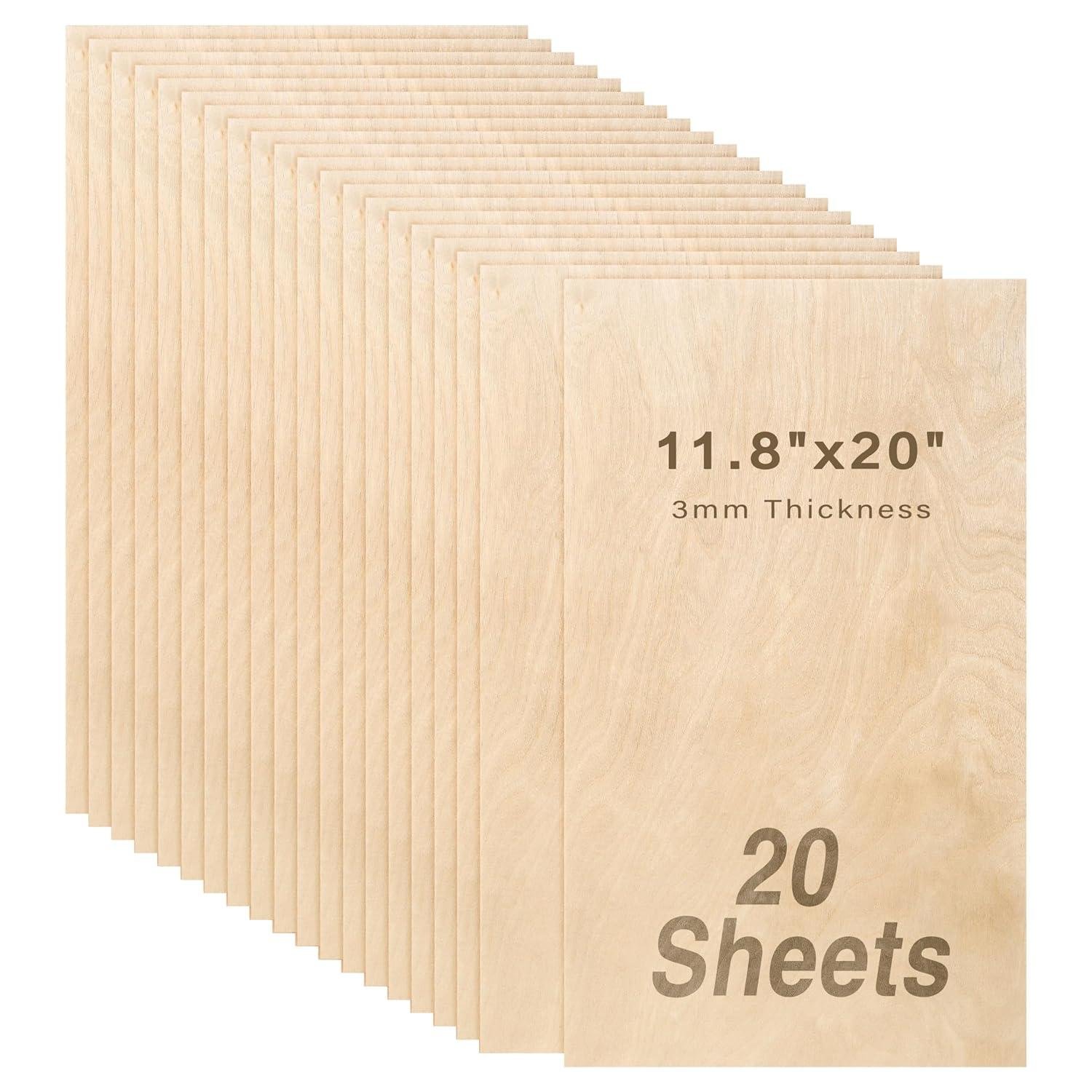
In real shop use, these sheets land in that sweet spot where a lot of us do our detailed work: thin Baltic birch plywood rated at ~3 mm (1/8″) in a convenient 11.8 x 20 inch format, bundled as a 20-pack.For laser cutting, 3 mm birch is a common baseline thickness because it balances cut speed with enough stiffness for layered builds—and customer themes back that up, with multiple reviewers saying it “cuts great on my laser machine” and one mentioning “very clean cuts” on default Baltic birch settings. That said, we have to plan around the variability people report: some users measure sheet thickness anywhere from 2.6 mm up to ~3.11 mm, and several mention “bad spots” where the laser doesn’t cut through all the way or leaves extra char. In our workflow, that means slowing down, adding a second pass, and always doing a small test cut in a corner before committing a full layout—especially on intricate mandalas and tight-tolerance slot-and-tab designs.
For scroll sawing and craft work, the thin, A-face veneer can be a big win when we’re chasing clean edges and minimal tear-out, but the same review patterns matter here too: customers repeatedly mention warping/cupping (“warps within hours,” “curled like potato chips” on some packs), plus broken corners and occasional delamination. On a scroll saw,even mild warp can translate into chatter and wandering cuts,so we’d flatten sheets under weight overnight (or lightly mist and sticker-stack if needed),then use a zero-clearance backer and a fine-tooth blade to support that top veneer. If we’re making earrings, ornaments, or small inlays, we can often “work around” defects the same way one reviewer does—cutting usable sections off and saving smaller clear areas for detail parts—but for display-grade engraving, staining, or paint-fill, it’s worth knowing that reviewers also report scorch marks, discoloration, and blemishes. In short, this pack can be very workable for hobby-to-intermediate makers who are comfortable sorting sheets and adjusting settings, but we wouldn’t treat it as guaranteed, furniture-grade consistency without inspection.
- Included accessories: None (sheets only); many arrive individually shrink wrapped.
- Compatible attachments/accessories: Laser honeycomb bed, hold-down pins/magnets, air assist, blue tape/masking, calipers, X-Acto/utility knife for touch-up, scroll saw zero-clearance insert, sanding block.
- Ideal project types: Layered ornaments, earrings, logo puzzles, small box parts, stamps, home décor panels, templates/patterns, light-duty jigs.
- Wood types tested by customers: Baltic birch plywood (~3 mm / 1/8″) (this product).
| Spec (Advertised) | What It Means in the Shop | Real-World Notes from reviews |
|---|---|---|
| Thickness: 3 mm (~1/8″) | Common baseline for laser/scroll work; good for layers and light parts | Reported variance: ~2.6 mm to ~3.11 mm; some say “undersized” |
| Sheet size: 11.8 x 20 in | Efficient nesting for ornaments and longer parts than 12×12 | Generally appreciated; format useful for batch cutting |
| A-grade veneer обе sides / “void-free core” | Typically helps engraving clarity and edge quality | Mixed: some praise “A quality,” others cite bad spots, glue/void issues |
| 20-pack, individually wrapped | Clean storage and less shipping scuffing | Praise for packaging/flat arrival; also reports of broken corners |
| Accessory | Use Case | Why It Helps with This Plywood |
|---|---|---|
| Calipers | measure thickness before slot design | Accounts for reported sheet-to-sheet variation |
| Air assist / strong extraction | Laser cutting/engraving | reduces char/scorch that some reviewers mention |
| Masking (blue tape/paper) | Cleaner laser faces | Helps manage smoke staining and cleanup time |
| Zero-clearance backer | scroll saw | Supports veneer to limit tear-out and fuzzing |
| task | Recommended Capacity (For Best Results) | reality Check (Based on Reviews) |
|---|---|---|
| Laser cut-through | Consistent 3.0 mm sheets with minimal glue pockets | Some users report spots that won’t cut through without touch-up |
| Engraving + paint fill | Uniform veneer color and thickness | Reports of blemishes/scorch; may require sorting sheets |
| Scroll-sawn fretwork | Flat sheets, stable plies | Warping and occasional layer splitting can affect fine work |
See Full Specifications & Customer Photos
Key Features Woodworkers Will Appreciate in Baltic Birch Ply

In the shop,what we appreciate first is how these sheets are sized and packaged for repeatable work. each panel is listed at 1/8 inch (3 mm) thick and measures 11.8 x 20 inches, and as woodworkers we can instantly see the advantage: that footprint fits small jigs, drawer-box bottoms, templates, and laser beds without wrestling a full 4×8 sheet. Multiple reviewers also call out the individual plastic wrapping—it’s a small detail, but it helps keep faces clean until we’re ready to glue, tape-mask for laser work, or layout parts. Customers frequently mention the sheets arriving “very flat” and note the veneer looks good quality (one theme: “better than big box store plywood”), which matters when we’re chasing consistent kerf and tight-fitting joinery on thin stock.
Where we think woodworkers will really feel the “baltic birch” appeal is in how it supports both machine and hand-tool workflows—at least when the batch is consistent. The product claims an A-grade veneer on both sides and a void-free core, which—when true—translates to cleaner edges, better glue surfaces, and fewer surprises when we’re cutting small profiles on a scroll saw or dialed-in passes on a laser. Review themes are mixed, though: some customers say it “cuts great on laser machines” and “laser-cut and engraved cleanly,” while others report bad spots where the laser won’t go through, plus scorching/char, broken corners, and even layers splitting. We also see recurring feedback about thickness variation (one customer measured roughly 2.9–3.11 mm, another reported as low as 2.6 mm), so for precision slots and press-fit assemblies, we’d treat this as “measure-first” stock and adjust our designs (or test-cut settings) accordingly.
- Included accessories:
- 20-pack of plywood sheets (each individually wrapped)
- Compatible attachments/accessories:
- Laser honeycomb bed and hold-down pins/magnets (helps reduce lift/warp during cutting)
- Masking tape / transfer tape (reduces smoke staining on laser cuts)
- CA glue and wood glue (for layered assemblies)
- Sharp hobby knife/X-Acto (for freeing occasional incomplete cuts customers mention)
- Scroll saw blades for thin plywood (for trimming around defects or salvaging smaller parts)
- Ideal project types:
- Laser-cut ornaments and layered mandala-style pieces (many reviewers mention layered projects)
- earrings and small accessories (customers mention cutting/salvaging smaller pieces)
- Templates, patterns, and router guides for light-duty layout work
- Small boxes, dividers, and cabinet organizers where thin panels make sense
- Wood types tested by customers:
- Baltic birch plywood (this product; customers specifically discuss laser cutting performance on birch ply)
| Spec (What’s Listed) | Why We Care in the Shop | What Customers Commonly Report |
|---|---|---|
| Thickness: 1/8″ / 3 mm | Slot/kerf fit, jig accuracy, and press-fit designs depend on true thickness | Mixed: some note variation (e.g., ~2.9–3.11 mm), others report thinner sheets (down to ~2.6 mm) |
| Sheet size: 11.8 x 20 in | Efficient nesting for laser layouts and smaller shop projects | Generally aligns with expectations for metric sizing (11.8″ ≈ 300 mm) |
| Veneer/Core: A-grade обе sides,void-free core (claimed) | Clean edges,reliable glue-up,fewer weak spots in tiny parts | mixed: some praise clean cutting; others mention defects/bad spots and uneven cutting |
| Packaging: Individually wrapped | Helps keep faces clean and dry before finishing/laser cutting | Frequently praised,though some question the extra wrapping |
| Accessory | Compatible? | What It Helps With |
|---|---|---|
| Masking/transfer tape | Yes | Reduces smoke staining/scorch marks on faces during laser work |
| Calipers | Yes | Confirms actual thickness for tight-tolerance joinery and press-fit designs |
| hobby knife (X-Acto) | Yes | Clears occasional non-through cuts customers mention without tearing veneer |
| Glue (PVA/CA) | Yes | Layered assemblies,small box builds,and fast tack-ups |
| Capacity / Tolerance Need | recommended approach | Real-World Notes (per reviews) |
|---|---|---|
| press-fit slots and tabbed kits | Measure each batch and adjust slot width in CAD | Some report sheet-to-sheet thickness variance |
| Laser cutting full-depth in one pass | Run a small test grid and watch for dense glue/defect areas | Customers cite bad spots that won’t cut through cleanly |
| Flat-panel work | store flat with light weight; consider taping/pinning on the bed | Flatness is often praised,but warping within hours is also a common complaint |
see Full Specifications & Customer Photos
Ease of Use for beginners and Pros in Layout Gluing and Finishing

For layout and glue-ups, we like that these sheets come in a predictable, repeatable format—11.8 x 20 inches at a stated ~3 mm (about 1/8″) thickness—because it simplifies jigs,templates,and nesting parts for small assemblies. Beginners can work right off the bench: the individually wrapped packaging is a practical touch that multiple customers appreciated for keeping faces clean and flat in storage, and it means less time wiping dust and shop grime before glue. in our shop workflow, thinner ply like this benefits from simple habits: scuff-sand lightly with 220 for better glue wetting, use a caul or a flat platen to keep parts from telegraphing any cup during clamp-up, and favor fast tack glues (or tape hinges) when aligning a lot of small laser-cut pieces. Customer feedback trends line up with that reality—many describe the sheets as “very flat” and “good quality”, but others report warping within hours or pieces arriving with broken corners, so we’d keep expectations realistic and sort the stack before committing to a precision layout.
For finishing,the thin face veneers on Baltic birch-style plywood can look great quickly,but they also demand a gentle hand—especially for beginners—because it’s easy to sand through on edges after laser cutting. Reviews repeatedly mention scorching marks,bad spots,and occasional uneven cutting; in finishing terms,that translates to extra prep: scrape or lightly sand char (rather than grinding it in),and consider a washcoat of shellac before staining to reduce blotch and lock down smoky residue. One customer noted it “accepted a stain finish reasonably well”, while others saw discoloration and defects, so pros will want to treat this as a “batch-check” material—measure thickness on a few sheets (some reviewers reported it ran thin, down to around 2.6 mm), and reserve the best faces for visible parts. The upside is that when you’re doing layered ornaments, boxes, or craft panels, the format and smooth faces make layout fast; the downside is you may spend time compensating for the occasional warp, voids/glue pockets, or char cleanup depending on your laser and your tolerance for rework.
See Full Specifications & Customer Photos
Customer Reviews Analysis
What woodworkers Are Saying (Review Analysis)
| Aspect | Common Feedback |
|---|---|
| Overall sentiment | Mixed—strong value praise, but notable quality-control complaints (voids, “bad spots,” thickness variation) |
| Performance | Many report clean laser cuts; others hit glue/void patches that prevent full cut-through and increase charring |
| Precision | Size is generally “as described” (metric-to-inch expectations noted), but thickness accuracy/consistency is a recurring concern |
| Build quality | Surface finish often praised; defects, patches, warping, and occasional broken corners reported by some |
| ease of use | Easy when sheets are clean; frustrating when defects force extra knife cleanup and sanding/char removal |
| Best use cases | Layered ornaments, mandala-style layers (with caveats), earrings, hobby crafts, quick laser jobs |
1. Overall sentiment from woodworking customers
Overall feedback trends mixed to polarized. Several woodworkers mentioned the plywood is “good quality for the price” and that it cuts great on laser machines. At the same time, multiple reviews highlight quality inconsistencies—especially internal voids/glue pockets and thickness that doesn’t match expectations—leading some buyers to say they wouldn’t purchase again if time and finish quality matter.
2. Performance feedback (accuracy, power, results)
Common praise includes reliable laser cutting on certain batches/sheets—especially for users running popular hobby lasers (one reviewer specifically mentioned using it on xTool F1 Ultra and M1 Ultra). Others said it “cut nicely” and would buy again.
Some users reported challenges with cut-through consistency: “bad spots” where a laser won’t go through or struggles even with generous settings. A frequent workaround mentioned is scoring the back with a knife/X-Acto to free parts—effective, but it can leave rougher edges and adds time.
Charring is a major performance divider. One reviewer reported it “chars badly” even at the same settings used successfully on higher-quality plywood, turning cleanup into a time sink—especially noticeable on detailed laser designs.
3. Build quality and durability observations
Woodworkers often liked the surface finish—several boards described as clean and “very nice” looking. Packaging also got positive mentions: multiple sheets being individually wrapped was seen as keeping material clean (though at least one person questioned why it’s done).
On the negative side, multiple reviews highlight:
- Glue-filled voids and poorly patched areas (sometimes running the full length)
- Warping (some expected at this thin 3mm/1/8″ thickness, but still noted)
- Broken corners on a few sheets
These issues can impact durability in delicate laser parts and layered assemblies, where weak void zones can snap or refuse to cut cleanly.
4. Ease of use for different skill levels
For beginners and casual DIYers, the appeal is straightforward: it’s ready-to-use, pre-cut sheet stock, and many people got acceptable results quickly when sheets were defect-free.
For experienced laser crafters, the frustration shows up when defects force process changes—extra test cuts, tweaking power/speed, more masking/sanding, and manual cleanup. Several users implied the learning curve isn’t in the laser—it’s in working around inconsistent plywood cores.
5. common project types and success stories
Customers successfully used this for:
- Layered projects (stacked designs/multi-layer art)
- Layered ornaments (one user noted getting ~9 pieces per sheet, with 1–2 sometimes needing manual freeing)
- Earrings (using smaller pieces cut down from sheets; one reviewer also uses a scroll saw to harvest usable sections)
- General hobby crafts and “DIY” laser work
When the core is clean, reviewers report crisp results suitable for giftable craft items and small product-style output.
6. Issues or limitations reported
The most repeated limitations are consistency and spec accuracy:
- Thickness not matching the listing: One detailed review measured boards around 2.6mm despite a 3mm ±5% claim, which matters for tight-fit slots, layered thickness totals, and jobs designed around true 3mm stock.
- Void/glue pockets (“bad spots”): These can cause incomplete cut-through and force manual knife work.
- Charring/dirty cuts: Some users reported heavy char even at normal settings, increasing sanding and cleanup time—especially painful on intricate designs like mandalas.
- Warping and defects: Thin ply warping, patched runs, dark blemishes/splits in veneer, and occasional corner damage.
Net takeaway from the reviews: good value when you get clean sheets, but if your projects demand reliable thickness, consistently clean cores, and minimal post-processing, multiple reviewers suggest it can become a time-costly material.
Pros & Cons

Pros & Cons: Baltic Birch Plywood (1/8″ / ~3mm, 11.8″ x 20″, 20-Pack)
| What we liked | What held us back |
|---|---|
| Frequently enough arrives impressively flat (especially for thin 3mm stock) | Warping can show up fast—sometimes within hours in a shop environment |
| Convenient 11.8″ x 20″ size for signs, trays, ornaments, and long layouts | Sheet-to-sheet thickness variation can throw off tight-fit slots and stacked layers |
| Individually wrapped sheets help keep surfaces clean and shipping scuffs down | Individual plastic wrap adds extra unwrapping time (and extra waste) |
| Can cut cleanly on many laser setups when the sheet is “good” | Some boards have “bad spots” (glue/voids/patches) that cause incomplete cuts |
| Light birch face looks crisp for simple engraving and minimalist projects | scorching/char marks and staining complaints suggest extra sanding/cleanup |
| 20-pack is a solid quantity for production runs or batch crafting | Durability is inconsistent: occasional split veneers, delamination, or broken corners |
Pros
- “Pretty flat, pretty often.” In our experience with thin plywood,flatness is half the battle—these are frequently reported as arriving very flat,which helps with consistent focus across the bed.
- Laser-cutter-kind sizing. The 11.8″ x 20″ format feels purpose-picked for laser work: long enough for door-hangers and name signs, but still manageable for smaller machines and storage bins.
- Clean faces when you score a good batch. Many customers describe the surface veneer as A-grade on both sides, which can meen less time filling patches if we’re doing “front-facing” pieces.
- Nice packaging for shop flow. Each sheet being individually wrapped reduces surface rubbing in transit—handy if we want clean, ready-to-mask panels.
- Works well for layered crafts. When the core is cooperative, it’s a solid candidate for stacked ornaments, earrings, simple boxes, and paint-ready cutouts.
Cons
- Warping is the headline risk. A recurring theme is panels warping quickly—which can lead to uneven focus, inconsistent kerf, and surprise misalignment mid-run.
- Cut quality can be unpredictable. Some sheets reportedly cut great; others hit hard spots where the laser won’t fully pass through without extra passes or manual cleanup. For time-sensitive orders, that unpredictability matters.
- Thickness isn’t always truly “3mm.” Reports range from ~2.6mm up to ~3.1mm. If our designs rely on press-fit tabs or zero-gap stacking, we may need to measure and adjust (or sort sheets by thickness).
- More char and scorching than we’d like. Several users mention heavy charring compared to higher-grade ply. That means more masking, sanding, and edge-cleaning before finishing.
- Durability concerns. Broken corners, veneer splits, and delamination are mentioned often enough that we’d plan on a small “waste tax” in any bulk workflow.
- Value depends on our tolerance for sorting. If we’re okay trimming out defects and reserving imperfect sheets for small parts, the pack can make sense. If we need “every sheet is production-ready,” the cost in time can outweigh the price.
Our takeaway: This pack can be a practical shop material when we treat it like “batch wood” (sort, test-cut, and reserve the best sheets for premium pieces). If we’re chasing flawless engraving, tight-fit engineering, or zero-fuss production, the inconsistency in warping, thickness, and cut behavior is the tradeoff we’d need to accept.
Q&A

Is the thickness truly 1/8″ (3mm), and how consistent is it sheet-to-sheet?
Expect “approximately 3mm,” not a dead-on 0.125″. The listing calls it ~3mm, but multiple buyers measured noticeable variation—one reviewer reported sheets ranging roughly 2.9–3.11mm, and another measured closer to ~2.6mm on their batch (after removing the plastic wrap). If your project needs tight tolerances (CNC inlays, press-fit kits, layered mandalas where every layer must match), plan on test-fitting and adjusting your slots/tabs, or buy a higher-tolerance ply and reserve this pack for less critical parts.
How does it perform for laser cutting and engraving?
results are mixed. Many customers say it “cuts great” on laser machines (including users running xTool models),but others report frequent “bad spots” where cuts don’t go through cleanly,plus heavier charring/scorching than expected. That usually points to inconsistencies in glue pockets/voids and density changes across a sheet. Practical tip: run a small cut-and-engrave test grid on each sheet, and keep a knife/X-Acto handy for occasional back-scoring if a small section doesn’t fully release.
Is it actually void-free Baltic birch, and will it glue up well?
The product description claims an A-grade veneer on both sides and a void-free core for better gluing. Some reviewers agree the faces are clean and the sheets can be “very flat,” but several others mention glue-filled voids, patches/defects, and even layer splitting/delamination after cutting. For woodworking joinery or laminations, treat it like craft-grade ply: use a quality wood glue, clamp with cauls to spread pressure, and avoid relying on the core being perfect on every sheet.
Do the sheets stay flat, or do they warp?
Warping is one of the most common complaints. Some packs arrive impressively flat (helped by the individual shrink-wrap), but other customers report cupping/twisting “within hours,” and some note the heat from laser cutting can introduce additional warp. If flatness matters, store the sheets stickered on a flat surface with weight on top, and consider masking + balanced finishing (seal both sides) after cutting/engraving to reduce moisture-driven movement.
Can I use these on a scroll saw, jig saw, or for small shop projects—not just lasers?
Yes—this size (11.8″ x 20″) and thickness (~3mm) is very workable for scroll saw ornaments, templates, drawer dividers, light panels, and craft assemblies. At least one buyer mentioned cutting pieces on a scroll saw and using offcuts for earrings. Just keep expectations realistic: at 3mm, it’s not structural, edges can be fragile, and any internal voids/patches can show up as chip-out or weak spots.
Is it beginner-friendly for DIY crafts and woodworking?
For beginners, the biggest “learning curve” isn’t tools—it’s material variability. Many customers love the clean faces and ready-to-use packaging, but others run into warped sheets, broken corners, and inconsistent cutting/engraving. If you’re new, start with simpler projects (ornaments, signs, layered art with forgiving fits), do quick test cuts first, and don’t design ultra-tight press fits unless you’re prepared to tweak dimensions per batch.
how durable is it in shipping and in use—do corners chip or layers split?
durability feedback leans negative. Multiple reviewers mention broken corners on arrival and some report delamination/layers splitting—especially after laser cutting. The individual wrapping helps keep surfaces clean and can reduce rub damage,but it won’t prevent corner impacts during transit. If you need pristine edges for production work, plan for a waste factor (extra sheets) or step up to a more consistently graded supplier.
Is it a good value compared to cheaper craft plywood or “premium” laser plywood?
Value is split. some buyers call it a great deal for the price and prefer it to big-box plywood, while others say it’s not worth it due to warping, thickness being under spec, charring, and time lost dealing with bad spots.If your priority is speed and repeatable results (selling products, production runs), higher-priced but more consistent laser-grade birch may be cheaper in the long run. If you’re prototyping, making hobby gifts, or can work around occasional defects, this 20-pack can still be a practical buy.
Ignite Your Passion
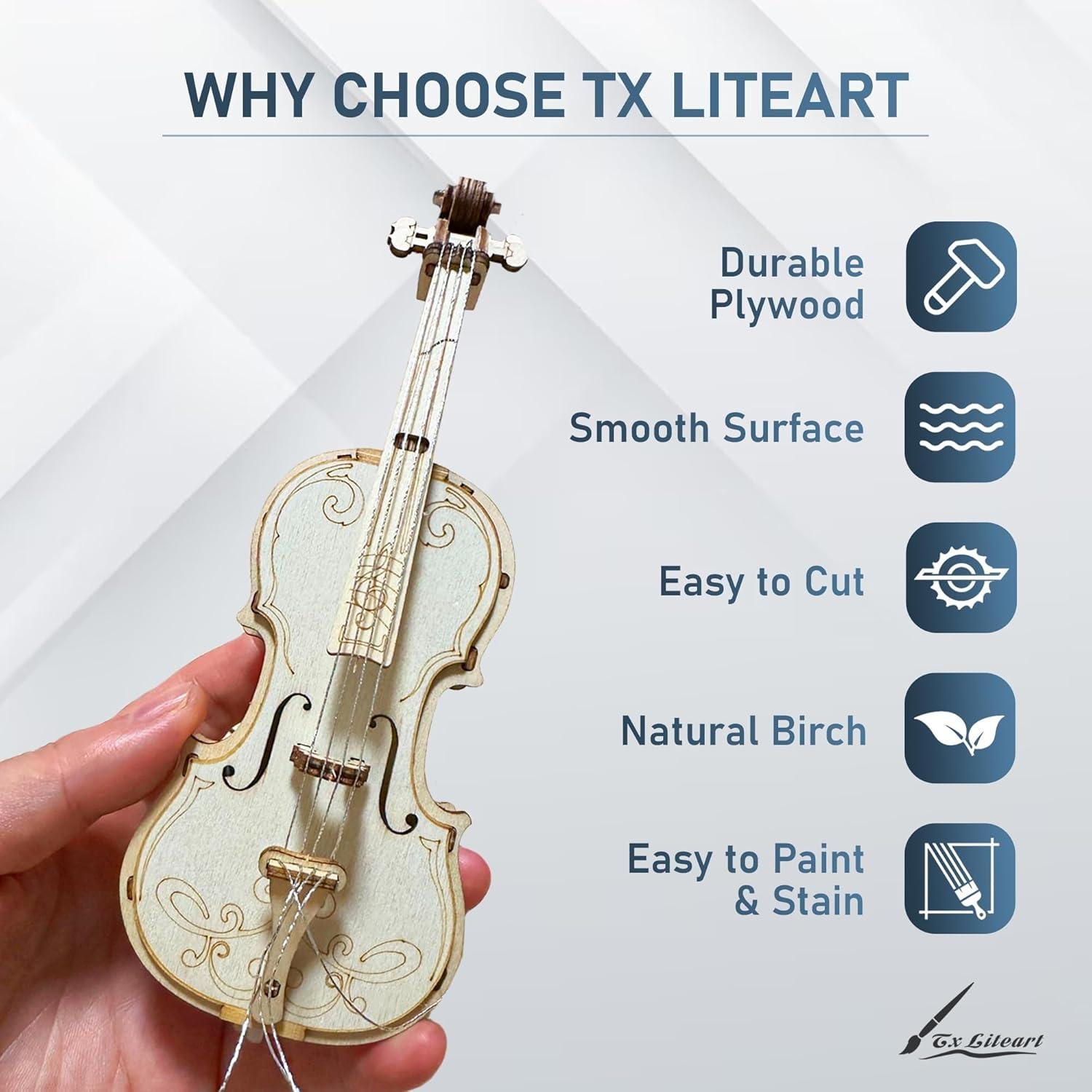
This 20-pack of Baltic Birch plywood sheets measures 11.8 x 20 inches at an advertised ~3mm (1/8″) thickness,with A-grade veneers on both faces and individually wrapped pieces meant to stay clean and protected in transit. Customer feedback often praises the smooth surfaces and flat arrival, and many report it cuts well on popular laser machines. The main drawbacks are inconsistent thickness, occasional scorching/blemishes, and frequent complaints about warping, broken corners, and delamination that can affect cut-through reliability.
Best for: hobby woodworkers with small to medium projects—laser-cut ornaments, layered signs, earrings, light-duty boxes, and DIY craft templates—especially if you can work around occasional defects.
Consider alternatives if: you need guaranteed thickness tolerance, consistently void-free cores for intricate mandalas, or you’re doing production runs where warping and rework will cost time.
Final assessment: a solid craft-grade option when you get a good batch, but quality variability means it’s not the most predictable choice for precision-critical work.
Want to see current pricing and customer photos? View on Amazon & Read More Reviews →