

Blog
42-Pack Basswood Sheets for Laser Cutter: Shop Fit?

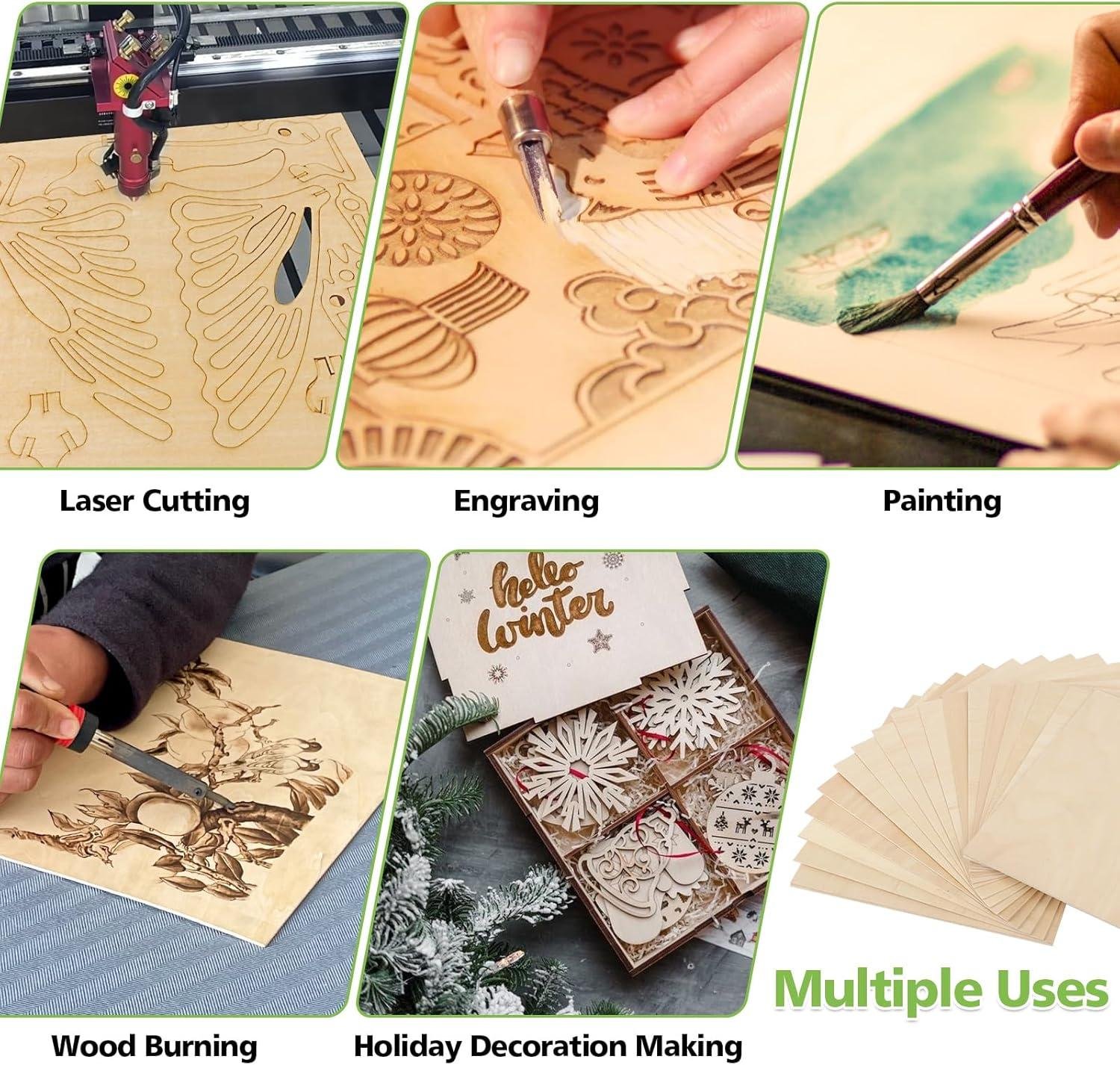
Ever start a laser-cut ornament or small box project only to discover your “flat” plywood is cupped, knotty, or inconsistent—turning precision cuts into a sanding marathon and throwing off tight-fitting parts? When accuracy matters, the sheet goods we choose can make or break the workflow, especially in a cramped shop where we can’t afford wasted material or endless setup tweaks.
In this review, we’re looking at the 42 pack Basswood Sheets 1/8″—12 x 12 x 0.118 in (3 mm) unfinished basswood panels aimed at laser cutting, engraving, wood burning, and general craft/build work. The specs highlight smooth, flat sheets with consistent thickness, no knots, and length tolerances within 2 mm, plus sturdy packaging with reinforced corners to reduce shipping damage.
We’ll cover what those claims mean in real-world use: fit and consistency for repeatable projects, ease of cutting across lasers and common shop tools, value for the quantity, and what customers commonly report about condition on arrival and surface quality.
As woodworkers who’ve learned the hard way that “budget wood” can get expensive fast, we’ll keep this focused on practical decision-making.
Tool Overview and What We Get in the Box

In our shop, these basswood blanks are less of a “tool” and more of a consumable material that determines whether our lasers, CNCs, and hand tools behave predictably. This set comes as 42 square basswood plywood sheets with a stated size of 12 x 12 x 0.118 in (about 30.3 x 30.3 cm x 3 mm), and the listing notes a length tolerance within 2 mm. On paper, that’s a sweet spot for ornament blanks, light model panels, and layered signage—thin enough for swift engraving and cutting, but thick enough to hold detail without feeling flimsy. The product description emphasizes smooth, flat sheets with no knots and a consistent height, while customer feedback largely echoes that theme with many saying they “cut and engrave perfectly” and arrive “smooth and no flaws,” though multiple reviewers also mention some warping as a reality of basswood and sheet storage.
What we “get in the box” is straightforward: a stack of sheets and packaging meant to keep them usable on arrival. The brand highlights a sturdy box with pearl cotton corner protection to prevent shipping dings, and several reviews specifically call out that the pack arrived “nicely packed.” That said, review themes are mixed on batch consistency—many buyers report most sheets flat with only minor warp, while a smaller but loud group reports severe warping, roughly cut edges/splinters, and even visible seams or glue-line issues that can telegraph through stain and engraving. We also see a practical caution from laser users: one review notes the “recommended setting” didn’t cut until they treated some boards as closer to ~2.3 mm, which is a good reminder that “3 mm” stock should still be measured and test-cut—especially if we’re running tight kerf tolerances or stacking parts on a honeycomb bed where flatness matters.
- 42 unfinished basswood plywood sheets
- Sturdy shipping box with pearl cotton corner protection (per description)
- Laser cutters/engravers (CO₂ and diode—settings will vary)
- CNC routers (spoiler board + hold-down recommended)
- Hand saws, table saw, and other shop cutting tools (per description)
- Wood burning pens, carving tools, paints, stains, and clear coats
- Paint-your-own ornaments (a common review use case)
- laser-cut ornaments, tags, and small signage
- Model panels and craft prototypes
- Layered engravings and inlays where clean faces matter
- Basswood plywood (this product)
- Reviewers also report success on CNC and laser workflows (material-specific performance focus)
| Spec | What’s Listed | Why It Matters in the Shop |
|---|---|---|
| Sheet count | 42 pack | Enough repetition for batching test cuts, jigs, and production runs. |
| Sheet size | 12 x 12 in | Fits many hobby laser beds and is easy to fixture on CNCs. |
| Thickness | 0.118 in (~3 mm) | Impacts engraving depth, cut pass count, and tab strength. |
| Tolerance | Length ±2 mm | Plan for slight sizing variation if your design uses edge-to-edge registration. |
| Accessory / Add-On | compatible? | Workshop Benefit |
|---|---|---|
| Calipers / micrometer | Yes (recommended) | Confirms true thickness before committing laser/CNC settings. |
| Laser honeycomb bed + hold-down pins | Yes | Helps manage minor warp and improves cut consistency. |
| CNC clamps or vacuum hold-down | Yes | Prevents chatter and lifts on thinner sheet goods. |
| Sanding block (220–320 grit) | Yes | Quick prep for finish; also knocks down any rough edges noted in some reviews. |
| Capacity Metric | Recommended for Planning | What Reviews Suggest in Reality |
|---|---|---|
| Thickness assumption for laser settings | 3.0 mm (listed) | Some users report needing to adjust because a few sheets behaved differently (measure + test). |
| flatness expectation | “Smooth and flat” (listed) | Many report mostly flat sheets; others report batches with meaningful warping—plan hold-down. |
See Full Specifications & Customer Photos
Key Features Woodworkers Will Appreciate in Basswood Sheet Stock
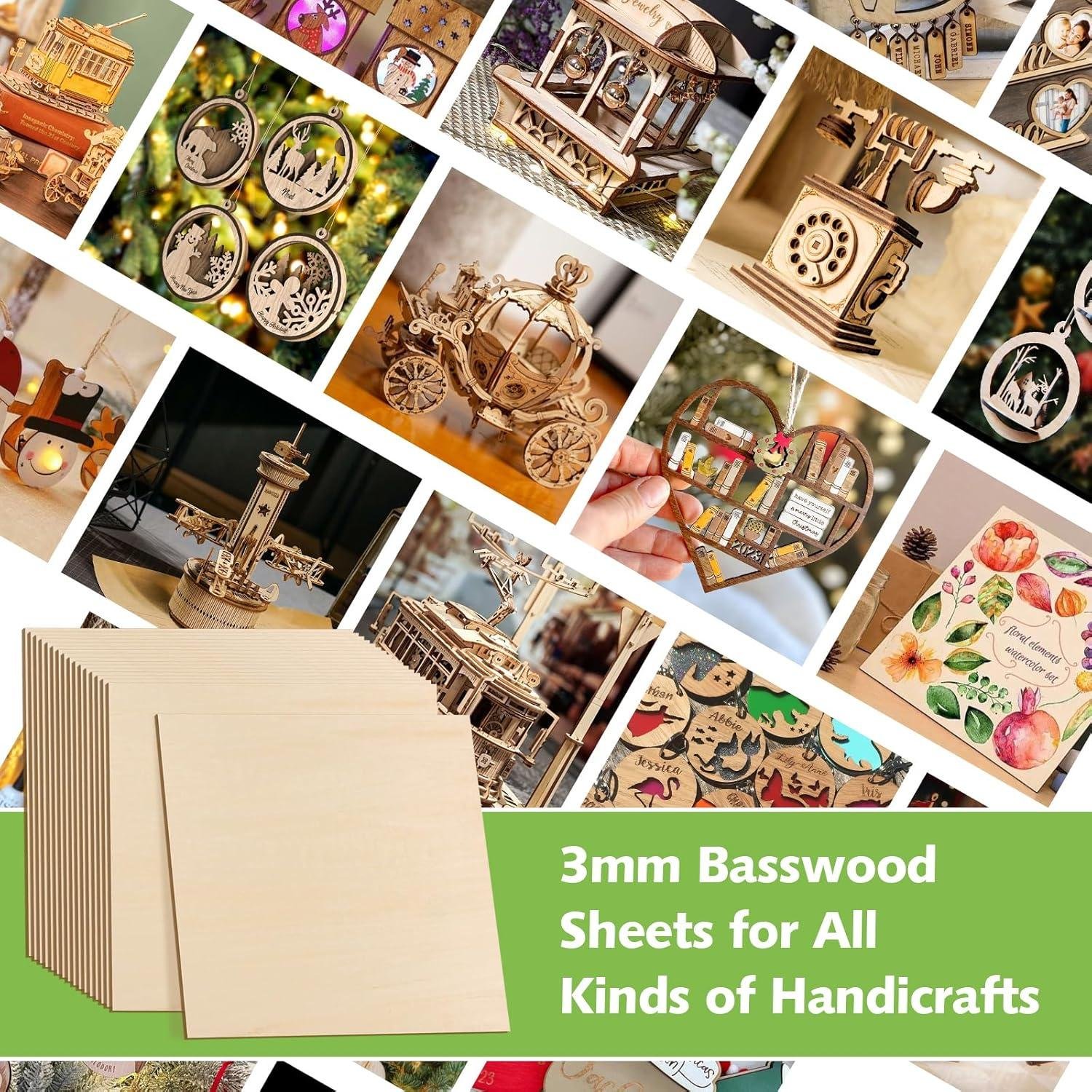
In the shop, what we appreciate most about this pack is how “ready-to-run” the stock is for light fabrication and layout work. Each sheet is listed at 12 x 12 x 0.118 in (3 mm),and that square 12-inch format is a practical sweet spot for laser beds,CNC spoilboards,and quick table-saw or bandsaw jigs. The product description calls out smooth,flat faces,no knots,and consistent height,and many customers echo that theme—several mention the sheets cut and engrave perfectly,arrive nicely packed,and have very consistent thickness with no voids showing up in their projects. From a woodworker’s standpoint, basswood’s fine, even grain is forgiving: it takes pencil lines cleanly, sands quickly, and is less likely to tear out when we’re routing small profiles or trimming delicate parts. For best results on our tools, we still want to use a sharp, high-tooth-count blade for saw work (to reduce fuzzing) and a backer board on the scroll saw or CNC to prevent chip-out along exit edges.
That said, customer feedback also highlights the “sheet goods reality” we need to plan around: a recurring theme is some pieces arriving slightly warped—often described as “just the nature of basswood”—with reports like about 8 boards out of 42 showing minor warp in one review, while a smaller set of reviewers describe severe warping and even visible seams/splitting on their batch. For laser and CNC users, there’s also an vital note: at least one customer reports the sheets wouldn’t cut at their usual “recommended” settings and they had to sand/plane down to about 2.3 mm, which tells us to measure thickness per sheet and run test cuts before committing to a full production run. In practical terms, we can usually manage mild cup or bow by storing the sheets flat with weight, using blue-tape and CA glue fixturing for CNC, or selecting flatter boards for precision engraving—but we shouldn’t expect every sheet to be dead-flat out of the box.If our work demands perfectly flat panels (tight laser focus across the whole surface or inlay work with thin glue lines), we’ll want to sort the pack on arrival and reserve the best sheets for our most critical cuts.
- Included accessories: 42 basswood plywood sheets (12 x 12 x 0.118 in / 3 mm)
- Compatible attachments/accessories:
- Laser honeycomb bed / standoffs
- CNC spoilboard + hold-down clamps or blue-tape/CA fixturing
- Scroll-saw blades (fine-tooth), bandsaw blade (fine pitch)
- Small router bits (downcut bits help reduce top-face fuzz)
- Sanding block or random-orbit sander (light grits for cleanup)
- Ideal project types:
- Laser engraving/cutting plaques, tags, and signs
- Paint-your-own ornaments and holiday décor (a common review use)
- CNC-carved coasters, small trays, and craft panels
- Templates, patterns, and shop jigs in a pinch
- School/home craft builds and model parts
- Wood types tested by customers:
- Basswood plywood (this product) used on lasers and CNCs
| Spec | What’s Listed | Why We Care in the Shop |
|---|---|---|
| Sheet size | 12 x 12 in | Efficient for laser beds and repeatable jig/template layouts |
| Thickness | 0.118 in (~3 mm) (tolerance within 2 mm on length per description) | Critical for laser focus and CNC toolpaths; measure before dialing settings |
| Quantity | 42 sheets | Enough for batching ornaments, tags, or small production runs |
| Compatible accessory | What it helps with | When we’d use it |
|---|---|---|
| Calipers | Verify actual thickness per sheet | Before laser/CNC jobs where settings are sensitive |
| Clamps/weights + flat storage | Manage minor warping | After delivery and between job runs |
| Masking tape (laser) | Reduce smoke staining on the face | Engraving and fine detail work |
| Capacity Type | Recommended expectation | Actual Notes From Reviews |
|---|---|---|
| Flatness | Expect “mostly flat” craft plywood | Many report most sheets flat; some report minor to severe warping depending on batch |
| Laser settings | Plan to tune power/speed for ~3 mm | At least one customer had to reduce thickness to about 2.3 mm to cut reliably—test cuts are essential |
See Full Specifications & Customer Photos
Real World Performance for Laser Cutting Engraving and shop cuts
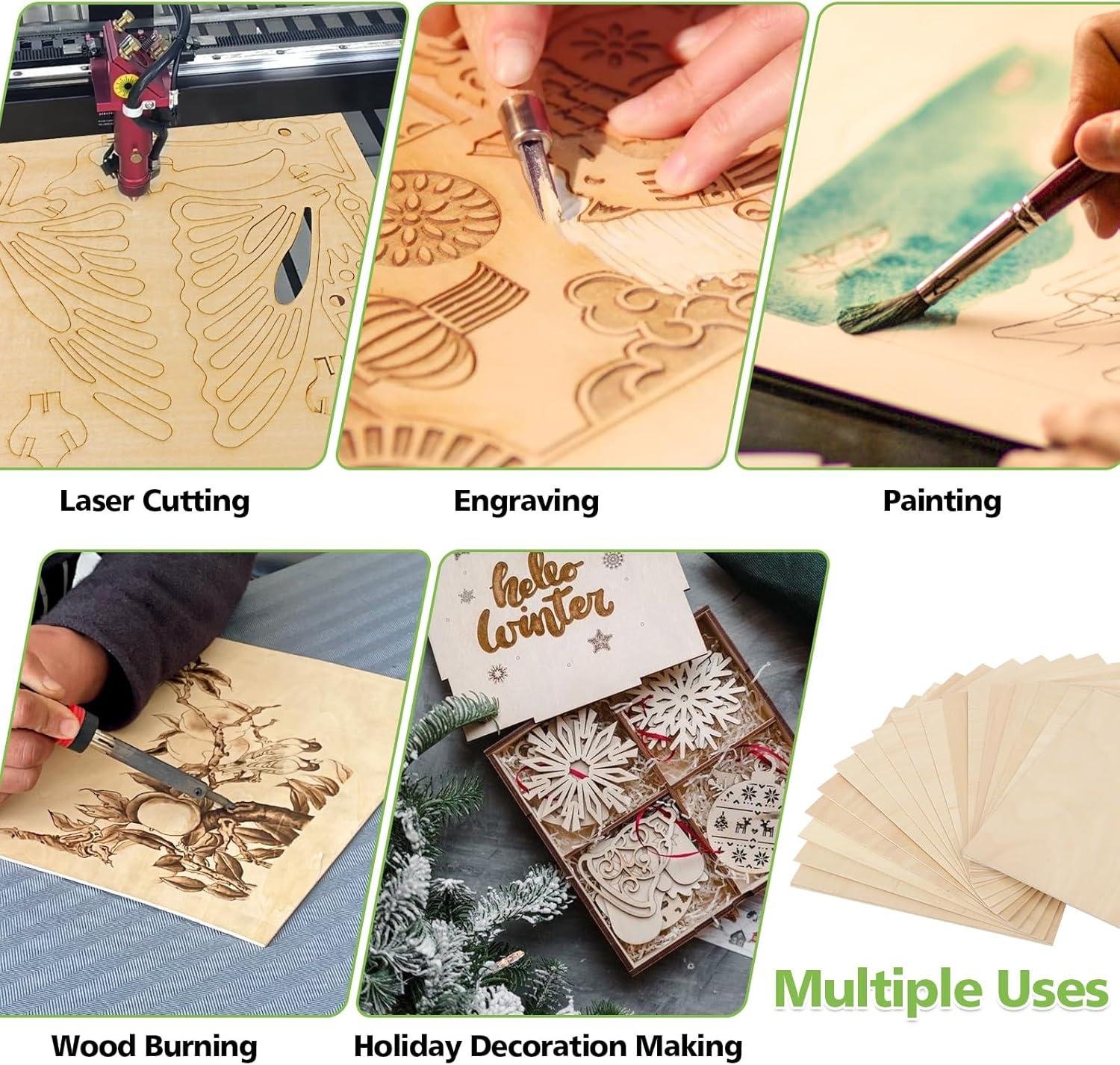
In our laser corner, these basswood squares behave like the “everyday stock” we like to keep within arm’s reach: each sheet is listed at 12 x 12 x 0.118 in (3 mm), and that consistent footprint makes it easy to drop into jigs, pin beds, and ornament templates without re-zeroing every job. Multiple reviewers echo that they “cut and engrave perfectly” and are “great for laser engraving,” with several noting smooth surfaces, consistent color, and even “no voids” in the sheet—exactly what we want when we’re chasing clean raster fills and crisp vector edges. Having mentioned that, real-world performance hinges on flatness: the dominant review theme is that some pieces arrive slightly warped (frequently enough described as “just the nature of basswood”), while a minority report batches with severe warping and visible seams/splitting that can wreck focus, cause inconsistent cut-through, or force hold-down workarounds. We also saw a practical warning that matters in production: one customer reported the sheets wouldn’t cut at their “recommended setting” until they surfaced the stock down to about 2.3 mm, which points to thickness variation and/or laser-to-laser differences—so we’d treat these as “nominal 3 mm” and run a quick material test grid before committing a full sheet.
For shop cuts (scroll saw, band saw, table saw sleds, utility knife scoring, and even light CNC), basswood at ~1/8 in is forgiving and beginner-friendly, but it still rewards good technique. We’ve found that thin sheet goods like this cut cleaner when we support them fully (sacrificial MDF underlay on the CNC, zero-clearance/backer boards at the saw, and painter’s tape on the show face for splinter control). If a sheet shows a cup or twist, we’d rather reject it for precision laser work and save it for painted ornaments, layered sign backers, or practice burns—several customers specifically call these the “perfect size to make Paint Your Own Ornaments.” Safety-wise, keep hands well away from small offcuts and use push sticks; and for laser users, be extra mindful that warped sheets can lift into the nozzle path and change the focal distance mid-cut. Bottom line: when the batch is flat, this 42-pack of 12x12x3 mm basswood is a convenient, workshop-practical consumable for engraving and light cutting—but the review record suggests we should plan for occasional sorting and always test, test, test before a production run.
See full specifications & Customer Photos
Ease of Use for Beginners and Experienced Woodworkers in Craft Projects

For beginners, these basswood panels are a friendly on-ramp because the format is simple and repeatable: 12 x 12 inches and marketed as 1/8” (0.118 in / 3 mm), with a stated length tolerance within 2 mm. In our shop,that kind of consistency matters more than fancy labeling—especially when we’re learning laser/CNC feeds and speeds or practicing clean hand-tool technique.Multiple reviewers echo that they “cut and engrave perfectly,” are “great for laser engraving,” and arrive “smooth and flat” with “very consistent thickness,” which helps beginners avoid chasing settings that change from board to board. The key lesson we’d pass on: don’t treat “3 mm” as a guarantee—at least one customer warned they had to measure down around 2.3 mm for reliable cutting, so we’d recommend calipers plus a quick test grid (speed/power matrix) before committing to a batch of ornaments or school projects.
For experienced woodworkers and small-batch makers, the appeal is workflow: having 42 sheets on hand supports jigs, templates, and production runs of repeatable parts—especially for laser engraving, CNC routing, wood burning, and painted craft pieces. Reviews also highlight practical strengths like “no voids,” “performed great on CNC and laser cutters,” and “packaged nicely,” but the theme we can’t ignore is variability—several customers report that some boards arrive slightly warped (frequently enough described as “the nature of basswood”), while a few report extreme warping, visible seams, or rough edges that led to splinters. In a real workshop, that means we should plan for triage: sort sheets on arrival, reserve the flattest panels for precise inlays/engraves, and keep the imperfect ones for smaller parts where we can cut around defects. If we’re running a laser, we’ll also watch for bowing that changes focus height; if we’re using a table saw or hand saw, we’ll support the sheet well and use a zero-clearance backer to reduce tear-out on thin stock.
- Included accessories: None (sheets only)
- Compatible attachments/accessories: Laser honeycomb bed,hold-down pins/magnets,sanding block,calipers,painter’s tape/masking for engraving,wood sealer/primer
- ideal project types: Paint-your-own ornaments,engraved coasters/signage,model parts,craft blanks,holiday decorations,school/home projects
- Wood types tested by customers: basswood plywood sheets (used successfully on laser cutters and CNC per reviews)
| Spec | What It Means in the Shop |
|---|---|
| Sheet size: 12 x 12 in (30.3 x 30.3 cm) | Easy to fixture on small CNCs/diode lasers; convenient for template work and repeatable blanks. |
| Thickness: 0.118 in / ~3 mm (marketed as 1/8″) | common craft thickness; verify with calipers because some reviewers report thickness variation affecting laser cut-through. |
| Quantity: 42 sheets | Useful for batching projects; plan to sort for flatness if you need tight tolerances. |
| Stated tolerance: within 2 mm (length) | Expect slight size variation—fine for crafts, but measure if your jig or frame relies on exact dimensions. |
| Accessory | Why We’d Use It | Best For |
|---|---|---|
| Digital calipers | Confirms actual thickness before dialing in laser/CNC settings. | Laser cut-through reliability |
| Masking/painter’s tape | Reduces smoke staining during engraving and keeps surfaces cleaner. | Laser engraving |
| Honeycomb bed + hold-downs | Helps manage mild warp and improves airflow under cuts. | Laser cutting |
| Sanding block (fine grit) | Quickly knocks down fuzz or rough edges if any sheets arrive splintery. | Hand-finishing craft pieces |
| Capacity Item | Recommended in Practice | What Reviews Suggest Can Happen |
|---|---|---|
| Thickness assumption for laser settings | Measure each batch; run a small speed/power test on one sheet. | Some users report marketed 3 mm doesn’t match their cut settings; one reported needing ~2.3 mm equivalent adjustments. |
| Flatness for precision engraving | Sort the flattest sheets for detailed work; hold-down mild warp. | Many report “mostly flat” with “only a small few” warped; a minority report severe warping. |
See Full Specifications & Customer Photos
Customer Reviews Analysis
What Woodworkers Are saying (Review Analysis)
1. Overall sentiment from woodworking customers
Overall sentiment is mixed but leaning positive,with many customers praising clean laser/CNC performance,smooth faces,and generally consistent thickness.Simultaneously occurring, a notable minority reported serious warping, inconsistent batches, and occasional measurement/thickness surprises that affected cutting settings and usability.
2. Performance feedback (accuracy, power, results)
Several woodworkers mentioned the sheets “cut and engrave perfectly” and specifically called out good laser results with clean engraving and reliable cut quality.
- Common praise includes strong performance on laser cutters and CNC, with one reviewer noting the sheets “performed great… on my CNC and laser cutters.”
- Multiple reviews highlight surfaces that engrave well and sheets that “cut well” with no voids, which matters for predictable results and avoiding blowouts mid-cut.
- Some users reported challenges with cutting at expected settings: one laser user said the boards didn’t cut at the recommended setting and they had to reduce thickness to ~2.3 mm to get consistent cuts—suggesting either thickness variance, labeling confusion, or the need to recalibrate per batch.
Bottom line on performance: when flat and within expected thickness, results are commonly described as clean and consistent—but a few reviewers had to adjust settings more than expected.
3. Build quality and durability observations
Build quality feedback focuses on flatness, ply seams, and edge finishing rather than “durability” in a tool sense.
- Several woodworkers mentioned good consistency: “flat and thickness is very consistent,” “smooth and no flaws,” and “no voids.”
- Some users reported challenges with warping, ranging from “slight warping” (seen as normal for basswood) to severe, unusable bowing.
- One highly negative review described visible seams that don’t align, plus internal splitting (“splitting in half depthwise”), indicating occasional structural/lamination issues in certain batches.
- A few reviews also mention roughly cut edges causing splinters—an issue if you handle a lot of sheets quickly in production.
4. Ease of use for different skill levels
- Beginners and casual crafters seemed to appreciate the “ready-to-go” nature when sheets arrived flat: consistent thickness and smooth faces reduce prep time.
- Small business users (laser sellers) valued packs where most sheets where flat because it meant no jigging, weighting, or refixturing needed.
- Some DIYers found the experiance frustrating when warping was severe—flattening attempts didn’t hold, and parts reportedly re-warped after cutting, which can ruin alignment in layered designs or assemblies.
5. Common project types and success stories
Customers successfully used this pack for:
- Laser engraving and laser cutting projects (general production work)
- “Paint Your Own” ornaments (one reviewer called the 12″ x 12″ size “perfect” for this)
- CNC work (multiple mentions alongside laser use)
Success stories typically center on smooth surfaces, clean engraving, and minimal defects/voids, which helps with detailed ornament designs and consistent production runs.
6. Issues or limitations reported
Commonly reported drawbacks include:
- Warping / batch inconsistency:
- Several reviews mention a few warped boards (e.g., “about 8 boards out of 42”), frequently enough described as “the nature of basswood.”
- Others reported extreme warping across an entire pack, calling the sheets unusable and claiming quality was not consistent across orders.
- Thickness/measurement mismatch affecting laser settings:
- One user said it was advertised at ~3 mm but behaved more like thicker stock,requiring them to plane/sand down to cut reliably.
- Visible seams and internal splitting (rare but severe when present):
- One reviewer described unusually visible seams and even depthwise splitting—bad news for stain/finish appearance and structural reliability.
- Edge quality:
- rough edges and splinters were mentioned in at least one negative review, which adds handling hassle and can slow workflow.
Summary Table (Themes at a glance)
| Aspect | Common Feedback |
|---|---|
| Performance | Often praised for clean laser engraving/cutting and good CNC results; a few users had to adjust power/speed due to thickness variance. |
| Precision / Consistency | Many reported consistent thickness and smooth faces; others reported batch-to-batch inconsistency and unexpected thickness. |
| Build Quality | Positive notes: smooth surfaces, no voids; negative notes: visible seams, occasional splitting, rough edges. |
| Ease of use | Easy when sheets arrive flat; frustrating when warping requires flattening or causes re-warp after cutting. |
| Value | Frequently enough seen as good value for quantity/quality; some wished it was cheaper, and others felt severe defects made it a poor buy. |
If you want, I can rewrite this section in a tighter “eCommerce product page” voice or tailor it for laser-only users vs. mixed CNC/laser audiences.
Pros & cons

Pros & Cons
When we look at these 12″ x 12″ x ~3mm (0.118″) basswood sheets through a laser-cutter lens, the story is mostly about consistency, convenience, and how forgiving the wood feels across different craft styles. Here’s what stood out to us.
| What We Noticed | Why It Matters in Our Shop |
|---|---|
| 42-sheet bulk pack | We can run batches (ornaments, tags, test grids) without rationing every sheet. |
| Nominal 1/8″ (3mm) thickness | A common “sweet spot” for clean laser cuts and sturdy small builds. |
| 12″ x 12″ square format | Easy to design layouts,tile projects,and store flat in our workflow. |
| Protective packaging | Helps reduce corner dings—critically important when we want crisp edges for engraving. |
Pros
- Workshop-friendly quantity. With 42 sheets, we can prototype, iterate, and still have plenty left for final runs.
- Smooth, flat surfaces. The product aims for clean faces with no warping/knots, which helps engraving read sharper and paint go on more evenly.
- Laser + hand-tool versatility. We like that it’s positioned for lasers but also workable with saws and other common tools—useful for hybrid projects.
- Consistent project sizing. The 12″ x 12″ square shape makes layout planning straightforward (especially for ornaments, panels, and classroom crafts).
- Good “blank canvas” material. Unfinished basswood is friendly to staining, painting, and wood burning—great when we want different looks from the same base stock.
- Shipping protection is a priority. reinforced corners and padding can mean fewer sheets arrive pre-damaged, which saves us time and waste.
Cons
- Thickness can still vary slightly. The stated tolerances (within a couple millimeters on length) hint that we should still measure and adjust laser focus/settings when precision really matters.
- Not everyone needs 42 sheets. For casual crafters, the quantity can be more than we’d use before the next material obsession arrives.
- Square-only sizing. If our projects are designed around longer panels or pre-cut strips, we’ll be doing more trimming and offcut management.
- Requires dialing in laser settings. like most basswood, results depend on speed/power—so we should expect a short testing phase for our specific machine.
- Unfinished means “finish required.” If we want a sealed, display-ready surface, we’ll need extra steps (sanding, sealing, topcoat), especially for gifts or items handled often.
Our takeaway: If we’re regularly cutting and engraving 3mm wood—especially ornaments, signage, models, and classroom-style builds—this pack reads like a practical, batch-friendly stockpile, with the usual expectation that we’ll do a quick settings test before committing to a full run.
Q&A
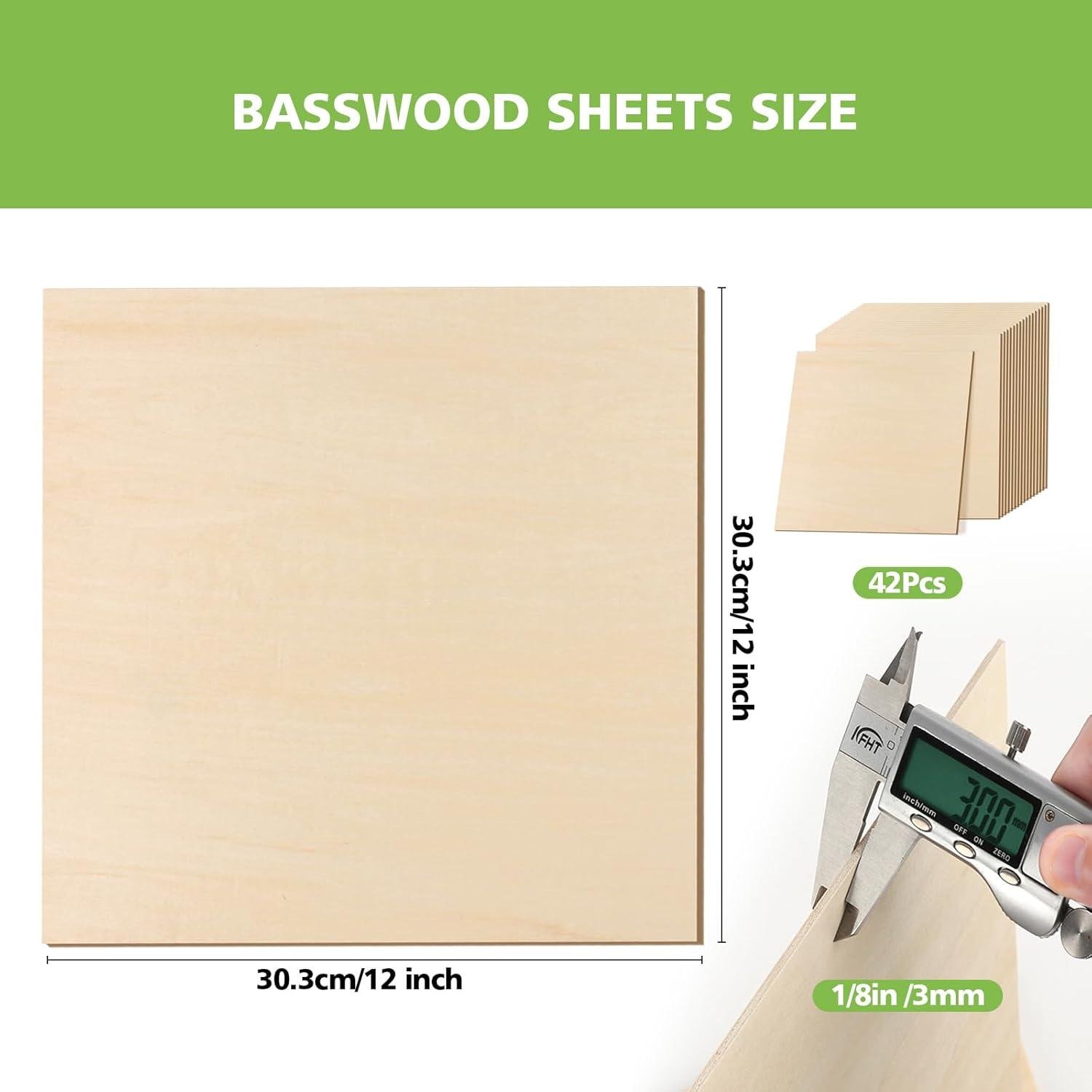
Is this real 1/8″ basswood, and how consistent is the thickness for laser/CNC work?
The sheets are listed at 12 x 12 x 0.118 in (about 3 mm), with length tolerances within 2 mm.Many buyers report the thickness is “very consistent” and works well for laser and CNC projects. That said, a few reviews mention sheets measuring thicker than expected and needing sanding/planing down (one user reported taking material down to ~2.3 mm to match their laser settings). Practical advice: don’t rely on a single preset—measure a few sheets with calipers and run a small test cut/engrave before committing to a batch.
What tools and “woodworking operations” do these sheets handle best?
This is basswood plywood designed primarily for laser cutting/engraving, wood burning, labeling, ornaments, models, and light carving. Basswood is a soft,forgiving species,so it’s also beginner-friendly for hand tools (craft knife,scroll saw,coping saw) and small-shop machines (band saw,table saw with proper support). Because the sheets are only ~3 mm thick, they’re best for parts, panels, and overlays—not structural joinery or load-bearing components.
Will it cut cleanly on a laser, and do I need special settings?
Users commonly report that these “cut and engrave perfectly,” especially for ornaments and small laser projects, and some mention little to no voids. However, basswood sheets can vary slightly by batch (thickness and moisture), and a few customers report needing more power/slower speed than their normal 3 mm presets—or that a “recommended setting” didn’t cut through. Expect to tune settings: run a power/speed test grid, watch for edge char, and consider masking tape to keep smoke marks off the surface.
Do these arrive flat, or should I expect warping?
Packaging is described as a sturdy box with reinforced corners and pearl cotton for protection, and many buyers say most sheets arrive smooth, flat, and usable. Warping is still a recurring theme in reviews: some customers report only a few slightly warped sheets (e.g., “about 8 out of 42”), while others reported severe warping in a bad batch. Basswood is sensitive to humidity, and thin sheets move easily. If flatness matters (laser focus/CNC hold-down), store the stack flat, weighted, and acclimated to your shop, and plan to set aside any sheets that won’t stay flat.
Is this suitable for production work, or more of a hobby material?
It can work for light production—several buyers mention using it for a small laser business and keeping sheets on hand—mainly because the size is standardized (12 x 12) and the surfaces are typically smooth. The main limitation for production is batch-to-batch variability (occasional warping, occasional thickness differences, and one review noting visible seams/splitting). If you’re producing for shows or tight deadlines, it’s smart to order early, inspect promptly, and keep a backup supplier/material option.
Are there visible seams, voids, or surface defects that will show under stain/paint?
Many users describe the sheets as smooth with no knots and good consistency, and at least one reviewer specifically noted “no voids.” But plywood is layered, so seams can be visible on some sheets, and one negative review complained about very visible seams that didn’t align between faces and even splitting along a glue line. If your project will be stained (which highlights glue lines and grain changes), do a quick face check under raking light, and reserve the best-looking sheets for “show faces.” Paint tends to hide seams better than stain.
Beginner-friendly: can I use these for my first laser/wood burning/hand-tool projects?
Yes—basswood is one of the easiest woods to learn on. It engraves and burns cleanly, cuts easily, and is commonly used for school/home crafts, ornaments, and model work. The main “beginner gotcha” is expecting every sheet to behave identically. To avoid frustration, start with small test pieces, confirm focus/hold-down, and keep humidity control in mind so thin sheets don’t warp between setup and cutting.
is this good value vs cheaper basswood sheets, and what’s the trade-off?
For many buyers, the value comes from the quantity (42-pack), the convenient 12″ x 12″ size, and generally smooth faces that work well for engraving and ornaments. Compared with cheaper sheets, you’re mainly paying for convenience and (frequently enough) better packaging/overall consistency—but reviews also suggest quality can vary by batch. If you need guaranteed flatness and exact thickness for fixtures or precision in production, consider budgeting for premium laser-grade plywood or ordering a smaller pack first to validate thickness/flatness in your specific environment.
Transform your World

Tool Summary: This 42-pack of basswood plywood sheets measures 12″ x 12″ x 0.118″ (about 3 mm) and is marketed for laser cutting/engraving, CNC work, and general craft use. the standout is the smooth, generally flat surface and consistent thickness many buyers report, along with sturdy packaging that helps reduce shipping damage. customer feedback is mostly positive on clean cuts and minimal voids, but several reviews flag batch-to-batch inconsistency—occasional warping, visible seams, rough edges, and a few thickness/measurement surprises that may require testing and adjusted laser settings.
Best For: Ideal for hobby woodworkers with small to medium projects, laser engravers making ornaments/signage, model builders, classrooms, and beginners practicing cutting and finishing on a forgiving wood.
Consider Alternatives If: You need guaranteed dead-flat sheets for production runs, require tighter thickness tolerances, or primarily build structural pieces.
Final Assessment: A solid value pack when you get a good batch, but plan to inspect and test before committing to time-sensitive work.
want to see current pricing and customer photos? View on amazon & Read More Reviews →